Paid Test Content as a Creator Vetting Method
Paid test briefs reveal work habits that portfolios and follower counts can't.

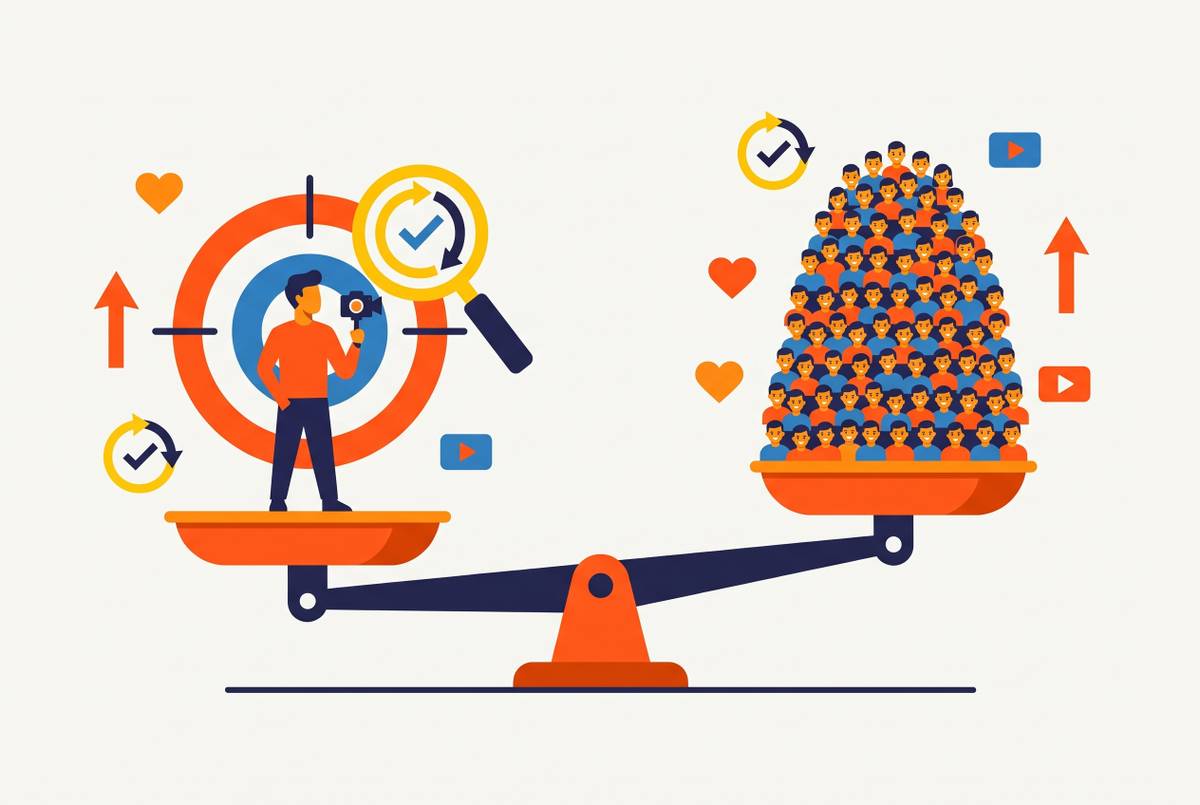
UGC brands buy content, not audiences. That distinction sounds small until you trace what it does to the vetting process: influencer marketing pays for reach, so a follower count is a reasonable proxy for what you're purchasing. UGC content gets distributed through the brand's own paid channels, so a creator's personal following has almost nothing to do with what the brand is actually paying for.
Hustler Marketing's 2026 guide states this directly. A creator with a small following who consistently delivers authentic, on-brief content is worth more than a creator with tens of thousands of followers who can't follow creative direction. Follower count measures audience size. It does not measure whether someone shows up on time, reads a brief carefully, or delivers a usable take on the first try.
Follower audits carry a second problem underneath the first one. A HypeAuditor audit cited by InfluenceFlow found that 15 to 20 percent of creators have inflated follower counts, some through bot networks or engagement pods built specifically to fool metric-based screening. That's not a rounding error.
Supply-side growth makes this worse, not better. The pool of available UGC creators has expanded fast, and UGC Copilot reports that by 2025 the share of creators offering UGC as a professional service had grown to a clear majority, up sharply from the year before. The field is professionalizing faster than most brands' screening processes can keep up. More creators means more noise, and follower audits and informal reviews don't scale through noise, they just process it more slowly. Hustler Marketing names over-reliance on a handful of creators as a common failure mode in these stalled programs: when one creator leaves, production stops cold. That's what happens when quality verification takes hours per creator and the roster never gets past a handful of names.
Portfolio review has a different flaw, but it lands in the same place. A portfolio shows a creator's best past work, shot on their own terms, under conditions nobody controlled. Hustler Marketing's sourcing guide lists the qualities that actually predict performance: camera confidence, brief compliance, audience match, and consistency. None of those qualities are visible in a static reel of old videos. Worse, the guide flags "overly polished" content and anything that "feels scripted or forced" as warning signs, not selling points. A portfolio built to impress can be actively misleading about what the brand needs, because polish and performance under a live brief aren't the same skill.
The question a brand actually needs answered is whether this person will execute the brief, on the brand's timeline, following its directionit's "will this person execute my brief, on my timeline, following my direction?". Portfolios and follower counts don't answer that question. Something else has to.
What a paid test brief reveals beyond a portfolio
A paid test brief puts the creator inside a live version of the actual job, not a curated sample of their past work. Hustler Marketing identifies four things a test brief surfaces that nothing else can: how fast the creator responds, the quality of the questions they ask before shooting, how closely they follow instructions, and whether their on-camera delivery holds up as authentic rather than performed.
Each of those is a behavior, not a credential. Response speed and question quality tell a brand something about how the working relationship will run day to day, long before any content gets made. A creator who takes four days to answer a simple brief, or who shoots without asking a single clarifying question, is showing you how they'll operate once the stakes go up.
Brief compliance is the sharpest of the four signals, because it's testable in a way the others aren't. A creator who ignores formatting requirements on a cheap test video will ignore them on a paid, whitelisted campaign with a much larger budget behind it. That pattern doesn't change with the size of the check.
Authenticity is the harder one to explain, but it's the one that determines whether the ad actually works. Hustler Marketing's sourcing guide is blunt: if a creator doesn't feel natural on camera, or doesn't match the target audience, the ad fails regardless of how good the script or the edit is. That kind of authenticity is visible only under real working conditions, when a creator has to interpret direction they didn't write themselves without turning it into a stiff, over-rehearsed read. A portfolio shoot, done entirely on the creator's own terms, never recreates that pressure. A test brief does, by design.
There's a fraud-resistance angle worth a single observation here. Inflated follower counts and engagement pods are invisible to a metrics dashboard, but they don't help a creator produce a usable video against a brief. Either the deliverable meets the brief or it doesn't. That binary makes the test brief a harder filter to fake than anything based on public numbers.
Structuring a test brief that screens for the right things
A test brief only works if it's built correctly, and that means resisting the urge to over-control it. Hustler Marketing's sourcing guide lays out what a good brief should include: context on the product, hook direction offered as a few options rather than a locked script, clear dos and don'ts, format and platform specs, and guidance on tone.
What the brief should leave out matters just as much. A full script defeats the entire point of the exercise, because over-scripting kills the on-camera naturalness that makes UGC convert in the first place. A line-by-line script tests a creator's ability to read, not their ability to perform under direction. The brief needs enough structure that compliance means something, paired with enough open space that the creator has real choices to make. If there's no room to choose, there's nothing to observe.
Build in modular asset requirements from the start of the test, before a creator proves themselves. An influencers-time.com brief guide recommends structuring briefs meant for paid amplification around modular pieces: a standalone hook clip, a swappable mid-section, and a CTA shot as its own separate take. That structure hands the media team raw material to build A/B variants later without ever going back for a reshoot. A creator who can't deliver clean, separate takes on a low-stakes test won't deliver them on a live campaign either, and it's better to find that out before any real money is committed.
Usage rights and whitelisting terms belong in the test brief too, not bolted on after the content gets approved. Influencers Time's guidance on paid amplification is clear that these terms need to be written into the brief before the creator is ever briefed, because adding them as a conditional afterthought creates legal and operational headaches down the line. Launchpoint's hiring guide adds a related warning: verbal agreements and DM confirmations don't function as contracts, and rights confusion is one of the most common operational failures inside UGC programs. Settling these terms at the test stage does two jobs, it sets expectations for the working relationship from day one, and it screens out creators unwilling to operate inside those terms before either side has invested real time.
None of this costs much relative to what it protects against. Launchpoint's cost data shows beginner-creator rates for a test video sitting well below what paid usage, exclusivity, and amplification cost once a creator passes and moves into a live campaign. Paid usage rights alone run notably higher than base creation rates, and exclusivity terms can double the rate again. Filtering early, at test-brief prices, is simply the cheaper place to find out a creator isn't a fit. Hustler Marketing notes that most brands only need three to five reliable UGC creators to validate a format or a message before scaling further. The test brief is the intake valve that decides who gets into that small, high-value group.
What to evaluate once test content comes back
Test content should get scored against the exact variables the brief was designed to expose, not judged on how nice the video looks. Hustler Marketing points to four dimensions that predict whether a creator will keep performing over time: fit with the target audience, delivery quality, reliability (did the deadline and format specs actually get hit?), and how closely the creator followed the brief.
Reliability deserves attention on its own, because it's the signal brands most often let slide. A missed deadline or an ignored spec on a cheap test video is the same behavior a brand will get on a live campaign, just with more money riding on it. The test brief makes that pattern visible while the cost of finding out is still low.
Audience fit is a separate question from follower count, and it's one most brands never actually screen for when they lean on platform metrics instead. Does the creator look and sound like the brand's actual customer? That's a judgment call, and it decides whether the finished ad feels believable to the person watching it.
Brief compliance carries equal weight to how good the footage looks, maybe more. A creator who turns in a beautifully shot video that ignores the hook direction, skips the separate CTA take, or breaks a stated dos-and-don'ts rule has failed the test, no matter how the footage looks. That's not pedantry. Compliance on a simple test predicts how a creator will handle direction once it gets more specific, and it always gets more specific once whitelisting, A/B testing, and paid amplification enter the picture. SocialBook's platform guide treats vetting the same way: as a quality threshold rather than a ranking system. Clip approves only 7 percent of applicants by SocialBook's own data, and the underlying logic is binary, a submission is either usable or it isn't.
Communication is the trailing signal that's easy to skip past, and it shouldn't be. How quickly a creator acknowledged the brief, what questions came back before shooting started, and how they handled a revision note if one was sent, all of that points to how much management time this person will cost at scale. Creators who ask sharp, specific questions before shooting tend to turn in cleaner first takes and need fewer rounds of revision, and that's a pattern only a live brief interaction can reveal. Slow or muddled communication on a low-stakes test is a fair predictor of the same thing happening during a campaign with a real deadline attached.
A creator who clears all four of these isn't a one-off vendor who happened to turn in one good video. They've demonstrated, under real conditions, the specific behaviors a brand needs repeated across dozens of future briefs. What that repetition actually requires, and how a single test brief turns into the entry point for a whole system built around it, is the next piece of the picture.
How the test brief feeds a system for replication
A paid test brief serves a purpose beyond screening individual creators. It's the intake process for a system that keeps testing creative ideas and scaling whatever proves out. Hustler Marketing frames a working UGC creator management system around four outputs: consistent output, predictable quality, lower creative churn, and faster testing and iteration on new creative. The test brief is what makes each of those four outputs achievable, because every creator who enters the roster has already proven the behaviors the system depends on.
Brands that consistently outperform on Meta and TikTok run a system, not a single good ad they hope holds up. They're running a system that continuously tests different variations against each other, and the test brief is the entry point into that system rather than a one-time hiring checkpoint.
Replicating a winning piece of creative requires knowing exactly which variable made it work in the first place, whether that's the hook, the specific creator, the tone, or the CTA framing. That's a harder problem than it sounds, and it's the reason a real testing program looks nothing like a single video run against a small budget. Joinflare's creative testing guide names that exact mistake, treating one video and one budget as "a test," when a real test needs several distinct hypotheses running at the same time. Running multiple hypotheses at once only works if the brand already knows which variables to isolate.
This is where the modular structure built into the test brief earlier pays off twice. A test brief built around modular assets, a standalone hook, a swappable mid-section, a CTA recorded as its own take, generates exactly the raw material needed to build A/B variants without a single reshoot. That means the testing loop moves faster from day one, because the assets needed to run it already exist, produced by a creator who has already proven they can follow this kind of direction reliably.
None of this replaces judgment. A brand still has to decide which hypotheses to run, which creators to keep testing against new briefs, and when a winning format has run its course. But the test brief is what makes that judgment possible to act on quickly, and consistently, across a roster of three to five creators instead of one lucky video that nobody can explain or repeat.
Sources
- UGC Creators Management: The Complete Guide to Finding, Hiring, and Scaling in 2026
- How to Find UGC Creators in 2026: Free & Paid Methods That Work
- How to Hire UGC Creators for Your Brand: A Complete Guide for 2026 | Launchpoint
- Top UGC Platforms in 2026: A Guide for Brands and Creators
- How to vet UGC creators for brand safety (checklist) | Flare