Evaluating UGC Creator Engagement Quality vs Vanity Metrics
Authenticity and engagement consistency matter more than follower counts for predicting sales.

A brand picks a creator, runs the campaign, and watches it fall flat. The post looks fine. The creator showed up, delivered the lines, hit the deadline. But sales barely moved. This happens often enough that it points to something structural: the signals most brands use to pick creators, follower count, total likes, raw view counts, don't actually predict whether that creator will move product.
Follower count tells you the size of an audience, not whether that audience is the one buying what the brand sells. A creator with more followers in the wrong demographic can deliver less value than a creator with fewer followers whose audience matches the buyer profile exactly. Raw likes and views carry a similar problem: they can spike because an algorithm decided to push a clip, or because a trending sound carried the video, neither of which has anything to do with whether the creator can persuade someone to buy something. The tell is erratic performance from post to post, big numbers one week, nothing the next, with no clear pattern connecting them.
A feed that's wall-to-wall brand deals, with no personal content mixed in, is a visual red flag worth learning to spot on sight. It's a content factory wearing a creator's face, and audiences tend to sense it and disengage accordingly.
Engagement fraud produces a lot of these numbers. An engagement ratio under 1% against follower count is a strong signal of purchased followers or bot-inflated numbers. When comment sections fill up with generic reactions, strings of fire emojis with nothing substantive behind them, that's a secondary marker of comment pod activity rather than real audience response. None of this appears in a follower count. It becomes visible only once someone actually looks.
Why UGC outperforms branded content
Understanding why UGC works at all explains why creator selection fails so often. User-generated content earns about 28% higher engagement than branded content, and on Instagram specifically, UGC posts pull in roughly 70% more engagement than brand-only posts. That gap comes from peer-recommendation dynamics: polished corporate creative, no matter the budget behind it, can't replicate the feeling of a recommendation from someone who looks and sounds like a regular person.
Indie Collaborates frames the underlying cause as psychological alignment. Creator-led content mirrors what people already see from their own friends and social circles, so it lowers the guard that normally goes up around traditional ads, the reflex marketers call ad blindness. On TikTok, nano-influencers achieve engagement rates around 10.3%, significantly higher than macro or celebrity creators on the same platform.
That mechanism has a direct consequence for how creators should get evaluated. A creator who comes across as a brand mouthpiece, rather than a person sharing something they actually use, loses the exact quality that makes UGC perform in the first place. Authenticity is the variable the entire format depends on. Data-driven creator marketing agencies apply this principle at scale: rather than optimizing for follower count, firms like Pebble source creators using engagement-rate consistency and audience-alignment signals, looking for whose audience is actually primed to convert rather than just primed to view.
Engagement-rate consistency across multiple posts, including the ones nobody paid for, tells a brand more than any single viral moment can. A viral hit reveals that a trend worked. A steady pattern across dozens of posts reveals a real relationship between the creator and the audience watching them.
Engagement-rate benchmarks by creator tier and platform
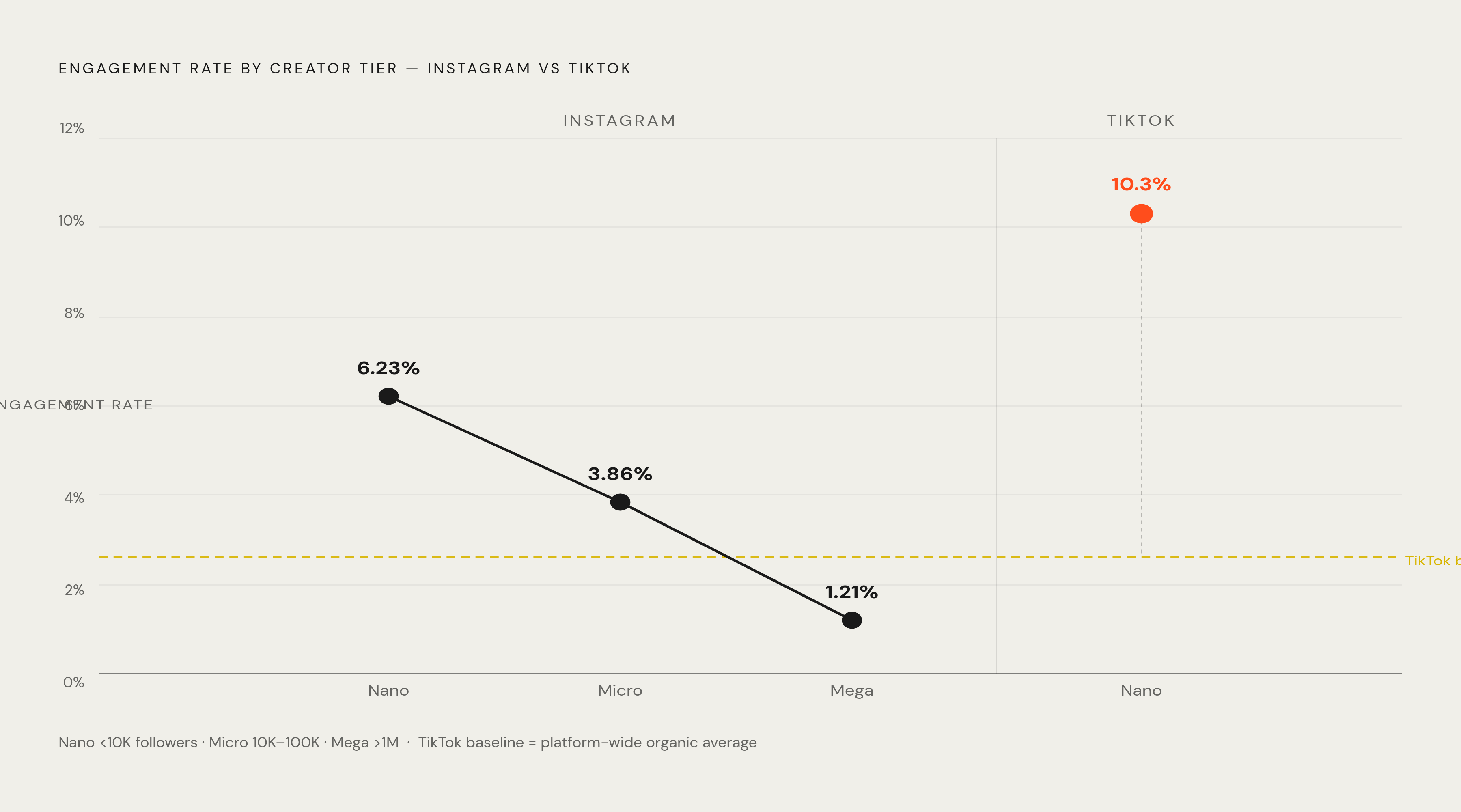
Once authenticity becomes the thing being measured, the next question is practical: what numbers actually count as good? Engagement rate, read against the norms for a creator's size and platform, gives a far more honest filter than follower count ever could, as long as it gets checked across several posts rather than judged from a single one.
On Instagram, the pattern runs in a clear direction. Nano-influencers, the smallest tier, average 6.23% engagement. Micro-influencers average 3.86%. Mega-influencers average just 1.21%. Size and engagement move in opposite directions, consistently enough that it's safe to treat as a rule of thumb rather than an exception.
TikTok tells a similar story at a different scale. Nano-influencers there post engagement rates around 10.3%, well above what macro or celebrity-tier creators pull on the same platform. Set that against the platform's baseline: organic engagement per post on TikTok runs around 2.63% across all creator types. A nano-creator clearing 10% is performing at several multiples of what the average post on the platform achieves.
These numbers work best as a floor, not a ceiling. A range of 3% to 6% is a reasonable baseline for genuine engagement. Anything under 1% against follower count should trigger a fraud check before any further evaluation proceeds. And the number only means something if it holds up over time: scroll back through a creator's last dozen posts and look for swings. A creator who posts 8% engagement one week and 0.4% the next isn't showing skill, they're showing the result of a one-time algorithmic boost or plain luck.
Showcase's UGC analytics guide makes a related point: comparing engagement rates, not totals, is the right method, and a smaller creator holding a steady 10% to 15% engagement rate is reaching a more loyal, more active audience than a large account racking up thousands of passive interactions that never amount to anything. Reach is another diagnostic worth tracking alongside engagement rate. If a creator's reach keeps climbing while their engagement rate keeps dropping, that's not growth. It usually points to audience mismatch or creative fatigue setting in.
Comment quality and audience behavior as signals of genuine persuasion ability
Engagement rate answers how many people are reacting. Comment quality answers something closer to the question a brand actually cares about: will this audience act on what the creator tells them? That makes comment quality a stronger predictor of conversion than engagement rate on its own.
Open a creator's best-performing video and read the comments literally. Are people asking "where do I get this?" or writing "I need this"? Those comments mean the audience is self-selecting as buyers rather than passive scrollers, and that's about as direct a signal of persuasion ability as a brand will find before running its own campaign.
Pod activity has a recognizable shape once you know to look for it: comments that are emoji-only, comments that clearly aren't responding to anything in the actual video, or near-identical phrasing repeated across several comments. That pattern looks nothing like a genuinely engaged community, where comments reference specific details from the video and build into actual back-and-forth conversation.
Saves deserve particular attention on both Instagram and TikTok. A save means someone intends to come back to that content later, which tracks closely with consideration behavior, the stage right before a purchase decision gets made. Hashmeta's UGC metrics framework treats comment sentiment and save rate as genuine engagement metrics in their own right, describing them as signals of "audience connection depth and content resonance patterns," distinct from vanity counts like raw likes. Watch-through rate and average watch time serve a parallel function on video: an audience that sticks around to the end hasn't been trained to scroll past, and that habit of attention is what a brand is paying to borrow.
The full creator vetting sequence: what to check before signing a brief
Put the signals from the prior sections together, in order, and a vetting process starts to take shape.
Start with organic content, not the portfolio a creator sends over. Scroll back 90 days on TikTok, Instagram, or YouTube and look at what they posted when no brand was watching. That's the clearest read on tone, style, and whether their audience actually matches the buyer a brand is trying to reach. A portfolio shows a creator's best work for other brands. Ninety days of organic posting shows who they actually are.
From there, you check disclosure compliance across five or six past sponsored posts. A caption that buries "Thanks [Brand]!" at the end doesn't meet the FTC standard. Look for a clear #ad or #sponsored tag and disclosure inside the video itself, not just tucked into caption text. This matters for legal exposure, and it also tells a brand something about how carefully the creator handles the rules of the format they work in.
Weigh audience alignment over audience size at every step. A large following in the wrong demographic is worth less than a smaller one that actually matches the buyer profile, and most brands will agree with that statement the moment it's said out loud and then ignore it the moment a pitch deck shows up with a big follower number on it. Run the engagement fraud screen covered earlier: compare engagement rate against follower count, treating 3% to 6% as credible and anything under 1% as worth investigating, check comment quality for pod signatures, and run past content through brand safety filters before any product ships.
Controlled research on sustainable activewear creators gives you a useful data point here. Creators sourced manually needed far fewer content revisions, because tone and style fit had already been confirmed before outreach ever started. That approach cost more per partnership than AI-assisted sourcing, but it came with substantially less revision overhead. This is the kind of authenticity work agencies like Pebble build into how briefs and performance frameworks get structured, preserving a creator's actual voice while still anchoring the message to conversion intent, since the moment a creator starts sounding like a press release, the engagement advantage of UGC disappears.
Before committing to a full campaign, run one paid video at the standard rate as a test. That single piece of content answers three questions: did the creator follow the brief without sounding like they were reading off a script, did they deliver on time, and would the brand run this as a paid ad without hesitating?
Last in the sequence, and most often skipped, is activation rate. If a brand recruits a large cohort of creators and fewer than 30% of them actually post, the cause is usually onboarding friction, a compensation structure that doesn't work, or a mismatch between the product and the creators' audiences, not a failure of creator quality. That number is a read on the health of the whole program, and it sets up the next question: how does a brand make strong performance repeat, rather than happen once and disappear?
The KPIs that predict whether a creator will move product
Vetting gets a creator in the door. What happens after that needs its own measurement, and the order those measurements get read in matters as much as the numbers themselves.
Business outcomes come first. ROAS, conversions with cost per conversion and new-customer CAC, average order value, and lifetime value measured against CAC are the numbers that settle whether the creative is actually doing its job. Hook rate, hold rate, click-through rate, and conversion rate make up the creative-diagnostic tier, and their value is in explaining why a piece of creative is or isn't driving the outcomes above, not in standing in for those outcomes.
Get that order backward and the failure mode is predictable: a campaign posting great hook rates and strong CTR while ROAS quietly sinks, because the diagnostics were treated as the finish line instead of the clue they're meant to be. Brand awareness still shows up as the top-reported KPI across the largest share of brands, even as conversion tracking has grown sharply year over year and direct sales measurement has climbed right alongside it. Awareness has its place. It's not the number that tells a brand whether a creator moved product.
Watch-through rate and completion rate belong in the diagnostic tier for a reason specific to video: a creator whose audience watches to the end is delivering the full persuasion arc the brand is paying for. A creator whose audience bails in the first five seconds has a hook problem, and that problem lowers ROAS before it ever appears on a media plan.
Creative fatigue has a measurable signature as a campaign runs: frequency climbing alongside a rising cost per acquisition, or hook rate and CTR sliding downward together. That combination is the cue to refresh a winning piece of creative before it starts dragging the whole account down, before the damage appears in the monthly numbers. It's also the natural hinge into a bigger question: if one creative can go stale, what does it take to keep producing fresh ones that work?
How to engineer repeatability in a creator program
A single strong-performing creator is a nice outcome. A system that reliably produces strong-performing creative, over and over, is a growth channel, and the gap between those two things comes down to process, not talent.
Erratic results from a creator might mean they got lucky on one post. Consistent results across many posts means they understand something about what works for their audience, and that understanding is what separates a one-off talent from a repeatable asset a brand can keep working with.
The strongest programs run a hybrid pipeline that moves organic content into paid spend only once it's earned the right to. Content runs natively first, inside a qualification window that typically lasts 24 to 72 hours. Platform signals during that window, saves, shares, watch-through rate, click behavior, act as the filter. Content that clears the bar moves into paid distribution. Content that doesn't gets reviewed for what it reveals about messaging, rather than getting pushed into ad spend anyway. That structure keeps CPM spend efficient, because only proven creative ever reaches a paid audience, and it generates a steady stream of performance data that feeds directly into the next round of briefs.
When evaluating creators at scale across high-volume campaigns, this kind of consistency check becomes the primary way to separate a real, durable audience relationship from a one-off algorithmic win, so agencies working at that scale check for consistency across multiple posts before any creator gets onboarded.
Brief structure turns out to be the actual lever that makes repeatability possible. A brief that includes product context, two or three hook directions instead of a locked script, platform specs, and clear boundaries around claims and tone produces creators who build on what's already working, rather than starting from zero on every single piece. Indie Collaborates' 2026 framework lays out a testing hierarchy built around this idea: test hooks before testing body content, since a hook that proves itself at low spend can then get scaled with confidence.
What separates brands that get a strong return on creator spend from the ones that don't is that the winners built measurement and optimization into the process itself, so each round of creative makes the next round a little better than the last.
Sources
- 25 User-Generated Content (UGC) Engagement Statistics: Essential Data for Modern Brands in 2026
- UGC Analytics: How to Track, Measure & Optimise Content Performance
- High-Performing UGC: 2026 Strategy for Performance Brands
- UGC Performance Metrics: Measuring Authentic Content ROI
- AI Outreach Personalization Loses to Manual Creator Vetting - Influencers Time
- Engagement Metrics Across Social Networks 2026 Guide |...
- How to Vet UGC Creators: Quality & Brand Safety Guide