FTC Disclosure Rules for UGC Creators in Paid Campaigns

This rule change isn't theoretical. The 2023 Endorsement Guide overhaul, plus a new Fake Reviews Rule in 2024, changed what "compliant UGC" actually means, and most brand teams are still operating on outdated assumptions. This piece walks through what changed, where teams keep getting tripped up, and how to build disclosure into a campaign before anything goes live.
What the 2023 Endorsement Guide overhaul actually changed
The FTC hadn't touched its Endorsement Guides since 2009. Think about what didn't exist yet back then: no TikTok, no Instagram as an ad platform, nothing resembling the creator economy we work in now. The 2023 revision was the agency catching up on sixteen years it had missed.
The big shift is a much wider definition of "endorsement." It used to mean something close to a testimonial or explicit praise. Now it covers a tag, a brand mention buried in a caption, even an AI-generated persona that never existed as an actual person. The updated definition of "endorser" pulls in bots and virtual influencers, not just humans with a brand deal sitting in their inbox.
Most of the day-to-day detail, the stuff that tells a brand team what to actually do on a Tuesday afternoon, lives in the companion FAQs, and there are 40 new questions in there. The Guides state principles; the FAQs read more like an operating manual, with platform-specific guidance spelled out in granular detail.
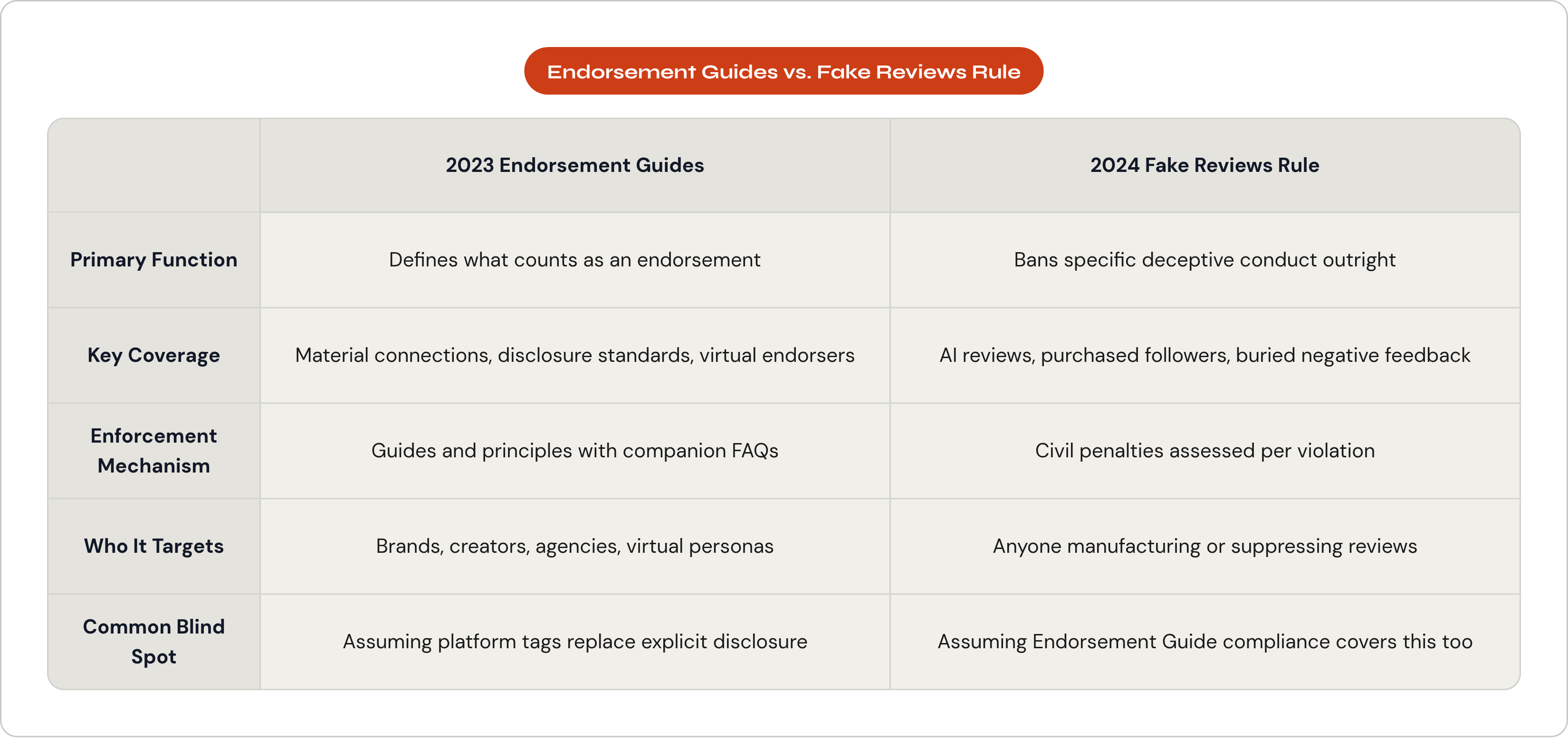
Separate from all that, the FTC's Fake Reviews Rule went into effect in October 2024, and it's a different document doing a different job. The Endorsement Guides describe what counts as an endorsement. The Fake Reviews Rule bans specific conduct outright: fake reviews, AI testimonials dressed up as real ones, purchased followers or likes, undisclosed insider reviews, burying negative feedback. Violations now carry civil penalties assessed per violation, and that adds up fast for repeat offenders.
I've seen brands treat these two documents as one policy and develop blind spots because of it. They nail the Endorsement Guides' disclosure principles and assume fake reviews are covered by the same logic, or the reverse. The two are related, but they're not the same rulebook.
When UGC becomes a regulated endorsement, and when it doesn't
Everything comes down to one phrase: material connection. That's any relationship between a brand and a creator that could sway the content, and that a normal consumer wouldn't already expect to be there.
What counts? Direct payment, sure, but also free product, a discount code, an affiliate commission, entry into a giveaway, or honestly any benefit of value tied to the post. Brand gave something, creator posted something, and that's usually a connection worth disclosing.
Genuine UGC is narrower than most people think. A customer buys something with their own money, likes it, posts about it, and the brand never reached out, gifted anything, or offered a code. Nothing to disclose there, because there's no connection to point to.
Here's where it gets interesting for CPG and DTC brands specifically: the "submit a photo for a chance to win" campaign. The contest entry itself is the incentive. Every post submitted under that mechanic is now an endorsement requiring disclosure, even for creators who never see a dollar, because the prize is the material connection.
And there's a trap that catches brands who think they're just being good community managers. The moment a brand reposts or republishes something a happy customer said, even something posted with zero brand involvement originally, that content becomes an endorsement the brand is now on the hook for. Amplification is an act, not a neutral gesture, even though it feels like one.
So the question isn't "did we pay for this?" It's "does any material connection exist between us and this creator, in any form, at any point?" That net is wider than most teams are casting.
What "clear and conspicuous" actually requires, platform by platform
The standard: a disclosure has to be visible to anyone engaging with the content, actually and unavoidably visible, not just technically present in the metadata somewhere.
Here's the misconception that trips up almost everyone I talk to: platform tools like Instagram's "Paid Partnership" label or TikTok's branded content toggle satisfy the FTC on their own. They don't. Those tags supplement a disclosure; they don't replace one. An explicit #ad or "Sponsored by [Brand]" still has to appear inside the content itself.
Language that passes: #ad, #sponsored, "Sponsored by [Brand]." Language that fails: "collab," "thanks," "partner," or some vague abbreviation a normal consumer wouldn't decode as "I got paid for this." Timing matters too. A disclosure buried at the bottom of a long caption, or tacked onto the last three seconds of a video nobody finishes watching, doesn't clear the bar.
Video has its own layered requirement. A visual endorsement needs visual disclosure. An audible endorsement needs an audible one. When content carries both, the FTC is direct about it: disclosing in both modes at once is the safer bet.
TikTok gets named specifically in FTC guidance, for good reason. Small caption text often doesn't contrast against the video background, competes with on-screen graphics and sound effects and text overlays, and gets missed constantly. A caption-only disclosure on TikTok probably won't hold up. Superimposed text, actually inside the visual frame, is what gets seen.
Run this test on anything before it goes live: would someone who skips the caption, scrubs past the first five seconds, or watches on mute still catch a clear disclosure? If not, it probably doesn't meet the standard, no matter how compliant it looks on paper.
Repurposing UGC across channels is where brand teams create compounding compliance gaps
Disclosure travels with the content, not with the platform it was born on. That's the single principle where a lot of otherwise careful teams lose the thread.
Say a creator posts a fully compliant #ad video natively on TikTok. The brand loves it, strips the caption, runs the raw footage as a paid Meta ad in a new placement. The FTC treats each new placement as its own disclosure event, not a continuation of whatever compliance existed on the original post.
Break it down by channel and the pattern gets sharper. Paid social (boosted posts, Spark Ads, programmatic display) draws the most scrutiny from both the FTC and the platforms themselves, and the built-in ad-labeling tools remain a supplement at best, never the whole answer. Owned channels are where things get missed most: a product page or email with a testimonial clip from a gifted or paid relationship needs its own disclosure right where the consumer sees it, not in a footer, not buried in terms of service. Brand-owned reposts, regramming a happy customer into the brand's own Stories, feel lower-risk, but if a material connection existed anywhere upstream, the brand has to restate the disclosure in its own caption.
Three situations trip people up over and over. A UGC clip dropped into a paid display unit needs the disclosure inside the ad unit itself, not on the landing page it links to. A testimonial screenshot in an email needs the disclosure right next to the quote, not in six-point font at the bottom. Creator content reposted to a brand's own account needs the brand's own fresh disclosure, since whatever the creator wrote originally doesn't carry over just because it's technically still visible somewhere in the post history.
Most brands treat repurposing as a content decision, and that's the root of it. Someone in marketing sees a clip performing well and says "let's put this in the ad set," and it's a creative call in their head, not a compliance one. The review checkpoint happens once, at the original creator post, and then never again.
Who is liable when a disclosure is missed, brand, agency, or creator
The FTC holds advertisers responsible for monitoring what their endorsers say and do, and that includes content the brand chooses to republish, not just content it commissioned directly.
Brand liability shows up in a couple of predictable spots. A brand reposts or embeds a creator's statement, even one made with zero prior relationship, and the act of amplifying it creates responsibility that didn't exist a moment before. Or a brand's creator partner posts something non-compliant, and nobody catches it or fixes it in time.
Agencies aren't insulated either. Influencer marketing agencies and other intermediaries can be held liable for creating or spreading endorsements they knew, or should have known, were deceptive. That "should have known" phrase does a lot of work; it closes off the argument that an agency was just a pass-through, forwarding whatever the creator handed them.
Which has a direct implication for any brand working through an agency: the agency's compliance process is functionally your compliance process. Shared liability means shared accountability, from the brief through final approval.
The FTC has already shown it'll pursue the whole chain. In November 2023, it sent warning letters to health influencers and, separately, to the trade associations that paid them, so both the intermediaries and the individual creators got letters. That's the agency signaling it won't stop at whatever name is most visible in the campaign.
For early-stage brands running lean, without a legal team big enough to review every post across every creator and channel, this is exactly why compliance can't be the thing someone remembers to do when they have a spare hour. It has to live inside how the campaign actually runs, day to day.
AI-generated UGC and virtual influencers under the current rules
AI opened up a set of shortcuts, and the FTC has already moved to close most of them. Drafting reviews that read like they came from real customers, running fully virtual influencers in paid work, manufacturing engagement through purchased followers or likes: all of it sits squarely inside the current rules now.
The 2024 Fake Reviews Rule bans AI-generated reviews presented as if a real human wrote them. It doesn't matter how the review got produced; what matters is whether it deceives someone into thinking a real person said it.
The 2023 Guide revision quietly did its own important work here, too, by updating the definition of "endorser" to include parties that merely appear to be individuals. That single change is what brings virtual personas and fabricated reviewers under the same umbrella as human creators.
So if a brand runs a paid campaign through an AI-generated persona, the same material connection standard applies, and the synthetic nature of that endorser needs its own disclosure. Consumers need to know they're watching something generated, not just that the post is sponsored.
There's genuine tension here for brands eyeing AI-generated UGC at scale. The cost savings are real, and so is the exposure. AI content can be fully compliant, but it needs explicit disclosure of what it actually is, spelled out plainly, not assumed from a generic #ad tag that doesn't tell anyone anything about how the content was made.
And there's a line the current framework hasn't fully drawn yet: where AI-assisted editing of a real creator's real content ends, and where a fully synthetic endorsement begins. Brands sitting in that gray area are better off leaning conservative on disclosure until the guidance sharpens, because "the rule didn't say exactly this" has never once worked as a defense in front of a regulator.
Building disclosure compliance into campaign operations before content goes live
Here's the failure mode worth naming directly: treating disclosure as the creator's job instead of the campaign's job. Leave it to individual creators to self-police and it will fail, not on every post, not predictably, but often enough to matter.
Good compliance starts at the brief. Creator agreements need the exact approved disclosure language spelled out, not a vague pointer to "follow FTC guidelines." Give creators the actual terms: #ad, "Sponsored by [Brand]," and exactly where each one needs to sit for that format. Add platform-specific instructions on top: on-screen text placement for TikTok, verbal disclosure timing for video, caption position for static posts. And name what's explicitly off-limits: "collab," "thanks," a platform tag standing alone with nothing else backing it up.
Then build review checkpoints in. Content gets checked for disclosure before it posts, not just for whether the creative looks sharp. And every time content moves to a new channel, that move triggers a second review, because each channel transition is its own compliance event, not a formality.
Rights and licensing documentation belongs in the same conversation as compliance, not a separate one down the hall. If a brand can't trace where a piece of UGC came from, who made it, under what terms, with what incentive attached, it can't figure out its disclosure obligation when it wants to reuse that content six months later. Track rights and compliance history together, or you'll end up guessing every time.
At real scale, volume is the actual problem. A program running dozens of creators across several campaigns and channels can't rely on someone manually eyeballing every post. That needs standardized brief templates, required disclosure fields built directly into the workflow, and approval steps that run the same way every time instead of getting reinvented per campaign.
What a compliant paid UGC program looks like in practice
There's a quiet assumption sitting under a lot of hesitation about disclosure: that #ad tags make content feel less authentic, and less authentic content performs worse. Worth examining that directly, because I don't think it holds up anymore.
Disclosure language like #ad and "Sponsored" is so normal across social platforms at this point that it barely registers as a red flag to most consumers. Good content still performs when it's properly disclosed. What actually kills performance, and everything riding on it, is getting caught without a disclosure in the first place.
A compliant program moves just as fast and stays just as creative as any other. The brief, the contract, the review, and the repurposing plan all account for disclosure from day one, so nobody's scrambling to retrofit compliance onto content that's already live and already working. Build it in early enough, and it stops feeling like a constraint, becoming instead just how the campaign runs.