Giving Feedback to UGC Creators Without Losing Authenticity

Feedback is the moment most brands accidentally break the thing they hired a creator to make. UGC converts because it feels like a person talking through their own voice; the second a note pushes that content toward "brand voice," it starts performing like every other ad in the feed. I've pulled campaign reports where consumers rated UGC as roughly 2.4 times more authentic than polished brand content, and that authenticity was doing real work: conversions can run up to 29% higher than traditional marketing assets. So the question is whether the feedback you give protects the exact quality you paid for, or quietly sands it off.
The two failure modes brands fall into when giving creator feedback
There are two ways this goes wrong, and I've watched both happen inside the same campaign.
The first is over-scripting. A brand writes a shot-by-shot screenplay, dictates exact line readings, and asks a creator to smooth out the "ums" and restarts that make them sound like an actual human being. What comes back reads like a studio ad wearing a handheld camera as a costume. Platforms notice, too: TikTok and Meta's ranking systems now actively down-weight content that reads as "ad-like." Raw, native-feeling UGC consistently shows stronger performance against studio creative on impressions and cost-per-action. Overcorrect the performance out of a creator, and you've paid creator rates for studio-grade underperformance.
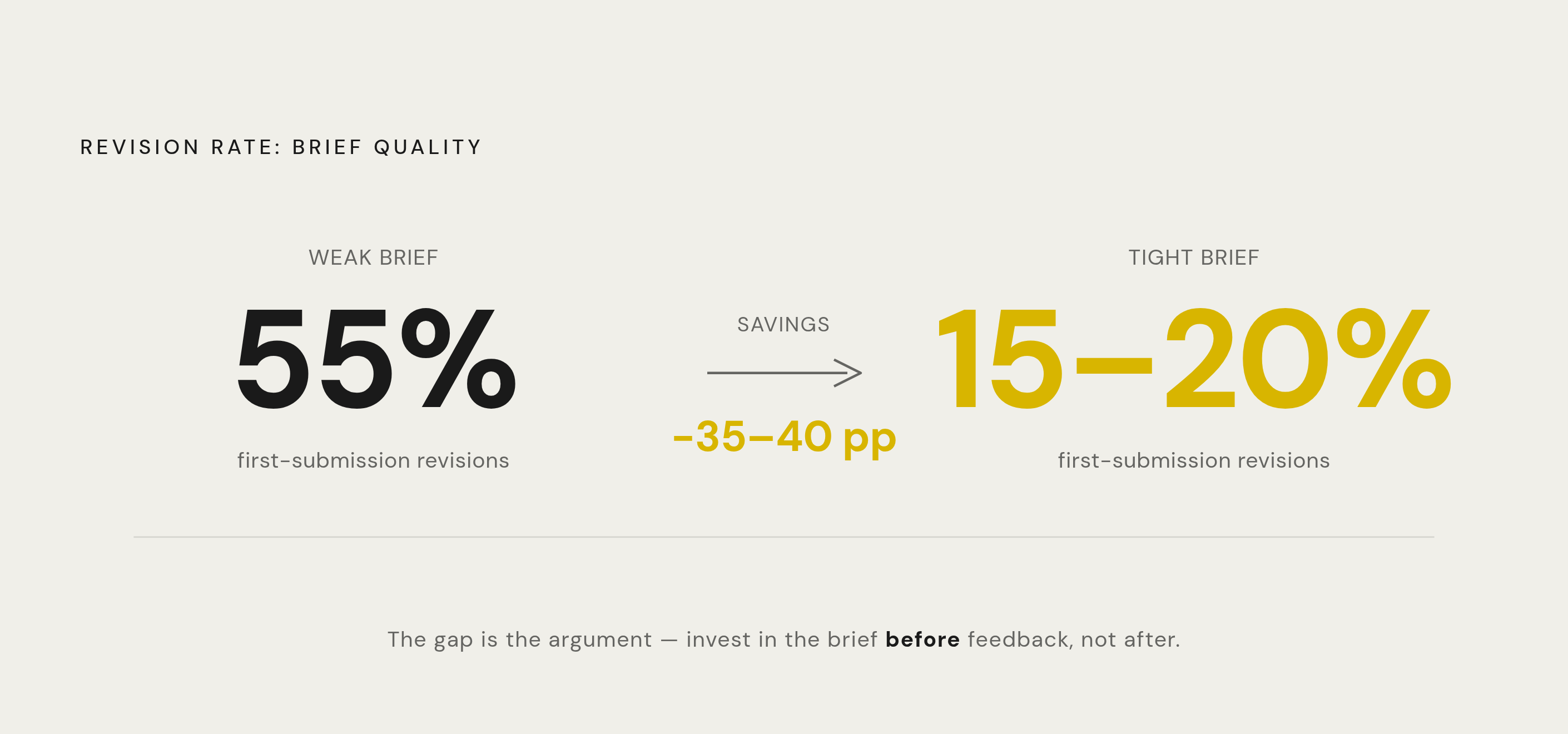
Under-briefing, then over-correcting, is the second failure mode, and it's almost the opposite, and somehow more common. The brand gives a loose, adjective-heavy brief ("make it fun, make it feel authentic") and then buries the creator in notes once the video misses a target nobody defined. Poorly communicated briefs are associated with first-submission revision rates as high as 55%, while teams that tighten their briefs bring that down to somewhere in the 15 to 20% range. Read that gap carefully. Most revision cycles trace back to a briefing problem wearing a creator's name.
Both failures trace back to the same confusion: brands mistake control over output for control over outcome. Dictate delivery and you get compliance (a creator doing exactly what they're told, no more). Direct outcomes instead, and you get creativity that still lands inside your guardrails. This isn't just an aesthetic preference, either. Creators are increasingly willing to turn down deals specifically over micromanagement or what feels like censorship, which means your feedback style is quietly shaping who's still willing to work with you next quarter.
What belongs in the brief versus what belongs in feedback
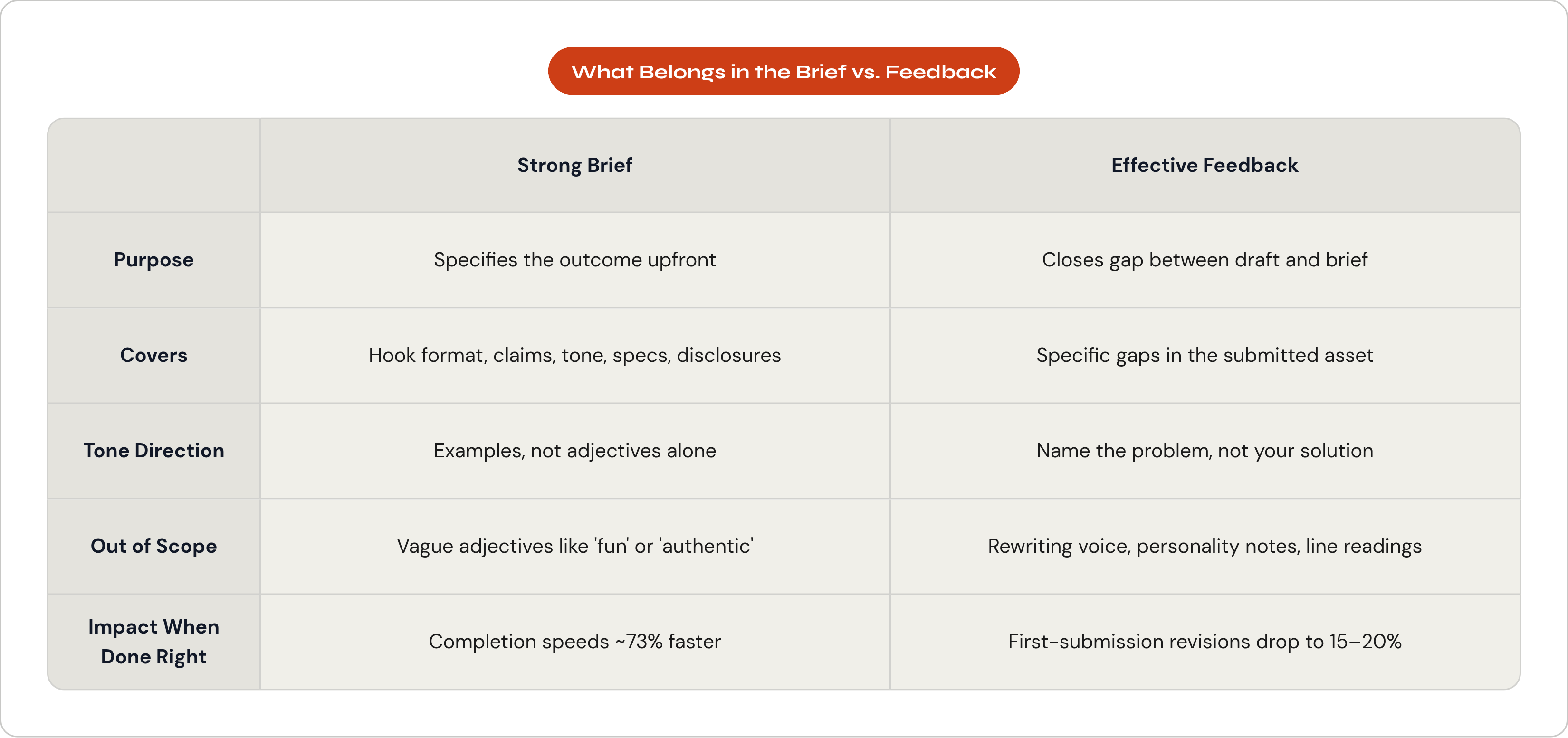
Here's a distinction that solves half the problems above before they start: the brief specifies the outcome, and feedback closes the gap between what arrived and what was specified. Feedback should close that gap, not redo the brief's job after the fact.
A strong brief locks in, before a single frame gets shot:
- The hook format and what needs to happen in the first three seconds
- The one product claim the video has to land, not five
- Tone direction with actual examples ("conversational and dry, like this video") rather than adjectives alone
- Required disclosures and compliance language
- Deliverable specs: length, aspect ratio, platform, caption requirements
- Whether the creator is scripting or improvising, stated outright, never assumed
Brands running detailed briefs see completion speeds around 73% faster than teams working off vague instructions. Clarity upfront removes the guesswork that turns into revision rounds later, and that's not a coincidence.
Here's a test I'd genuinely recommend before any brief goes wide: send it to one creator first. If they come back with clarifying questions, the brief wasn't ready. Fix it before it reaches the other nineteen people on your roster, not after.
What belongs in feedback, then, is narrower than most brands think: specific gaps in the submitted asset. A hook that doesn't grab. A claim that got left out. Audio that's too rough to run in paid placement. A word-for-word rewrite of someone's natural speech, a note on their personality, or a request to "sound more professional" belongs outside that scope entirely. That last one, especially, tells a creator you hired them for their voice and are now asking them to use someone else's.
How to frame feedback so it directs outcomes without prescribing delivery
The rule I keep coming back to, after watching this go wrong enough times to trust it: name the problem, not your solution. "The hook doesn't create curiosity fast enough" opens up creative options. "Say it like this instead" closes them.
Outcome-directed feedback sounds like performance objectives, not stage directions:
- "A viewer needs to understand what this solves for them within three seconds. That's not happening yet."
- "The claim you led with tests weaker in our paid data than claim Y. Can you work that one in instead?"
- "Energy drops in the back half compared to the open. On the paid version, that's where we lose people before the CTA even shows up."
Delivery-prescriptive notes quietly kill a video's authenticity: marking up filler words, rewriting sentences in brand voice and asking for a verbatim re-record, or reaching for corporate shorthand like "more aspirational but grounded" without ever showing what that looks like in an actual UGC video. Show another piece of UGC if you're going to reference a clip, not a polished brand spot. Otherwise you're calibrating the creator to the wrong genre entirely.
One more thing worth saying plainly: prioritize. Send the two or three notes that actually move performance. A long, flat list where every point carries equal weight tells the creator that you haven't done the work of deciding what matters, and now they have to guess. Separate the must-haves (compliance, the core claim) from the preferences (a stylistic nudge), every single round, so they're never left decoding your intent.
The creative latitude that makes UGC outperform brand-directed content
Here's the thing worth sitting with: the creator's voice functions as the product itself. Cadence, humor, the specific way someone frames why they like something: that's the social proof signal driving the conversion lift in the first place. Which means what you treat as negotiable in feedback should follow directly from that fact.
Protect, in feedback: the creator's natural speech rhythm, their platform-native instincts (handheld angles, jump cuts, audio that isn't studio-clean), and their own framing of why they use the product. Own, and feel free to direct: the claim itself, where the CTA sits, compliance disclosures, which feature gets the spotlight, and the structure of the hook.
Talking points beat scripts here, consistently, consistently across campaigns. Give a creator the points they need to hit and let them find their own delivery, and the variation in phrasing is exactly what makes it read as a genuine endorsement instead of a paid recitation. That distinction is becoming more important, not less. UGC creation has shifted from a side hustle into a stated professional service for a growing share of creators, up sharply from where it stood just a year prior. These are people who understand their platform for a living. Treating them as talent-for-hire reciting a script wastes the exact expertise you're paying for. It's also worth noting that creator suitability (the specific fit between this person and this brand) now ranks as the top selection factor for both brands and agencies. If that's why you hired them, feedback that erases their fit is working against your own selection criteria.
Running revision rounds without eroding the creator relationship
Payment delays remain creators' single biggest frustration in this line of work, cited as the top complaint in creator surveys. Feedback friction is right behind it: slow responses, inconsistent notes, unclear revision scope. All of it stacks on top of an already strained operational relationship.
Scope revisions in the contract, not in the moment. Specify how many rounds are included, what turnaround the brand owes the creator, and what counts as a material change that might warrant extra pay. Response time matters more than brands tend to assume. A creator who submits and hears nothing for two weeks loses momentum, loses calendar alignment, and starts wondering if this is a professional relationship or a black hole. Fast, specific feedback keeps production moving and tells the creator you run a tight operation.
Quality of the brand relationship shows up in the numbers, too: a meaningful share of creators say they prioritize working with high-quality brands, and open communication ranks among the top factors creators cite when evaluating deals. A majority of creators turned down at least one brand deal recently, which tells you something important: creators with leverage are choosing partnerships that function like partnerships, where the notes flow both directions.
One habit that costs nothing and pays for itself, and one I'd argue is underused: say what's working before you say what isn't. That's calibration, not flattery. It tells the creator which instincts to repeat and which to adjust, and it makes every round after the first one faster. Long-term creator relationships consistently outperform one-off gigs for exactly this reason. Brief quality, feedback quality, and creative alignment all compound across videos when you're not starting from zero each time.
Using performance data to make feedback objective rather than subjective
The strongest feedback rests on evidence rather than opinion. "Our paid testing shows hooks that open on the problem outperform hooks that open on the product, can you reopen with the pain point?" is a much harder note to push back on than "it just feels like it needs a stronger open." One reflects data. The other reflects a Tuesday afternoon feeling in a conference room.
A few signals worth tracking and sharing back with creators over time:
- Hook retention: what share of viewers make it past the first three seconds, which tells you if the open is doing its job
- Watch-through rate: where viewers actually drop off, which points to the structural issue in the edit
- Click-through and conversion on the paid version: the number that actually matters, separate from raw engagement
- Engagement rate benchmarks, generally landing somewhere in the 3 to 5% range on platforms like TikTok and Instagram for video UGC, useful as a gut check on whether a given piece is in range
When a creator knows which of their past videos worked and why, their next brief needs less correction, because they've already internalized what this brand's audience responds to. That matters because creative fatigue on paid social sets in fast; a video that's crushing it can start degrading within days of hitting real scale. Performance data makes that visible in a way gut feeling never will, and gives creators a concrete reason to iterate instead of just repeating the last format that worked.
There's a quieter benefit here too, one that took me longer to appreciate than it should have. Data-backed feedback protects against the internal brand team's taste overriding what the audience is actually doing. Those two things are not always the same, and it's worth remembering which one pays the bills.
How high-volume UGC programs build feedback into the system, not the exception
Once you're running five, ten, twenty creators at once, ad hoc feedback stops being a minor inefficiency and becomes the bottleneck. A UGC video runs somewhere between $100 and $500 to produce, a fraction of what traditional studio production typically costs. That cost advantage only holds up if the feedback loop moves fast enough to keep revision rounds tight.
At scale, the brands doing this well build a few things into the system rather than reinventing feedback every time:
- Standardized templates that separate performance notes from compliance notes from creative suggestions, so nothing gets lost in a wall of undifferentiated text
- A living brief that gets updated after every production cycle based on what the data actually showed, so the brief itself gets smarter over time
- A versioned library documenting which hooks, formats, and claims have worked, so feedback points to real precedent instead of someone's opinion in a Slack thread
- A clear approval chain on the brand side, so creators aren't getting contradictory notes from three different stakeholders on the same video
More brands now run dedicated creator management platforms to keep all of this organized, a sharp rise from where things stood just a couple years back. That's not surprising, once you've seen firsthand how fast an ungoverned feedback process falls apart. Infrastructure is what separates a program from a series of one-off favors.
The brands actually compounding value from UGC treat every production cycle as a data point that sharpens the next brief. Repeatability, not any single hit video, is the real measure of whether a program is working, and feedback is the mechanism that makes each cycle smarter instead of just identical. Running that end-to-end (briefing, feedback, contracts, payments, analytics) is a lot of operational weight for most internal teams to carry alongside everything else on their plate. It's part of why agencies like Pebble exist to run that layer, so the brand's attention stays on the creative direction and the outcomes, not the mechanics of getting a note from a Google Doc into a creator's inbox.