Building a Long-Term UGC Creator Roster vs One-Off Casting
Building a roster of trusted creators generates better returns than constantly casting new talent.

UGC out-converts brand-made content because of a simple trick of perception: people read an ad as an ad, but they read a creator's video as a recommendation from someone they'd actually listen to. That gap in trust shows up in the numbers. UGC drives 6.9x more engagement than brand-made content and gets trusted 2.4x more, per widely cited industry benchmarks. Click-through rates run 53% higher, and when that same content lands on a product page, conversion jumps 161%. Iconic London saw a 126% lift in conversion and an 11% bump in average order value within 12 months of building their strategy around UGC, which is the kind of number that should make you ask why so many brands still treat this like a one-time purchase order instead of a relationship worth building.
How the UGC creator landscape has shifted since 2023
The supply side exploded, with the number of UGC creators jumping 93% between 2024 and 2025. Sounds like great news if you're sourcing talent, right?
More creators means more noise: more fake portfolios, more engagement numbers dressed up to look organic. Sourcing didn't get easier, it got harder to filter, and vetting has become the real bottleneck, more than availability ever was.
The economics moved too. Flat per-video rates are giving way to retainers, tiered pricing, usage rights structures that read more like production contracts than gig work. The creators worth hiring are running small studios at this point, and they behave that way: the average UGC creator today turns down more deals than they accept. So supply looks abundant from a distance, but the good layer of talent is picky about where it spends its time.
Which leaves brands still doing one-off procurement fighting over whoever's left, usually the bottom of the pool rather than the top. And the stakes keep climbing: the UGC market is on track to grow from $4.7 billion today to $71.3 billion by 2032. That's a market reorganizing itself around the brands building real creator relationships, leaving the spot-buyers to compete for scraps.
What one-off casting actually costs beyond the invoice
The invoice is the part everyone sees. What sits underneath it is easier to ignore, and more expensive.
Start with sourcing time. Reviewing portfolios, chasing non-responses, filtering fraud across dozens of applicants for one open slot: that's hours of somebody's week, every time you need content. Then there's vetting. Engagement pods, purchased followers, accounts built around a theme instead of real expertise, all of it passes a first glance just fine. Real vetting takes real time per creator, and most teams quietly give up around candidate 20 and take whoever's willing.
Add contracting and payment setup, redone from scratch each round. Add ramp-up, since every new creator has to learn your brand voice and your product's quirks before they produce anything usable. Add revision cycles too: a creator who's never worked with you is going to miss the brief more often, and every miss costs someone internal time to fix.
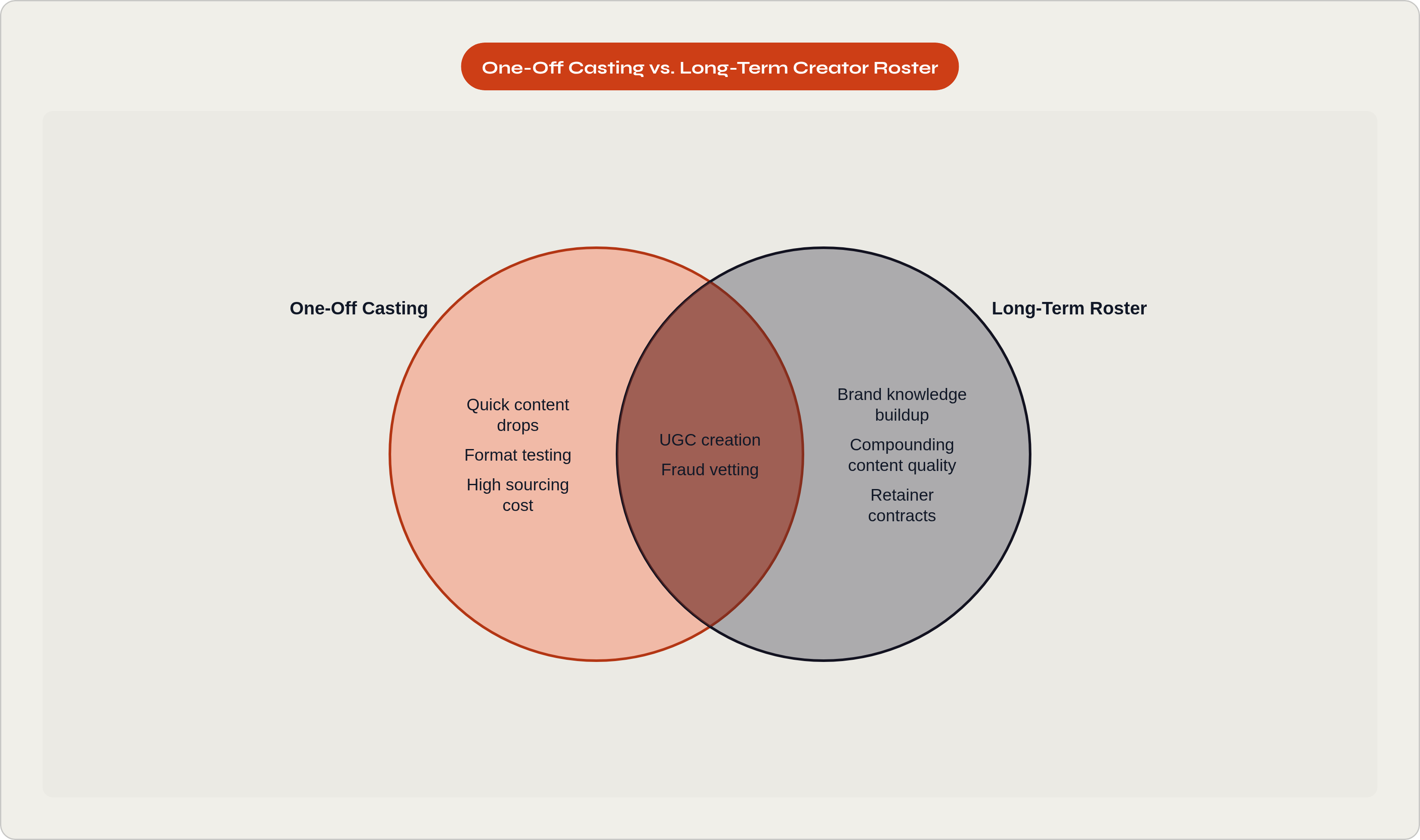
Here's the part that's easy to lose track of. The knowledge a creator builds, what hooks work, what angles convert, how your brand actually talks, walks out the door the moment the engagement ends. You paid for that knowledge once, but you don't get to keep it.
One-off casting still earns its place for a quick content drop, testing a new format before you commit real budget, or filling a narrow gap in one category. Marketplaces like Insense, Billo, and JoinBrands exist for exactly this, and they do it well. The trouble starts when one-off casting becomes the whole strategy instead of the exception inside a bigger one.
What a long-term creator roster compounds over time
Here's the part worth sitting with. A creator who's worked across several of your briefs is carrying knowledge in their head that a stranger simply doesn't have: brand voice, product nuance, which angles landed and which flopped. That knowledge doesn't just save time; it produces better content, faster, on every round.
Re-briefing someone you've already vetted takes a fraction of the time sourcing a new person does, and that savings compounds. Cost per activated creator drops the longer they stick around, because you're not rebuilding the relationship from zero each cycle.
Content quality follows a similar curve. A creator's first video for you is almost never their best work. The good stuff tends to show up by round three or four, once they've actually used the product and found their own way of talking about it. Set a cadence, say 2 to 4 videos a month per creator, and briefing overhead drops because nobody's reinventing the wheel every time. Build out standard operating procedures for hooks, formats, editing style, and what took a brand-new creator two or three days now takes a familiar one a few hours.
Depth beats breadth, plainly. Sixty creators you know well will out-convert 300 you've never worked with, because the roster's value isn't headcount. It's how much brand knowledge is sitting inside it. DTC brands running serious Meta ad spend feel this hardest: one-off UGC can't fuel the continuous creative testing that keeping ROAS up demands. A pipeline does that work; a string of one-time transactions doesn't.
How to select creators worth building long-term relationships with
Follower count isn't the signal it used to be, and honestly, it probably was never as good a signal as brands assumed. Content quality, how closely someone follows a brief, whether their aesthetic actually fits your brand: these matter more. A creator with 500 followers and a strong UGC reel can out-land campaigns against someone with tens of thousands of followers and mediocre content.
The data backs this up. MIT Sloan Management Review found nano creators produced meaningfully higher sales conversion than bigger names across Instagram and TikTok studies, and nano and micro creators are projected to take 45.5% of all influencer marketing spend in 2026. That's where the money is actually moving.
Set an engagement floor somewhere above 5%, since below that, reach isn't translating into anyone actually responding.
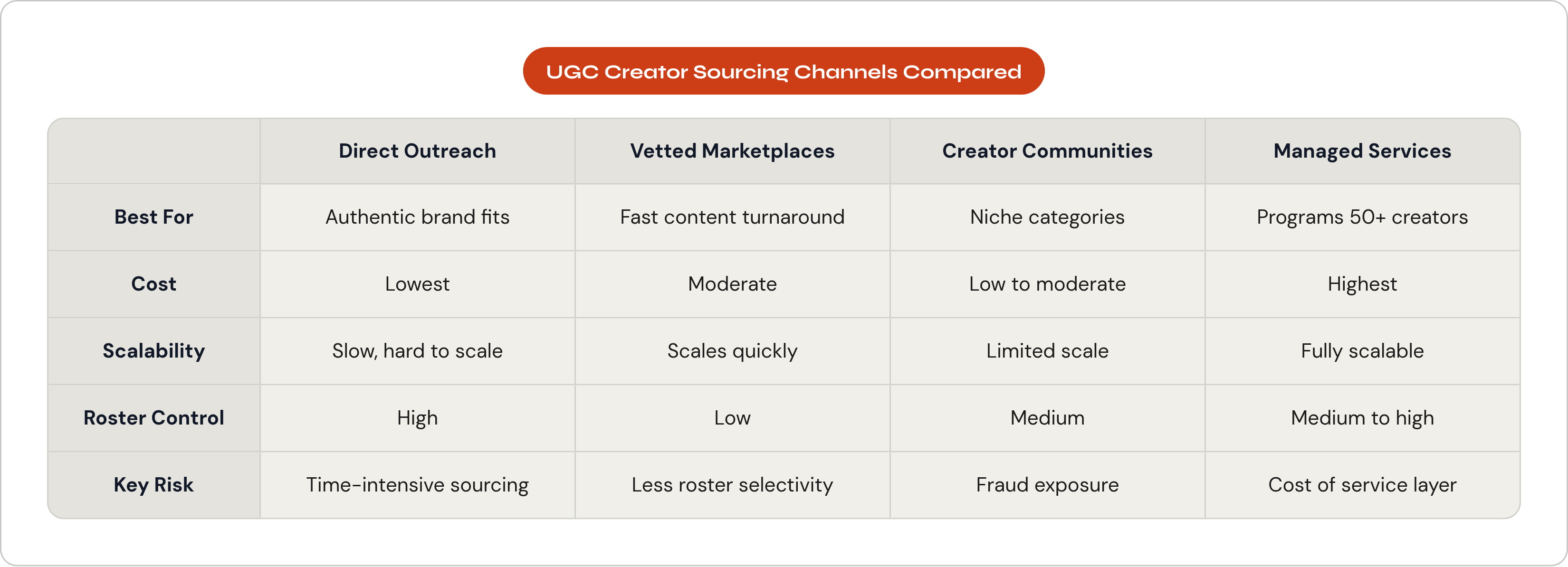
Where you look for these people matters too, and each channel has its own tradeoff.
- Direct outreach through your own hashtags, tags, and mentions gets the most authentic fits at the lowest cost, but it's slow and doesn't scale.
- Vetted marketplaces like Insense, Billo, and JoinBrands get you to content fast and handle contracts and payment, but you have less say over who lands on your roster. Good for testing, less good for building a bench.
- Creator communities and Discord servers give strong signal in niche categories like beauty, fashion, and gaming, but they demand real relationship-building and carry real fraud risk.
- Managed services handle sourcing, vetting, briefing, and payouts end to end, which starts to make sense once you're running 50-plus creators. This is the gap agencies like Pebble exist to fill.
Fraud vetting isn't optional anywhere in this. Pods, purchased followers, theme accounts with no real expertise behind them, they all look fine on a first pass. Checking someone's actual past work, whether their audience is real, whether they've followed briefs before, takes hours. Skip it, and you end up with a roster full of people who can't deliver.
Beyond the portfolio, watch how a candidate takes feedback, how they handle revisions, whether output stays consistent over time, and whether they treat your brief as a starting point or a box to check.
Structuring compensation to keep the right creators committed
Flat per-video rates are fading. Retainer packages, a monthly commitment for a set volume of assets, are becoming the norm, and that shift alone tells you the market is growing up.
For orientation, current benchmarks run roughly like this: a raw 30 to 60 second UGC video with organic rights only sits at $100 to $300. Add 90 days of paid ad usage rights and you're at $200 to $500. Whitelisting adds another $150 to $400 on top of the base. Experienced creators with strong portfolios command $500 to $1,500 or more per deliverable.
Lowball any of this and you don't just lose one good creator. You signal you're not a serious long-term partner, and word travels fast in creator circles, faster than most brands assume.
The pay structure that actually keeps top performers around is a hybrid: a base creation fee plus a 10 to 15% commission, with bonuses that unlock when creators hit conversion milestones. Layer loyalty incentives on top, say a bonus when a post clears engagement targets by 10% or more, and creator incentives start pointing the same direction as brand outcomes. That alignment matters more than the dollar figure itself. A structure like this tells a creator this brand is worth sticking with, and that's the precondition for getting their best work instead of the bare minimum.
The volume requirement that makes roster consistency non-negotiable
Most brands fail at UGC because they treat it like a campaign, something with a start date and an end date. The ones actually winning treat it as a system, a workflow that never fully closes out.
Volume needs scale with ad spend. At lower daily ad spend levels, plan for 10 to 20 new assets a week. At higher daily ad spend levels, that climbs to 50 to 100-plus a week. A one-off casting model can't hold that pace without rebuilding the sourcing, vetting, and contracting pipeline every few weeks, and that rebuild is exactly where most in-house programs hit their ceiling.
A stable roster with a pre-agreed cadence is what makes those numbers achievable without a proportionally bigger team. The point of the volume isn't flooding the feed for its own sake. It's generating enough variation to find which hooks, formats, and angles actually convert, then doubling down on what wins.
This feeds straight into paid amplification too. The assets a long-term roster produces become raw material for whitelisting and paid social, and content that's already converting organically is the safest bet you can make with paid budget. Pebble's model is a useful example of how this runs day to day: end-to-end program management, briefing, contracts, payments, analytics, takes the operational weight off the brand team so they spend their time reading results instead of chasing logistics.
How to structure the roster itself: size, tiers, and rotation
Depth over breadth, again, worth repeating because it's the organizing idea for the whole roster: sixty creators you know well beats 300 strangers, every time.
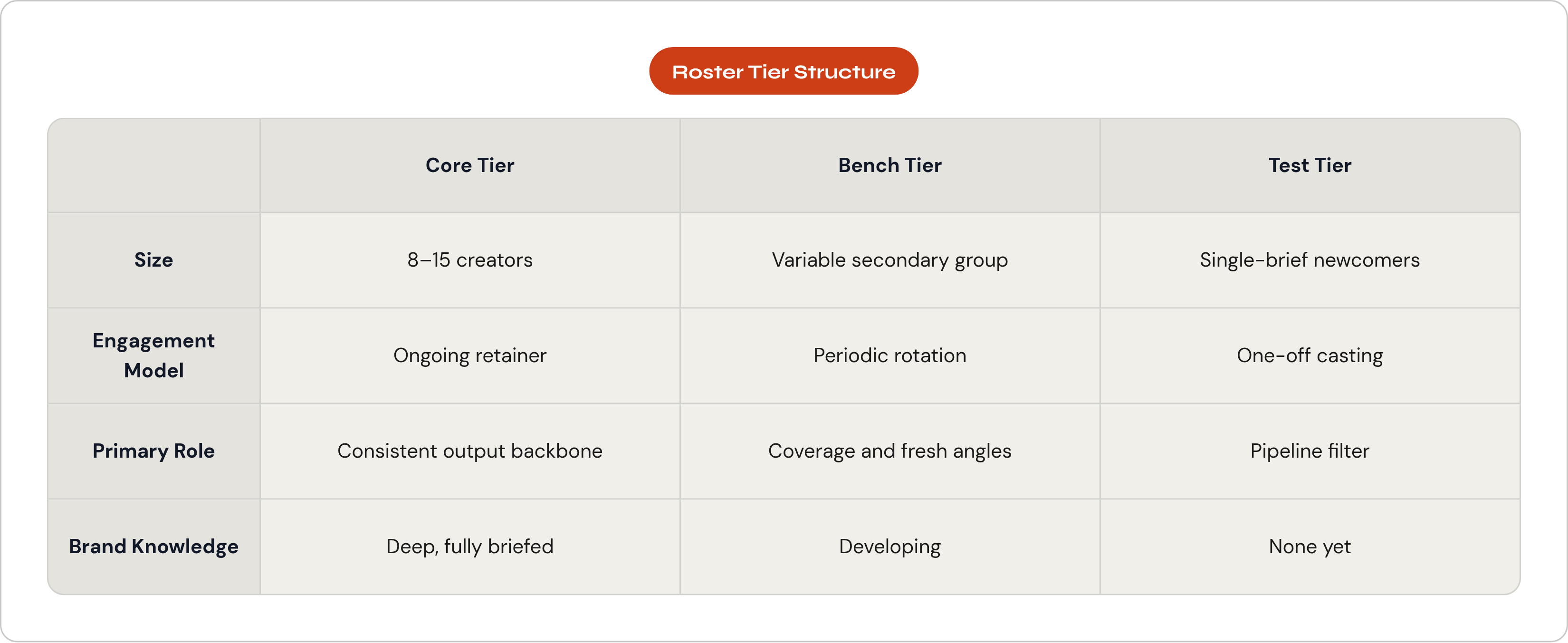
A workable roster splits into three tiers. The core tier runs 8 to 15 creators on retainer, producing on a steady cadence, fully briefed on your voice and your past performance data. This is the backbone. The bench tier is a secondary group you test periodically and rotate in when a core creator is unavailable, or when you need an angle the core group isn't giving you. The test tier is where new creators come in for a single brief to see if they're worth a retainer conversation at all; this is where one-off casting earns its keep, as a filter feeding the pipeline.
Rotation matters even among your strongest relationships. Audiences get tired of a single creator's style no matter how good it is, and a rotating bench keeps you from leaning too hard on any one voice.
Different creators bring different strengths: hook-forward unboxing, tutorial-style reviews, lifestyle integration. A well-built roster covers that range rather than cloning one style across everyone.
Expand the roster when a new product line, a new audience, or a new platform needs content your current people can't credibly make. A rising volume target alone isn't reason enough; deepen what you already have first.
Measuring roster performance so the program compounds rather than plateaus
A roster is only as valuable as the feedback loop underneath it. Performance data from one creator's content should shape the next brief you send them, not sit in a report nobody reopens.
Track creator-level numbers: hook rate (retention in the first three seconds), click-through rate, conversion by creative, and cost per acquisition by creator. These tell you who's actually driving revenue, not just racking up views. Track content-level numbers too: which hooks hold attention, which formats push link clicks, which angles bring the lowest CPA once paid dollars sit behind them.
When something outperforms, don't just repost it. Break down what actually drove it, the hook, the format, the way the creator delivered the line, and brief other creators to test variations on that theme. That's how one win turns into five.
Performance bonuses tied to real milestones, conversion targets, engagement thresholds, do double duty here. They motivate creators, and they leave you a data trail showing exactly who's worth deepening the relationship with.
Run it this way and the roster improves on its own over time. Creators get sharper at reading briefs, your team gets sharper at writing them, and the loop keeps producing stronger work without a matching jump in spend. A program that compounds treats every result as an input to the next decision; a program that plateaus closes the book the moment the content ships.