Onboarding UGC Creators to a Brand Program at Scale

UGC creator onboarding at scale isn't paperwork you rush through before the "real work" starts. It's the operational system that decides whether a brand program keeps growing as it adds people, or buckles under its own weight. I've sat through both versions of this, and the difference almost never comes down to who's more creative on camera. It comes down to what happens before a creator ever presses record.
The performance numbers make the case for urgency on their own. UGC-driven conversion rates jumped from Q4 2025 to Q1 2026, and jumped hard, over 50% in a single quarter. When results move that fast, brands do the obvious thing: they sign more creators. What they usually skip is building anything to manage what they just added. Every creator relationship runs through the same chain, brief, receive, review, revise, approve, pay, distribute. At five creators, a shared inbox and some good intentions will hold that chain together. At two hundred, the chain becomes the job itself, and your team spends its week chasing coordination instead of steering creative. Onboarding is where you decide, upfront, whether that weight gets designed for, or piles up quietly until something breaks.
What UGC creator onboarding actually means at scale, and why it's not like signing a few influencers
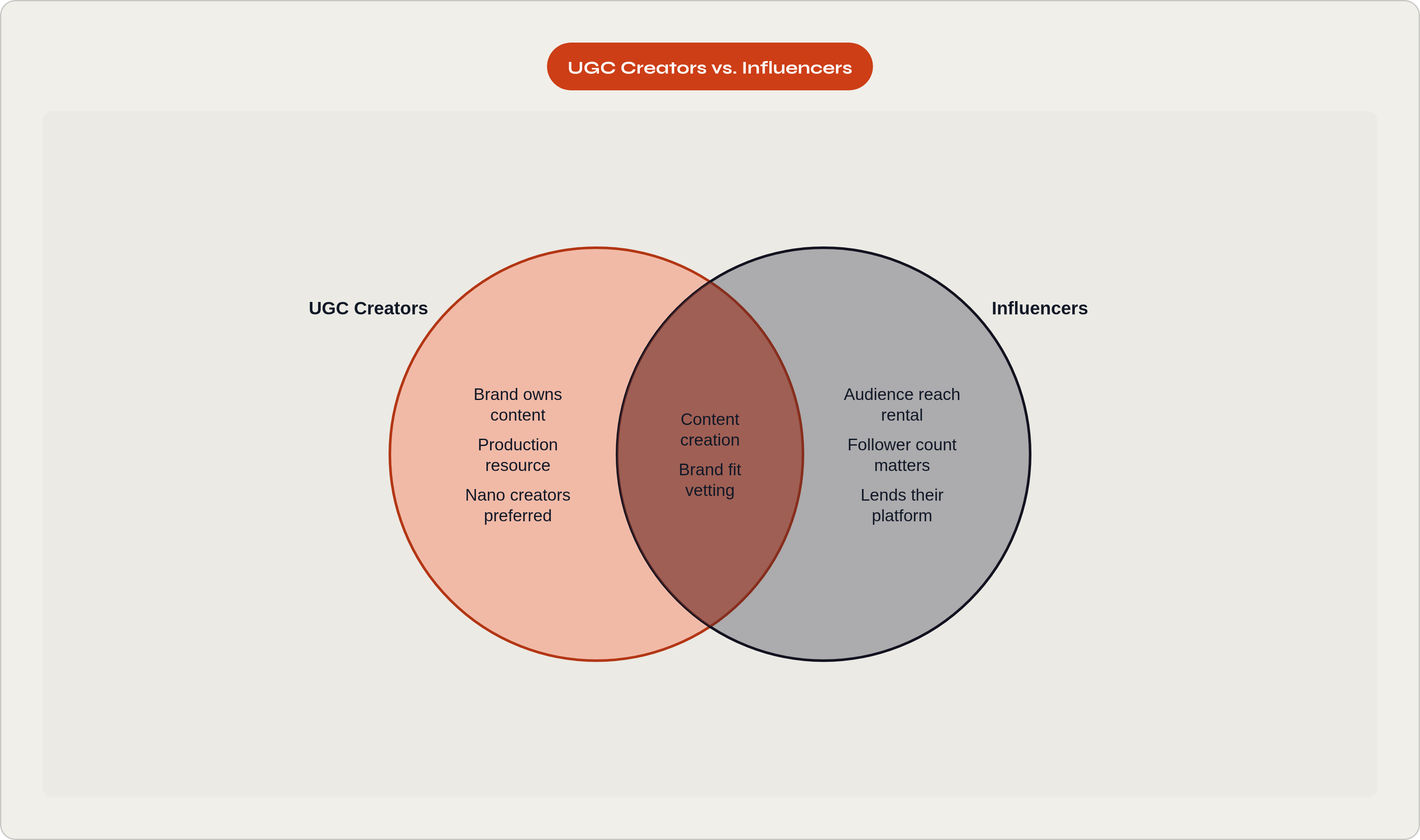
Here's the distinction that trips people up. UGC creators make content the brand owns and distributes. They're not lending you their audience the way an influencer does, they're a production resource, plain and simple. That one fact changes what onboarding actually has to accomplish.
It isn't relationship building. It's setting up a production line. Every creator needs to land at the same starting point: briefed, contracted, paid on clear terms, and capable of turning in on-spec work without someone walking them through it step by step.
The shape of the problem changes with volume, too. A handful of creators is a coordination task, something a founder can juggle in their head between meetings. A few dozen turns into a workflow design problem: you need templates, queues, rules that don't live only in your memory. Hundreds of creators is an infrastructure problem, full stop; you can't run it without automation and standardized intake. Skip that structure and every new creator becomes a one-off: a custom brief written from scratch, an ad hoc contract, a payment arrangement nobody wrote down anywhere. The program never compounds, because nothing ever gets standardized. So the real question isn't "how do I find more creators." It's "what happens the second a new creator says yes." That's where repeatable systems get built, or don't.
Vetting creators before onboarding starts: filter for reliability, not reach
The most common mistake I see is brands filtering candidates by follower count. Makes sense for an influencer campaign, where you're renting reach. Makes no sense in UGC, because the brand is the one distributing the content. Follower count barely correlates with what you're actually paying for.
So what does predict whether a creator works out?
Authenticity of delivery, mostly, and it's the hardest thing to fix once you've signed someone. Watch a portfolio and ask yourself: does this sound like a real person talking, or someone reading lines at a camera? You can coach framing and lighting. You can't really coach someone into sounding like themselves.
Audio and visual consistency across a few samples tells you whether the creator has a real setup, or just got lucky once. Brief compliance matters too, has this person worked from a structured brief before, or only ever posted whatever they felt like? Communication speed during outreach is underrated as a signal. How fast someone answers your first message tends to predict how fast they'll turn around a deliverable later, and I've never seen that correlation break.
Then there's reuse. If a brand already ran a creator's content in paid ads, that's about the strongest outside validation you'll find. Nobody keeps spending media dollars on content that flops.
Build this into an actual scorecard: rate each candidate on authenticity (weight it double, it matters that much), audio-visual quality, format range, brand fit, and price against quality. That turns thirty applications into something you can compare side by side instead of going on gut feel.
Before committing to a batch, though, one tool beats every scorecard: a single paid test deliverable at your standard rate. On time, on brief, needs almost no revisions? Green light, scale it up. Anything less, and you just learned something you needed to know before signing a bigger deal.
Worth planning around: a large share of UGC creators stop producing within their first couple months on a program. That's not proof your vetting is too strict, it's pipeline math. You vet hard because churn is the baseline, not the exception.
One more thing that catches people coming over from influencer marketing off guard: nano creators, the smallest follower tiers, deliver the best engagement per dollar and the lowest cost per video. They're the default choice for scaled UGC programs right now. Borrow vetting criteria built for influencer work, and you're optimizing for the wrong thing entirely.
The onboarding intake sequence: what every creator needs before they produce anything
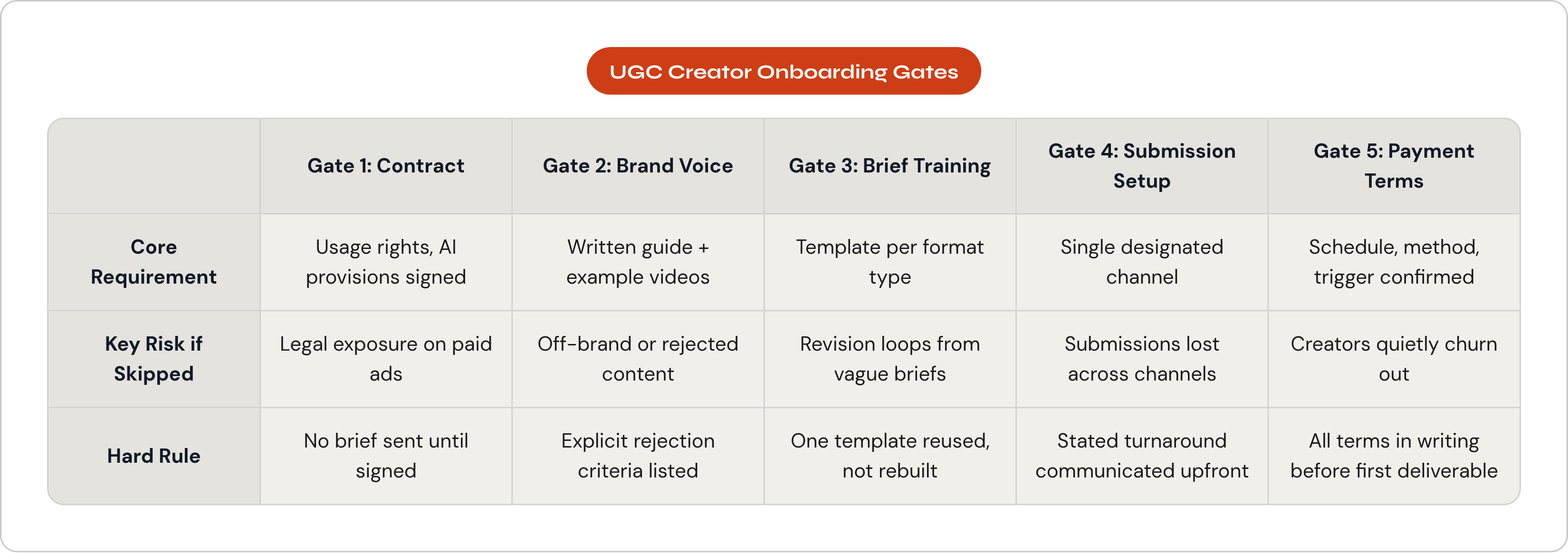
Every creator, first hire or three-hundredth, should move through the same gates in the same order. The sequence itself is what makes this scalable, since it takes the guesswork out of each individual onboarding.
Gate one is the contract. Usage rights need to be spelled out: which platforms, organic only or paid too, how long, what geography. If you plan to run creator content through paid ads (whitelisting), that needs its own clause, written specifically for it. Skipping that isn't a shortcut, it's legal exposure you built yourself. AI provisions are standard now too, whether AI-generated material is allowed in the work, and who owns the final piece. And here's a hard rule, not a nice-to-have: no brief goes out until the contract is signed.
Gate two covers brand voice and format. A short written guide (tone, what the brand sounds like and doesn't, visual no-goes), two or three example videos showing "this is what good looks like," and an explicit list of what gets content rejected outright: banned claims, competitor mentions, anything brand-unsafe.
Gate three is brief format training. Creators need to know how to read your brief template, what each field means, how much creative room they actually have. Standardize by content format, not by creator, one template for hook videos, one for testimonials, one for unboxings, reused across the whole roster instead of rewritten from scratch each time. Worth sitting with: creators who get loose creative freedom within clear talking points usually produce your best work. Creators who ask you to write them a full script tend to hand back something flatter, more performed.
Gate four sets up submission and communication. Pick one channel. Not email plus Slack plus WhatsApp plus DMs, one. Every submission lands in a named queue with a stated turnaround for review. Tell creators upfront how many revision rounds they get, what feedback looks like, how long approval takes.
Gate five locks in payment terms. Schedule, method, and trigger (on submission, on approval, on a fixed date), all confirmed in writing before the first deliverable shows up. Late or unclear payment is the number one reason creators quietly vanish from a program. Getting this right isn't bookkeeping, it's retention.
Brief design as a production lever: what separates briefs that scale from briefs that spawn revision loops
There's a real calibration problem with briefs. Too vague, and the creator has nothing to build from. Too prescriptive, and you've scripted away the exact authenticity you're paying for in the first place. So where's the middle ground?
A brief that scales covers product context (what it is, the one claim the content has to land, who it's talking to), hook guidance (suggest two or three opening directions, don't hand over exact words), mandatory and prohibited elements (a feature that must appear, a competitor name that must not), format specs (platform, aspect ratio, target length), and a tone reference that's two or three words plus an example video, not a paragraph of adjectives.
Standardize by format, not by creator. One "hook-first testimonial" template should work across the whole roster; personalization happens in the tone reference and product context, not in rebuilding the structure from scratch each time.
Here's the multiplier that catches teams off guard: every vague field in a brief generates at least one clarifying message back and forth. That's minor with five creators. At fifty, it's dozens of exchanges a week, eating up time a tighter template would have saved before it started.
When you review the work, split your feedback. Technical issues (audio, framing, lighting) and creative issues (hook strength, pacing, does this feel scripted) need different responses on different timelines; lump them together and the revision just gets confused. And when something works, say exactly what worked. A creator who knows precisely what landed will make more of it.
Contracts, usage rights, and payment structures built to hold when the roster grows
Usage rights are the single most consequential line in a UGC contract, and the one most commonly left vague. Organic posting rights and paid amplification rights are two different things and need separate grants. Whitelisting, running paid ads through a creator's own handle, needs its own authorization language beyond a generic usage clause. Duration and geography change price too: evergreen rights cost more than a campaign window, global rights cost more than domestic only. Paid usage rights typically add a real chunk on top of the base rate, and that needs to sit in your budget from day one, not get negotiated after the content is already sitting in your drive.
AI provisions belong in every contract now: whether AI-generated elements are allowed in a submission, who owns AI-assisted output, and how that ownership actually gets documented.
Payment structure isn't just accounting, it's a lever for quality and for keeping people around. Flat per-deliverable fees work fine for one-off sourcing. Retainers work better at scale, because rate, rights, and brief terms get set once and reused instead of renegotiated every single time. Per the Influencer Marketing Factory's 2026 report, performance-based compensation, a base fee plus commission on attributable sales or bonuses tied to views, now makes up the majority of brand partnerships. The hybrid model is becoming the default, not the experiment. Some earlier-stage brands are even trying equity-adjacent arrangements to save cash while locking in commitment; it takes real legal work to structure properly, but it creates strong alignment when it lands.
Here's the part people underweight: the most expensive cycle in any UGC program is re-onboarding. Re-briefing, re-contracting, re-negotiating rights with a fresh creator to replace one who churned out. Brands that never move toward retainers are, in effect, rebuilding their production pipeline from zero every month. So when you budget, set aside a real chunk of total creator spend for management overhead, whether that's a hire or an agency, before your roster hits the size where coordination quietly eats your team's whole week.
The communication and feedback setup that keeps a big roster moving without falling apart
Without a designated place for content to land, it lands everywhere: email, Slack, WhatsApp, DMs, all at once. Some of it gets missed. Review stops being managed and starts being reactive, and reactive means you're always a step behind.
The fix is a centralized queue: one channel, one place, named reviewers, a stated turnaround. Revision limits get agreed to upfront, in the brief and the contract both, because open-ended revisions are both a time sink and a slow drain on the relationship. Agencies that put this kind of structure in place report cutting content turnaround by roughly 30%. That's not nothing when you're running dozens of creators through the same review loop every week.
Worth separating: transactional communication (sending the brief, confirming a submission, giving revision notes, confirming payment) from relationship communication (performance feedback, program updates, renewal conversations). Template and automate the first kind through your one channel. Keep the second kind personal and occasional, because that's where a creator feels like part of something instead of a vendor line item.
Feedback compounds over time, but only if it's specific. "Great video" tells a creator nothing useful. Naming the exact hook, the transition, the delivery moment that landed, that's what lets them repeat it. Keep technical notes (fix the audio, reframe the shot) separate from creative direction (the hook needs to move faster, this feels scripted); mix the two and you get revisions that fix the wrong problem.
One number worth knowing: without workflow tooling, a single coordinator managing the full cycle tops out around 30 active creators before quality starts slipping. With the right systems in place, that number roughly doubles per person. Thirty versus sixty is basically the whole argument for building systems instead of hiring your way through the problem.
Phasing the program: prove the system works before you add volume
Don't build the whole machine on day one. Test it first.
Phase 1 runs with a small cohort, roughly three to five creators. This is where you find out if your brief actually produces on-spec content, whether your contract covers the usage you actually need, and whether payment runs cleanly from start to finish. You're also learning which formats and angles convert, which becomes the creative intelligence the whole program runs on later. Don't add volume until the loop, brief to submit to review to approve to pay, runs without you stepping in manually at every stage.
Phase 2 is where you systemize, somewhere in the ten-to-thirty creator range. Standardize your brief templates by format. Stand up the centralized submission queue for real, not as a someday project. Write down the onboarding sequence so anyone on your team can run a new creator through it without asking you what comes next. And move your best performers off one-off deals onto retainers, which cuts re-onboarding overhead and locks in the people whose work you've already proven out.
Phase 3 is scaling with the infrastructure already built, fifty creators and up. By this point the systems from Phase 1 and 2 aren't optional extras, they're the only reason the program can keep growing without your team drowning in coordination. Everything before this phase was building the machine. This is where it finally does the work it was built for.