UGC Creator Application Forms — What to Ask Before You Hire
Smart UGC hiring focuses on production ability and brief fit, not follower counts.

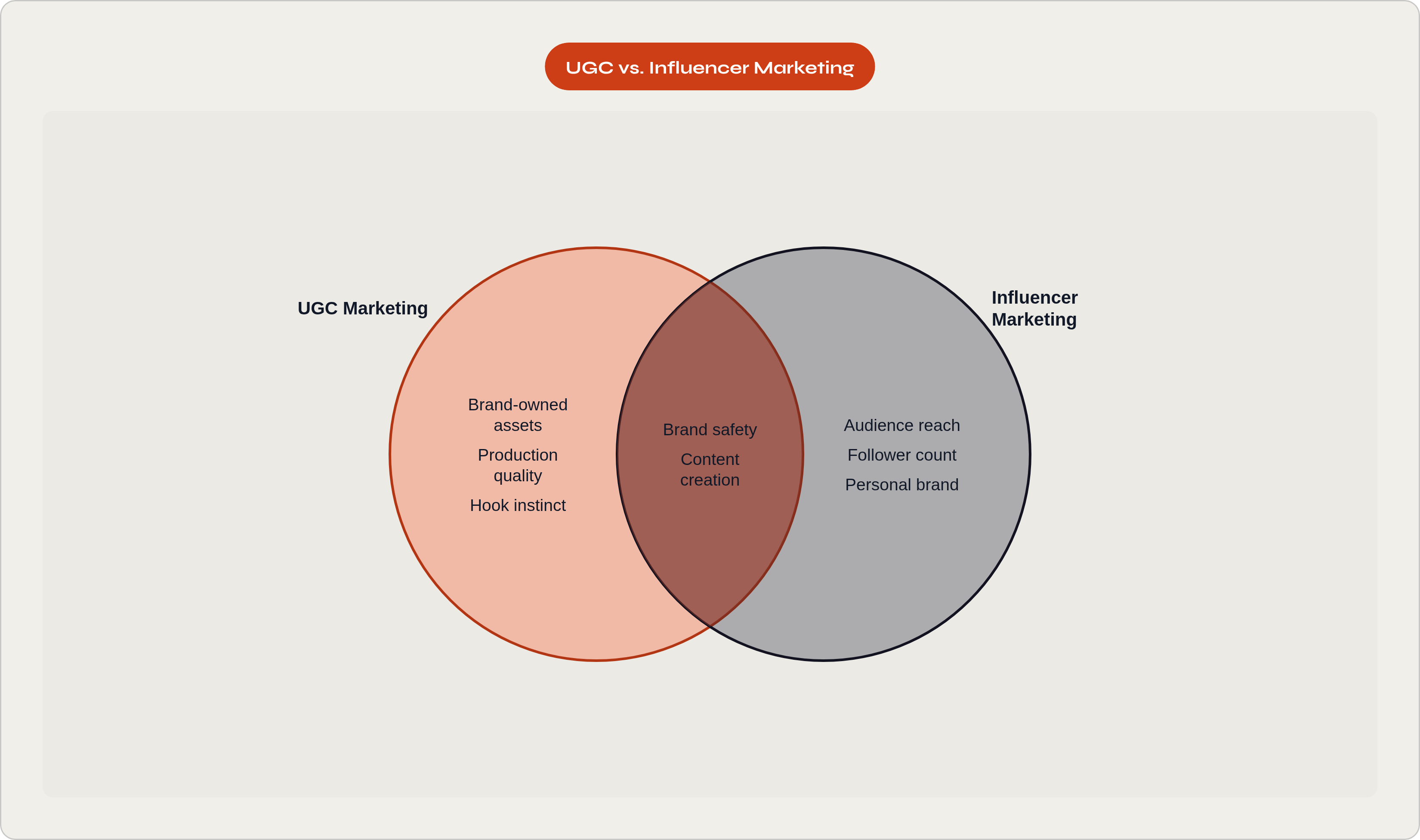
UGC and influencer marketing solve different problems. Influencer marketing buys reach; UGC buys a content asset the brand owns and controls, and that distinction changes everything about who you should be evaluating.
Because the creator's follower count has no bearing on how the asset performs in a paid placement, the evaluation frame shifts entirely. You are not scouting for audience size. You are asking whether this person can produce content that earns attention, fits the brief, and holds up as paid creative at scale.
The creators I've seen perform best in UGC programs often have small or no public audiences. That is a feature. It means they were never optimizing for personal brand; they were just making content, and they got good at it. A large following attached to weak creative instincts is a distraction in an application review, not a credential.
Every question in your application form should pass one test: does it surface production ability or creative fit? If not, cut it.
Why Most Application Forms Ask the Wrong Things
The most common mistakes I see on UGC application forms: asking for follower counts, listing social handles as the primary credential, and using broad "content experience" language that carries no signal of category fit or production quality. These questions feel like due diligence. They screen for visibility.
A creator with a large lifestyle following on Instagram can be completely wrong for a DTC skincare brief. Follower count tells you nothing about whether they can hold a camera steady, deliver a hook in under two seconds, or follow a brief without five revision rounds.
The deeper problem is structural. Many forms are designed to accept rather than filter. They collect information without a rubric for acting on it, which means the marketing team still has to make judgment calls on every single applicant. That is not an intake process; that is a spreadsheet with extra steps.
What gets missed when forms are too permissive: reliability signals, production infrastructure, on-camera style fit, and rights eligibility. All of these surface downstream as expensive problems, at exactly the moment when you have the least leverage to fix them.
The Questions That Actually Predict Whether a Creator Will Perform
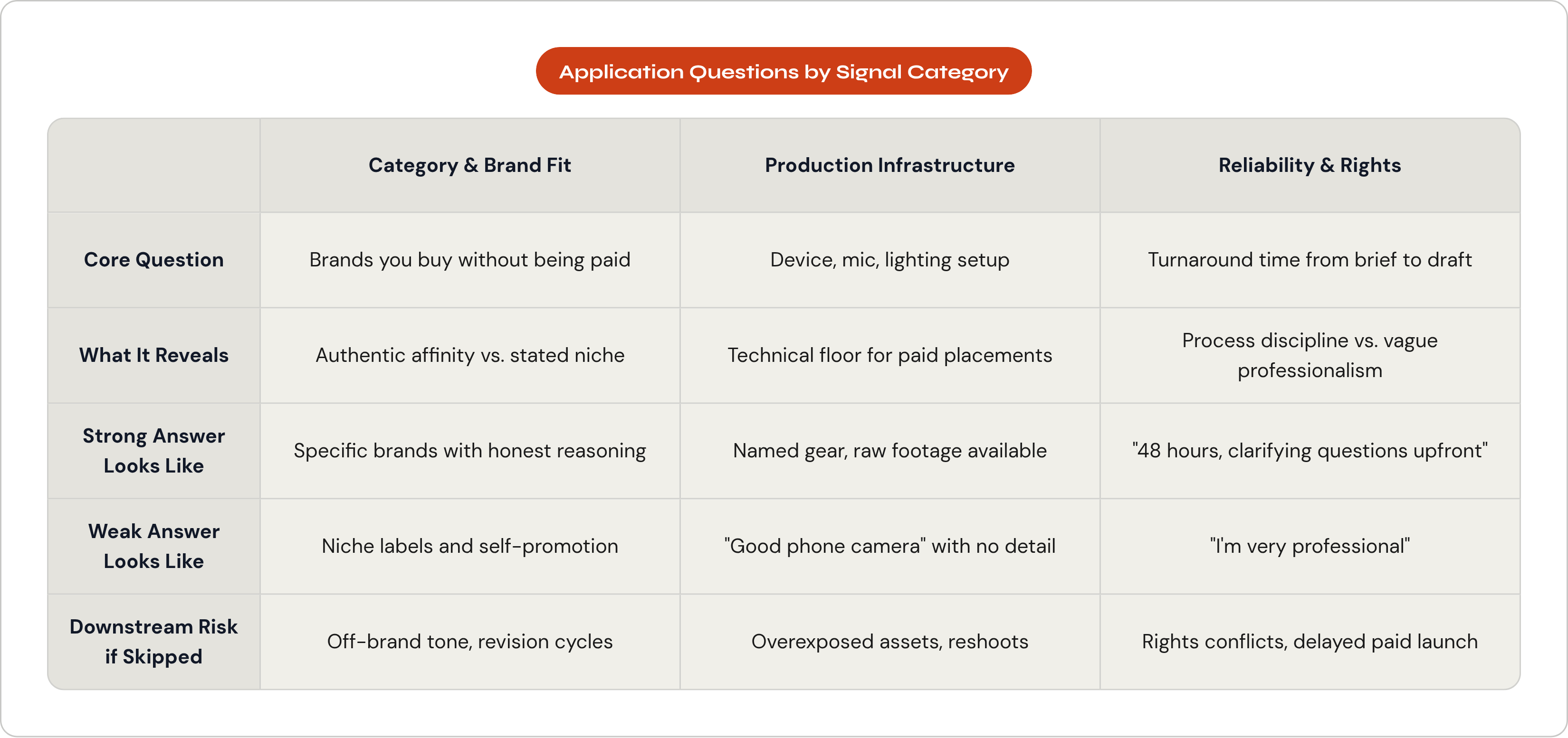
Organize your questions around signal categories, not form aesthetics.
Category and brand fit. Ask creators to name three to five brands they genuinely use, not brands in their content niche, but brands they would buy without being paid. Then ask them to describe their content category and the type of person they make content for. Creator-brand fit predicts authenticity more reliably than a stated niche does, because stated niches are self-promotional; purchase behavior is honest.
Platform fluency. Ask which platforms they create for natively and require examples from each, native productions only, not reposts. A creator who performs on TikTok is built around opening seconds, conversational delivery, and trend-awareness that does not translate mechanically to Pinterest or YouTube. Generic "social media experience" framing tells you nothing about platform-specific creative instincts.
On-camera style and tone. Two questions do real work here. First: "Describe your natural on-camera style in three words." This surfaces self-awareness and gives you a calibration point against their sample work. Second: "Walk us through how you would introduce this product to a first-time buyer." This is a low-stakes creative prompt that reveals authentic voice without the cost of a paid deliverable. Over-polished applicants who write in brand-speak are a flag.
Hook instinct. Ask: "What types of hooks have you found most effective, and can you give a specific example?" On short-form platforms, the opening seconds determine whether content survives. A creator who can articulate hook mechanics has thought about performance, not just aesthetics. Strong answers are specific, tied to real examples, and category-aware. Weak answers sound like this: "I just try to be relatable."
Production infrastructure. What device do they film on? Do they have a dedicated microphone and lighting setup? Can they deliver raw footage alongside edited deliverables? That last question matters enormously for brands that need assets for paid amplification or whitelisting. HDR recording is a surprisingly common production mistake that makes UGC look overexposed in ad placements, and creators who are unaware of it will cost you reshoots. Set a technical floor in the form itself so creators self-select out if they cannot meet it.
Turnaround and revision behavior. "What is your typical turnaround from receiving a brief to submitting a draft?" and "How do you handle revision requests when your first take does not match the brief?" Reliability and brief-adherence are the two most common failure modes in creator programs, not creative quality. A creator who says "I deliver within 48 hours and ask clarifying questions upfront" has a process. One who say "I am very professional" does not.
Volume and batch capacity. Ask how many pieces of content they can commit to per month and whether they can batch-record multiple deliverables from a single session. Creative fatigue on paid platforms is real and fast. Programs that ship multiple fresh variants per week outperform those shipping one polished piece per month, and your roster needs creators who can sustain that cadence.
Content rights and usage. Ask explicitly: "Are you comfortable with the brand using your content in paid advertising, including whitelisted and boosted placements?" and "Do you have any existing brand agreements or exclusivity commitments that would conflict with this campaign?" Rights confusion discovered after delivery is an operational and legal problem. The application form is the cheapest place to surface it.
Portfolio Review: What to Look for Beyond "Does This Look Good"
A portfolio of even a handful of short product videos is enough to evaluate most of what matters. You do not need volume; you need the right viewing frame. Ten to fifteen samples is a solid target, enough to see consistency across products and moods, not just peak performance.
When you review samples, here is what you are actually watching for:
- Does the creator hold attention through the full clip, or does energy drop after the hook?
- Does the delivery feel conversational, or does it sound scripted and promotional?
- Are product claims specific and believable, or generic and vague?
- Does the visual quality, including lighting, framing, and audio, meet the technical floor you need for paid placements?
For brand-new creators with no product portfolio, casually filmed lifestyle content is usable. The signal is voice, pacing, and on-camera presence.
The red flag I watch for most: a portfolio that looks like a commercial reel, perfectly lit, tightly scripted, heavy branding. It signals the creator does not understand what makes UGC work, which is the absence of that polish.
Brand Safety and Fraud Signals the Form Should Surface Before Vetting Goes Deeper
Every piece of content a UGC creator produces reflects on the brand. Proactive screening is cheaper than crisis management.
Ask creators to share recent post performance, not just handles, and look at comment quality when you review. Fake engagement patterns are consistent: comment sections full of generic praise ("Love this! So inspiring!"), sudden follower spikes disconnected from content events, engagement rates that swing wildly across posts. These are detectable before you ever send a brief.
For creators who will appear in paid placements, third-party verification tools like CreatorIQ catch fraud patterns that manual review misses. Worth noting in the form that verification is part of your process; it signals professionalism and tends to filter out fraudulent applicants before they self-submit.
Two form questions that surface safety signals directly:
- "Have you been involved in any brand partnerships in the past six months? If so, describe the category."
- "Is any of your content subject to existing platform restrictions or age-gating?"
The form should also collect social handles explicitly, not to evaluate follower count, but to allow independent review before advancing a candidate.
How the Application Feeds the Brief (and Why That Connection Is the Real Performance Lever)
The brief is the single biggest lever in UGC performance. A weak brief produces weak content regardless of creator quality, and I have seen strong creators deliver unusable assets because the brief gave them nothing to work with.
The application answers (specifically natural style, hook preferences, and product introduction approach) are raw material for a creator-specific brief that actually fits the person executing it. When you know a creator leads with humor and conversational specificity, you write the hook options differently than you would for someone whose strength is quiet, demonstration-forward delivery. That is not a small adjustment; it is the difference between a first draft you can use and one you send back.
Modern briefs need to specify hook options for A/B testing, pacing guidance, platform-specific format norms, tone guardrails, and key message hierarchy. Over-scripting kills authenticity, which is the asset's competitive advantage. Under-briefing produces unusable content that burns revision cycles and delays your paid launch. Both failure modes are avoidable, and both trace back to the quality of information you collected at intake.
What creators consistently say they want from brands: clear briefs, fast communication, creative freedom within guardrails, and realistic timelines. The application form is the first place to signal that the brand operates that way.
Scaling the Form as the Program Grows from Pilot to Production Roster
A small pilot (three to five creators) is enough to validate formats and messaging before scaling. In this phase, the form is a learning tool as much as a filter. You are not just screening applicants; you are learning which questions predicted the creators who actually delivered.
But how do you know which questions are pulling weight? Which application answers correlated with revision-heavy deliveries? Which category signals matched the audience segments that converted? These are not rhetorical questions. By the time you are managing a production roster, they should have data-backed answers.
As rosters grow, the operational math changes fast. Without systematized intake, a single coordinator managing communications manually hits a ceiling well before the program reaches its potential. The form cannot stay static if the program is going to grow.
This is where end-to-end program management compounds in value. Brands trying to run briefing, contracts, payments, revision cycles, and analytics in-house hit that ceiling faster than those with a dedicated operational layer. Pebble structures its program management around exactly this loop: structured intake feeds creative testing, performance measurement feeds roster decisions, and iteration feeds an updated application. The form becomes a continuously improving filter rather than a one-time document.
Connecting Application Data to the KPIs That Determine Whether the Program Is Working
Measurement in UGC programs operates on two tiers. Creative KPIs (including hook rate, watch-through rate, and engagement rate) tell you whether the asset earns attention. Business KPIs (including cost per acquisition, ROAS, and promo code redemption) tell you whether attention converts to revenue. You need both, and they should live in the same dashboard.
The application's platform fluency questions connect directly to hook rate data. A creator who articulated specific hook instincts in the form should show stronger opening-second retention in the asset. That is a testable hypothesis, and programs that treat it as one get better at recruiting over time.
Batch and turnaround questions connect directly to creative refresh velocity. The programs that consistently win on paid platforms ship fresh variants continuously; they are not waiting on a single polished asset.
The most common measurement mistake I see: running UGC performance against organic social benchmarks. UGC's job is to feed paid, and it should be measured against paid creative benchmarks. Promo codes and affiliate links, built into the creator agreement from the start, give the clearest direct line between creator activity and sales. But if rights and exclusivity questions were skipped in the application, that infrastructure cannot be deployed cleanly. The setup dependencies run all the way back to intake, which is why the form is not a formality.