Whitelisting UGC Creators on Facebook and Instagram Ads
Creators' identities boost ad performance while brands control targeting and budget.

Whitelisting on Facebook and Instagram means running paid ads directly through a creator's handle instead of the brand's own account. That single shift, letting the ad wear a creator's identity while the brand controls the targeting and budget behind it, is what separates a whitelisting program from ordinary influencer marketing or content licensing.
Why does this matter right now? Organic reach has thinned out badly, even for creators with six-figure followings. An account with 100,000 followers might only reach 5 to 10% of them without spending money behind the post. So the old model, where a creator posts and hopes the algorithm cooperates, doesn't really work anymore.
Meanwhile, brand-run ads carry a credibility problem that's baked into the format. Consumers trust peer recommendations over brand messaging by a wide margin, and a large majority say they trust a brand more when they see real user content in its marketing. The broader product direction backs this up: paid amplification of creator content isn't a nice-to-have anymore, it's treated as a core piece of a serious performance strategy.
A cost logic here is also worth sitting with. A single polished brand video shoot can run $15,000 to $50,000 for one finished asset. That same budget, put toward UGC creators instead, can fund 20 to 50 creators producing a full testing library in about two weeks. So a brand must combine the trust of a creator's identity with the precision of paid targeting. Whitelisting is the mechanism that answers that.
What whitelisting actually means in 2025-2026, and what it doesn't
The word "whitelisting" stuck around in the industry's vocabulary, but Meta doesn't call it that anymore. The actual workflow now lives inside something called the Partnership Ads Hub. Same idea, different name, and worth knowing because searching for "whitelisting" in Ads Manager won't get you very far.
Three things get lumped together constantly, and they shouldn't be:
Whitelisting, or allowlisting, is permission for a brand to run paid ads from a creator's own handle. Content licensing is a different right entirely: it lets the brand take a creator's asset and post it under the brand's own account. Dark posting is a third thing again, ads served from the creator's handle that never show up on that creator's organic feed at all. Dark posts exist purely for paid distribution without appearing on the creator's organic feed at all.
There's a related but separate concept: the "branded content" label. That's a transparency tag that sits on a post the creator owns. Whitelisting is the permission that lets the brand pay to push that post (or a variant of it) to a wider audience. Most serious campaigns run both at once, the label for disclosure, whitelisting for reach.
One caveat worth flagging: Threads doesn't support Partnership Ads or boosted organic branded posts as of this writing. So this entire workflow is currently an Instagram and Facebook story.
Getting these three concepts confused isn't just a semantic issue. Contracts, creator briefs, and ad setup in Ads Manager all hinge on knowing exactly which right has been granted. Mix them up and you're looking at legal exposure or a campaign stuck in setup while someone figures out what was actually agreed to.
How the permission handshake works between creator and brand
Meta gives brands two ways to get permission from a creator.
The first is content-level: the brand promotes one specific post the creator already published, and that requires approval on a per-post basis. The second is account-level, done through the Partnership Ads Hub, and it's broader: once granted, the brand gets ongoing access without needing the creator to sign off on every single post. That access gets managed entirely inside the brand's own Ads Manager.
Before any of this can happen, the creator has to meet a few conditions. Their Instagram or Facebook account needs to be public and set up as a professional account, either creator or business type. They also need branded content tools turned on in their settings. One thing that trips people up: connecting a Facebook Page through Accounts Center is optional, despite what a lot of outdated guides still claim.
Here's the actual sequence once those boxes are checked. The brand goes into the Partnership Ads Hub inside Ads Manager, clicks the Partners tab, selects "Add partnership," and enters the creator's Instagram handle. That generates a link or in-app notification, which gets sent to the creator for approval. Once accepted, the brand builds ads using the "Partnership ad" toggle inside campaign setup. If the creator already generated an ad code, the brand enters it here. If not, the brand can boost an existing post or build a fresh dark post from scratch.
Control splits cleanly between the two parties. The brand owns targeting, budget, optimization, scheduling, and creative edits on dark posts. The creator owns the decision to grant or pull access, and sets the time window that access covers.
One real improvement over the old system: no password sharing, no exchanging Business Manager IDs. That used to be a genuine friction point, and it's gone now.
One flag worth double-checking before anything goes live: if the brand is boosting a post that already has licensed music in it, someone needs to confirm the rights to that track cover paid use, or swap the audio out before the ad runs.
Identity display options and dark posting as a creative testing lever
Meta gives three options for how the ad identifies itself. Both the creator's handle and the brand name can show up together. Or just the creator's handle shows in the header, with the brand invisible. Or Meta's system picks automatically, choosing single or double header based on which it predicts will perform better for that specific audience.
Dark posting is where the real leverage sits. These ads run from the creator's account but only reach the audience the brand targets, they never touch that creator's organic feed. The creator's actual followers see nothing unless they happen to fall inside the targeted segment.
Why does that matter so much for testing? A brand can run five, ten, fifteen different hook and CTA variations off the same creator's handle at the same time, without a single one showing up in that creator's feed. No cluttering their timeline, no tipping off their audience that a paid flight is running.
One production detail that gets overlooked constantly: shoot vertical, always. Vertical video takes up 78% more screen space than landscape footage on Reels and Stories. The stylistic preference is not minor, since it directly changes how much of the screen the ad occupies and how it performs. Horizontal creative dropped into a vertical placement looks off, and it wastes the space Meta is giving you.
This is really the core of why whitelisting counts as a performance channel and not just an awareness play. Being able to run unlimited variants off a creator's identity, invisibly, is the testing engine.
The performance gap between creator-handle ads and brand-handle ads
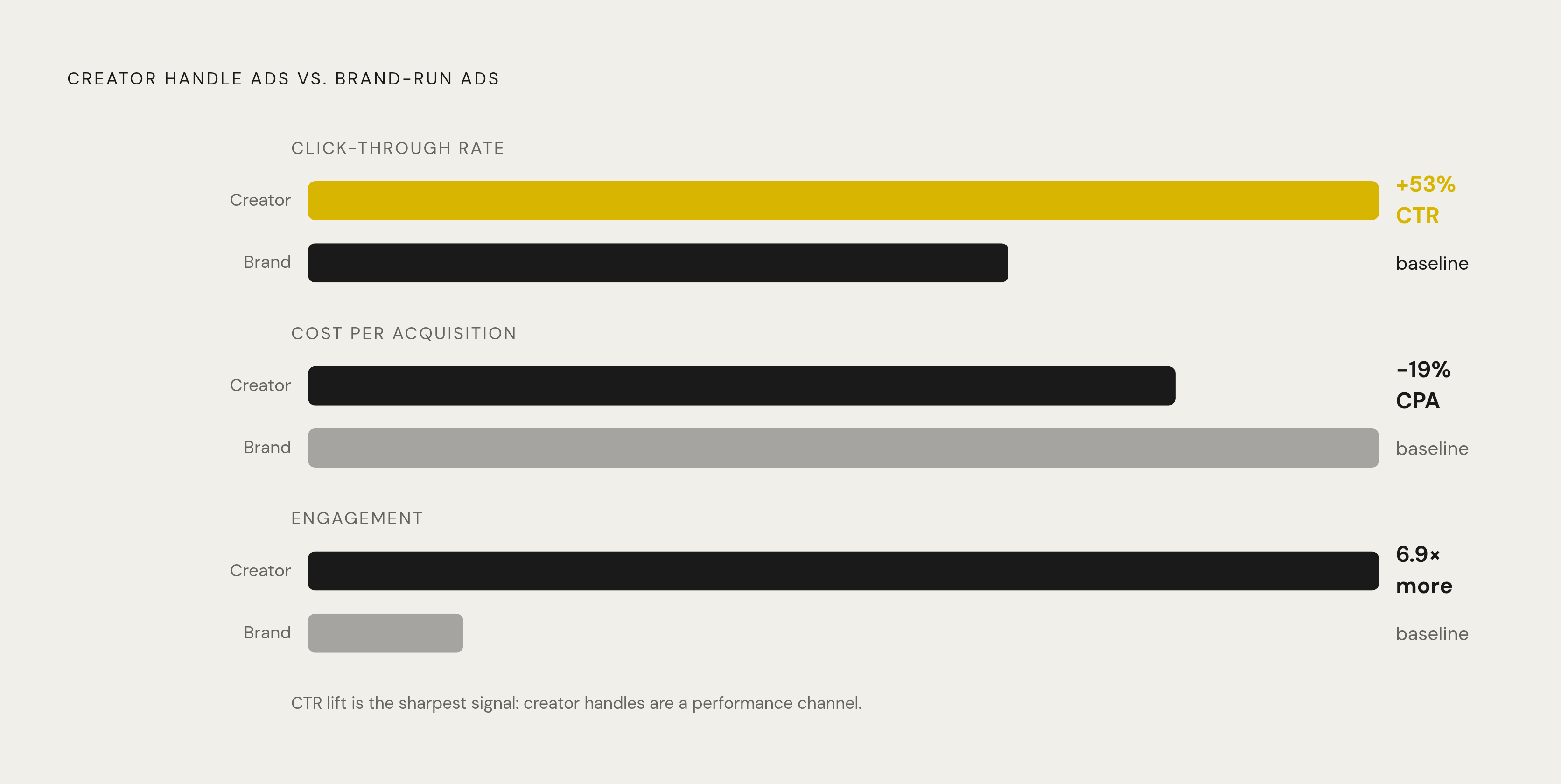
Industry data shows creator-handle ads paired with precision targeting deliver 53% higher click-through rates and 19% lower cost-per-acquisition than standard brand-run ads. The edge is not marginal.
Why does this happen mechanically? The ad keeps the creator's account name, profile photo, and visible engagement (likes, comments) intact. Those are trust signals. A viewer scrolling past registers the post as something closer to a recommendation from someone they follow, rather than an ad they're being served, and that lowers the mental resistance people put up against advertising.
Consumers are 63% more likely to buy or install an app after seeing user-generated content. That's not just a feeling people report in a survey, it shows up directly in conversion numbers. Multiple direct-to-consumer brands have cut acquisition costs by half after moving from polished, studio-shot brand creative to creator-made UGC.
UGC overall pulls 6.9x more engagement than brand-generated content, with engagement rates running 28% higher. Whitelisting stacks paid distribution on top of that native trust effect, rather than replacing one with the other.
And the number that ties it together: 88% of consumers say they've made a purchase based on an influencer's recommendation. Whitelisting is the tool that lets a brand take that recommendation effect and push it to audiences well beyond whoever happens to follow that creator organically.
Disclosure and compliance requirements that apply even after the ad is live
Ads run through the Partnership Ads Hub get a "Paid partnership" label automatically. That's Meta's built-in disclosure layer, and it's useful, but it does not by itself satisfy FTC requirements. Treating the platform label as legal cover is a mistake.
FTC rules sit on top of whatever Meta shows automatically. Video ads need both a verbal disclosure and one visible on-screen. Feed posts that get boosted into ads need the disclosure sitting in the caption above the "more" cutoff, not buried where nobody scrolls to see it. Any specific performance claim in the creative, numbers, results, comparisons, needs to get flagged and cleared before the ad ever launches.
Here's a detail that catches people off guard: even if the original organic post already had a sponsored tag on it, the FTC's endorsement guidelines require a fresh, clear disclosure once that same post gets boosted as a paid ad. The old disclosure doesn't carry over automatically in the eyes of the rule.
AI use is its own emerging disclosure category. Creator briefs should ask about AI tool usage directly in production, and any applicable disclosure should be addressed during ad setup rather than assumed one way or the other.
These choices go beyond just a checkbox inside Ads Manager. It's contractual. The agreement between brand and creator should spell out approval timelines, takedown rights tied to specific consent records, and a fast path to react if the creator's behavior or content creates risk once the ad is already running.
What a whitelisting contract needs to cover before any ad goes live
Scope of rights comes first: which handle, which platforms, which placements (Reels, Stories, Feed, Advantage+ Shopping), which countries, and which edits are allowed, subtitle cuts, recuts, crops for different formats.
Time windows matter more than people think. A 30 to 90 day window is a commonly used default, and contracts should spell out an explicit fee for extending that window rather than leaving renewal terms vague and open-ended.
Exclusivity clauses protect the brand's media spend: by product category and by region, so the creator isn't running a competing brand's ad through the same handle during the same window.
Data rights need their own line item. Can the brand build lookalike audiences off engagement from these creator-handle ads? That has to be written down, not assumed as a default. Pixel usage and how conversion events get deduplicated also need to be spelled out, otherwise attribution gets messy fast once creator-handle conversions start flowing into the brand's reporting.
Performance bonuses tied to ROAS or CPA targets give the creator a reason to care about how the ad actually performs, not just whether it gets delivered on schedule.
And audit provisions matter more than they get credit for. Capture explicit, revocable consent records for each partnership, log every creative edit and every targeting change, and build in a fast takedown path. Being able to produce that paper trail on short notice is what keeps legal friction low and lets someone hit pause immediately if something goes wrong.
Building the UGC content layer that makes whitelisting worth running
Organic UGC and what's sometimes called Performance UGC are not the same thing. Organic UGC is voluntary, a customer posts because they felt like it, genuine sentiment, no brief involved. Performance UGC is built on purpose: scripted, briefed strategically, made specifically to convert once it's running as a paid ad. Whitelisting is the distribution layer built for the second kind.
Volume isn't optional here. Whitelisting works as a testing engine, and testing engines need enough raw variation to actually find winners. Posting ten videos and eyeballing the results isn't a program, it's a guess.
A modular brief structure tends to work well, starting with the hook first (the opening moment is where both the algorithm and the viewer make their decision), then proof (a demo, a testimonial, a side-by-side comparison), then the call to action. From there, iterate the hook and the proof independently across different creators and formats.
Creator diversity matters more than it seems on the surface. Run the same face across every single dark post variant, and audiences start tuning that face out before the message even lands. Varying age, gender, and background across the creator roster reaches different segments of the same target audience, rather than fatiguing one segment repeatedly.
There's a lo-fi advantage too, worth taking seriously. Research consistently shows that consumers value authenticity from brands as a key factor in their purchase decisions. Overproduced, studio-polished creative can actually work against a whitelisting program, since it undercuts the exact native feel that makes creator-handle ads outperform brand ads in the first place.
A rough starting framework: split budget 70/20/10 across creators, angles, and formats while hunting for winners, before committing real scale spend to any one direction.
How to select creators specifically for whitelisting programs
Whitelisting isn't influencer marketing wearing a different hat, and treating it that way leads to the wrong creator picks. The brand isn't buying access to a creator's audience here, it's licensing their identity and their content to run through the brand's own targeting engine. Follower count, largely, doesn't matter.
What actually matters: can this creator follow a brief and deliver consistently on-spec content? Do they come across as authentic and relatable to the exact customer the brand is targeting? Does their footage look like it belongs in the placement it's headed for, Reels footage should look like Reels, not like a repurposed TV spot. And are they willing to grant account-level partnership access and work inside the contract terms laid out above?
One number worth sitting with: creators under 5,000 followers convert 20% better in this context than larger accounts. Smaller creators, counterintuitively, often make better whitelisting partners than macro influencers with huge followings.
Vetting matters before access gets granted, not after. Look through a creator's past content for questionable claims, adjacency risks, or anything that brushes against platform policy. Once that handle starts running paid ads, whatever baggage sits in their history becomes the brand's liability too.
Build the roster with intention, not by accumulating whoever's available. The same face running every ad hits diminishing returns fast. A spread of creators running concurrent dark post variants is the actual goal here, not a single star performer carrying the whole program.
Measuring what a whitelisting program is actually delivering
The core metrics aren't exotic: CTR by creative variant, CPA by creator handle, conversion rate, ROAS by ad set. Same numbers any direct-response campaign tracks, just segmented by which creator identity is running which ad, so it's clear which handles and which creative structures are actually driving results.
Set scale gates in advance. Decide the ROAS and CPA thresholds that trigger more spend behind a winner, and the thresholds that trigger pausing a creator, before the campaign launches. That takes the guesswork and gut-feel out of scaling decisions later.
Watch for fatigue too. Frequency and engagement decay by creative variant tell you when a hook is wearing out. Dark posts make this easy to manage, since a hook can get swapped or a creator rotated in without pausing the whole campaign.
One thing worth being skeptical about: a creator-handle ad can post a great CTR while delivering the same conversions the brand would've gotten anyway, if the audience was already primed to buy. Holdout tests or geo splits are how a brand confirms real incremental lift instead of just reading a flattering top-line number.
If the contract grants the right, lookalike audiences built from engagement on whitelisted ads become a durable asset, one that outlasts the specific campaign that generated them.
And the real marker of a mature program isn't a single ad that crushed it. One great creative from one creator is a data point, nothing more. A documented process that reliably produces winning creative across multiple creators and repeated brief iterations, that's the difference between a tactic that got lucky once and an actual channel.