Nano vs Micro UGC Creators — Which Tier Performs Better for DTC
Engagement rate drops as follower count climbs. That holds on Instagram, holds on TikTok, holds across pretty much every measurement method I've seen, even when the exact numbers shift depending on who's running the report. Smaller accounts engage harder, and that pattern traces back to structure rather than chance.
Think about why. A nano's audience comments more, sends more DMs, rewatches the same fifteen-second clip three times. Those are relevance signals, and platforms reward relevance with distribution. A creator with 3,000 followers can end up in front of more relevant eyeballs per follower than someone sitting at 300,000, simply because the algorithm reads the engagement and decides people actually care.
Sit with what that engagement represents for a second. Inside a nano's community, the creator functions less like a media property and more like a peer, and her recommendation lands closer to a text from a friend than an ad ever could. That's the trust mechanism. It's also why nano campaigns convert at rates that look disproportionate next to their audience size, on paper anyway.
But conversion rate and conversion volume aren't the same thing, and mixing them up is where budgets go sideways. If a nano's audience is 4,000 people, you're capped no matter how persuaded those 4,000 people are. High engagement per follower doesn't magically produce a large number of total sales when the denominator stays small.
So where do nanos actually earn their spot in a DTC program? Proof of concept, mostly. Seeding a new product into a tight community before real media dollars go behind it. Driving purchases inside a narrow, well-defined segment where trust does the heavy lifting instead of ad spend. That's a real lane, just not a wide one.
Where micros outperform: reach, content volume, and creative range
Micros keep the niche focus nanos have and reach more people while doing it. Engagement rate comes down off nano levels, sure, but it's still meaningfully higher than what you'd get from a macro or mega influencer. Micros occupy their own performance band, sitting between the tight intimacy of nanos and the broad reach of larger tiers, with strengths that have nothing to do with being a smaller nano.
Volume is the first one. A micro creator has usually shot more content, in more formats, over a longer stretch of time, than a nano ever has. That production history shows up the moment you need a library instead of a handful of clips. Fifteen different angles on the same product? A micro's back catalog will tell you, fairly quickly, whether they can actually deliver that.
There's a vetting shortcut buried in that history too. Has this person worked with other brands in your category before, and did those integrations feel like ads or feel like content? If the answer's the latter, that's real evidence they know how to fold a product in without making the whole thing feel like a commercial. You can scroll their feed and know roughly what you're signing up for.
Micros also earn their keep once paid amplification enters the picture. Whitelisting a creator's post, or running it as a Spark Ad, works better when the post already has organic traction behind it. Micros bring a wider baseline of that traction, meaning the algorithm has already extended some trust before a dollar of media spend touches the content.
Take the Coach Dreams Sunset perfume launch: a single gifted outreach program that combined micros and nanos together. It produced strong impression volume, strong engagement, and a reusable library of assets afterward, three outcomes that neither tier alone tends to deliver at once. Run the two together and you start to see why the pairing works.
The cost structure that makes volume-based nano programs viable
Nano rates per piece of content sit well below every other tier, often low enough that what a single micro post costs can fund a whole stack of nano videos instead. That math changes what's actually possible on a limited budget, and it's worth running the numbers before you default to whichever tier feels more familiar.
The comparison that matters isn't nano versus macro influencer. It's nano UGC versus an agency shoot. Hire a crew, rent the lighting, pay for the edit, and you get a small number of polished assets. Spread that same dollar amount across a group of nano creators instead, and you get a much bigger, much messier pool of raw footage: different hooks, different faces, different angles, all ready to test.
That volume feeds the thing most DTC paid media teams are actually short on, which is fresh creative to rotate before fatigue sets in. And fatigue doesn't hit every platform at the same speed. Meta gives an ad some runway before efficiency drops off; TikTok moves faster, sometimes demanding a new hook inside a week. A high-volume nano program is built for that TikTok pace in a way four expensive micro assets just aren't.
Here's the part that catches people off guard: cost-per-conversion often favors nanos even when reach-per-dollar clearly favors micros. The gap in engagement and conversion is wide enough to flip a comparison that, on paper, should go the other direction.
The catch is operational, and it's a real one. Twenty nano relationships means twenty rounds of sourcing, briefing, contracting, paying, chasing down deliverables. That's a different job than managing four or five micros, and brands that underestimate the difference end up with a stack of half-usable clips and a lot of burned coordination time.
Matching each tier to the DTC campaign objective it actually serves
There's no universal winner, because you can't separate the performance question from the objective question. A brand fighting for new customers in a crowded category needs a different creator mix than one trying to get its existing customers to buy again. Same channel, different job entirely.
Nanos tend to make sense when the brand is early-stage and needs proof points more than reach, or when the product sits in a category where peer trust beats advertising outright, think wellness, personal care, food. They also make sense when the goal is seeding a new SKU inside a specific community before real media dollars go behind it, or when what you actually need is a high volume of raw UGC for paid creative testing at a low cost per piece.
Micros make more sense when organic reach is genuinely part of what you're buying, not just the ability to shoot a video on request. Categories that reward demonstrated expertise, fitness, beauty tutorials, style, benefit from a creator's point of view adding credibility the product alone can't supply. Micros also earn their place when you're scaling paid amplification and want content with organic traction already built in, ready to whitelist or push as a Spark Ad, and when production consistency matters more than sheer volume.
Poppi and Glossier are worth studying here, since both built systems where making content is baked into being a customer, rather than run as a one-off campaign, and neither one simply picked a tier and stuck with it. That flywheel comes from treating creation as part of what it means to belong to the brand, and building the infrastructure to run that at scale, drawing on both tiers together.
How whitelisting and paid amplification change the tier calculus
Whitelisting a creator's account, or running their post as a Spark Ad, is really just buying media against a piece of creative. The moment that happens, the creator's organic reach stops being the main event. Targeting takes over.
That shift changes what you should be screening for. Follower count and organic engagement rate matter less; content quality, hook strength, and how naturally the product sits inside the video matter more, because that's the raw material the ad is actually built from.
Nanos get more attractive here, not less. Their content usually reads as less produced, more native, and that plays well in paid feeds full of people who've gotten good at clocking an ad within three seconds.
Micros still hold an edge when their organic post picked up real traction before you amplified it. That early signal carries into paid distribution and can pull your cost-per-result down further than a cold-start piece of content ever would.
Usage rights work differently by tier too. Nanos tend to be flexible and cheap on rights; micros can charge more for paid amplification, especially with an exclusivity window attached. Either way, get the usage terms written into the contract before content gets made, not after. That overhead scales fast once you're running a lot of creators, which is exactly the argument for building a real system instead of managing it DM by DM.
Vetting creators at either tier before committing budget
Fake followers and manufactured engagement haven't gone away, and AI-generated synthetic creator profiles have made the problem messier, not simpler. This isn't a fringe risk sitting off to the side of influencer marketing; it's baked into the channel, and it shows up at both tiers.
The risk isn't spread evenly, though. Nanos are harder to audit at scale, since checking a hundred small accounts by hand eats real time. Micros carry more history, so third-party tools return cleaner signals when you run them through one.
A few things worth checking regardless of tier: comment quality over comment count (generic "love this!!" spam is a warning sign, specific replies from real people mean a real community), a few months of content history checked for a consistent voice and honest sponsorship disclosure, audience composition matched against your actual customer base by geography, age, and gender, and platform-specific benchmarks, since what counts as healthy engagement on Instagram doesn't map cleanly onto TikTok.
One source gets overlooked constantly: your own customer list. Cross-reference customer emails against social handles and you'll find people who already buy the product and already like it, which beats cold outreach every single time. For scoring and filtering at volume, tools like Modash, Heepsy, and Upfluence do the job well. Without access to those, manual hashtag digging on TikTok and Instagram still turns up creators already posting in your category. It just takes longer.
Building a program that uses both tiers deliberately rather than defaulting to one
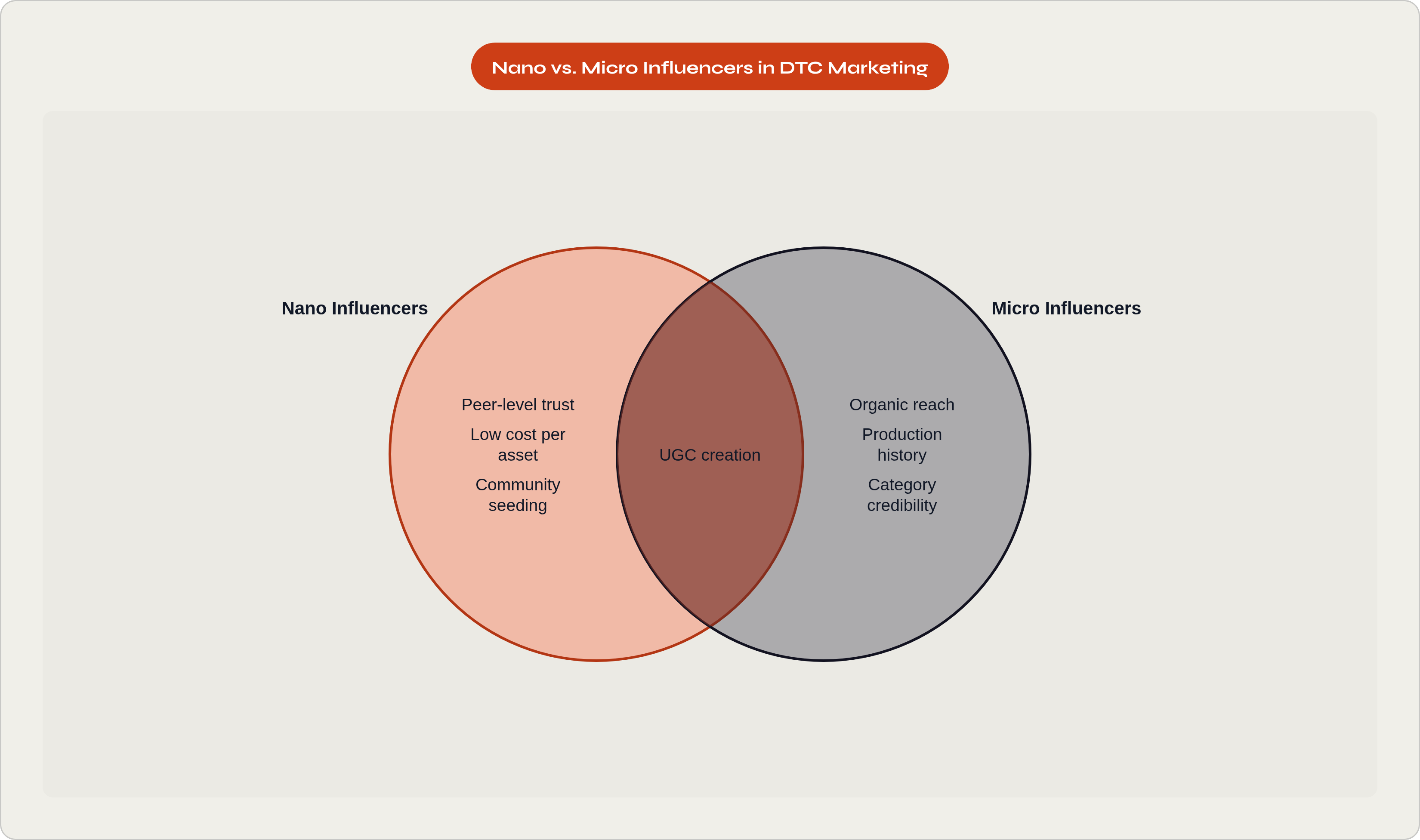
The brands getting the most out of this channel treat nanos and micros as two different tools suited to two different jobs. Each tier runs against a different job inside the same program, and conflating them is where most of the budget waste starts.
A structure I've seen work for DTC: nanos handle continuous UGC production and community seeding, run at high volume and low cost per asset, feeding a paid creative testing pipeline that needs fresh material constantly. Micros handle organic reach, category credibility, and paid amplification, run as fewer relationships with more investment per creator.
The real payoff shows up once both tiers feed the same loop. Nanos generate a wide pool of testable creative, and whichever pieces perform get pulled into whitelisting or Spark Ads. Micro content adds organic distribution on top, stretching the program's total reach further than either tier manages on its own.
None of this runs itself. Managing a large group of nano relationships alongside a smaller set of micro partnerships means briefing, contracting, paying, tracking usage rights, and measuring performance across all of it simultaneously, and that's not a task a lean brand team bolts onto someone's existing job without something breaking.
Skip the system and you land in one of two bad places: under-managed nanos who miss briefs and hand back content you can't use, or over-invested micros who give you too few creative variations, leaving your paid account exposed to fatigue sooner than it should be.
One strong result doesn't make a program; it could be luck, timing, or a creator who happened to nail the brief on instinct. Getting that result again, across tiers, across campaigns, across months, means you've built the measurement to know exactly which tier, which brief, which creative element actually drove it. That measurement is what turns a creator channel from a gamble into something you can plan a quarter around.