UGC Agency vs Influencer Marketing Agency for Consumer Brands
UGC builds proof your product works; influencer marketing builds awareness that you exist.

I've picked wrong on this before. Signed a six-month influencer retainer when what my product page actually needed was proof it worked. The campaigns hit their impression targets and conversion barely moved, because nobody was confused about whether the brand existed. They were confused about whether it delivered. That gap between UGC and influencer marketing is the one this whole piece is built around: two agency models solving two different problems, paid on different terms, and breaking in different ways when the fit is wrong.
What each model is actually optimized for, and where each breaks down
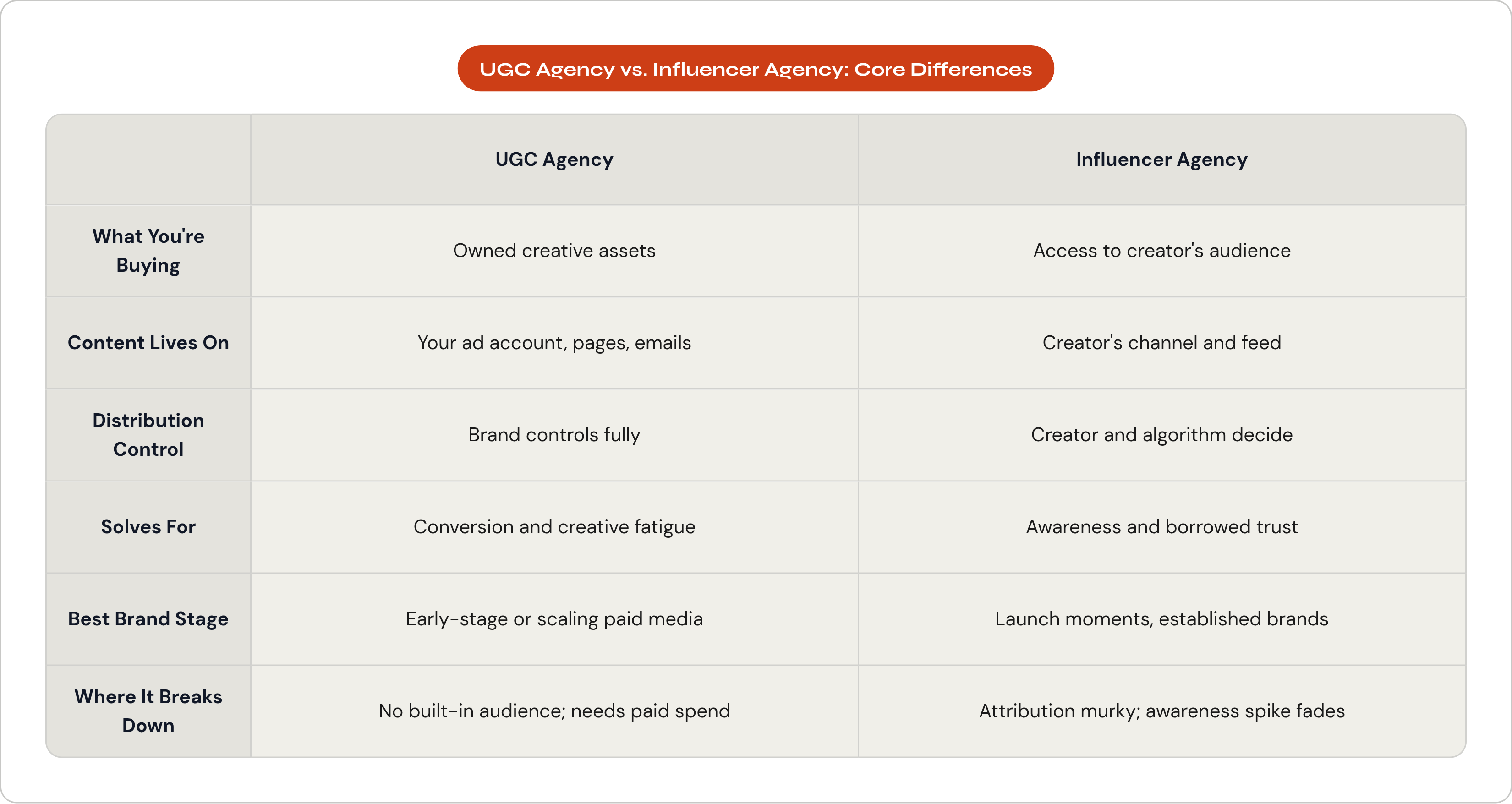
Start with what you're buying, because these aren't close cousins.
A UGC agency sells you content. Creators shoot testimonials, demos, unboxings, whatever the brief calls for, and the brand owns that footage outright. It never touches the creator's own feed. You put it in your ad account, on your product page, in an email flow, wherever it converts. The creator gets paid once, sometimes per usage terms, and the asset is yours to run, cut, test, and retire whenever you want.
An influencer marketing agency sells you access. You're paying to put your product in front of somebody else's audience, on their channel, in their voice. The post lives on their page. Whatever trust that audience built with the creator over years of posting rubs off on your brand, for as long as that post stays up and gets seen.
That ownership line is the whole ballgame operationally. With UGC, you decide where and when something runs, so it feeds straight into paid media and gets iterated like any other creative asset. With influencer content, the creator, or the platform's algorithm, decides how long that post stays visible. You're renting a moment, and the calendar isn't yours.
UGC agencies earn their keep on volume. You get more assets, faster, at a lower cost per piece than a traditional shoot, and every asset is something you can A/B test in an ad account without renegotiating a creator deal. If you're staring down ad fatigue, a steady pipeline of fresh variants beats one perfect hero video most days. Where it falls apart: there's no built-in audience. You still have to buy the media and build the targeting yourself, and awareness lift stays slow and indirect unless real spend sits behind it.
Influencer agencies earn their keep on speed and borrowed trust. One campaign, timed right, puts a brand in front of millions of people who already trust the person doing the recommending. That's genuinely useful during a launch, or when the bottleneck is just that nobody's heard of you yet. Where it falls apart: the content sits on someone else's channel, so you have limited say over how long it lives or whether you can reuse it. Attribution gets murky fast without extra tracking bolted on, and a one-off campaign doesn't compound. Once the post ages out of the feed, the awareness spike tends to go with it.
Which one fits depends entirely on the problem sitting in front of you right now.
The market conditions making this choice more consequential in 2026
The money behind this decision has grown fast enough that getting it wrong now costs real dollars, not just a missed shot.
Global influencer marketing hit $32.55 billion in 2025, up from $24 billion the year before, and has grown dramatically over the past several years. In the US alone, sponsored content spend reached $10.52 billion in 2025, up 15% year over year. This is a budget line with its own gravity now, not some niche add-on a junior marketer pitches once a year.
Two shifts are pushing brands toward UGC even as influencer spend keeps climbing right alongside it. Social algorithms in 2026 favor content that reads like real experience over content that reads produced. And AI-powered search tools are starting to surface content tied to actual usage, meaning video testimonials and UGC clips are becoming part of a brand's trust footprint in search results and AI-generated answers, not just in the Instagram feed.
Budgets are following the shift. About 87.49% of brands plan to spend more in this category in 2026, with average allocation now sitting at 23% of total marketing budget, up from 18% in 2023. As that number climbs, so does the cost of putting the money in the wrong bucket. Hire an influencer agency when what you actually need is a creative production pipeline, and you're spending real dollars on the wrong deliverable. That mistake compounds every quarter you don't catch it.
The performance spread makes the stakes concrete. Brands earn an average of $5.78 for every dollar spent on influencer marketing, but top campaigns with strong creator selection return $11 to $20 per dollar. That gap between median and top quartile isn't rounding error. It's agency fit and program structure doing real, measurable work.
How brand stage determines which agency type fits
Ask what stage you're actually at before you ask which agency to call.
Early-stage brands, the ones without much paid media infrastructure yet, usually have a trust problem more than a reach problem. Nobody's converting because there isn't enough social proof on the page. A UGC agency builds that library of testimonials and demo footage that chips away at hesitation. Hire an influencer agency at this stage and you risk paying for traffic that lands on a page with nothing to convince it to buy.
Scaling brands, the ones already running paid social with product-market fit proven, usually need a constant supply of fresh creative to keep ad fatigue at bay. UGC tends to be the right call here: it feeds the ad account new variants to test. Once that engine's running, an influencer layer can get added on top to reach new audiences or push into a new category.
Established brands, where category awareness already exists, face a different question: what's actually blocking growth next? Influencer partnerships make sense for launch moments and brand campaigns. UGC keeps the always-on performance engine fed.
The cleanest diagnostic question I know: what would you actually do with the content this agency hands you? "Run it in ads and iterate on what converts" is a UGC job. "Get it in front of the creator's followers and build recognition" is influencer marketing. Company stage matters, but goal type matters just as much; an awareness bottleneck points one direction, and a conversion bottleneck points the other.
Creator selection standards that apply regardless of which agency type a brand chooses
Follower count tells you less than most people assume. According to Sprout Social, only 17% of consumers check a creator's follower count before deciding whether to engage with their content at all. Relevance and content quality carry far more weight than raw audience size.
Statista's 2025 research backs this up from the performance side. Micro-influencers, in the tens-of-thousands follower range, deliver 60% higher engagement rates than accounts north of a million followers. Brands that built 2025 programs around 50 to 100 micro-influencers outperformed peers spending the same total budget on a single celebrity activation, by 3 to 5x on conversion. Scale isn't the same thing as reach that actually converts.
Weak vetting carries a real price tag. Fake influencer partnerships waste an estimated $1.3 billion a year worldwide, per a 2025 Statista study, and Influencer Marketing Hub's 2025 report found 63% of marketers struggle to verify a creator's authenticity before signing anything. The fraud itself has gotten sharper too: AI-generated personas with full, convincing posting histories, engagement pods manufacturing metrics that look organic on the surface.
Here's a test worth running no matter what tool you're using: scroll a creator's history back to their earliest posts. Authentic accounts tend to show engagement and follower count climbing together, steadily. A sudden follower spike paired with flat engagement is a red flag, and it's one fraud-detection software doesn't always catch on its own.
Ask for native platform analytics before committing anything: audience demographics, geography, age split. If a creator hesitates to share that, take the hesitation as information.
For UGC creators specifically, the vetting emphasis shifts entirely. Audience quality matters less, since they're not posting to a following anyway. What matters instead is content quality, how reliably they follow a brief, and whether their production holds steady from one batch to the next.
Worth building over time: an internal record of creators who turned out fraudulent or fudged their numbers. That institutional memory is what keeps you from rediscovering the same bad actor eighteen months later under a different campaign name.
Whitelisting and paid amplification as the bridge between the two models
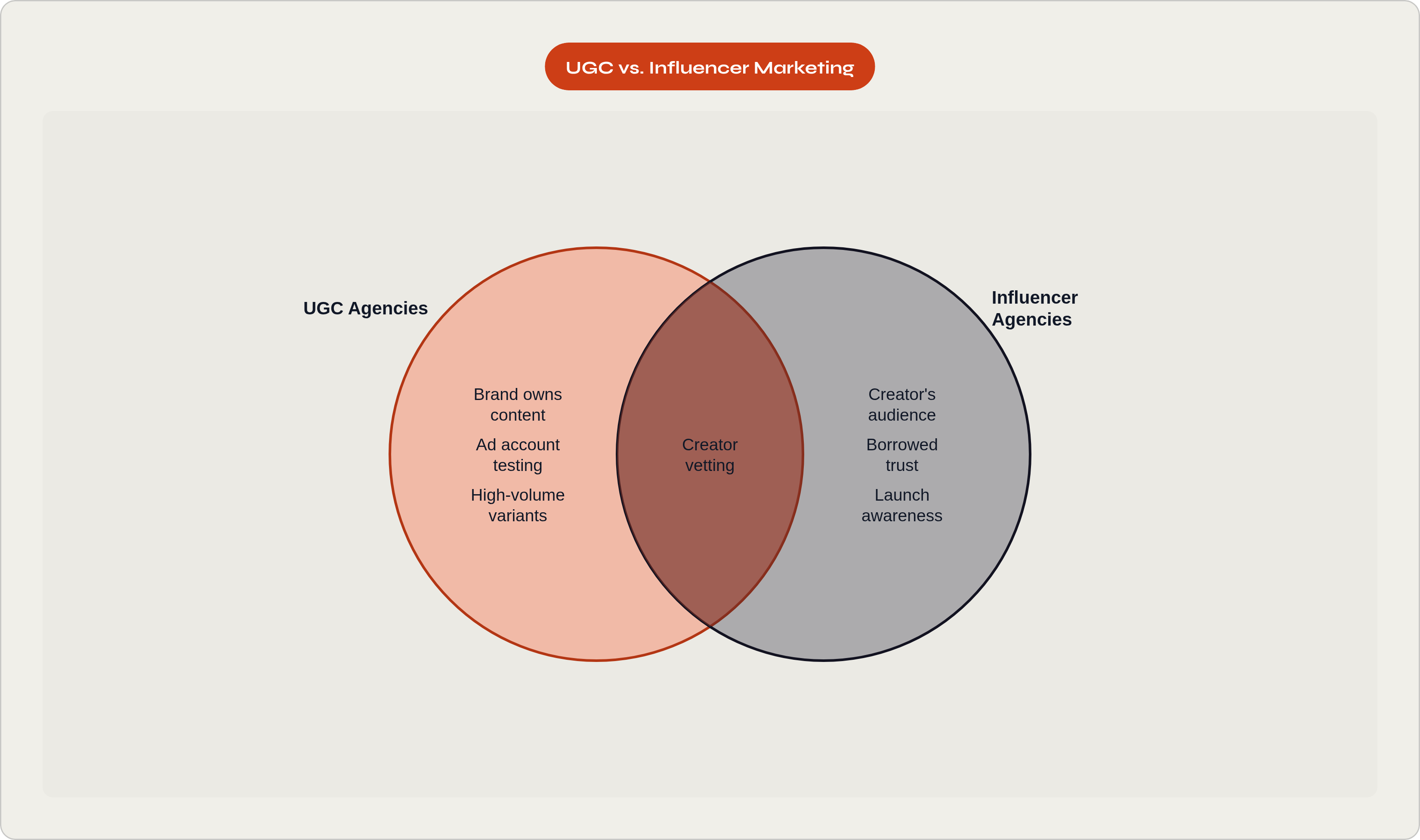
This is where the line between the two models gets genuinely blurry, and it's worth understanding even if you're sure which lane you're in.
Whitelisting, sometimes called creator licensing or partnership ads, lets a brand run paid ads directly from a creator's account handle instead of its own. The ad looks native because it technically comes from a real person's profile, not a brand page. That combines the trust premium of creator-made content with the targeting precision of a normal paid media buy: you decide who sees it and how much budget backs it.
The mechanics are straightforward. The creator grants ad account access through something like Meta Business Manager or TikTok's Spark Ads, so the brand runs the ad without ever touching the creator's password. Content can also get dark-posted, meaning it runs purely as a paid ad and never shows up organically on the creator's public feed. That gives the brand full control over distribution without asking the creator to post anything publicly.
This is where the two agency types start to blend in practice. An influencer agency managing whitelisting is producing paid performance assets out of creator content. A UGC agency securing whitelisting rights is extending its content past the brand's own ad accounts, into something closer to influencer distribution.
Worth asking any agency you're sizing up: do they manage whitelisting in-house, and how are the licensing agreements structured? The answer tells you whether they're thinking about performance outcomes, or just handing over deliverables and moving on to the next client.
TikTok leads 2026 brand investment intent at 31% selection incidence, and its Spark Ads infrastructure builds whitelisting straight into the platform's ad system. That's a big part of why the line between UGC and influencer work is blurring fastest on TikTok specifically.
The measurement infrastructure each agency type should be accountable to
Measurement, not budget, is the industry's biggest unresolved problem right now. Across the industry, ROI attribution remains among the top challenges marketers report, and measurement infrastructure has not kept pace with spending growth.
UGC agencies should get held to cost per asset and total production volume: is the agency actually delivering enough variants to run a real creative test? Past that, look at performance inside paid media itself: click-through rate, conversion rate, cost per acquisition, broken out by individual creative variant. And check how fast the agency turns performance data into the next round of briefs. A slow feedback loop defeats the entire point of high-volume production.
Influencer agencies need a different scorecard. Earned media value and reach numbers are a starting point, not a finish line. Look at engagement quality: are the comments substantive, or generic emoji spam? Does the audience sound like it actually recognizes the problem your product solves? Then check downstream signals, branded search lift, traffic spikes tied to a specific post, promo code redemptions that trace back to one creator.
The baseline that applies to both: an agency that can't tie its work to a funnel-level number is a production vendor with better vocabulary, whatever it calls itself on the pitch deck. For brands running whitelisted content, attribution actually gets cleaner, because paid ad reporting ties directly to specific creative assets. That lets you measure UGC and influencer spend inside the same dashboard as every other paid channel.
What to look for when evaluating agencies in either category
Start with whether the agency handles the whole job or just a slice of it. An agency that only sources creators, or only produces creative, leaves the rest, contracts, payments, rights clearance, reporting, sitting on your team's desk. That overhead adds up faster than people expect.
For UGC agencies, a few things worth checking before signing anything:
- Volume capacity: can they actually produce enough variants to run a real A/B test across your ad sets, not just a handful of one-off videos?
- Brief quality: ask to see sample creative briefs. A vague brief produces inconsistent content, every single time.
- Rights management: do they clearly own and transfer content rights, with usage spelled out for paid, organic, and whitelisting use?
- Iteration process: do they look at which assets perform and feed that into the next round, or hand off a batch and move straight to the next client?
For influencer agencies, the questions shift toward relationships and rigor:
- Network depth: a huge creator roster matters less than whether the agency has real relationships with creators who actually fit your category.
- Vetting process: what fraud-detection tools do they use, and do they require native analytics from creators before committing budget?
- Campaign structure: are they building one-off placements or long-term creator relationships? Ongoing partnerships tend to beat single activations on conversion.
A handful of questions work no matter which type you're talking to. How do you define success for a program like this, and how do you measure it? What does reporting look like at 30, 60, and 90 days? Can you show results from a brand at a stage similar to mine? What happens when a creator underperforms after you've already paid them?
The programs that actually work, UGC-led or influencer-led, are built to repeat. An agency that can't explain how it replicates a win is selling a campaign, no matter how the pitch is dressed up. And increasingly, the agencies doing this well sit at the intersection of both models: performance creative, creator relationships, whitelisting, and measurement, all under one roof. For a brand that needs awareness and conversion moving at the same time, that combination is worth more than either model running alone. I'd rather deal with one agency accountable for both than referee two vendors pointing at each other when the numbers don't add up.