How to Evaluate a UGC Agency Before Signing a Contract
Know what to demand from a UGC agency before they become your problem.

Here's the distinction nobody in this industry likes to say plainly: a UGC agency and a UGC marketplace are not the same thing, even when they're using identical language on their websites.
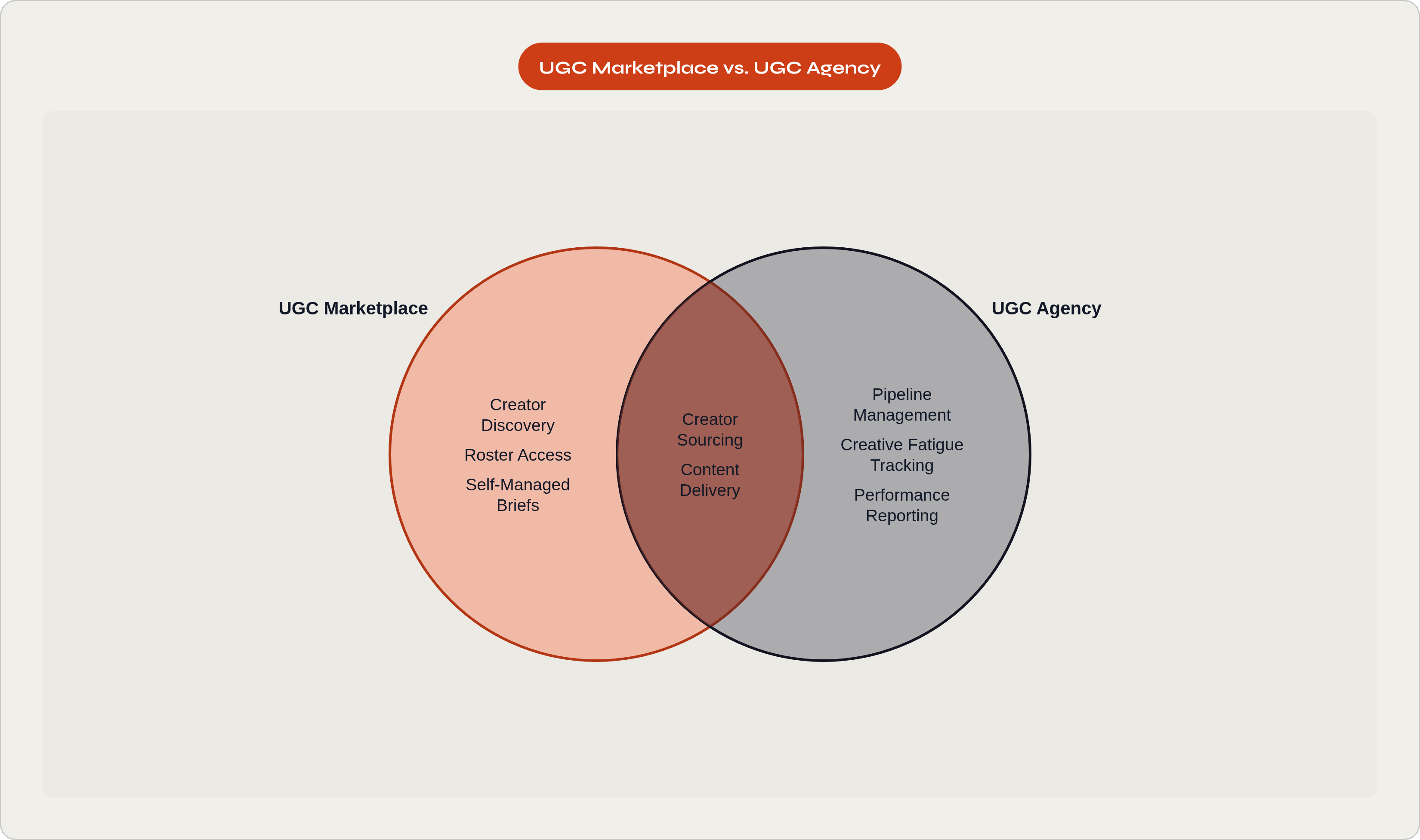
A marketplace connects you with creators. An agency runs the pipeline. Strategy, creator sourcing, briefing, scripting, production, editing, rights clearance, performance tracking. The whole chain. That difference sounds bureaucratic until you've actually managed a UGC program at volume, at which point you start to understand that briefing quality, revision cycles, rights negotiations, and measurement are where every dollar either compounds or quietly disappears. They're also the functions most providers hand back to your team the moment the engagement gets complicated.
So what does full-service actually look like? It means your brief produces content from creators who resemble your customers, not attractive strangers who happen to own ring lights. It means platform-native output: vertical framing, hook timing tuned to how people actually scroll, captions built for consumption rather than presentation. It means contracts, creator payments, and revision rounds handled without your team ever opening a spreadsheet. And it means reporting at the creative level, segmented by creator type, hook style, and format, not just campaign-level numbers that tell you what happened without touching why.
Creative fatigue is real and relentless. Performance on Meta and TikTok degrades within days of an ad hitting meaningful scale. That's not an edge case; it's how paid social is structurally built. An agency that can't maintain production tempo across that cycle is a content vendor in agency clothing. You'll get assets. Growth is a different conversation.
The simplest diagnostic in any early meeting: ask the agency to walk you through their process from brief to live ad. Don't tell them what you're listening for. Just let them talk. Notice where they hesitate, where they redirect, where the language gets suddenly vague around revision ownership or rights clearance. That's the waterline. Everything below it is your team's problem.
How to Read a UGC Agency's Creator Vetting Process
The best UGC creators don't look like influencers. They look like customers. This is obvious until you're sitting across from an agency pitching you a roster of mid-tier influencers repackaged as UGC talent, follower counts prominently displayed, aesthetics very clean, conversion data conspicuously absent.
Follower count is the wrong filter entirely. For conversion-focused UGC, creators under a few thousand followers consistently drive higher conversion than larger accounts. What you're actually evaluating is on-camera reliability and brief adherence, neither of which correlates with audience size.
Rigorous vetting is specific in ways a superficial version isn't. It reviews portfolio depth: range of deliverables, short-form video, product shots, voiceover, not just whether someone photographs well. It looks for renewal signals, because repeat brand appearances in a creator's history mean something. Brands don't renew partnerships that didn't perform. It runs paid test briefs before committing volume; a single video at standard rate is usually enough to evaluate tone, reliability, and whether the creator actually reads what they're given. And it checks production basics: clean audio, usable lighting, native pacing. These aren't aesthetic preferences. They're signals that a creator understands how content gets consumed.
Fake engagement detection is where a lot of agencies quietly skip steps, because doing it properly is tedious and requires actual process. A serious vetting pass reviews recent posts for comment quality (generic comments exceeding roughly 30% of total is a meaningful red flag), requests platform analytics directly from the creator including audience location, age, gender, and top-performing content, and cross-checks engagement trends using available tools to separate organic growth from purchased spikes.
Brand safety review is omitted entirely by lighter-touch providers. Every creator you work with extends your brand's voice. Their content history is attached to your product whether you've reviewed it or not.
If an agency can't describe their fake engagement detection or brand safety process in specific, procedural terms, one of two things is true: they don't have one, or they've quietly made it your responsibility.
Creator Pipeline Depth and Churn Management as a Sign of Operational Maturity
Most UGC creators stop producing content within one to two months. This isn't a relationship management failure; it's the structure of the freelance creator market. An agency that doesn't acknowledge this, plan around it, and build their infrastructure to absorb it is not a reliable production partner. They're a roster you'll end up managing yourself once the initial engagement settles in.
Mature pipeline management looks like something particular. It maintains two to three creators at the test stage continuously, so when a top performer churns, the production line doesn't stall while someone scrambles to find replacements. It runs sourcing in parallel with active campaigns rather than reactively, after a creator has already disappeared. It has coordinator capacity that actually scales: without real infrastructure and some degree of automation, a single coordinator managing creator relationships caps out at around 30 active creators before quality starts degrading and things begin falling through.
Pebble manages creator relationships, contracts, and payments as an operational system, keeping brand teams out of the coordination loop. That separation matters not because coordination is beneath brand teams but because every loop that returns to your team is a ceiling on how fast the program can move.
Two questions to ask any agency before signing anything: How many creators are you actively managing right now? How many new creators entered your pipeline last month? Those numbers reveal whether you're looking at real infrastructure or a small project team operating near capacity.
The more direct version is this: "What happens to our production schedule when two of our top creators churn at the same time?" An agency with a system has a practiced answer. An agency without one will tell you they'll cross that bridge when they come to it. That phrase, by the way, should end the conversation.
The Performance Measurement Infrastructure That Separates Systematic Agencies from One-Hit Shops
Campaign-level reporting is not performance measurement. Cost-per-acquisition across a campaign tells you whether the creative paid back. It does not tell you which creator profile, which hook style, or which format produced that result. Without that breakdown, you cannot replicate winners, and diagnosing failures becomes an exercise in opinion rather than data.
The KPIs that matter at a creative-performance level start with CTR and CPA at the individual creative level, not averages. For DTC UGC programs, a 3:1 return on ad spend is a reasonable floor. Viewing performance through a blended Marketing Efficiency Ratio of 4.0 or higher is more reliable at scale, because it captures behavior that platform pixels miss, particularly in channels where attribution is partial.
Hook performance deserves its own scrutiny. Thumb-stop rate, the percentage of viewers watching past the three-second mark, functions as a leading indicator of creative health. High thumb-stop with low conversion signals a hook-body mismatch: the entry point works, but the creative doesn't follow through. Low thumb-stop with high conversion means the product is strong but the creative is burying the lead. You cannot identify these patterns in a blended dashboard.
Creative fatigue has a measurable signature. A week-over-week CPA increase above roughly 20% signals a creative starting to exhaust its audience. Above 50% in a single week and it's burned. What triggers a refresh decision at that agency, and how fast can they execute one? That answer is more revealing than any case study they'll show you.
Iteration speed is the metric most brands underweight until they've run enough programs to understand why it matters. Time from brief to launch, and variants tested per week, are leading indicators of where CPA is headed. Backward-looking ROAS tells you what worked; iteration speed tells you whether the next cycle will be better or just more of the same.
Before signing with anyone, ask to see a sample reporting template or a live dashboard. If the agency can't show you creative-level segmentation by creator type, hook style, and format, they're running a production shop. A performance program looks different, and any agency that has built one will know exactly what you're asking for.
What the Contract Should and Shouldn't Say
Content ownership is the highest-stakes clause, and it rewards slow reading. The brand must retain full ownership of all produced assets, not a limited license that expires or restricts deployment to specific channels. When a contract says "licensing" where it should say "ownership," that distinction surfaces at the precise moment you least want to negotiate: when a creative is performing and the leverage has shifted away from you.
Usage rights scope requires close reading beyond the ownership question. Which channels are actually covered? Paid social, organic, product pages, email, and out-of-home are distinct use cases. A contract specifying only "social media" will not cover your actual deployment plan. Does it include whitelisting and paid amplification rights? What is the duration? Time-limited licenses create renegotiation risk at exactly the wrong moment.
Revision and rejection rights matter operationally. How many revision rounds are included? What happens when a creator repeatedly misses the brief? The contract should protect the brand's ability to reject non-compliant work without absorbing the cost.
Exclusivity terms protect competitive position. Does the contract prevent creators from working with direct competitors during and after the engagement? Does the agency carry non-compete protections for your category?
Payment structure reveals how much risk the agency is willing to share. Milestone-based payment tied to asset delivery and approval is preferable to upfront retainers with vague deliverable definitions. A retainer with no defined deliverables is a budget commitment with no accountability structure attached to it.
Performance accountability is the clause that most clearly separates systematic agencies from production shops. Agencies with real infrastructure will accept some form of performance expectation in writing. Providers who won't tend to have a reason, and the reason is rarely in your favor.
Contracts that are vague on content ownership, usage duration, or deliverable definitions are not drafting oversights. They are the terms that become expensive disputes when a campaign underperforms.
How to Evaluate an Agency's Track Record Honestly
Case studies are marketing materials. Treating them otherwise is a budgetary mistake. They show best-case results by design, and reading them critically means asking specific questions the agency will not love being asked: What was the measurement methodology? Platform ROAS alone is incomplete; blended MER or third-party attribution is more credible. What was the timeframe? A two-week spike is a different result than sustained performance across a quarter. Is the client category comparable to yours? Results for a consumer app don't automatically transfer to a CPG brand or a DTC skincare line.
Beyond the deck, ask for reference calls with current or recent clients, not the logo slide anyone can populate. Ask for an example of a campaign that underperformed and what the agency learned from it. That question alone separates systematic operators from everyone else, because a one-hit shop has no meaningful answer; there's nothing to learn when you don't understand why something worked in the first place.
Repeatability is the real question underneath all of it. A single viral result is a data point. A pattern of results across multiple clients and categories is evidence of a system, and a system is something you can actually evaluate. Flukes are not.
Pebble's documented results, scaling clients from a standing start to millions of weekly impressions and driving tens of millions of views across a deliberately small creator roster, represent the kind of evidence worth asking any agency to match: named methodology, clear production cadence, compounding results tied to a defined process.
The question worth closing on: can you show me a client where results compounded over three or more months? Compounding performance is the signature of a program with genuine infrastructure behind it. It does not happen by accident, and agencies that have produced it can tell you exactly what they did. That specificity is worth listening for.
A Practical Evaluation Framework to Use Before Any Agency Conversation
Five areas, each corresponding to a distinct operational dimension. Bring these into every agency conversation before they get the chance to run the deck.
Operational scope. Can they describe their full pipeline from brief to live ad, including rights clearance and creator payment handling, without redirecting any part of it back to your team? The hesitations are the answer.
Creator vetting. What is their specific process for fake engagement detection, brand safety review, and paid test briefs? Can they describe it without prompting? Vague answers signal a vague process, and a vague process is, functionally, no process.
Pipeline resilience. How many creators are in their active pipeline right now, and what happens when top performers churn? Ask for a number. The specificity of the answer reveals whether you're looking at infrastructure or a roster.
Performance measurement. Can they show a sample dashboard with creative-level segmentation by creator, hook style, and format? Do they report blended MER alongside platform ROAS? An agency presenting only platform-native attribution without accounting for dark social or attribution gaps is giving you an incomplete picture of your own program.
Contract terms. Is content ownership unambiguous? Are usage rights broad enough for your actual deployment channels, including paid amplification? Is payment tied to deliverable milestones rather than open-ended retainer commitments?
One thing worth calculating before any of these conversations: the true cost of UGC is not the creator fee. Factor in product costs, your team's time managing the relationship, and any attribution tooling the program requires. The cost-per-asset calculation, once those variables are included, reveals whether the pricing makes sense at the volume you actually need.
Early-stage brands often assume this level of scrutiny is reserved for companies already operating at scale. It isn't. The sooner you evaluate rigorously, the sooner you stop paying for programs that reset every quarter and calling it a strategy.
The most revealing question to close any agency evaluation: "Walk me through what you do the week after a creative stops performing." The answer tells you, with more precision than any case study, whether you're talking to a production shop or a performance partner.