UGC Hooks That Drive App Installs on TikTok and Instagram
UGC converts 63% better than polished ads, but only if the hook lands in the first three seconds.

Start with trust, because trust actually has a measurable shape. Edelman's 2025 Trust Barometer found that 80% of consumers now look to peers rather than brand experts for accurate information, and 92% trust peer recommendations over brand messaging outright. These are not marginal sentiment shifts. They reflect a structural erosion of the authority that polished brand creative once took for granted, and for app advertisers specifically, that erosion has real dollar consequences.
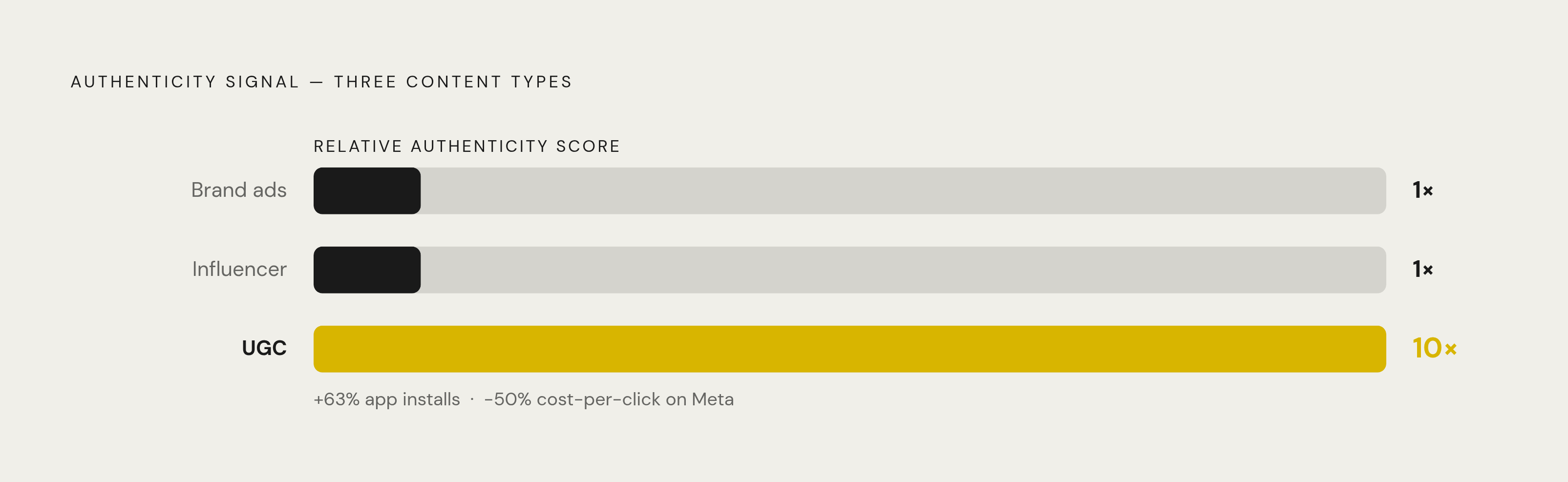
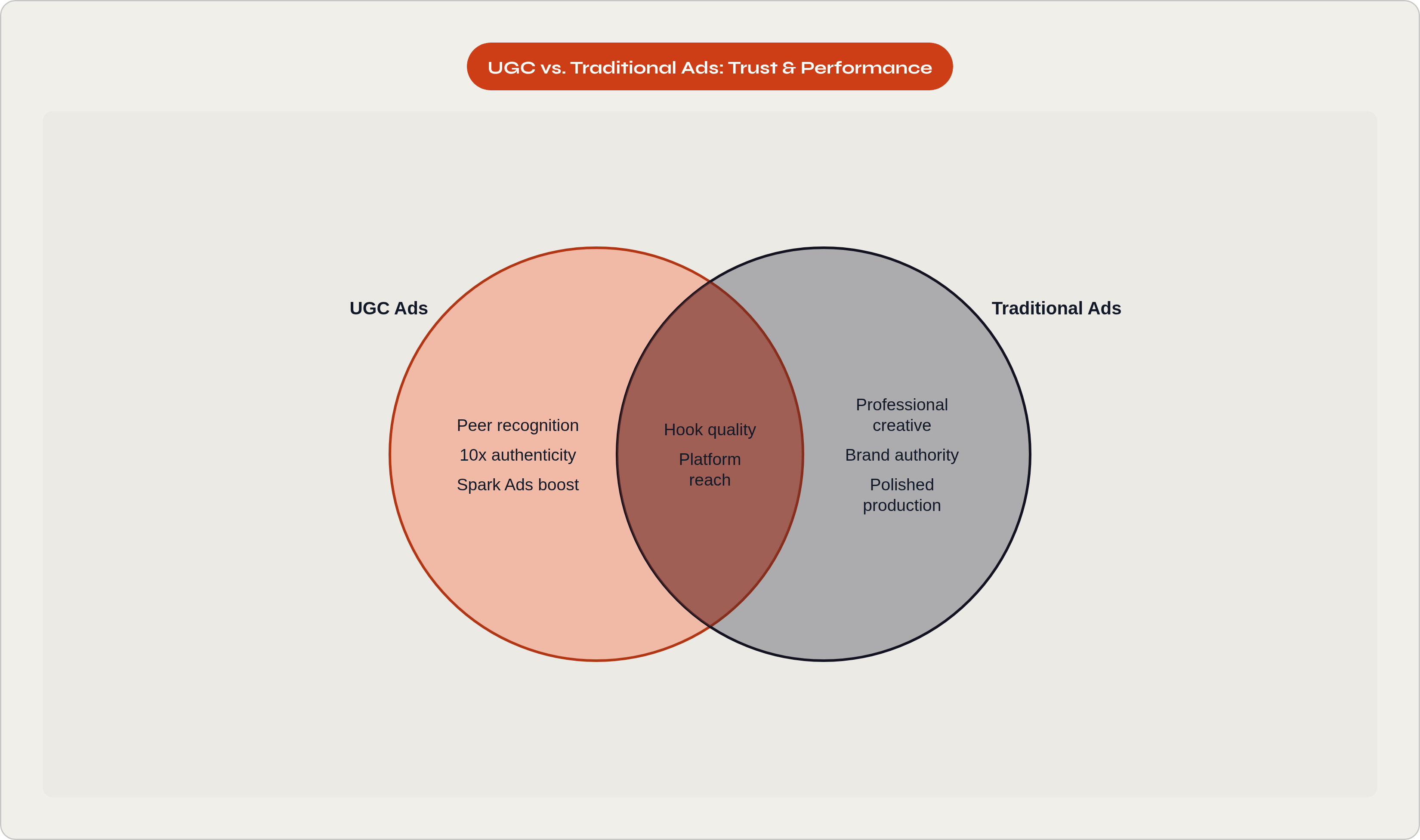
UGC registers as nearly ten times more authentic than influencer content, which is itself already a step removed from brand-produced advertising. And authenticity here is not a soft concept you paste onto a slide deck. Consumers show a 63% increased likelihood of installing an application after viewing UGC. On Meta platforms, UGC ads achieve a 50% lower cost-per-click than traditional ads. I have watched brands hemorrhage budget on beautifully produced creative that simply could not replicate what happens when a viewer watches someone on screen and thinks, "this person is like me."
That peer-recognition effect is not executional. It is structural. Sharp cinematography and professional color grading cannot manufacture the cognitive signal that fires when a viewer sees someone with their specific frustration, their specific cluttered apartment, discovering something that actually fixed something. UGC earns trust before it earns attention. But what if trust alone is not enough to stop a thumb? That is exactly the question the hook answers — it is what ensures that trust gets activated before the viewer has already scrolled three videos past yours.
How TikTok and Instagram Reels Actually Reward or Punish Hook Quality
TikTok averages a 4.07% engagement rate compared to Instagram's 1.22%. That gap is not arbitrary. It reflects TikTok's discovery-first algorithm, which surfaces content to non-followers based almost entirely on early watch-through and interaction signals. The opening seconds are not a stylistic choice. They are the algorithmic input that determines whether the platform shows your creative to anyone beyond the initial test pool.
Here is the part that took me longer to internalize than I would like to admit: the primary lever for reducing cost-per-install on TikTok is no longer audience segmentation. It is creative quality, evaluated in the first few seconds of every video. A hook that loses viewers early suppresses the entire video's reach, whether you are running it as a paid ad or relying on organic distribution. The platform does not distinguish between the two when calculating early retention signals.
Instagram Reels operates on similar mechanics but demands different executional choices. Sound-off behavior is more prevalent there, so text overlay hooks carry more weight. The same hook that performs on TikTok usually needs to be recut for Reels, not because the underlying structure is wrong, but because platform context shapes how viewers process a first impression. Vertical formats show substantially higher watch-completion rates than horizontal equivalents, which matters because app UGC lives almost exclusively in vertical feeds.
The implication is uncomfortable for people who want a single creative to run everywhere. It is not the hook that is wrong; it is the assumption that one version serves all surfaces. That raises an important question: if every platform demands a different execution, how do you build a hook strategy that scales without rebuilding from scratch each time?
The Four Hook Archetypes That Consistently Convert for App Installs
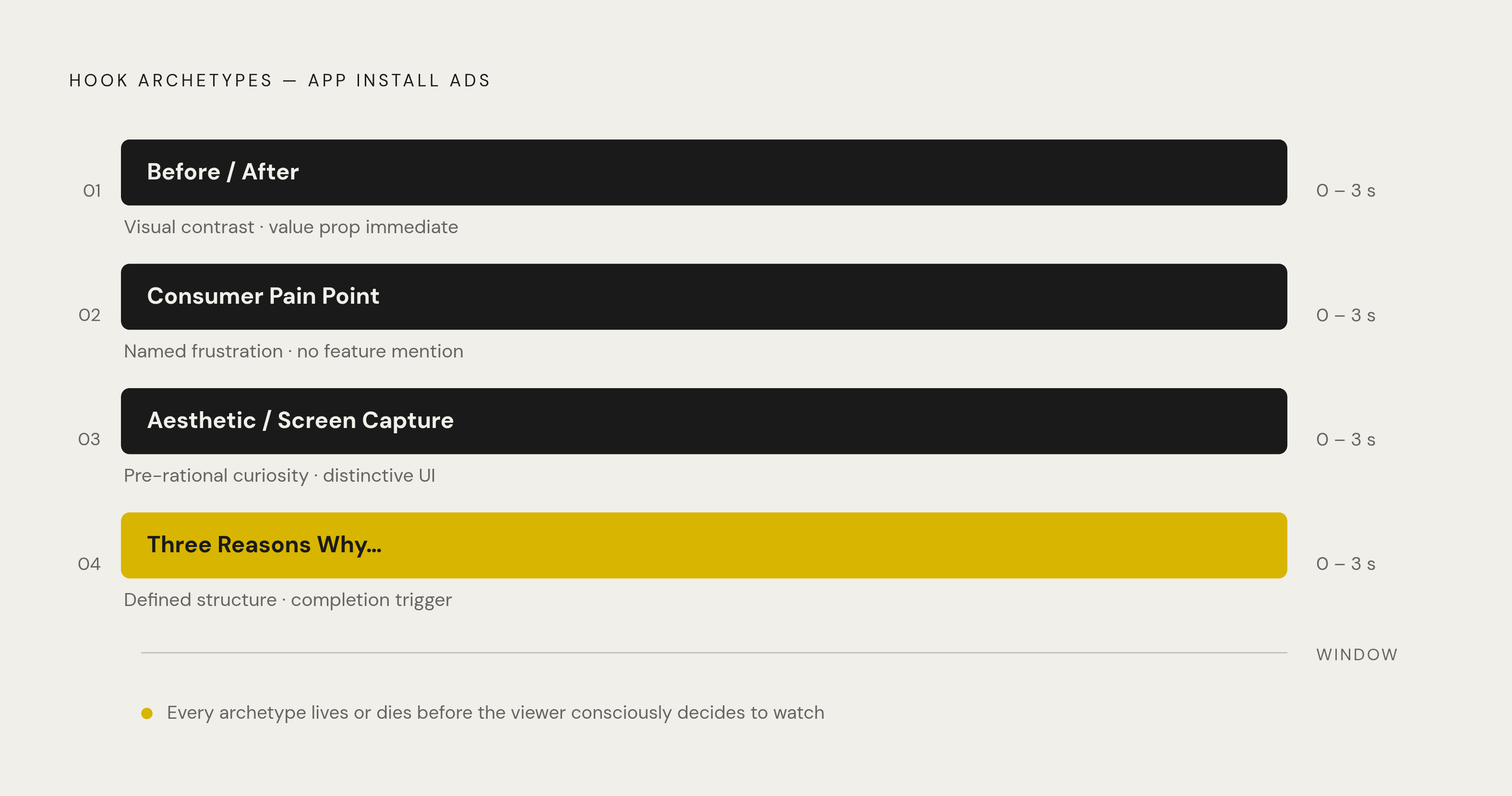
The best-converting hooks land within the first one to three seconds. And the most reliable of them combine a visual element with a verbal or text element simultaneously, because neither alone sustains attention as durably.
Before/After. This archetype compresses the app's entire value proposition into a visual contrast the viewer can immediately map onto their own situation: chaotic finances versus an organized dashboard, a stressful morning routine versus a calm one, a task that used to take an hour taking thirty seconds. It works because the cognitive lift is minimal. The viewer does not have to be convinced of anything; they can see it. The critical caveat for app installs: the "after" state must be achievable within minutes of downloading. Transformation promises that require weeks undermine conversion quality, because the viewer unconsciously calculates whether the result is real.
Consumer Pain Point. This hook opens by naming or dramatizing a frustration the target user already carries. A specific scenario, delivered in the first sentence: "I was spending three hours every Sunday doing something that took me ten minutes once I found this." The emotional precondition for the app's solution to feel necessary, rather than optional, gets established before any feature is mentioned. Specificity is everything here. Generic pain lands far softer than a concrete, recognizable situation.
Aesthetic Product Shot or Screen Capture. For apps, this means a visually compelling screen recording or phone mockup that makes the UI look immediately desirable. The appeal is pre-rational; curiosity drives the watch-through before any claim is made. This archetype performs especially well for apps with distinctive visual identities or satisfying micro-interactions: animation, color transitions, motion that reads as pleasing even on a small screen. The viewer has not yet been told why they want this. They just want to keep looking.
"Three Reasons Why..." or List Format. Signaling to the viewer that the video has a defined structure and a clear endpoint reduces the cognitive cost of committing to watch. For utility apps, productivity tools, finance apps, or learning platforms, the rational case matters alongside the emotional one. The number in the hook functions as a completion trigger. Viewers stay to hear all the items, because the brain dislikes an incomplete set.
Text overlay hooks, bold captions like "I almost deleted this app" or "This saved me two hours a day," extend all four archetypes to sound-off viewers while reinforcing the verbal hook for those watching with sound. None of these archetypes is inherently superior to the others. Performance depends on the app category, target audience, and platform, and the argument for testing multiple is not hedging. It is the actual strategy.
The Discovery-to-Result Narrative Structure That App UGC Hooks Unlock
For app UGC specifically, the underlying narrative structure that consistently holds viewers is: discovery, then feature demonstration, then concrete result. The hook initiates the first beat by making the viewer feel the discovery moment themselves, that particular sensation of someone like me just found something I have not heard about yet.
Why exactly does this work? Because the install decision is made emotionally before it is made rationally. The viewer wants the result before they have evaluated the app. The hook must trigger that emotional beat first, because the rational evaluation, the "let me look this up" moment, only happens if the viewer cares enough to get there.
Storytelling formats hold viewers through the feature demonstration and into the result, which is why user success narratives convert at higher rates than product-centric clips. But the result beat has to be specific and credible. Vague outcomes convert measurably worse than concrete ones: a specific dollar amount saved, a specific number of hours reclaimed, a specific problem with a specific solution. I have seen advertisers spend months testing hooks only to watch their conversions stall at the result beat because the payoff was too abstract to feel real to anyone outside the company that built the product.
The implication for hook writing is direct: the first three seconds must plant a question the rest of the video answers. "What is this app?" "How did they do that?" Retention becomes structural rather than dependent on production quality. The viewer is not watching because the video looks expensive. They are watching because they need to know the answer.
Why Creative Volume and Hook Variation Are as Important as Creative Quality
Most brands find a hook that works, run it until performance collapses, then scramble to find the next one. TikTok ad creative degrades fast; high-performing assets typically see significant decline within roughly one to two weeks. Once ad frequency rises past a certain threshold, conversion rates fall sharply. The same hook shown too many times does not just flatten. It actively damages install rates.
Brands spending meaningfully on TikTok need to introduce several new creative concepts per week to sustain performance. That is a volume requirement that individual creators or small internal teams rarely meet, not because of talent, but because of throughput. I have watched well-funded apps grind their campaigns into the ground this way, not from bad creative, but from insufficient creative cadence.
One approach that practitioners have refined: commission one video per creator, but request multiple hook variations that differ only in the opening seconds. Test all versions simultaneously, identify which hook drives the strongest early retention and install metrics, and use that structure as the template for the next creative cycle. What this process reveals, consistently, is that hook quality is discovered empirically rather than predicted creatively. What feels like the strongest hook in a brief is often not what converts in-market. Sometimes the margin is not even close.
It is also worth considering that TikTok's discovery mechanics make it the more efficient testing ground for hook variation before scaling to Instagram. A TikTok-proven hook structure can be reshot or recut for Reels without starting from scratch; the underlying logic survives the platform translation even when the execution changes.
Turning Hook Performance Data into a Repeatable Install Engine
A viral hook moment is only useful if you understand why it worked. The real capability, the one that compounds over time, is encoding that understanding into the next brief so the cycle starts from a higher baseline rather than resetting from zero.
The metrics that isolate hook performance specifically: two-second and three-second view rates tell you whether the hook itself is holding attention before the rest of the video does any work. CTR functions as a hook proxy when viewed alongside per-platform benchmarks; a hook that consistently beats those thresholds is worth dissecting for structural replication. Install-to-viewer ratio is the most unambiguous signal of all. It distinguishes hooks that entertain from hooks that actually convert.
Running UGC through creator handles via Spark Ads delivers meaningfully lower cost-per-install than standard in-feed placements. The authentic delivery format compounds the hook's trust signal in a paid context, because the viewer sees a person's profile rather than a brand account, and the peer-recognition effect fires before they have registered that it is an ad.
Only 16% of brands have a dedicated UGC strategy, despite widespread recognition of UGC's value. Most find a hook that works once and lack the infrastructure to systematize what they learned. A repeatable system requires three things: structured creative briefs that isolate hook type as a testable variable rather than leaving it to creative intuition; creator relationships capable of producing hook variations on fast turnaround, not one-off engagements; and a feedback loop from paid performance data back into the next round of briefs.
Brands that treat hook testing as a systematic program rather than a series of individual bets accumulate something that is hard for competitors to replicate. The individual hooks are not secret, but the knowledge of which structures work for a specific audience on a specific platform cannot be copied with a single good ad. It builds cycle by cycle, and the gap between brands that have done that work and brands that have not eventually stops looking like a creative advantage and starts looking like a different category of operation entirely.