UGC Strategy for Consumer Wellness Apps on TikTok
Micro-creators outperform mega-influencers for wellness app installs on TikTok.

There is a version of this strategy that looks like a plan but functions like a bet. Hire a creator with a big following, hand them the app, hope the video pops. Sometimes it does. More often, it vanishes into TikTok's testing queue and you're left explaining to a growth lead why half the quarter's influencer budget produced forty-three installs.
What actually works is less glamorous and considerably more durable. It's a system. And wellness apps require a more deliberate version of that system than almost any other consumer category, for reasons that run deeper than aesthetics.
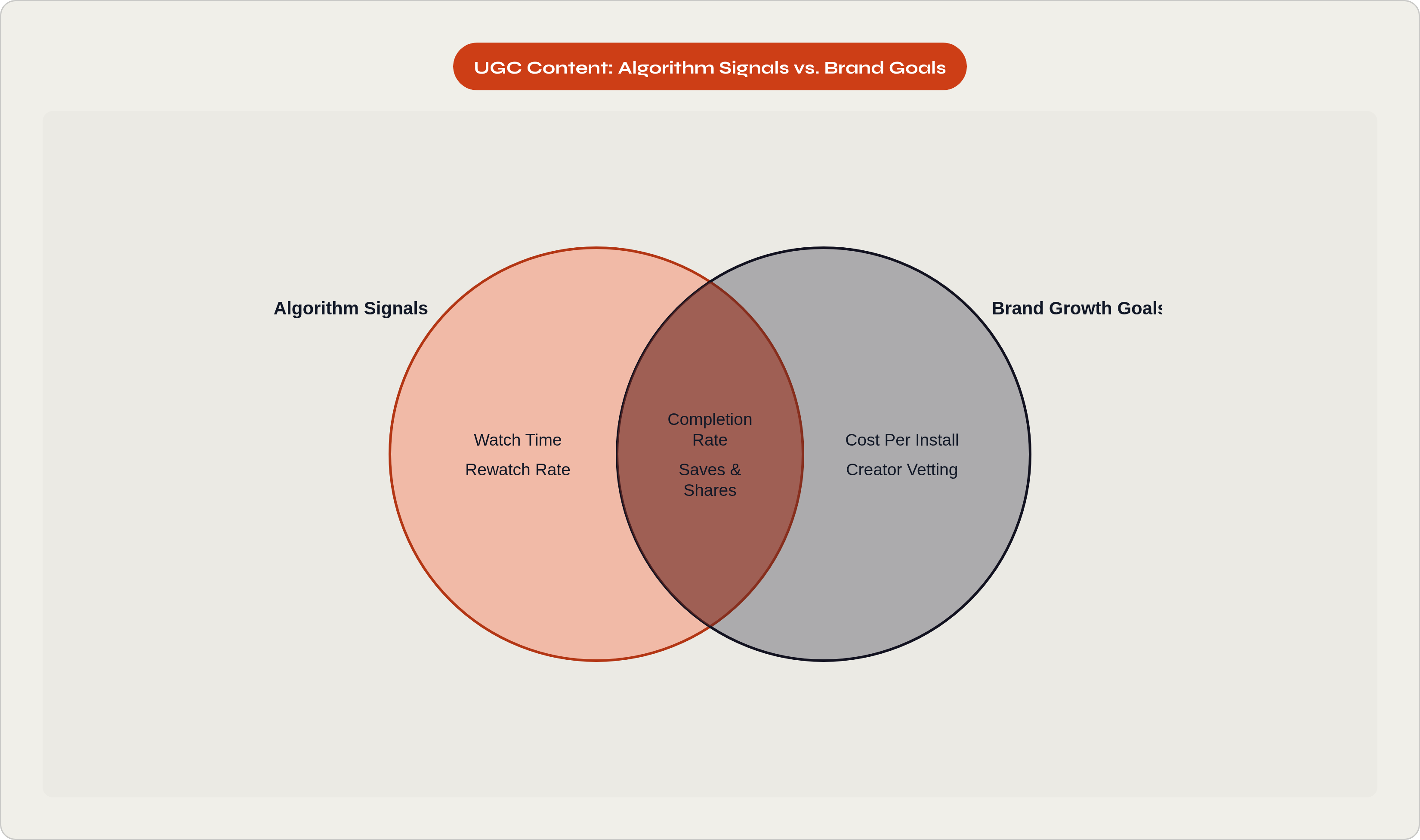
UGC's dominance on TikTok isn't about audiences finding raw video charming. TikTok tests every video on a small initial cohort and expands distribution based on earned engagement signals: watch time, shares, saves, rewatches. Polished branded content doesn't earn those signals. Native-feeling content does. A video that looks like an ad gets skipped. A video that looks like something a real person made about their actual morning routine gets rewatched, shared to a close friend, saved for later. Those behavioral signals tell the algorithm to push it further. Ad spend cannot purchase that expansion. Engagement earns it.
For wellness apps, this creates a native advantage most brands consistently underuse. App features can surface on-screen through green screen or split-screen formats, making the product tangible rather than conceptual. A creator pulling up a sleep tracking dashboard during their wind-down routine is more persuasive than any product description. The viewer sees the thing functioning inside a real life, not a rendered demo environment.
The underlying logic isn't complicated: UGC earns trust because it looks like content, not commerce. On TikTok, that distinction is the difference between being watched and being scrolled past.
The Five UGC Formats That Drive Installs for Wellness Apps, and How to Brief Each One
Format selection in wellness is a strategic decision, not a creative afterthought. Five formats consistently outperform for app installs, each serving a different function in the conversion funnel.
Routine and Habit Content. "My 9pm wind-down," "what I do before bed," "morning pages before coffee." This format is endlessly rewatchable. Viewers save it as reference, return to it, and build familiarity with whatever products appear inside it. The brief here should be intentionally minimal: give the creator the routine hook and let them fill in authentic detail. Over-scripting kills the effect. You want their apartment, their mug, their actual tired voice. You want the app to appear because they use it, or because using it fits the scene. That distinction is usually visible on screen.
Relatable Testimonials with In-Screen App Demo. This format addresses the most common friction for skeptical viewers: does this actually do anything? A split-screen or green screen showing the app's interface alongside a creator explaining what changed for them answers that in real time. Brief these tightly on which specific feature to demonstrate, loosely on how they describe their experience. The feature needs to be visible and functional. The story around it needs to be theirs.
Before-and-After Storytelling. High attention-grab in the first two seconds, when the contrast is genuine. Sleep quality before and after guided meditation. Anxiety baseline at week one versus week six of consistent journaling. Streak tracking that shows someone actually sticking with something. This format requires the most careful briefing in wellness because the "after" must be believable, not a health claim. An exaggerated transformation reads as sponsored content immediately. A modest, specific, plausible improvement is far more persuasive, and far less of a compliance liability.
Day-in-the-Life Content. The app appears as part of a real day, not as the video's subject. This format resonates with audiences in the consideration phase, people who aren't yet sold but are open, because it answers the implicit question: would this fit into my actual life? Brief these loosely. The creator should be making a day-in-the-life video first. The app appears the way any tool they genuinely use would appear: briefly, contextually, without ceremony.
How-To and Educational Content. The fastest-growing format for discovery, because TikTok's search behavior has matured. A large share of Gen Z now uses TikTok as a search engine weekly, and keywords in captions have become more important for discoverability than hashtags. A how-to video titled "how to actually build a sleep routine" with relevant caption keywords reaches people actively searching for that information. Brief these with SEO logic in mind: what is someone searching for that this app solves? Build the video around that query, not around the product.
Across all five formats, certain brief elements are non-negotiable: a clear hook in the first two seconds, sustained engagement rather than front-loaded attention, and one soft mention of the app. Hard selling in the first half of a wellness video kills retention immediately. The category's tone demands a lighter touch, and briefs that ignore that tend to produce content that performs like ads, because functionally, that's what they are.
How to Select and Vet the Creators Who Will Actually Move the Needle
Creator selection is where most wellness app campaigns quietly fail before a single video is shot. The instinct is to reach for the largest audience available. The data points stubbornly in the opposite direction.
Micro-influencers, roughly ten thousand to one hundred thousand followers, are the highest-efficiency tier for most wellness app campaigns. Their audiences remain consistently engaged, costs are a fraction of macro talent, and a fixed budget distributed across several micro-creators typically produces stronger aggregate results than concentrating spend in a single large account. Nano creators, below ten thousand followers, deliver the highest raw engagement rates across social platforms. They're especially relevant for seeding campaigns where volume and authenticity matter more than reach.
Quantitative vetting. Engagement rate is the first filter. For micro-influencers, target the three-to-six-plus percent range. A high follower count with low engagement is a meaningful red flag, not a minor concern. Examine audience demographics carefully: age, location, and interest alignment with the app's actual user base matter considerably, especially given that TikTok's fastest-growing age segment is now the thirty-five-to-forty-four cohort, a demographic reshaping both who wellness content reaches and who should be creating it. Follower authenticity warrants scrutiny: sudden spikes in follower counts, engagement that doesn't match audience size, and audiences concentrated in unrelated geographies signal purchased growth. Comment quality is a fast proxy for real community. Genuine conversations in the comment section indicate a real audience. Emoji strings alone do not.
Platforms like HypeAuditor, Modash, and CreatorIQ surface audience authenticity scores and engagement velocity analysis, moving fraud detection from a manual red-flag process to a systematic filter. At any meaningful creator volume, this infrastructure is not optional.
Qualitative criteria that tools miss. Does the creator's content style align with the app's brand? A creator whose visual identity and tone clash with the product will produce content that feels forced regardless of brief quality. More importantly: does the creator already post about sleep, habits, mindfulness, or fitness? Genuine category affinity produces content audiences can distinguish from a paid placement, and that distinction matters for conversion in ways engagement rate alone won't capture.
Compliance and sensitivity alignment deserves equal weight to engagement rate as a vetting criterion. A creator with a history of exaggerating health outcomes or making misleading claims is a liability, not just a poor performer. The wellness category carries brand safety risk that most app categories don't.
Why Volume and Variety Are Inseparable in a Functioning Wellness App UGC Program
The math here is worth sitting with: only a small fraction of seeded creators will produce content that meaningfully drives installs. This is not a failure condition. It is the nature of the format. It means a large creator pool is a structural requirement, not an aspiration. Volume-based seeding, reaching a consistently large pool of creators each month, is the most reliable mechanism for regularly surfacing top performers.
Volume alone, though, compounds the wrong way if it lacks variety.
A meditation app is relevant to a stressed college student, a new parent, a forty-something managing clinical anxiety, and a professional trying to build a focus practice. Each of those people needs a different creator voice, a different content angle, a different entry point into the app's value proposition. A creator making student-life sleep content and a creator making parenting-and-mental-health content are not competing for the same audience segment. They're covering different ones. Together, they saturate the app's full addressable audience in a way no single creator type, regardless of how well-chosen, can manage alone.
Each creator variation is a different door into the same product. Scaling volume without variety means reaching the same audience repeatedly with the same message, while every other segment remains untouched.
Content cadence matters for the algorithm in a parallel way. Posting consistently across multiple creators several times per week keeps a brand inside TikTok's continuous distribution testing pipeline. A brand that surges content once a month loses algorithmic momentum between those surges. Steady weekly output across multiple creators maintains presence in that testing cycle and compounds learning over time.
The practical way to build toward volume is through a pilot phase first. Start with a small group of well-vetted creators, test how their audiences respond, evaluate brief-following discipline, and establish working relationships before scaling. A pilot campaign functions as a live audition. It surfaces which creator types and which content angles actually convert before the full budget is committed. Long-term partnerships with proven performers then compound in a specific way: repeated content from the same trusted creator builds audience familiarity with the app, making their recommendations read as credible advocacy rather than contracted promotion.
The Metrics That Distinguish a Performing Wellness App UGC Program From One That Just Produces Content
Cost per install is the north star. Not views, not likes, not follower reach. If the program goal is app growth, CPI is the metric that tells you whether it's working.
Completion rate is the leading indicator that predicts whether CPI will be achievable. The threshold for triggering meaningful distribution has risen sharply, meaning hooks and pacing need to be tighter than most brands assume. Videos achieving strong six-second view rates consistently show stronger conversion performance than high-view-count videos with low completion, regardless of total impressions. Rewatch rate is a particularly powerful signal in wellness content: a viewer rewatching a morning routine video or a journaling how-to is demonstrating intent, not passive consumption, and that behavioral signal carries real algorithmic weight.
Saves and shares outweigh likes in TikTok's current algorithm. Wellness content that gets saved as a reference is algorithmically more valuable than content earning passive double-taps. This should directly inform brief structure: routine content, educational explainers, and how-to formats are specifically designed to be saved, and they serve the algorithm as directly as they serve the viewer.
There is a trap worth naming: the view-to-install disconnect. A creator with millions of views will drive a fraction of the installs produced by a creator with a much smaller but highly engaged audience. Without tracking installs and conversion at the creator level, there is no way to identify real performers, explain why they work, or replicate what they're doing. Views feel like a signal because they're visible and satisfying to report. They are not a conversion metric.
TikTok's engaged view attribution window, which credits conversion to content that earns a genuine six-second-plus view within a seven-day window, means completion rate functions as a proxy for conversion probability. The algorithm and the conversion funnel are, in a sense, measuring the same user behavior from different angles.
At high creator volume, manual tracking breaks down entirely. Winners don't get scaled. Underperformers bleed budget. The signal disappears into a spreadsheet nobody has time to maintain. A tracking infrastructure built for the actual scale of the program is a prerequisite for the program to improve over time, not a nice-to-have once the budget grows.
How TikTok's Algorithm Actually Tests and Distributes Wellness Content, and What That Means for Creative Decisions
Every new video enters a batch testing system. TikTok shows it to a small initial cohort, measures engagement signals, then either expands distribution to successively larger audiences or deprioritizes it. Virality is earned incrementally through successive distribution rounds, not awarded at upload. A hook that fails in the first batch kills distribution before the rest of the video can land. The first two seconds are not a creative preference. They are an algorithmic requirement.
TikTok's current algorithm applies what Hootsuite's Social Trends 2025 Report describes as "micro-virality": content is served to specific interest communities before broader audiences, routing related content to users who engage with similar material. For wellness apps, this is structurally favorable. Content about sleep hygiene or habit tracking reaches the audience predisposed to act on it before being tested with a general audience. Keywords in captions and relevant audio choices help the algorithm classify content correctly for that initial interest-community push.
The algorithm also now shows content to a creator's existing followers before non-followers, which changes how creator selection affects seeding. The community quality of a creator matters for the initial batch performance of a new video. A creator with a highly engaged, wellness-aligned follower base seeds a video's first distribution batch with the highest-quality possible initial audience, which gives the engagement signals more predictive value for whether the algorithm should expand reach.
The practical implication for creative decisions: design content to earn micro-community engagement first. A meditation video that earns saves and shares within the wellness interest community will compound within that community. It doesn't need to break into a mass audience to generate installs. The mass audience can follow later, if the micro-community engagement earns it. Chasing broad reach from the first batch is, in most cases, the wrong objective.
Building the Creative Iteration System That Turns One Good Video Into a Repeatable Growth Engine
A single viral post that the brand can't explain or replicate is a lucky moment. It feels like traction and produces little of lasting value. A system that identifies which hooks, formats, creators, and content angles drive installs, and then replicates and iterates on those elements at volume, is a growth engine. The difference between the two is documentation and process, neither of which is exciting, both of which are decisive.
The iteration system has a few core components.
A creative database, first: every produced video tagged by format type, creator tier, content angle, hook style, and audience segment targeted. This is not optional overhead. It's the institutional memory of the program. Without it, the same mistakes recur in the next creator cohort because no one can remember what the last cohort already demonstrated.
A performance review cadence built around completion rate and CPI at the creator level, second. Not monthly. Weekly, or as close to it as the volume supports. The goal is to identify what's working before it stops working, not six weeks after.
A signal-to-brief feedback loop, third. When a specific hook style performs above benchmark, the brief for the next cohort updates to reflect that. When a content angle underperforms consistently across multiple creators, it gets deprioritized. The brief is a living document, not a template that calcifies into habit.
A scaling protocol for top performers, fourth. When a creator produces content that performs meaningfully above CPI benchmark, the next step isn't to celebrate it. It's to brief them again quickly, increase their content volume, and test variations of what made the first video work. Long-form partnerships compound in ways that one-off wins cannot. A familiar creator appearing repeatedly in a viewer's feed builds a kind of ambient credibility that is genuinely difficult to manufacture any other way.
The system produces compound returns because each iteration improves the brief, each improved brief produces better content, and each better-performing piece contributes more signal to the next round of creator selection. Over time, cost per install trends down. The creative library deepens. What began as a guess about what would resonate becomes, gradually, something closer to a working theory, tested and revised in real time.