UGC Program Scaling Roadmap from 5 to 50 Creators
Validate your pilot's foundation before doubling down on creators and complexity.

Scaling a broken pilot doesn't fix anything. It produces more broken content faster, at greater expense, with more stakeholders watching. I've seen this happen to brands that had every reason to succeed: good product, real budget, engaged team. They just moved too fast, and what they scaled was the dysfunction.
The precondition for scaling is a validated foundation, and validation is more specific than "the content is live and the team feels good about it." But what if you skipped that validation step and moved straight to growth? That's exactly where most programs quietly break.
At five creators, three things should already be demonstrably working. First, at least one content format has produced measurable conversion lift. Not engagement, not impressions. A downstream action you can trace to a specific asset. Second, your creator selection was intentional: you reviewed for platform fluency, hook construction, and brief compliance, not just aesthetic quality or vibe. Third, a feedback loop exists. You know which creator made which asset, and you can follow that asset into its paid performance. If that traceability is missing, you don't have data yet. You have content.
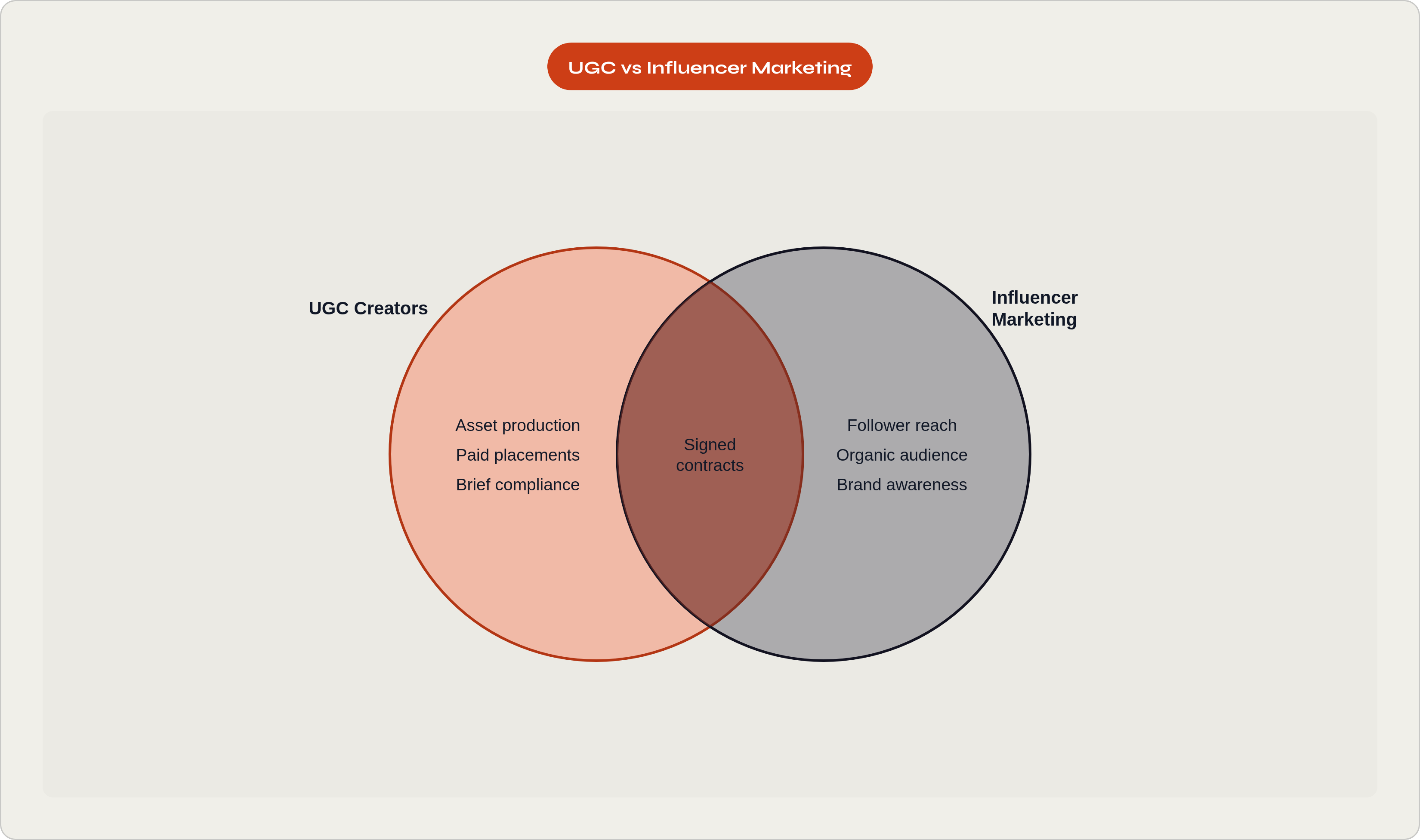
The UGC-versus-influencer distinction matters here, and it's worth naming plainly. At this stage, you should already be treating UGC creators as content producers, not audience holders. Follower count is irrelevant. The deliverable is the asset, and the asset's job is to perform in paid placements, not to reach the creator's organic following.
Signs a pilot is actually validated: you've identified at least one format that outperformed the others, whether that's a first-impression reveal, a direct-to-camera testimonial, or a before-and-after transformation. Your revision rate per creator is low, meaning creators are hitting the brief without heavy back-and-forth. Usage rights are locked in signed contracts, not assumed informally because the relationship feels friendly.
If those conditions don't exist, the operational infrastructure in the next section won't save you. It will just give you a more organized way to produce content that fails to convert.
The Operational Infrastructure That Must Exist Before the Roster Doubles
Here's a thing I've watched happen more than once: a brand's UGC pilot goes reasonably well, someone in leadership says "let's double the roster," and within six weeks the person managing the program is drowning. Not because they're bad at their job. Because the systems that worked for five creators were never actually systems. They were habits, muscle memory, and a lot of manual effort made invisible by sheer familiarity.
The moment you move from five to ten or fifteen creators, two things that previously lived in one person's head have to be formalized: the brief and the workflow.
The standardized creative brief is the single most consequential document in a scaled UGC program. Every creator needs the same core inputs: product positioning, platform target, hook format, tone, required claims, and prohibited language. Include explicit examples of approved and rejected hooks. Brief compliance is a leading indicator of creator quality; it tells you more about future performance than a polished portfolio does. A brief that feels self-explanatory to your internal team will frequently confuse a creator who has never worked with your brand before. That gap shows up in revision rates before it ever shows up in performance data.
Workflow infrastructure means a project management layer, Notion, Airtable, or a purpose-built creator platform, that tracks brief status, submission dates, revision rounds, and approval stage per creator. You also need defined SLAs: the creator has a set number of days to accept a brief, a set number of days to deliver a first draft, and a defined window for revision turnaround. Beyond a modest number of active creators, tooling is not optional. It's how the work gets done without proportional headcount increases.
Contracts and payments are where programs quietly fracture. At five creators, informal arrangements have survived. At fifteen or more, every creator needs a signed contract covering deliverables, usage rights, exclusivity windows, and payment terms before work begins. Usage rights are especially critical: paid whitelisting and asset repurposing require explicit rights grants. You cannot patch this retroactively after an asset performs well. Payment systems need to handle volume with structure, tracked per creator, not processed in one-off transfers that someone has to remember to initiate.
These systems feel like overhead until the moment they're absent.
How to Vet and Onboard Creators at Volume Without Letting Quality Drift
Manual creator discovery works occasionally at small scale. Browsing hashtags, scouring open marketplaces, asking around in community Slack channels. It doesn't scale to thirty or fifty creators without becoming someone's entire job, and a deeply unproductive one at that.
At volume, structured vetting means using platforms with pre-screened creator pools. The platform absorbs the first layer of quality filtering. The commission fees these platforms charge are not a luxury cost; they're the cost of avoiding that filtering process manually. A creator who delivers quality on one brief is already in the system for the next.
What you're actually evaluating in a portfolio at this stage comes down to a few specific signals. Platform fluency: does the content feel native, with quick cuts and conversational delivery, or does it feel ad-like and over-produced in a way that reads as a commercial? Hook construction: do they capture attention in the first three seconds? Brief compliance history: any signal that this person follows direction, not just that the finished product looks good. And communication cadence, because a creator who goes quiet mid-brief breaks the entire production tempo.
Some early warning signs warrant a quick cut rather than extended management: consistent late delivery, repeated brief misses that require heavy revision, passive communication that forces the brand team to chase. These patterns rarely improve at volume. They amplify.
On economics: micro-creators with smaller, niche audiences frequently deliver engagement per dollar that outpaces macro influencers by multiples. I've seen brands discover this the hard way after routing significant budget toward creators with large followings and underwhelming conversion rates, then quietly shifting back to a roster of unfamiliar names with deeply engaged, niche communities. At volume, that per-dollar efficiency compounds across the roster in ways that make a real budget difference over a quarter.
Onboarding should be systematized, not bespoke. New creators receive the same brief template, the same SLA expectations, and the same feedback structure as everyone else. High-performing creators do warrant some distinction, more creative latitude, better briefs, earlier access to new products. But core process should be consistent. Bespoke treatment extended too broadly creates inconsistency in output and expectations that you'll feel downstream in revision rates and production timelines, usually sooner than you expect.
Maintaining Creative Quality and Format Diversity as Output Volume Grows
A team shipping five fresh UGC variants per week will outperform a team shipping one polished creative spot per month, even if the polished spot peaks higher on any individual metric in a given week. Creative refresh velocity is a durable structural advantage of a scaled UGC program. The challenge is sustaining it without devolving into a content mill that technically ships volume but produces nothing worth amplifying.
The structural enemy here is creative fatigue. On Meta and TikTok, ad performance degrades within days of reaching scale. The program needs a continuous supply of net-new formats, not just net-new creators cycling through the same hook structure on rotation. More creators running the same format does not solve fatigue; it just accelerates it.
Format diversification means mapping your roster to format types rather than treating all creators as interchangeable. Some are strong at first-impression reveals. Others excel at direct-to-camera testimonials, at tutorials, at before-and-after structures. Your briefs should reflect the platform target explicitly. A brief written for a YouTube Shorts placement should look different from one written for TikTok's For You Page, and both should look different from a brief written for Meta feed placements. These are not interchangeable surfaces, and creators who understand one don't automatically understand another.
Lo-fi content is a deliberate production choice, not a cost-cutting shortcut. Unedited smartphone video and behind-the-scenes footage frequently outperforms heavily produced content because platform audiences have become sophisticated at identifying and scrolling past anything that reads as advertising. That raises an important question for most brand teams: if the content that looks less expensive often converts better, why does the instinct to polish persist? The answer is usually internal optics rather than performance logic. Authenticity is a production quality and a conversion lever, not just an aesthetic preference.
Quality control at volume comes back to the revision rate metric tracked in your workflow system. A rising revision rate is a leading indicator of brief drift or creator fatigue. It surfaces before any of it shows up in ROAS. Do not wait for performance to decline before diagnosing the production layer.
The Performance Measurement System That Tells You Which Creators and Formats to Scale
The most common measurement mistake at scale is tracking UGC performance inside organic social dashboards, where engagement is the primary signal. Likes are easy to report and nearly impossible to bank.
A scaled UGC program is a performance asset. It should be measured like one.
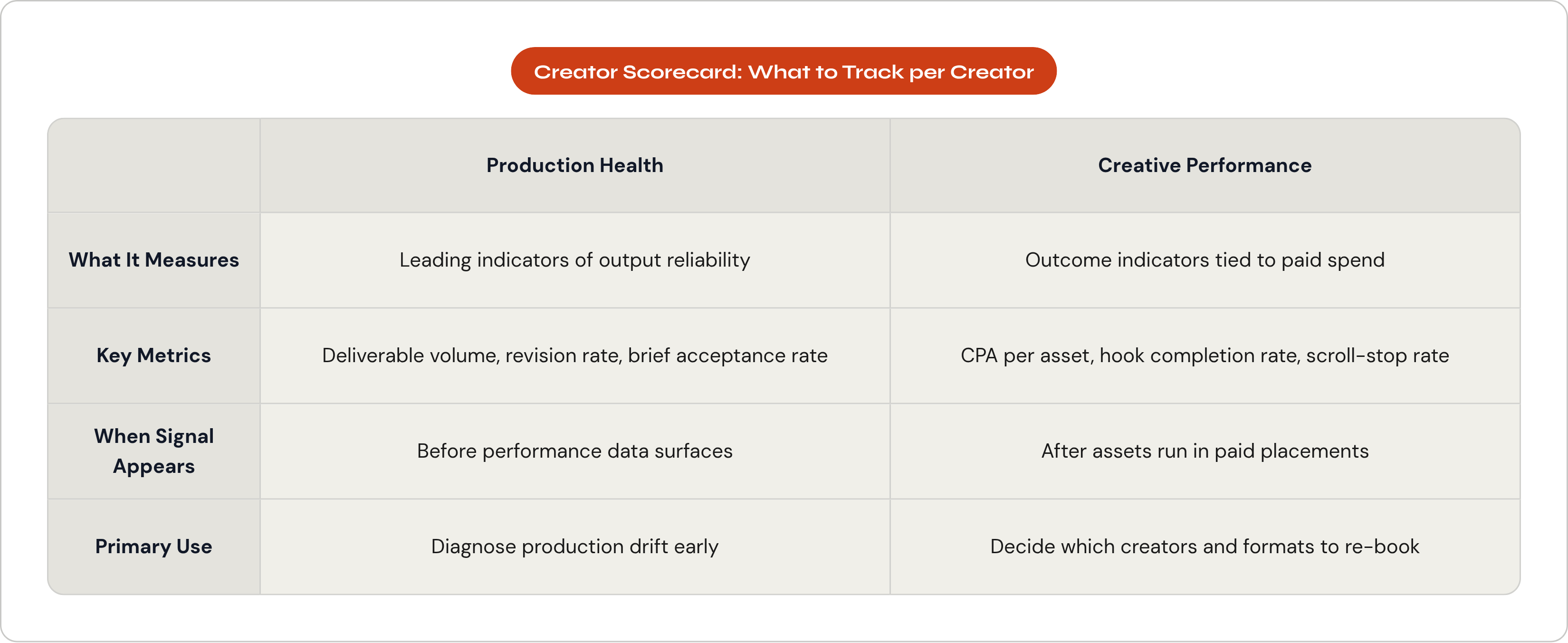
The right KPI hierarchy separates production health from creative performance. Production metrics are leading indicators: volume of assets delivered per week, time-from-brief-to-launch, revision rate per creator, creator acceptance rate on briefs. Performance metrics are outcome indicators: cost per acquisition at the creative level, segmented by creator type, format, and hook style. That segmentation is what lets you actually identify what produced a result, rather than reporting aggregate numbers that obscure everything interesting.
The creator scorecard is the instrument that makes this actionable. Every creator on a scaled roster should have a running record: deliverable volume, revision rate, CPA of their assets in paid media, hook performance measured by completion rate and scroll-stop rate. Brands that maintain scorecards and use them to re-book high performers and release underperformers consistently compress UGC CPA over time without changing platforms or budgets. The patterns that distinguish high-performing creators also feed directly back into brief templates, which improves the whole roster's output over successive cycles. It's a compounding loop, and it's one of the more satisfying things to watch work in practice.
Attribution infrastructure must connect creator output to paid outcome at the individual asset level: UTM parameters tied to creator IDs, platform-native conversion tracking through partnership ads, multi-touch attribution tools for cross-channel visibility where direct attribution is incomplete. Brand search lift as an upper-funnel signal when last-click models miss the full picture.
Track time-from-brief-to-launch and variants tested per week alongside your revenue metrics, not separately from them. These are leading indicators of where CPA is headed.
How Whitelisting and Paid Amplification Turn the Best UGC Into Performance Assets
Organic reach is not the goal of a scaled UGC program. The goal is identifying which assets convert, then deploying paid spend behind them with precision. Organic is a testing mechanism. Paid is where the program earns its budget.
Whitelisting is the mechanism: the creator grants the brand permission to run paid ads from the creator's account or via partnership ad units, so the content appears personal and native while the brand controls targeting, budget, and optimization. Content served from a creator's handle reads as earned rather than bought. It earns lower CPMs, higher relevance scores, and stronger engagement signals that feed the platform algorithm.
One might argue that running paid ads from a creator's handle undermines the authenticity that made the content effective in the first place. It's a fair challenge. But platform audiences, in practice, respond to the format and voice, not to the disclosure of media spend behind a placement. Authenticity in this context is a production quality. It lives in how the content was made and how it sounds, not in whether a dollar was spent to extend its reach.
The paid amplification decision framework is not complicated: not every asset earns paid spend. The creator scorecard and CPA-level data determine which assets get amplified. Run organic first as a low-cost test, then promote what the data confirms, not what looks the most polished in a review meeting. Those two things are frequently not the same, and the review meeting has a way of winning the argument unless you've built the habit of deferring to the data.
At scale, variant testing becomes a genuine advantage. Once a winning format is identified, paid amplification can test multiple hook variations, CTA framings, and creator profiles against the same audience simultaneously. A five-creator program cannot do this meaningfully. A fifty-creator program, run on the infrastructure above, can do it as a matter of routine.
The contractual prerequisite bears repeating because it's where programs get burned: whitelisting rights must be secured before production begins. Retroactively negotiating access after an asset performs is slower, more expensive, and sometimes simply not achievable.
Managing a Roster of 30–50 Creators Without It Consuming the Brand Team
At thirty to fifty active creators, relationship management is no longer personal. It has to be systematized without becoming cold, because creator motivation and content quality are directly connected. A creator who feels like a ticket in a queue produces content that feels like a ticket in a queue. I have seen this firsthand, and the degradation is gradual enough that it's easy to miss until the revision rates are already climbing.
The retention argument is operational, not sentimental. A creator who has delivered quality work across multiple briefs already knows your brand, your tone, your brief format. Re-booking high scorers is cheaper, faster, and more creatively consistent than constantly refreshing the roster with new names who require the full onboarding cycle. Treat retention as an efficiency strategy.
What keeps creators engaged is less complicated than most brand teams assume. Prompt, reliable payment is the baseline; nothing signals disorganization, or disrespect, faster than late payment, especially at the micro-creator level where individual payments represent real money. Specific feedback after every submission, not just approval or rejection but what worked and what to adjust, improves the next submission and signals that the brand is a professional partner worth prioritizing. Recognition costs nothing: acknowledging standout work publicly in brand channels or in creator community spaces increases participation and effort in ways that contract incentive clauses rarely replicate.
A program that scales gracefully from five to fifty creators is not the one with the most creators or the largest production budget. It is the one that treated infrastructure as a prerequisite rather than an afterthought, built its creative systems before it built its roster, and measured performance at the granularity required to know what to do next. That work is largely invisible when it's done well. The content just keeps coming, the data keeps accumulating, and the program keeps getting cheaper to run per conversion. Agencies like Pebble, a data-driven creator marketing agency that runs high-volume, creator-led organic campaigns on TikTok and Instagram for consumer brands, exist precisely to own that infrastructure layer so brand teams never have to build it from scratch. That's the compounding dynamic that makes a UGC program valuable over time, and it doesn't happen by accident.