Quality Control Systems for Large UGC Creator Rosters
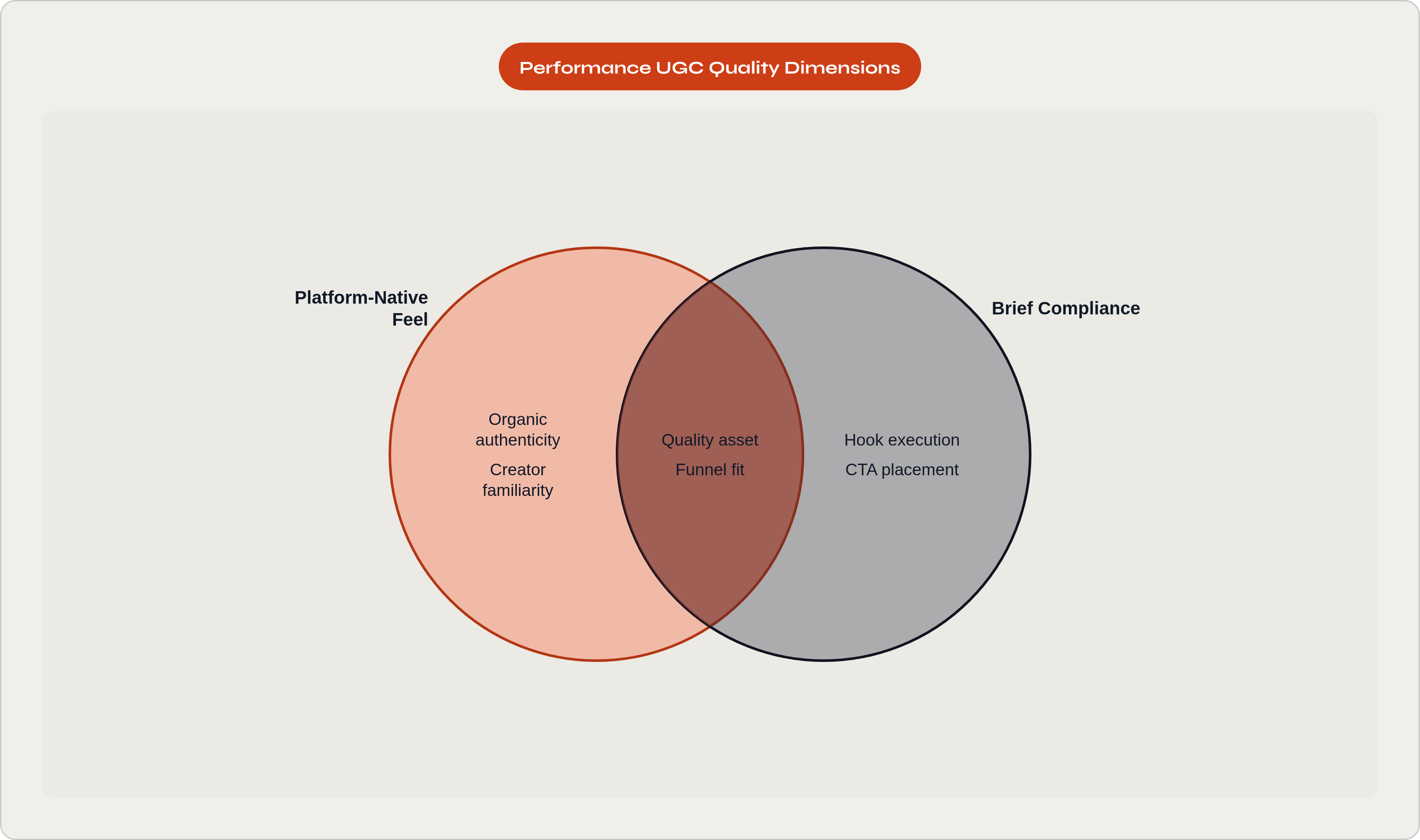
Platform-native feel and brief compliance both matter equally for performance UGC quality.

Most teams building UGC programs get quality wrong from the start: they treat it as a production value question. Does it look good? Is the lighting decent? Is the creator presentable? Those are reasonable instincts for brand advertising. For performance creative, they are almost entirely beside the point, and building a QC system around them means you are measuring the wrong thing from the start.
I watched a well-funded program spend six months optimizing for visual polish and then wonder why their CPAs kept climbing. The content looked good. It just didn't behave like anything a real person would post, and audiences on TikTok and Reels have a finely tuned radar for that distinction. Polish was crowding out the signal.
Quality in performance UGC has two dimensions, and both have to be present simultaneously. The first is platform-native feel: the content behaves the way real people's content behaves on that channel, earning attention through relevance and familiarity rather than production value. The second is brief compliance, the structural layer: correct hook execution, accurate product claim, proper duration, call to action in the right place. One without the other is a partial asset. A charming video that ignores the brief is not a quality asset. A technically compliant video that feels like a banner ad from 2011 fails on the other dimension entirely.
What complicates this further is that the quality bar shifts depending on where in the funnel the asset lives. At the top, where the job is to stop a scroll and earn two more seconds, hook rate and hold rate are what matter. In the middle, where someone is being asked to trust a brand they have encountered once, testimonial specificity and credibility carry the load. At the bottom, problem-solution clarity and CTA strength are the variables that actually move conversion. A slightly rough, imperfect clip that closes bottom-funnel traffic outperforms a polished, engaging video that doesn't, by the only standard that ultimately counts.
It is also worth considering a fourth dimension that rarely gets its due: creative fatigue. Even technically compliant, platform-native content loses value when the same angle or creator setup repeats too often. Audiences habituate. Hook rates decline. This is a quality dimension, not a scheduling detail, because it affects performance outcomes directly. A QC system that ignores it will eventually optimize a program into a kind of creative monotony that the data confirms only after the damage is done.
I lead with all of this before getting to process because you have to define quality in writing before you review a single asset. Without a documented standard, feedback becomes subjective, and subjective feedback cannot be applied consistently across a roster of any meaningful size. Build a scoring rubric. Assign numeric thresholds to each dimension so two different reviewers evaluating the same piece arrive at the same conclusion. That sounds fastidious until you are managing fifty creators and three coordinators and realize that everyone has quietly been applying their own personal standard for four months.
Intake standards that screen for fit before a brief is ever issued
The most persistent quality control failure in large UGC programs does not happen during review. It happens before the first brief is ever sent. A creator gets onto the roster who was never actually a fit, and no downstream review process, however thorough, can fully compensate for that initial selection error. You can catch bad assets and reject them. You cannot recoup the brief cycles, the feedback rounds, and the operational drag of managing someone who should never have been onboarded.
The first intake layer is audience authenticity, not follower count but engagement quality and follower legitimacy. Follower count is a vanity signal; engagement patterns and follower composition are substantive ones. A creator with modest reach and genuine audience alignment will consistently outperform one with inflated numbers and hollow engagement, and conflating the two at intake is a cost that compounds.
The second layer is geographic and language alignment. This sounds obvious, and it gets caught far too late in most programs. A creator producing English-language content whose audience is concentrated in a geography where the product does not ship is a reach problem wearing the costume of a creator relationship.
Third, sub-niche fit. Not "fitness" as a category, but something three levels more specific: high-protein cooking for endurance athletes, or recovery-focused content for people who train daily but are not competitive. Purchase behavior and tolerance for sponsored content vary enormously within broad verticals, and creators who feel native to a specific sub-community outperform generalists in performance contexts.
Fourth, past brief performance. For new creators, this means requesting campaign screenshots or performance case studies. For returning creators, it means using first-party data from prior work. Not gut feel; direct evidence that they can execute a performance brief rather than just produce content that looks compelling in isolation.
Fifth, brand safety, which includes content history but also something that resists easy systematization: how they handle revisions, how they respond to feedback, whether they are straightforward to work with at small scale. A creator who is difficult at low volume becomes operationally expensive at scale in ways that rarely surface in the metrics but are felt acutely by every person managing them.
For paid social specifically, there is an intake check that gets skipped more often than it should: not every creator who produces strong organic content can execute a performance brief. The skill sets are related but distinct. Screen explicitly for brief-following track record, file delivery reliability, and revision history. A creator who consistently requires multiple revision rounds per asset is a capacity drain that compounds badly when you are running dozens of them simultaneously.
At fifty or more creators, manual vetting through every layer for every applicant is not viable. Automate the first three layers using platform tooling that aggregates audience quality, geographic data, and niche signals without human review. Reserve human evaluation for the fourth and fifth layers, where judgment is irreplaceable.
The most underutilized intake tool is the test brief: a small, paid deliverable before full onboarding. It is the cheapest quality control investment in the entire program because it produces direct evidence of whether a creator can follow a performance brief before you have committed to anything longer-term. What that test deliverable reveals is worth considerably more than what it costs to commission.
Brief compliance checks as the first review gate after submission
When a creator submits an asset, the instinct for most creative teams is to evaluate it holistically: watch it, feel it, decide whether it works. That instinct is not wrong, but it should not be the first thing that happens. The first gate should be structural. Does this asset comply with the brief?
The reason for that sequencing is practical. Compliance review is the most objective layer in the entire QC system, which means it is also the cheapest to run. A coordinator with a checklist can do it. It requires careful reading and a functioning document rather than creative judgment. Duration. Hook execution within the first two to three seconds. File specifications: aspect ratio, resolution, audio quality. Claim accuracy, particularly in categories with legal or regulatory sensitivity. CTA presence, phrasing, and placement. Brand visual compliance.
Running compliance review before creative review keeps creative directors and strategists out of work that does not require them. Creative evaluation is expensive in attention and judgment. Spending it on assets that fail a basic compliance check is a misallocation, and at scale it becomes a meaningful drag on the capacity the program actually needs.
Compliance failures on first submission are a signal, not just an inconvenience. A creator who misses the hook requirement on their first delivery is showing you something about how they read briefs. That information matters and should be tracked by creator over time, not addressed as an isolated correction. First-submission compliance rates, tracked across the roster, become a leading indicator for performance gating decisions later in the program.
One might argue that the brief itself is a QC instrument. Vague briefs produce vague content, not because creators are careless but because ambiguity invites interpretation, and fifty creators interpreting the same brief will produce fifty different creative directions. A structurally specific brief—one that defines hook format, required claims, duration, CTA language, and file specifications without room for interpretation—reduces revision cycles across the entire roster. That return is large and persistently underestimated.
Iterative feedback loops that raise the roster's average output over time
Compliance checks find problems. Feedback loops fix them. Most programs have invested in the former without the latter, which means they are catching errors but failing to close the gap between current performance and what the roster is actually capable of. That gap, across a large roster over time, is not trivial.
Effective feedback at scale has specific characteristics. It is tied to brief requirements rather than subjective impression. "The hook didn't name the problem within three seconds" is actionable. "Felt a bit slow" is not. It is delivered promptly, because feedback on an asset a creator submitted three weeks ago has diminished utility; they have moved on, mentally and practically. And it is documented in a creator record so that patterns accumulate and become visible, rather than each interaction feeling like a fresh incident.
Beyond correcting errors, a well-functioning feedback system shares winning assets with the full roster as positive reference points. When a hook format produces strong performance, when a particular testimonial structure generates hold rates that outperform the account average, distributing that example to the broader creator pool raises the floor for everyone. Creators are pattern matchers. Show them a working pattern and many of them will adapt it without being explicitly told to.
Feedback should also push for angle diversity within individual creators. One creator can legitimately produce multiple distinct takes on the same product: a routine simplicity angle, a texture and sensory experience angle, a problem-framing angle. When the same creator keeps producing the same basic angle across multiple deliveries, the feedback loop is not working. Angle repetition is also a creative fatigue risk, which connects directly to performance decline even when technical compliance is intact.
There is a longitudinal benefit here that gets underweighted: creators who receive structured, data-referenced feedback improve faster and stay on rosters longer. Roster churn is expensive. Every creator you replace requires another intake cycle, another onboarding, another test brief. The feedback loop is not only a quality mechanism; it is a retention mechanism, and the program economics of treating it that way are meaningful.
Performance-based culling and the metrics that decide who stays on the roster
A roster without a culling mechanism grows indefinitely. A roster that grows indefinitely without selectivity pulls quality toward its average rather than its ceiling, because underperforming assets dilute the signal from strong ones, consume operational capacity, and make it progressively harder to identify what is actually working.
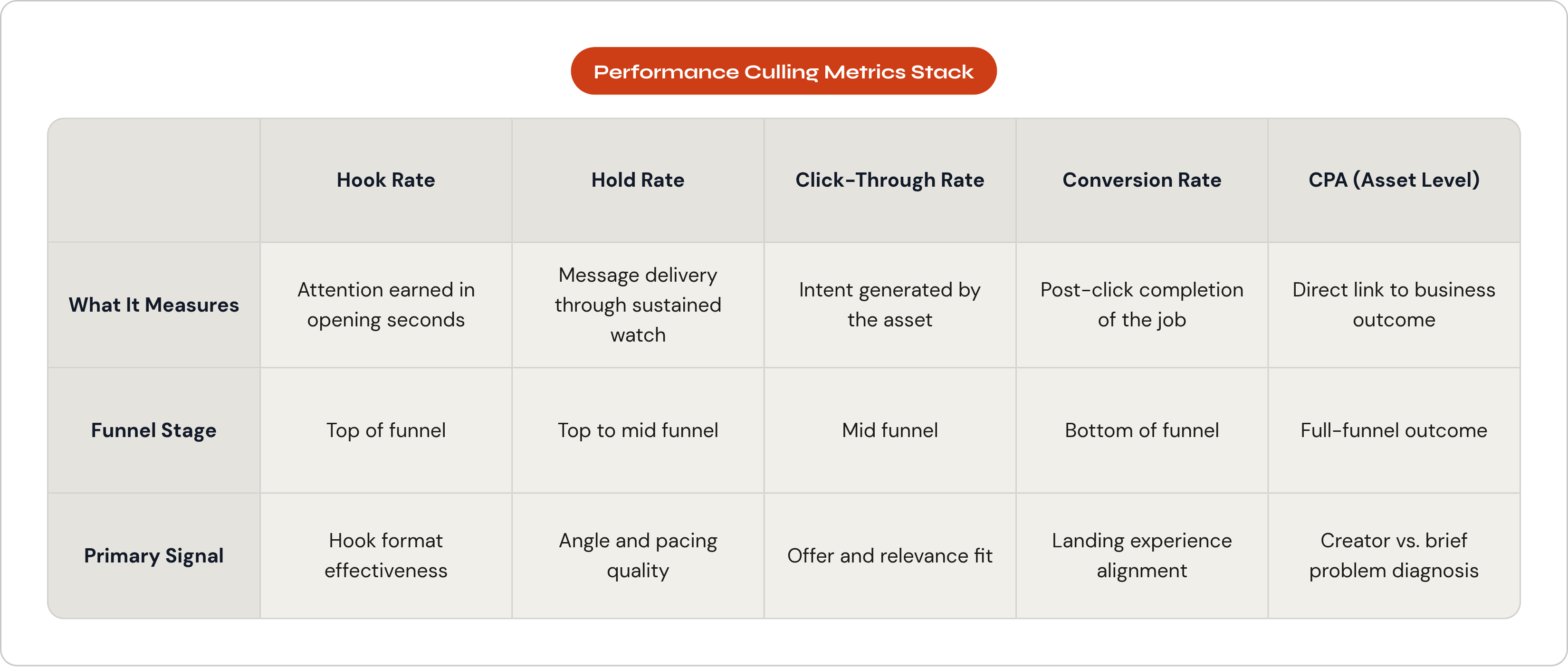
The metrics that drive culling decisions form a stack: hook rate, which tells you whether the asset earned the first seconds of attention; hold rate, which tells you whether it sustained enough engagement to deliver the message; click-through rate, which indicates whether it generated sufficient intent; conversion rate, which tells you whether the post-click experience completed the job; and cost per acquisition at the asset level, which provides the most direct line from a specific creator's output to an actual business outcome. CPA at the asset level is also what enables meaningful comparison between creator-produced content and other forms of paid media spend.
Define minimum thresholds before onboarding, then review against them after a set number of deliveries. A small sample of assets is not a reliable basis for culling decisions. The threshold review after meaningful volume is where the program gets rigorous.
Before any culling decision, run a diagnostic step: distinguish between a creator problem and a brief problem. That raises an important question—is the underperformance coming from the creator, or from the brief they were given? A creator whose assets consistently underperform on hook rate but who passes compliance review is probably receiving briefs that specify an ineffective hook structure. Check the compliance data first. A creator who passes compliance across multiple asset types but underperforms on CTR and CPA across that range is a fit problem, not a brief problem. The distinction determines whether the right response is a culling action or a brief revision. I have seen programs churn through creators for six months before realizing the brief was the variable that needed fixing.
Culling decisions should also be documented and separated from relationship decisions. A creator who underperforms on a paid acquisition brief may be a strong fit for organic seeding, brand awareness, or a different product line. Documenting the reason for removal means re-evaluation remains possible if program needs shift. Burning a creator relationship when you could redirect it is a resource loss that rarely gets measured but accumulates.
One important caveat on attribution: last-click models systematically undercount creator contribution, particularly for content that operates at the top and middle of the funnel. The same attribution logic you would apply to any channel-level spend decision should apply to creator-level performance assessment. Culling someone based on last-click data alone, when their content is contributing earlier in the decision process, is a measurement error dressed up as a performance decision.
The operational infrastructure that holds all four layers together at scale
Intake, compliance review, iterative feedback, performance-based culling. These four layers only function as a system if data flows between them. This is where most programs fall short. They build the layers in isolation and then wonder why the output does not compound. The data connections have to be deliberate and maintained.
First-submission compliance rates should feed culling decisions. If a creator's compliance performance is consistently low, that is input data for the performance gate, not just a compliance team problem. Performance data at the asset level should feed feedback specificity; you cannot give a creator meaningful direction on angle diversity if you cannot tell them which of their angles produced the strongest hold rates. And intake rubric scores should be revisited in light of actual performance, so future selection decisions are informed by what the program has learned rather than pre-intake assumptions alone.
The tooling layer makes this manageable. Creator platforms designed for UGC workflows handle matchmaking, contracts, payments, and brief-to-delivery logistics, removing administrative overhead from the review process. Multi-signal vetting dashboards automate the early intake layers without manual review for every applicant. The critical link that many programs are still missing is the connection between asset-level creative data and downstream conversion data. Without that link, culling decisions rest on incomplete evidence and the system cannot self-correct.
Human review should be concentrated where it is irreplaceable: brand safety assessment, nuanced feedback conversations, and performance interpretation that requires context the data alone cannot supply. Everything that can be templated, automated, or handled by a coordinator should be. The creative director's attention is finite; a well-designed operational structure protects it rather than consuming it with work that does not require it.
There are program-level metrics that tell you whether the QC system itself is functioning, distinct from whether individual creators are performing. First-submission approval rate across the roster. Average revision cycles per creator. Roster churn rate. The proportion of assets that clear compliance but underperform on business KPIs (because a high rate there signals a brief or angle problem at the program level, not a selection failure). These are system health metrics, and tracking them separately from creator performance metrics is how you distinguish between a program that needs better creators and one that needs better briefs.
When the data connections between layers are working, something useful happens: every iteration produces sharper information about what works at the creator and angle level, which makes the next brief more precise, which raises first-submission quality across the roster, which reduces revision cycles, which frees capacity for more creative experimentation. The compounding return of a well-built QC system is not efficiency for its own sake. It is accumulated knowledge, and accumulated knowledge changes how you make decisions.