UGC Volume Benchmarks by Consumer Brand Category
Organic and paid UGC operate on different logic and require distinct measurement strategies.

Before you can use a benchmark, you need to know what kind of UGC you're actually measuring. There are two distinct types, and they operate on completely different logic.
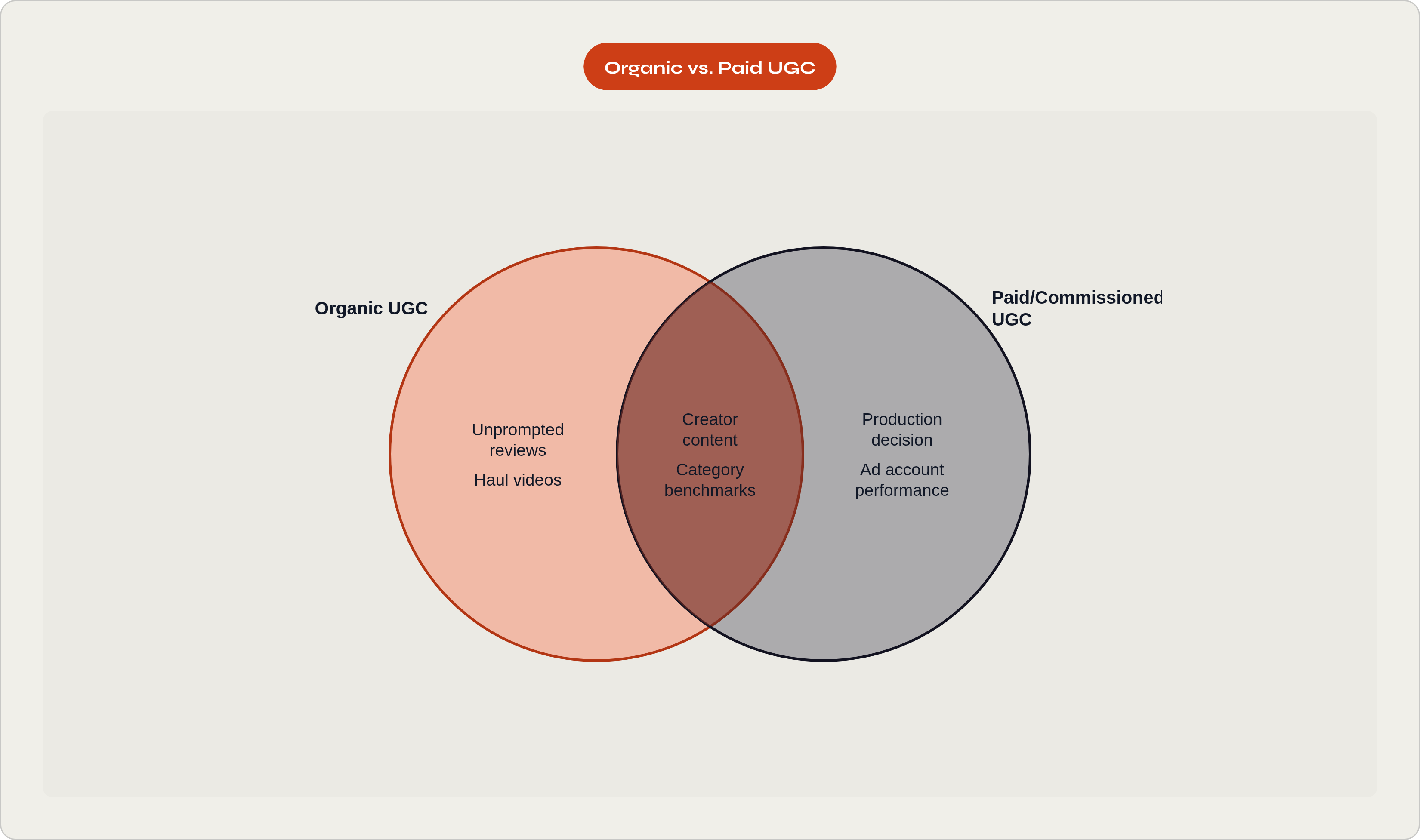
Organic UGC is the content customers create and share freely: the unprompted review, the haul video, the recipe post. You don't commission it, you don't control it, and its volume is fundamentally a signal of community health. When organic UGC is high in your category, that tells you something true and important about how your customers relate to your product and to each other.
Paid or commissioned UGC is something else entirely. You're hiring creators to produce assets that your brand then deploys, usually in paid media. Volume here isn't a signal; it's a production decision. And it's a decision with direct consequences for your ad account performance.
This distinction matters because benchmarks for each type mean different things. An organic volume benchmark tells you what customers in your category are already doing on their own. A paid UGC benchmark tells you how much creative a competitive program requires to sustain paid media efficiency. Confusing them is probably the most common planning error I see.
It's also worth clarifying why UGC volume calculus is different from influencer marketing. When you pay an influencer, you're buying their distribution: their audience, their credibility, their reach. When you commission a UGC creator, you're buying the asset. The brand runs it wherever it chooses. That changes everything about how you think about how much you need.
One more frame before the category breakdown: campaign versus always-on. A hashtag challenge generates a spike. It's exciting, it produces a lot of content in a compressed window, and it's useful for certain goals. But a performance-oriented UGC program built around paid social requires a sustained weekly production cadence to keep creative fresh and algorithms fed. Brands posting UGC three to four times weekly sustain the kind of reach and engagement that makes the channel work. That's an operational baseline, not a campaign target.
One last thing worth holding in mind as you read the numbers that follow: only 16% of brands have a dedicated UGC strategy. That means most brands benchmarking their programs are measuring against a competitive field where the majority of competitors have no systematic program at all. In some ways, the bar is lower than it looks. In other ways, the opportunity to differentiate is larger.
Beauty: the highest-pressure UGC category for volume and creative iteration
Beauty is where UGC volume pressure is most acute, and the reasons are structural, not incidental.
Seventy-four percent of consumers consider UGC important for health and beauty purchases, and 42% actively research beauty products through UGC specifically. Those numbers reflect something real about how beauty decisions get made. Color payoff, skin texture, how a foundation oxidizes after four hours, whether a serum actually changes anything visible: none of this is answerable by brand photography. Customers need to see the product on a real face, ideally one that resembles theirs.
Before-and-after testimonials convert 67% better than product-only creative in beauty. That single figure has enormous downstream consequences for production strategy. If a disproportionate share of your highest-converting content needs to be transformation-format, that means more creators, more briefs, more coordination. You can't just produce a handful of aesthetic product shots and call it a UGC program.
Beauty brands now route roughly 25 to 35% of digital marketing budget into influencers and creators, the highest allocation of any consumer category benchmarked here. That level of investment exists because the performance returns justify it. UGC drives 2.3x higher click-through rates than brand-produced content in beauty. A brand under-indexing on volume isn't just leaving content on the table; it's accepting a structural efficiency penalty in its paid media.
The volume playbook in beauty leans toward many smaller creators rather than fewer large ones. Micro-influencer collaborations in the 10,000 to 100,000 follower range drive 38% lower customer acquisition cost than macro-influencers. This isn't counterintuitive when you think it through: beauty audiences are highly engaged and visually sophisticated, and they're more receptive to someone who looks and lives like them than to someone with a million followers and a production team. The operational consequence is a creator roster that needs real depth, not a few high-profile names.
Ad fatigue sets in faster in beauty than in almost any other category, precisely because the audience is so engaged. They see a lot of content. They remember it. A creative that performs well in week one is exhausted by week three. This means paid UGC in beauty isn't a set-it-and-refresh-occasionally discipline; it's a continuous production cycle, and your creator roster needs to be sized accordingly.
Apparel and fashion: volume driven by newness, not just trust
Apparel sits at the very top of the UGC importance rankings: 88% of consumers in 2024 consider UGC important for clothing purchases, the highest of any consumer category. The number is striking. But the mechanism is different from beauty, and that difference shapes the volume strategy entirely.
In beauty, UGC is about proof. Does this work? Does it work on someone like me? In apparel, the question is more immediate: how does this actually look? How does it fit on a real body, in a real outfit, in a real context? That's a question brand photography answers badly almost by definition, because brand photography is built to show the ideal, and customers know it.
The other force driving volume in apparel is freshness. Seasonal and trend cycles mean a content library turns over faster here than in most other categories. A UGC asset produced in fall has limited utility by spring. Fashion doesn't just need volume; it needs volume that stays current, which is a harder production constraint.
The economics of apparel are worth understanding clearly. It operates with a lower customer acquisition cost than many benchmarked categories, but also delivers a lower return on ad spend due to intense competition. That combination means volume and efficiency are both required simultaneously. You can't out-spend the competition on awareness and compensate with thin creative; you need enough content to test, iterate, and find what converts.
The scale reference that gets cited most often in fashion is Uniqlo's #LifeWear campaign, which accumulated more than 500,000 posts across brand, influencer, and organic UGC. That's a useful order-of-magnitude signal for what a globally active fashion brand's content ecosystem looks like at full expression. For mid-size brands, this is a ceiling to understand, not a floor to reach. The competitive advantage for smaller fashion brands isn't hashtag scale; it's creator specificity, selecting creators whose aesthetic, community, and body representation align closely with the brand's actual customer.
One underused lever in apparel: organic creator content converted to whitelisted ads. The authenticity of a real person wearing the item carries directly into the ad unit. It doesn't need to be remade; it needs to be amplified.
Food, beverage, and CPG: organic UGC volume is high, paid UGC strategy is underdeveloped
Food and beverage has among the highest UGC adoption rates of any consumer category: 85%, near the top across industries. That makes intuitive sense. Eating and cooking are inherently social behaviors. People share meals, reactions, recipes, and rituals without needing any prompting from brands. The organic volume in this category is high.
And that's precisely the trap.
High organic volume creates a misleading benchmark. Brands see a steady stream of customer content, assume their community is handling it, and underinvest in commissioned UGC. The organic activity is real and valuable, but it doesn't substitute for a deliberate paid UGC strategy, particularly for brands with direct-to-consumer components.
The campaign ceiling in this category is well documented. Chipotle's #GuacDance generated over 250,000 video submissions and more than 800 million video views. Starbucks' #RedCupContest received 24,000 entries in five days. These are impressive numbers, but they're outlier activation moments built on enormous existing brand equity. They're not an operational model.
What the economics actually look like for food and beverage DTC is more instructive for most brands. Average order values in the mid-$60 range, combined with purchase frequency approaching six orders per year, make CAC investment worthwhile. Supplements within the broader category deliver some of the highest returns on ad spend, driven largely by subscription models. The implication for paid UGC strategy is concrete: content should be calibrated to drive first purchase and subscription conversion, not just awareness and reach.
For CPG brands where the purchase happens at retail, the calculus shifts. UGC content is serving top-of-funnel and consideration stages, building the mental availability and preference that gets expressed later at shelf. The volume requirement is real, but the creative brief looks different from a DTC brand optimizing for a direct click-to-purchase.
Recipe, unboxing, and taste-reaction formats are both category-native and algorithm-favored. A paid UGC library in food and beverage should be weighted heavily toward these; they perform because they feel earned, not manufactured.
Fitness and wellness: content volume tied to transformation proof and community identity
Fitness UGC is powered by two forces that feed each other: transformation documentation and community belonging. Before-and-after progressions, workout results, habit streaks, and physical change posts generate high organic volume because they serve real psychological needs for the people creating them. They're not just marketing content; they're part of how fitness communities function.
This creates an unusual dynamic for brands. The organic content environment is rich and emotionally resonant, which raises the bar for commissioned content. Creator posts that feel corporate or scripted land badly in a space where authenticity is the currency.
The "show me it works on someone like me" burden that beauty carries applies here with equal force. Health and wellness purchases require proof, not just appeal. A supplement, a training program, a piece of equipment: all of them face a skeptical buyer who has been disappointed before and wants evidence before committing.
Purchase frequency in the supplements sub-category runs at more than four times per year, which means UGC content needs to speak to buyers at multiple stages simultaneously. You need awareness content for new audiences encountering the brand for the first time, proof content for buyers in consideration, and community and identity content that retains existing customers and keeps them engaged between purchases. A single content format doesn't serve all three.
Creator profile matters more in fitness than in almost any other category. A creator with a small but highly engaged fitness-specific audience, nano-influencers averaged roughly 10.3% engagement in 2025, outperforms a larger generalist on both relevance and conversion. The audience trust in fitness communities is tight and specific; it doesn't transfer easily from a creator who doesn't actually live in that world.
Platform split matters too. TikTok drives discovery and viral transformation content. YouTube supports longer-form proof content: tutorials, program reviews, multi-week result documentation. A competitive fitness UGC program needs volume across both, because the buyer journey often moves between them.
Apps and digital products: UGC volume requirements are high and almost always underestimated
Apps present a content problem that doesn't resolve itself. There's no physical product to photograph, no texture or color payoff, no before-and-after that's inherently visual. UGC in this category must demonstrate an experience, an outcome, or a transformation, and it must do so with enough variety that creative fatigue doesn't set in before the audience converts.
That constraint makes content volume and creative diversity more critical for apps than for almost any physical product category, not less. A beauty brand can release a new shade and generate a fresh content cycle. An app brand needs to find new angles, new use cases, new user stories to keep the library from becoming repetitive.
This is partly why apps are typically heavy users of AI-generated UGC for volume. SaaS and social app brands often use AI-generated content to fill a significant portion of their volume targets, supplementing with traditional UGC for the trust and authenticity signals that human creators provide. It's a pragmatic response to a real production constraint, though it requires careful calibration to avoid content that reads as hollow.
The paid media volume requirement for apps is particularly acute. Meta and TikTok CPMs for paid placements run in the low-to-mid teens. A high-volume UGC library keeps creative fresh and suppresses the fatigue-driven cost increases that happen when ad accounts recycle the same assets repeatedly. App brands that treat UGC as a paid asset production system, rather than as organic creator outreach, see the clearest efficiency gains.
TikTok's branded hashtag challenges average over 4,500 user-generated videos per campaign. That's a useful competitive baseline for apps running TikTok-native campaigns to hold in mind. TikTok Shop leads social commerce at a 4.7% conversion rate, compared to 1 to 2% for traditional influencer campaigns. For apps with in-app purchase or subscription flows, UGC briefs should be designed specifically around driving that action, not just around awareness or brand recall.
What drives the volume gap between categories: purchase cycle, trust distance, and platform fit
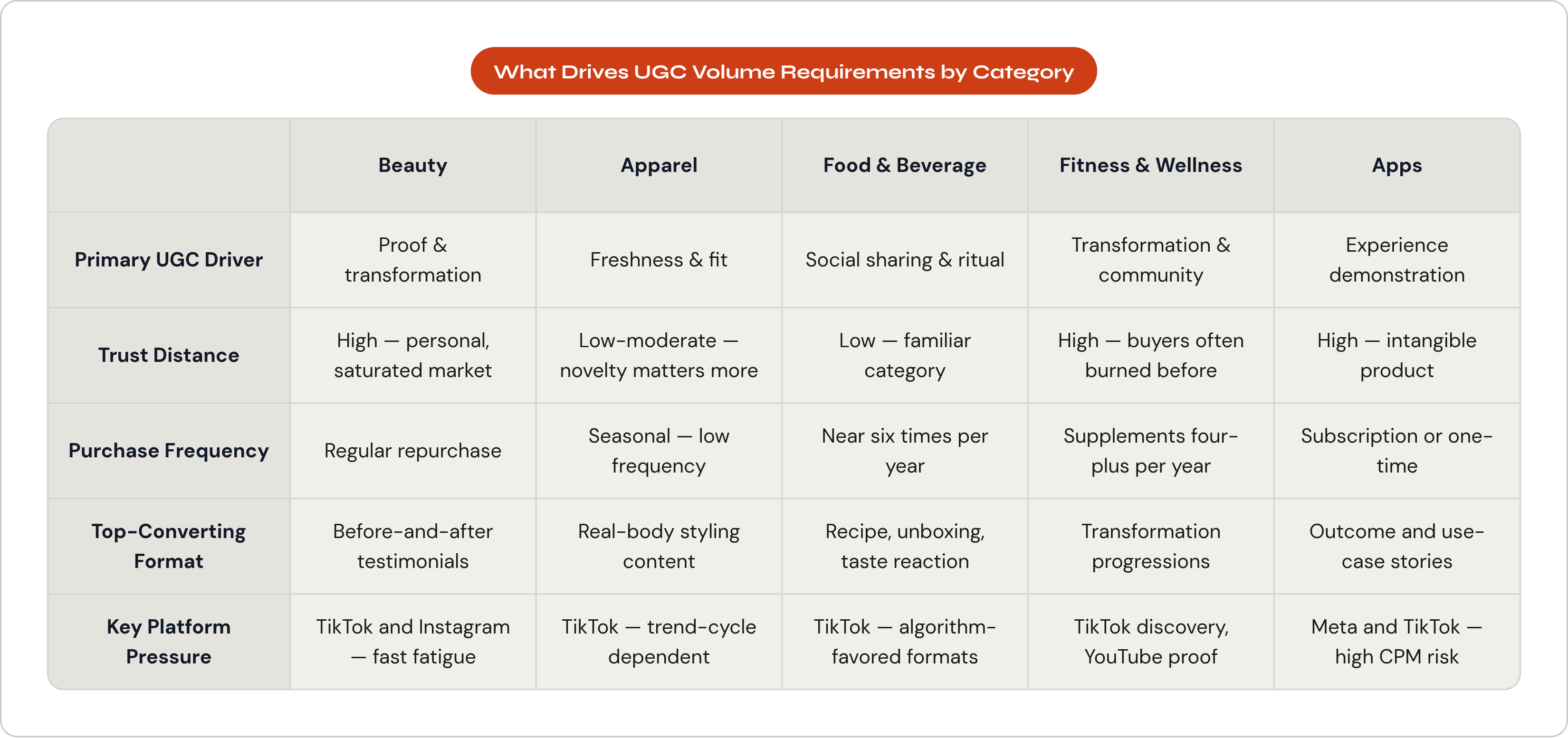
Three variables explain most of the volume variation across the categories above. Understanding them gives you a framework for reasoning about your own program, rather than just reading off a benchmark number.
Purchase cycle frequency sets the baseline content demand. High-frequency categories, food and beverage near six purchases per year, supplements over four, need UGC that serves both acquisition and retention. You're not just trying to bring in new buyers; you're trying to stay relevant to people who already purchase regularly. Low-frequency categories like apparel or certain fitness equipment face a different challenge: sustaining brand presence and consideration in the long gaps between purchase occasions. Different logic, but neither one is low-pressure.
Trust distance describes how much proof a buyer needs before converting. Beauty and fitness carry high trust distance. The purchase is personal, the category is saturated with underperforming products, and buyers have been burned. This drives format diversity requirements: more testimonials, more transformation content, more creator variety to represent different bodies, skin tones, and starting points. More formats means more creators and more briefs. Food and apparel carry lower trust distance on average, but higher novelty expectations. The content must be fresh to remain relevant, which creates its own volume pressure.
Platform fit is the variable brands most frequently underweight. TikTok UGC outperforms brand-created video by 22% on the platform and outperforms regular ads by 46% overall. Categories with strong TikTok audiences face higher volume floors because the platform rewards content density and punishes recycling. YouTube tells a different story: UGC there drives dramatically higher impressions and engagement than brand-owned content, making it essential for categories suited to longer-form proof content like fitness and apps.
Knowing where your category sits on each of these three axes produces a more accurate volume target than any single benchmark number. The benchmark tells you what the field is doing; the framework tells you why, and why your specific situation might diverge.
Translating category benchmarks into an actual production target for your program
Start with platform cadence as your floor. Three to four UGC posts per week is the operational baseline for sustaining algorithmic reach and engagement. That's the minimum before any category-specific adjustment.
Then layer in your paid media volume requirements. Creative fatigue on Meta and TikTok is real and measurable; any asset running in paid rotation needs to be refreshed, and the higher your spend, the faster the refresh cycle. A useful planning principle: if you're running paid social actively, your UGC production target should be set by how many new assets your ad account needs per month. Not by how many you feel comfortable briefing. Not by what you did last quarter. By what your media plan actually requires to stay efficient.
Creator roster sizing follows directly from your volume target. A creator with under 10,000 followers delivering consistent 3 to 6% engagement and reliably on-brief delivery is a more dependable volume asset than a macro-influencer who produces one piece per quarter and requires three rounds of revisions. Build minimum engagement thresholds into your sourcing criteria, and recruit for depth of fit, not breadth of reach.
The measurement frame that validates whether your volume is working: video view rate and hold rate are more reliable performance signals than engagement rate alone. They tell you whether your content is actually stopping people and keeping them, not just generating passive taps. A healthy creator program should be generating meaningful positive return for every dollar invested; if yours isn't, volume and creative variety are usually the first levers worth examining before you start renegotiating creator rates or changing platforms.
Here's the thing no benchmark document tells you: sourcing, briefing, contracting, and managing enough creators to hit competitive volume targets is the actual operational bottleneck. Most brand teams discover this before they discover that their content is underperforming. The creative isn't the hard part. The systems that keep the creative flowing consistently, at the cadence your paid media requires, across the format diversity your category demands: that's what separates programs that sustain performance from programs that run a good campaign and then go quiet.
Repeatability is the real benchmark worth chasing, which is the operational problem Pebble, a data-driven agency that runs high-volume creator-led organic campaigns on TikTok and Instagram for consumer brands, is structured to solve.