UGC Content Calendars for High-Frequency Brands
Treat your UGC calendar as a production system, not a publishing schedule.

There's a moment most brand marketing teams know well. The content calendar looks full at the start of the month. By week three, it's visibly hemorrhaging. Creators are late, assets are stuck in review, the paid team is recycling the same three videos, and someone in leadership is asking why the CPAs are climbing. The instinct is to blame ideation. "We need more concepts." But the concepts were never the problem.
The problem is the pipeline.
High-frequency brands, meaning DTC and app brands refreshing creative weekly, brands running paid UGC at scale, brands with multiple SKUs or seasonal drops, these teams don't fail at UGC because they run out of ideas. They fail because the infrastructure underneath the calendar can't sustain the cadence the algorithm demands. Creative fatigue sets in fast on Meta and TikTok. Performance degrades within days of an ad reaching meaningful scale. A team shipping five fresh UGC variants per week will, over time, outperform a team shipping one polished spot per month, even if that polished spot peaks higher at launch. Volume, when it's well-directed, compounds.
What this article is about is the system that makes that volume possible: how to architect the briefs, roster, review cycles, and calendar structure so that on-brief assets flow continuously without bottlenecks. Not ideation. Execution infrastructure.
What Makes UGC the Right Content Type for Brands That Need to Publish at This Tempo
Start with the performance rationale, because it's the reason volume matters in the first place. UGC ads achieve four times higher click-through rates and fifty percent lower cost-per-click compared to traditional brand ads, and UGC video ads show thirty-five percent higher watch-through rates than polished brand creative. Those are not marginal differences. When a format outperforms at that magnitude, producing more of it compounds the advantage. Volume isn't a brute-force strategy; it's a logical response to the data.
But what if the more structurally interesting story isn't in the performance numbers at all — but underneath them? Consumer trust in UGC is roughly two and a half times higher than trust in brand-created content, and that trust doesn't erode with repetition the way ad fatigue does with polished creative. A perfectly produced brand spot starts to feel like a brand spot after you've seen it twice. A creator talking to their phone about a product they actually use retains its texture. The format carries a credibility that is structural, not just tonal. Brands that understand this stop trying to make UGC feel more "premium" and start treating its informality as the actual product.
The format fit accelerates everything. Lo-fi, sub-thirty-second vertical video is both what creators can produce quickly and what platforms surface preferentially right now. Research consistently finds that a substantial majority of adults in the eighteen-to-thirty-six range respond favorably to creators who show imperfections. Authenticity isn't a compromise you make to reduce costs; it's a feature the audience is actively rewarding. That lowers the production ceiling dramatically, and when the production ceiling drops, speed of iteration becomes the competitive advantage.
This is why UGC is the only content type that can realistically match algorithmic demand for high-frequency brands without ballooning production costs. The format's inherent scalability is the point.
The Structural Difference Between a Content Calendar and a UGC Production System
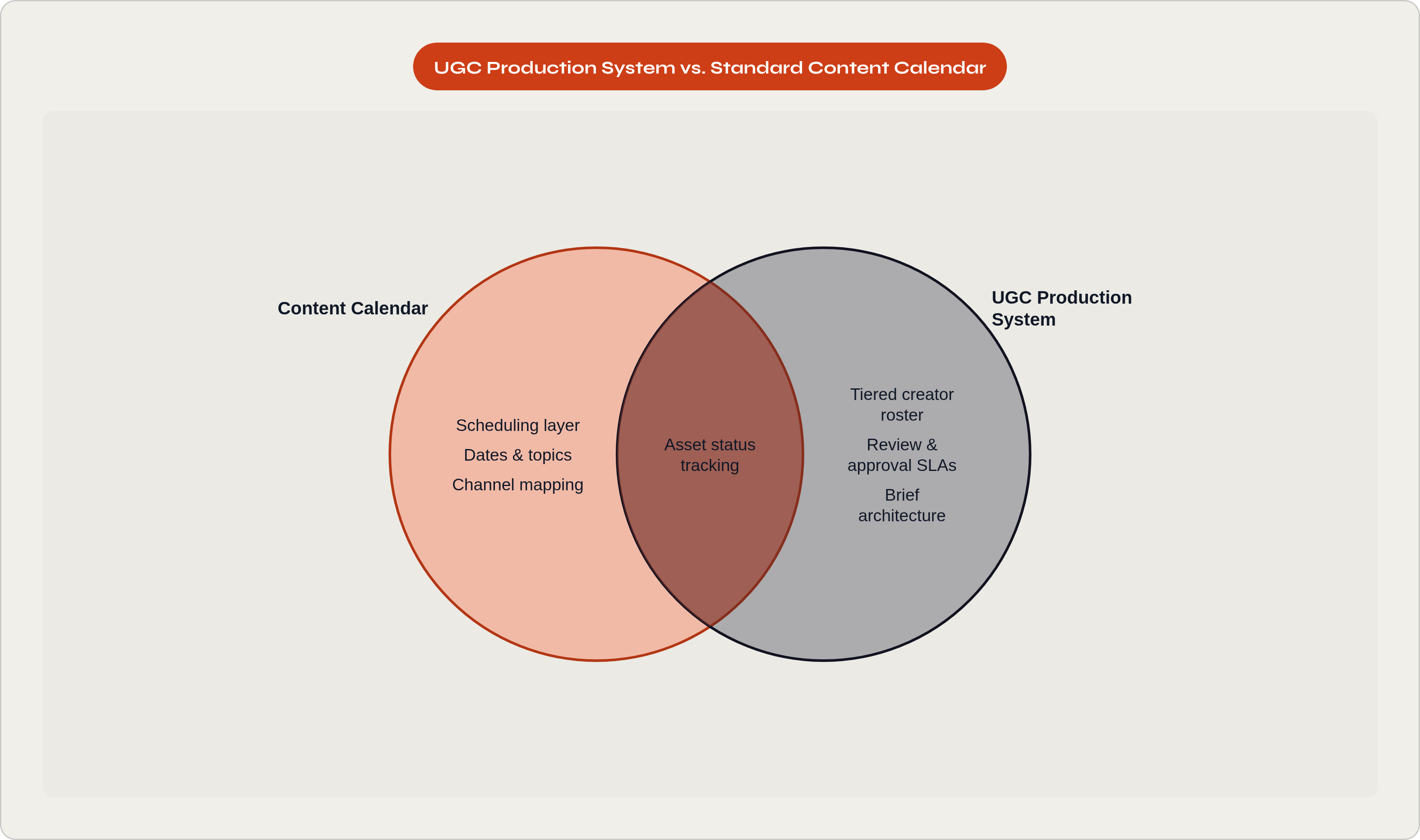
A standard editorial calendar is a scheduling layer. Dates, topics, channels. It answers the question: what are we publishing and when? A UGC production system answers an entirely different question: how does a continuous supply of approved assets get produced and delivered to those dates without breaking down?
To understand why this works, we must first look at the system in its own terms. Inputs are briefs. Throughput is creator production and the review cycle. Output is approved assets ready to publish or amplify. The calendar is the visible surface; the production system is what keeps that surface populated under volume.
One structural decision that separates functional programs from ones that buckle: the sixty-forty split. Plan sixty to seventy percent of your content in advance; hold thirty to forty percent as unscheduled capacity for reactive content and real-time opportunities. This isn't a preference. It's a load-management decision. Pre-planned slots are fed by the production pipeline. Reactive slots require a standing creator roster that can execute on short notice, not a cold-outreach process that takes two weeks to initiate. If you try to plan your calendar at one hundred percent, you've also planned away your ability to respond to anything.
The key components a system must actually contain: a live brief inventory with creative specs in different funnel stages, a tiered creator roster segmented by content type and speed, defined review and approval SLAs so assets don't sit idle between submission and publishing, and an organized asset library sortable by format, platform, and funnel stage. Each of these interacts with the others. A gap in any one of them creates a bottleneck somewhere else.
Research consistently shows that content teams using documented strategies outperform undocumented ones by significant margins in engagement and consistency. The discipline of documentation matters because it externalizes the system from any individual person. A process that only works when the right person is in the room isn't a system. It's a dependency.
How to Architect the Brief So Creators Can Produce at Volume Without Going Off-Brand
The brief, for high-frequency UGC programs, is not a mood board. It is a replicable creative specification. At volume, the brief is the primary mechanism of brand control; there is no in-person direction, no director on set. What goes into the brief is what comes out of the creator.
A functional volume brief specifies the hook format or a set of hook options for the first two to three seconds, because the hook is where watch-through rates are won or lost. It defines message hierarchy: what must land in every execution versus what the creator can interpret. It includes platform-specific format requirements, aspect ratio, length, caption style, because a brief that doesn't specify these produces assets you can't use without conversion costs. It identifies the funnel stage, because awareness content and conversion content have fundamentally different tonal registers and calls-to-action. And it includes explicit do's and don'ts, specific enough to prevent common off-brief outcomes without so constraining the creator that you've removed the energy that makes UGC work.
The architectural move that makes volume manageable is the separation of the core brief from the variable layer. The core brief contains brand constants: product positioning, tone, brand-safe language, category claims. You set this once per campaign or quarter. The variable layer contains the specific angle, hook option, or format for a given content slot. That variable layer changes weekly or by drop. This separation is what allows you to brief ten creators simultaneously without producing ten custom documents from scratch. You're updating a layer, not rebuilding the architecture.
Brief quality also functions as a creator retention lever, and this is underappreciated. Creators who receive clear, specific briefs produce faster and return more reliably. That raises an important question: are revision cycles and creator attrition really a content problem, or are they a brief problem? The operational speed of your program and the health of your creator relationships are the same variable. Ambiguous briefs produce revision cycles, and revision cycles produce attrition.
Building the Creator Roster That Can Actually Sustain Weekly Publishing Cadences
Volume requires a tiered roster. Not a single pool of creators, but a structured population with different roles and different expectations.
Tier one is your core layer: high-output creators with a proven record of on-brief production, available on short notice. These are the people you depend on when the calendar needs to move. Tier two is rotational: creators brought in for seasonal angles, new formats, or audience segments that your core roster doesn't cover. Tier three is the pipeline: creators in vetting or early relationship, introduced to your brand through product seeding before they receive paid briefs.
Selection criteria should center on fit and content performance, not reach. The TikTok and Brand Safety Institute's Creator Suitability Report from early 2026 found that creator fit ranked as the top selection factor for both brands and agencies, while follower count ranked last. This tracks with what you see in practice. A creator with a modest, highly engaged, category-specific audience will outperform a creator with ten times the followers whose audience has no particular affinity for your product category. A minimum engagement rate threshold in the two-to-three percent range is a reasonable floor; below that, audience quality is suspect regardless of the follower number.
Authenticity vetting matters more at volume, not less. Fake followers corrupt all downstream data: engagement benchmarks, conversion attribution, creator performance rankings. CreatorIQ's 2025 State of Safety Report found that the majority of brands who vetted creators used more than one tool, with an average of three per vetting process. That signals that no single tool is sufficient. Check for growth pattern spikes, assess engagement consistency over time, and look for geographic audience mismatches that don't align with the creator's apparent origin.
Product seeding functions as a pre-vetting mechanism that many brands underutilize. Approach creators who have already received product. Did they produce organic content? Do they have testimonials or unprompted opinions? This collapses the trust-building and vetting steps into one, and it surfaces natural brand advocates before you've spent paid budget.
On roster sizing: if you're publishing daily UGC across two platforms, work backward. How many creators need to be in active production simultaneously to cover review cycles, revision rounds, and the occasional missed submission? The number is almost always larger than brand teams initially expect. Build for coverage, not optimism.
The Production Timeline That Prevents the Calendar From Collapsing Mid-Month
The standard influencer content workflow runs four to eight weeks from outreach to publish. That lead time has to be built into the calendar architecture from the start, not treated as an anomaly or a delay to be apologized for.
A typical cycle: week one, identify and brief creators; weeks two and three, contracts and terms; weeks four through six, creator production; week seven, review and approval; week eight, publish and monitor. For a high-frequency brand, this means multiple cycles running simultaneously. The pipeline is staggered, not linear. While week-eight assets are going live, week-four assets are in production and week-one outreach for the next cycle has already started. Three overlapping cycles running at any given moment is the target state for daily-publishing brands.
A useful operational anchor is the monthly campaign rhythm: brief goes out at the start of the month, submissions collected mid-month, best assets scheduled for the back half while the next cycle's outreach is already in motion. This fills the calendar continuously rather than in discrete bursts.
Review cycles are the most common place volume programs stall. The approval process needs defined ownership, defined sequence, and a defined time window. A forty-eight-hour review window is a reasonable starting benchmark. Two revision rounds per asset is a reasonable maximum; if you're consistently going beyond two rounds, the problem is the brief, not the creator.
Track two leading operational metrics weekly: time from brief to published asset, and variants tested per week. These are predictive indicators. They tell you where cost-per-acquisition is heading before the revenue data confirms it. A rising average revision count signals a brief quality problem upstream. A declining asset approval rate signals a creator-brief fit problem in your roster. Both are solvable, but only if you're measuring them.
How to Structure the Calendar Itself Across Platforms and Funnel Stages
The calendar is a publishing map. The fields that matter operationally: date, platform, content format, funnel stage, creator or source, asset status, and brief reference. The asset status field is the one that makes the calendar functional rather than decorative. Brief sent, in production, in review, approved, scheduled, live. That progression is what the operational layer tracks.
Platform-specific requirements belong in the calendar structure, not in a separate document that someone has to cross-reference. TikTok and Instagram Reels demand sub-thirty-second vertical video with a hook in the first two to three seconds. YouTube Shorts permits slightly more length but the same vertical constraint. Paid placements using the same asset require a separate rights notation and a whitelisting or dark post flag. These are not retrofits; they need to be native to the calendar's architecture.
Funnel distribution across the calendar is a deliberate editorial decision. Awareness-stage content, broad hooks, product discovery, storytelling, feeds organic reach and top-of-funnel paid. Consideration and conversion content, testimonials, unboxings, comparison angles, feeds directly into the paid amplification queue. If you leave this distribution to whatever happened to get produced that week, you'll find yourself perpetually over-indexed on one stage and starving the other. The balance has to be planned.
Reactive slots, that thirty to forty percent of unscheduled capacity, are filled by the standing creator roster, not by new outreach. This is the structural reason roster maintenance isn't optional. If you let the roster atrophy, you've also eliminated your ability to respond to anything that happens outside the planned cycle.
One underrated function of the calendar: it should surface gaps prospectively. An empty slot three weeks out is a brief problem you can solve now. The same empty slot, discovered the day of, is a crisis.
Turning the Asset Library Into a Paid Amplification Engine
Every approved UGC asset is a potential paid creative. This sounds obvious; in practice, most brand teams treat paid creative and organic content as separate production tracks that occasionally share assets. The more efficient architecture tags assets for paid consideration at the point of approval, not as an afterthought. But how does this affect our original promise — that volume compounds advantage? Only if the assets reaching paid queues are actually organized and accessible. Without that, the library is just a folder.
The performance rationale for routing strong organic UGC into paid is straightforward: the same metrics that make UGC compelling organically, higher click-through rates, lower cost-per-click, stronger trust signals, hold in paid environments, particularly when the creative retains its native feel.
Two mechanisms for preserving that native feel in paid: whitelisting and dark posts. Whitelisting runs paid spend through the creator's handle rather than the brand account. The ad appears to come from a person, not a logo, and that distinction matters to the audience in ways the performance data eventually confirms. Dark posts serve paid creative without publishing it to the organic feed, which allows for precise audience targeting without cluttering your brand account. Both require specific rights language in the original creator contract. This is not a detail to negotiate after the fact; the language needs to be there before any asset enters the paid queue.
TikTok Spark Ads, the platform's native mechanism for boosting organic content from either the brand or the creator, requires creator authorization codes. That code-collection workflow needs to be a built-in step in the production timeline, not an improvised process handled post-publish.
Asset tagging in the library, organized by format, platform, funnel stage, and performance tier, is what allows the paid team to pull creative on demand rather than waiting on a production cycle. Without this organization, the library is just a folder.
Creative fatigue management across organic and paid requires coordination. An asset that has been running in paid rotation for two weeks should not re-enter the organic feed as fresh content without deliberate consideration of audience overlap. The calendars for both channels need to speak to each other.
The Performance Metrics That Tell You Whether the System Is Working
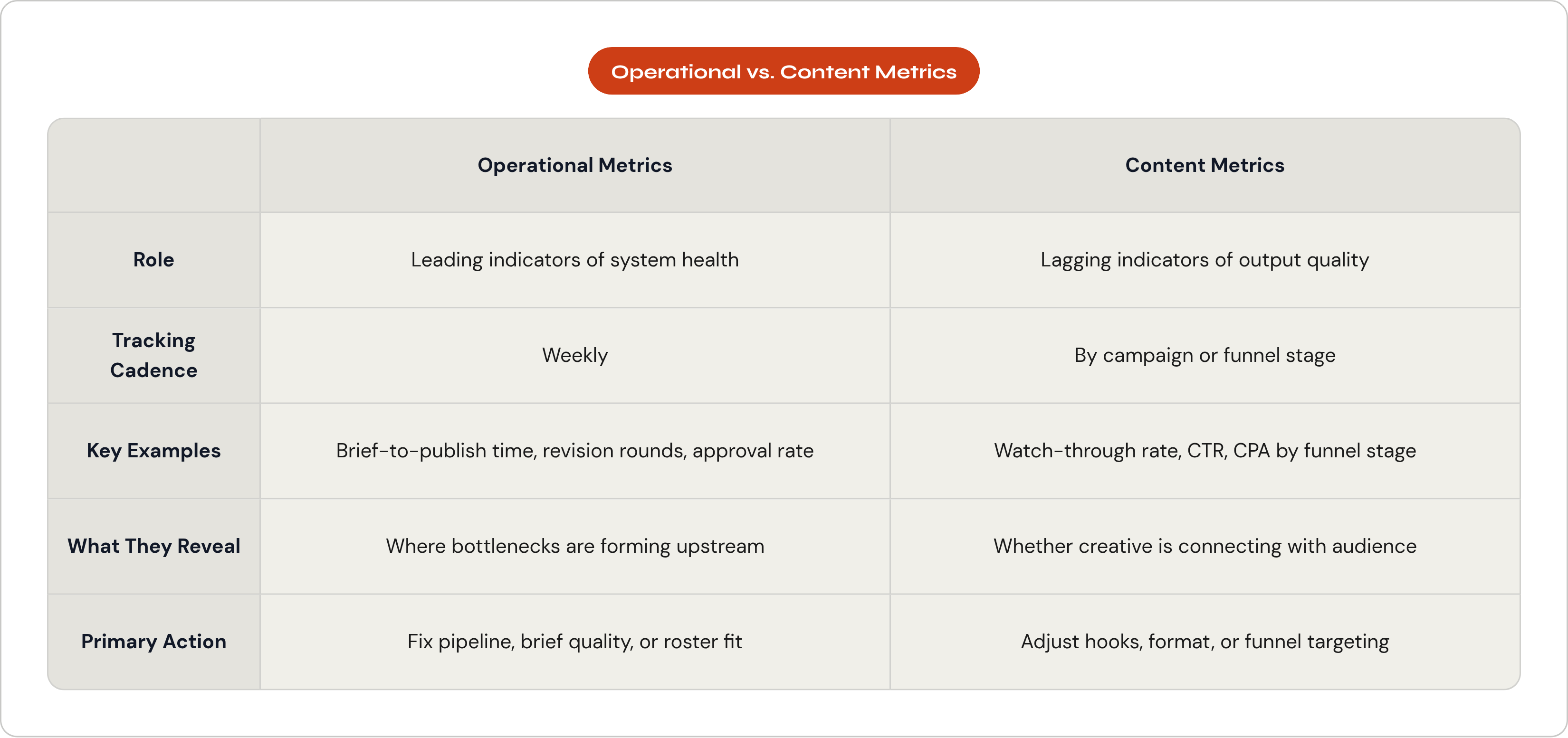
Separate your metrics into two categories: operational and content. Operational metrics are leading indicators of system health. Content metrics are lagging indicators of output quality. Conflating them obscures what needs attention and when.
Track operational metrics weekly. Time from brief to published asset measures pipeline velocity; a lengthening average tells you where the bottleneck is forming before it becomes a crisis. Variants tested per week measures creative iteration rate and directly predicts paid CPA trajectory. Revision rounds per asset, averaged across submissions, is the most direct signal of brief quality. Asset approval rate, the percentage of submitted assets that reach the publishing queue, measures creator-brief fit in your roster.
Content performance metrics should be tracked by funnel stage, not aggregated across the whole calendar. At the top of the funnel, watch-through rate, shares, and saves tell you whether the hook and storytelling are connecting. At the conversion stage, click-through rate, cost-per-click, and cost-per-acquisition on paid placements tell you whether the creative is closing. It is also worth considering what happens when you mix funnel stages in a single performance view — it's a methodological problem that produces misleading conclusions. A conversion-focused testimonial will always look weaker on watch-through rate than an awareness-stage storytelling piece, and comparing them in aggregate tells you nothing useful about either.
The system is working when operational metrics are stable or improving and content metrics are moving in the right direction at each funnel stage. When they diverge, the operational metrics tell you where to look first.
The brands that sustain high-frequency UGC output over time aren't the ones with the most creative ideas. They're the ones that built the infrastructure before they needed it: the brief architecture, the tiered roster, the staggered pipeline, the review SLAs, the asset library with paid tags already in place. The content calendar is the output of that system. It only looks full because the system behind it is running.