Managing 20-Plus UGC Creators Simultaneously

At five creators, a loose brief is survivable. You fill the gaps in real time, hop on a call, clarify over DM. At twenty-plus, every gap in the brief becomes a revision cycle, and enough revision cycles mean you're launching a paid campaign with placeholder creative. I've seen it happen on campaigns where everyone swore the process was solid.
A brief at this scale isn't a creative document. It's an operational one. It needs to be complete enough that a creator executes without any back-and-forth, and specific enough that twenty different people produce recognizable variants of the same campaign.
The non-negotiables: a campaign overview covering what the product does, who it's for, and what the ad needs to accomplish; two or three hook options rather than a full script; platform and format specs; reference videos showing tone and pacing, not examples of past work (creators replicate those rather than learn from them); brand guidelines covering mandatory inclusions and hard exclusions; exact deliverable specs with file count, dimensions, and naming conventions; a clear timeline with submission date, revision window, and approval deadline; and payment terms including rate, trigger, and method.
That last one. Teams bury payment terms in a separate thread or handle them informally, and it creates confusion, delay, and, eventually, relationship erosion. At twenty-plus creators, you cannot afford to manage payment as a side conversation.
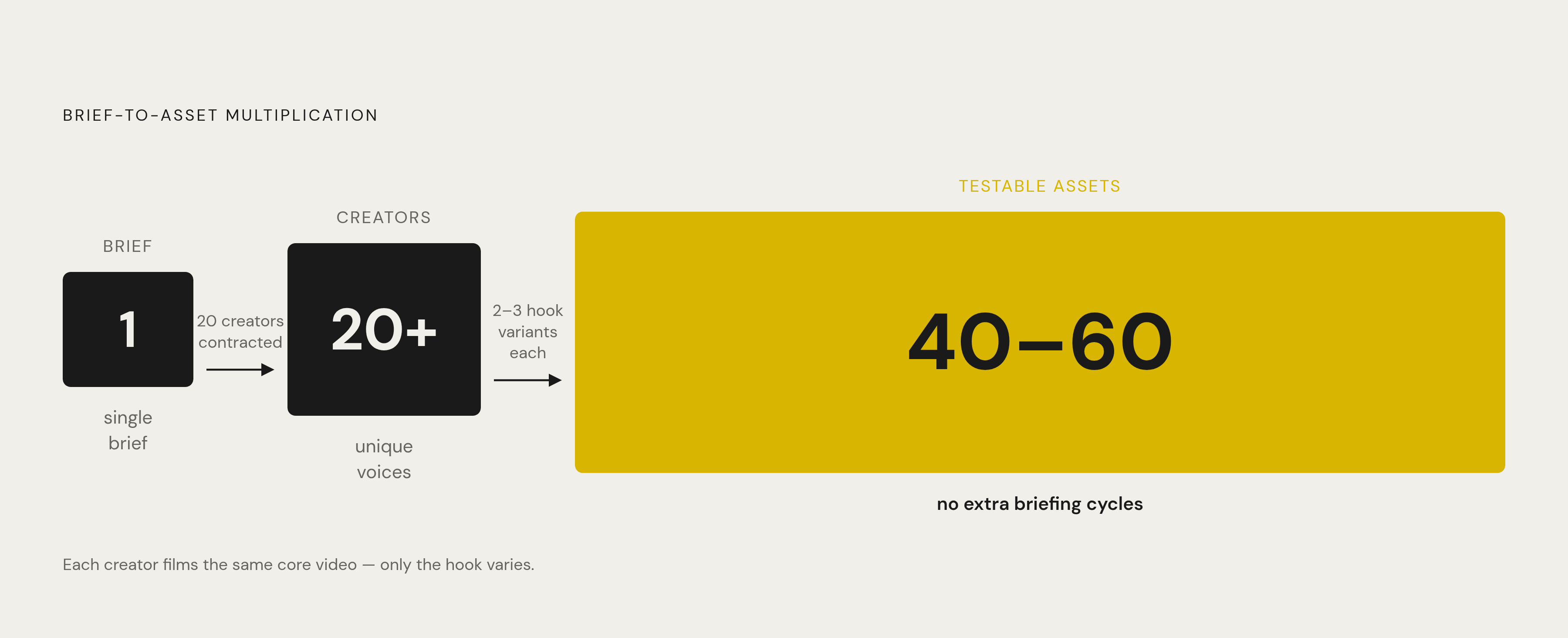
There's also a structural shortcut worth building into every brief: ask each creator to film two or three hook variations on the same core video. The body stays identical; only the opening changes. One brief cycle yields forty to sixty testable assets instead of twenty, and your media buyers have something to actually test without re-entering the briefing and contracting process every time a hook fatigues. Which it will, faster than you expect.
Brief templates should be tiered by content type. A testimonial brief looks different from an unboxing brief, which looks different from a before-and-after. Format-specific templates reduce revision rates because creators aren't interpreting generic direction through their own assumptions. The more specific the brief, the less guessing.
One more thing: at this scale, a brief is a legal document. Usage rights, exclusivity terms, and payment conditions need to live in the brief or a linked contract template. If those terms exist only in a follow-up email, you will discover that oversight at exactly the wrong moment, when you want to run paid spend behind an asset and the rights aren't documented.
How to structure a creator roster of 20-plus without managing each relationship from scratch
The core error most teams make when they scale is applying the same coordination overhead to every creator on the roster. Treating all twenty-plus relationships as equally high-touch doesn't scale; it just means every relationship gets less attention than it needs, and your best creators notice.
The solution is tiering, not as a way to deprioritize anyone, but to match coordination intensity to relationship value.
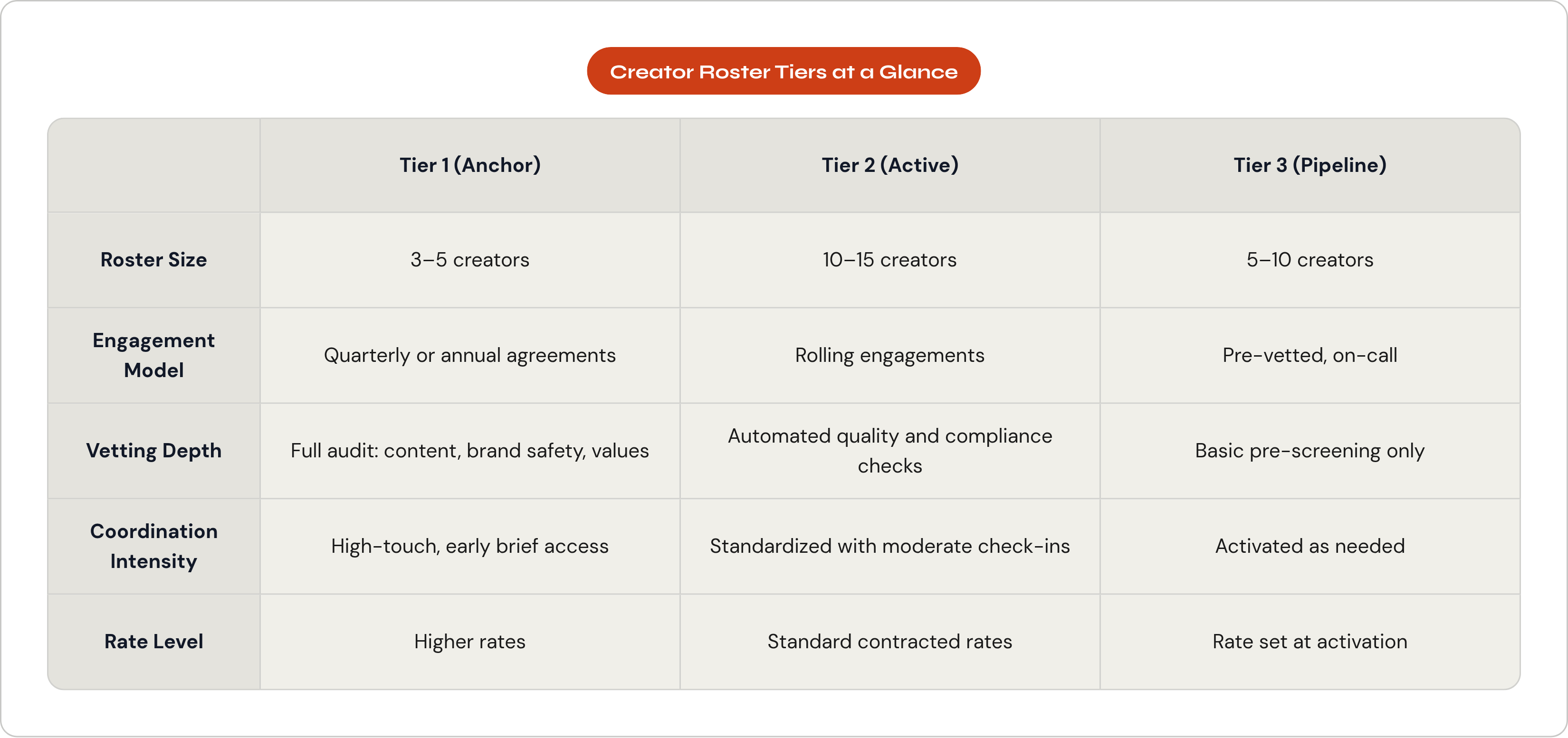
Three to five anchor creators at the top: people with a documented track record of on-brief, high-converting work. Quarterly or annual agreements, early access to new briefs, higher rates. Below that, an active roster of ten to fifteen creators on rolling engagements with standardized contracts and a moderate check-in cadence. Then a pipeline of five to ten pre-vetted creators ready to activate when a slot opens or a new format needs testing.
The vetting insight that changes the math: it should happen once and carry forward. A creator who has demonstrated quality work is already validated. The brief makes the content brand-specific. You don't need to re-vet from scratch every cycle.
For UGC specifically, follower count is the wrong variable entirely. A creator with eight hundred followers who consistently delivers on-brief, compelling content is more valuable than someone with eighty thousand who can't follow creative direction. What you're actually evaluating is content quality, reliability, and brand-safety profile. Tier 1 and high-budget allocations warrant a full audit: content review, brand safety assessment, values alignment. Tier 2 and Tier 3 creators can move through automated audience quality checks, basic disclosure compliance, and templated contracts without the program losing rigor.
Per CreatorIQ's 2024-2025 State of Creator Marketing survey, 84% of creators identify product quality as the primary reason they'll work with a brand. The practical implication is that onboarding should include actual product experience before the first brief. Not a link to the brand deck. The product. Creators who have used what they're being asked to talk about make better content, and they're less likely to quietly deprioritize the engagement when a more interesting brand comes along.
Pipeline sourcing becomes its own operational challenge at this scale. Platforms like Billo, Insense, and JoinBrands accelerate pipeline-building with the tradeoff of a commission on deals. Competitor mining works well as a research layer: identify creators already working in your category by searching competitor brand handles and analyzing tagged content. They're pre-validated for category fit. Seeding programs function as a vetting mechanism: send product before contracting, evaluate the organic response, and let quality filter itself before you write the first brief.
The coordination infrastructure that keeps 20-plus creators on track simultaneously
Once the roster is structured and the briefs are standardized, the remaining challenge is execution: keeping twenty-plus creators moving toward the same deadlines, on the same brief version, without a coordinator spending forty hours a week on status checks.
That requires a system of record. Not better communication, not more Slack channels. A single authoritative source for every piece of information about every creator engagement.
The system needs to track: which brief version was sent to which creator and when; each creator's submission deadline; assets received versus assets expected; revision status at each stage; payment status; and usage rights expiration dates. If any of those variables lives only in someone's inbox, you have a fragility that will surface at the worst possible time. It always does.
Tooling options span a wide range. At the lightweight end, an Airtable or Notion base with a creator pipeline view, linked brief templates, and a status column is genuinely serviceable for a small team managing twenty to thirty creators. Mid-tier purpose-built UGC platforms bundle sourcing, briefing, submission, and payment into a single workflow; the platform fee is real, but so is the coordination overhead it eliminates. At the enterprise end, a custom stack integrating a creator CRM with a media asset manager and paid social dashboard becomes appropriate when the program is running fifty-plus creators across multiple brands.
The single biggest coordination failure mode is brief changes after dispatch. A change pushed to fifteen creators via individual messages creates version drift almost immediately. Some creators get the update, some don't, some acknowledge receipt without actually incorporating it. A brief amendment protocol fixes this: one source of truth that all creators reference, with a change log, so there's no ambiguity about what the current brief says.
Batching is a useful lever that most programs underuse. Instead of managing rolling deadlines, group creators by submission window. Weekly batches reduce daily status checks and create natural review cycles for the approval and feedback process.
Payment automation deserves attention here too. Delayed or inconsistent payment is the fastest way to lose your best creators to a competitor who has their operations together. Automated payment triggers on asset approval remove that risk and signal to Tier 1 creators that working with you is professionally reliable, which is a form of retention no creative brief can replicate.
The two performance measurement layers that actually tell you if the program is working
Most teams skip straight to ROAS and then wonder why UGC looks expensive relative to static ads. The answer is almost always buried in production metrics, not media metrics. But what if the cost-per-acquisition problem you're trying to solve at the campaign level is actually a production problem in disguise? You can't fix a cost-per-acquisition problem at the campaign level if the root cause is a fifty percent revision rate on assets that should never have needed revision.
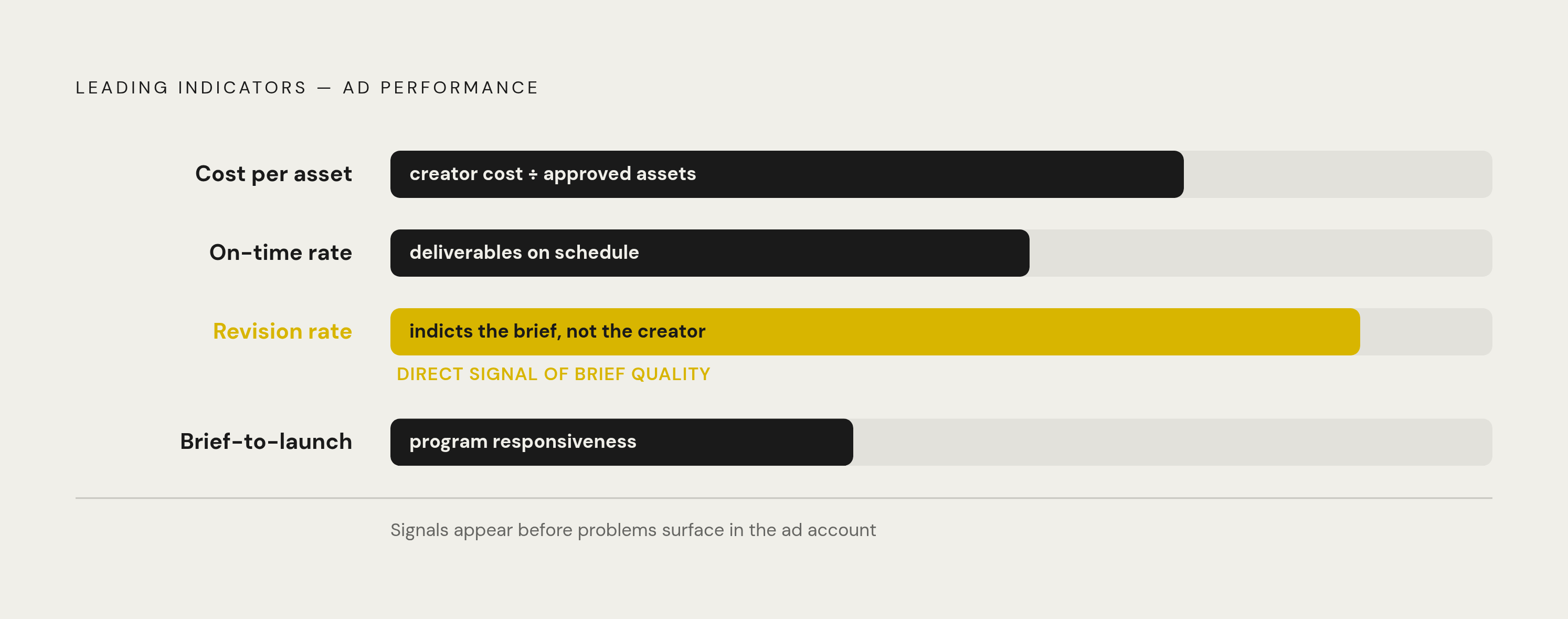
The first measurement layer is operational: the pipeline KPIs that are leading indicators of downstream performance. Cost per usable asset, calculated as total creator cost divided by approved assets, tells you what you're actually paying for finished creative, not what the rate card says. On-time rate measures whether deliverables are arriving when the media plan expects them. Revision rate is a direct signal of brief quality; a high revision rate almost always means the brief is ambiguous, not that the creators are difficult. Time from brief to launch tells you how quickly the program can respond when a creative fatigues or a new product needs coverage. Track these four consistently and you have visibility into the production engine before problems show up in the ad account.
The second layer is revenue-connected: cost per purchase, conversion rate, hold rate, video completion rate, blended ROAS or media efficiency ratio, and promo code or affiliate attribution. Hold rate and completion rate function as proxy metrics for creative quality before you've spent enough to get statistically meaningful conversion data. Promo codes and affiliate links provide the clearest direct line between a specific creator's content and a purchase event, which matters when you're trying to make re-booking decisions.
The mechanism connecting both layers is the creator scorecard. Tracking on-time rate, revision rate, hold rate, and conversion rate per creator enables re-booking decisions based on actual performance rather than gut feeling or relationship comfort. Brands that maintain creator scorecards can compress UGC cost per acquisition by double-digit percentages over a year without changing budgets, briefs, or platforms. The gain comes purely from reallocation: moving budget toward creators who demonstrably convert and away from those who look good on paper but underperform in the ad account.
One measurement blind spot worth naming: UGC's indirect value is routinely undercounted. Content that doesn't drive a last-click conversion still operates as social proof on landing pages, in email flows, and across organic channels. A measurement framework that attributes all value to paid performance is making the program look more expensive than it is, and that matters when you're defending the budget.
How content quality degrades at scale and the brief and feedback systems that prevent it
Quality degradation at twenty-plus creators is not primarily a talent problem. It's a feedback latency problem. When creators receive no signal about what worked, they have no basis for iteration and no incentive to push quality higher. They default to what they've always done, which eventually becomes predictable, which eventually stops performing.
Three quality failure modes emerge reliably as a program scales. Brief drift occurs when ambiguous direction gets interpreted differently by different creators, and with each deliverable cycle the content diverges a little further from what the brand actually needs. Feedback silence is what happens when a creator submits content consistently but never hears whether it worked; after ten videos with no signal, they're operating without a compass. Fatigue recycling is the pattern where even strong creators settle into a fixed hook, pacing, and structure because no one has told them to vary the format.
Version control addresses brief drift: a single current document with a change log, available to all creators, eliminates the problem of different creators working from different generations of the same direction. Format-specific templates reduce interpretation variance further because a testimonial brief leaves fewer ambiguous variables than a general brief asking for something authentic.
Feedback silence is addressable in a way most programs ignore. Share performance data with your creators. Hold rate, completion rate, basic conversion signals. This doesn't require elaborate reporting; it requires sharing data the brand already has. The cost is minimal. What it communicates to the creator is that the brand views them as a collaborator, not a content vendor. I've seen that distinction change the quality of the next three deliverables from a creator who had been quietly phoning it in.
Fatigue recycling requires deliberate format rotation tied to the content calendar. Different content types serve different funnel stages. Awareness hooks and community content work at the top. Reviews, unboxings, and tutorials operate at mid-funnel. Testimonials and before-and-after content convert lower in the funnel. Mapping format to stage and rotating explicitly prevents any creator from defaulting to their comfort zone indefinitely.
Across a March 2025 survey covering nine countries, 28% of global consumers said they need to see a creator promote a product three to four times before purchasing. Only 17% convert after one or two exposures. That raises an important question: if purchase requires repeated exposure, does constantly cycling in new creators actually work against the program? The operational implication is that rotating constantly to new creators works against the program. Sustained relationships with the same creators build the repetition that actually drives purchase, and, as a secondary benefit, produce better content over time as the creator's familiarity with the product deepens.
Turning the best-performing UGC into paid assets without rebuilding the workflow
The operational prerequisite for paid activation is that usage rights are captured at contracting, not negotiated retroactively. At twenty-plus creators, trying to clear rights after the fact is a coordination project in its own right. It takes time you don't have when the media buyer is ready to go, and it occasionally surfaces terms that make the whole thing untenable.
The rights framework needs to specify channel scope explicitly: paid social, owned channels, landing pages, email. Not a general clause about "marketing use." Each channel named. Duration should be defined with a clear expiration date rather than vague language about "reasonable usage." Exclusivity terms, where relevant for Tier 1 creators in competitive categories, need to be negotiated upfront when the creator has leverage to agree to them, not asked for later as a favor.
Identifying which assets to amplify is where the creator scorecard earns its keep. Hold rate, completion rate, and conversion rate surface the top-performing assets without a manual review process. A relatively small share of a large roster's output tends to carry disproportionate paid performance. The scorecard shows you which assets those are.
Whitelisting deserves specific attention as an activation format. Running paid spend behind a creator's handle rather than the brand account preserves the authenticity signal that drives UGC's performance advantage. UGC ads achieve four times higher click-through rates and fifty percent lower cost-per-click compared to traditional brand ads, and whitelisting maintains that gap in a way that brand-account creative does not.
The volume advantage of a large, well-briefed roster is that when each creator produces two to three hook variations, the media team has a continuous supply of testable variants. The program doesn't pause to source new creative when a hook fatigues. It already has the next iteration queued.
For high-velocity variant testing, AI-assisted iteration becomes a cost-efficient complement to human creative. Once a top-performing human-made asset is identified, AI UGC tools can generate hook variations at a fraction of the cost of commissioning new creator deliverables, roughly $2 to $4 per AI-generated video compared to $150 to $500 for a new creator deliverable. The hybrid model reserves human creators for hero content and brand storytelling, and uses AI for volume. All major platforms currently permit synthetic media in ads, though disclosure labeling requirements vary and are evolving; confirm current policy before deploying at scale.
The operational checks that keep a large program from degrading over time
A program that is well-structured at launch will drift if it isn't actively maintained. The structure doesn't prevent degradation; it just makes degradation visible early enough to do something about it.
A monthly audit of brief versions confirms that all active creators are working from the current document, not a version from three campaigns ago. A quarterly review of the creator scorecard ensures that re-booking decisions are still being made on performance data rather than familiarity or inertia. A payment ledger review confirms that all triggered payments have cleared and that no outstanding obligations have quietly accumulated. A rights expiration calendar surfaces assets approaching their usage window limit before they get deployed in a campaign that will have to be pulled.
Creator relationship health is harder to quantify but worth monitoring through qualitative signals. Response time on brief acknowledgments, engagement in feedback exchanges, whether creators are proactively suggesting format variations or simply executing instructions. Tier 1 creators who are fully engaged behave differently from ones who are coasting, and the difference usually shows up in content quality before it surfaces in performance metrics.
The sourcing pipeline also needs a regular check. The pipeline tier exists to prevent the active roster from ever becoming a bottleneck, but it requires maintenance. Pre-vetted creators who haven't been activated in two to three months may have shifted their content style, taken on exclusivity agreements with competitors, or simply moved on. Light quarterly outreach confirms who is still available and engaged.
What the operational layer ultimately provides is visibility. The creative decisions, the briefing, the performance measurement: those are the substance of the program. But without operational checks running underneath, the program's own complexity works against it. Complexity that goes unmonitored doesn't stay static. It compounds, quietly, until someone asks why the assets aren't there.