Batching UGC Production Across 50+ Creators Monthly
Systems and staggered scheduling replace chaos when scaling UGC production.

Running UGC production across fifty or more creators in a single month is not a content challenge. It is an operations challenge wearing a content challenge's clothing. I've watched teams learn this distinction the hard way, usually somewhere around creator number thirty, when the Slack threads stop making sense and the spreadsheet has seventeen tabs nobody can explain.
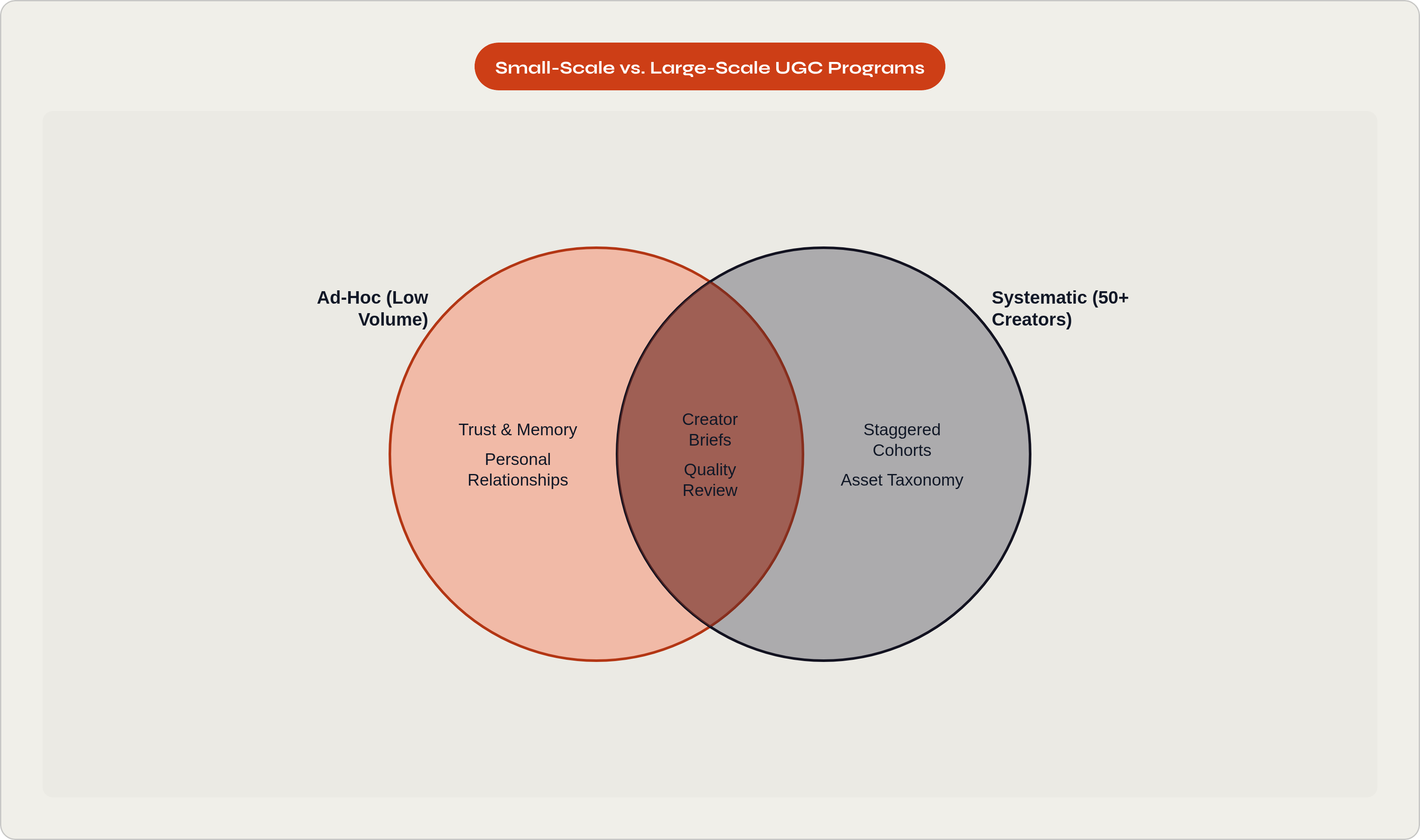
The jump from five or ten creators to fifty-plus is not a linear scale-up. It is a category change. At low volumes, ad-hoc coordination is sufficient: one shared doc, a few direct messages, personal relationships that compensate for process gaps. The program runs on trust and memory. That works, until it doesn't.
At fifty-plus creators monthly, the same ad-hoc approach produces a specific and predictable set of failures: missed deadlines, inconsistent assets, messaging that drifts from brief to brief, payment disputes that stall entire cohorts, and creative output that is impossible to learn anything from. That last failure is the most costly one, and the least discussed. The compounding loss isn't just wasted budget on content that underperforms. It's the destruction of signal. When production is chaotic, you cannot identify what creative actually worked. Volume is only an advantage if it generates usable, comparable data. Chaos converts volume into noise.
The market context makes this operational discipline increasingly consequential. 86% of U.S. marketers are now using influencer marketing, and 57% plan to increase creator partnerships heading into 2026. The space is becoming more crowded, which means execution quality is emerging as the actual competitive differentiator. Having fifty creators is not the edge. Running fifty creators well is.
The solution is not a single tool or a single hire. It is a set of interlocking disciplines: standardized briefing, staggered scheduling, centralized asset management, continuous performance feedback, and contract and payment infrastructure that doesn't slow production down. Each discipline depends on the others. Remove one and the others degrade.
What a standardized brief actually needs to contain at this volume
The brief is the primary control mechanism of the entire program. At five creators, the mechanism is you: your conversations, your taste, your ability to course-correct in real time. At fifty, that isn't possible. The brief substitutes for the one-on-one coaching that works at small scale and breaks at large scale.
Here is where teams get into trouble. They either over-correct toward rigidity, producing briefs so prescriptive that every video sounds like a corporate press release, or they under-correct toward looseness, giving creators so much latitude that fifty different assets arrive with no common throughline and no systematic testability. Both failure modes are real, and I have seen programs destroyed by each of them.
The brief that works at scale has to be prescriptive enough to produce consistent output and open enough to preserve the authentic creator voice that makes UGC perform in the first place. That balance is achievable, but it requires specific architecture.
What goes into a brief that actually scales
Start with hook options. Provide two or three tested hook variants the creator can choose from or lightly adapt. Not a blank slate, not a script. Options. This preserves voice while keeping the opening moment, where a significant share of viewing decisions are made, aligned across the cohort.
Lock in mandatories: claims, disclosures, and any non-negotiable language. These are not suggestions in the brief. They are conditions.
Define tone through guardrails, not scripts. Adjectives that describe persona, "energetic and skeptical," "warm and direct," "polished but conversational," give a creator enough direction to calibrate without constraining their delivery into something that reads like performance.
Specify deliverables upfront and completely. Raw edit and final edit, captions burned in or as a separate file, copyright-free music, platform safe-zone compliance. If the program runs paid amplification, the paid team needs the right versions from submission, not after a round of follow-ups. Ambiguity here costs weeks.
Define revision terms in the brief. Not in a follow-up email, not in the contract negotiation after a creator submits something off-target. In the brief. One revision is standard at this volume; two is generous; open-ended revision rounds will destroy your schedule.
Concept architecture prevents brief sprawl
One pattern I see constantly in scaled programs: teams try to manage fifty individual creative directions in a spreadsheet. That approach fails because it treats each creator's brief as a separate document rather than as an instance of a shared structure.
The better architecture groups briefs into campaign concepts with named variations. Build angle variants, testimonial, demo, comparison, problem/solution, as sub-types of a master brief. Each variant shares the same mandatories, the same tone guardrails, the same deliverable specs; only the creative angle differs. This keeps the roster organized, makes performance comparison tractable, and prevents the mental overhead of managing what eventually feels like fifty entirely different creative programs running simultaneously.
Quality gates belong in the brief structure too. Submission requirements should specify that assets are reviewed before they enter the active asset library, not after they've already been distributed or boosted. Catching off-brief content at submission is trivially cheaper than catching it in the wild.
How to schedule 50+ creators without collisions, gaps, or a single point of failure
The naive scheduling approach is to brief all fifty creators on day one and expect deliverables by week three. I understand the appeal. It feels efficient. In practice it creates a submission avalanche that overwhelms review capacity, produces a feast-or-famine asset calendar, and concentrates all your operational risk into a single window.
The approach that works at this volume is the staggered cohort model.
Cohorts, offsets, and why they matter
Divide the roster into cohorts of ten to fifteen creators. Stagger when each cohort begins, not just when they shoot. If cohort one starts in week one, cohort two starts in week two, cohort three in week three. Each cohort follows the same milestone sequence; they're just offset in time.
This does two things simultaneously. It keeps the review queue manageable throughout the month, rather than empty for three weeks and then catastrophically full. And it ensures a steady stream of new assets throughout the month, which is what a paid amplification team actually needs.
Milestone-based scheduling beats deadline-only scheduling. "Deliver by the 20th" is a single point of failure. A milestone sequence, brief delivery, concept approval, raw submission, revision window, final delivery, each with a hard date, is a system with multiple intervention points. A creator who misses concept approval by two days can be flagged and resequenced before they become a bottleneck at final delivery. You find out about problems when they're still recoverable.
Build buffer into the architecture. At fifty-plus creators, someone will be late. This is not pessimism; it is actuarial thinking. A 48 to 72 hour buffer before any asset needs to go live means that late deliveries are inconvenient rather than catastrophic.
Onboarding and ownership as structural requirements
A creator who receives a brief without prior onboarding, brand history, tone examples, platform conventions the brand is built for, produces a first submission that requires substantially more revision. Front-loading onboarding is not a courtesy; it reduces downstream revision cycles across the entire cohort, which is where you recover that time investment.
At this volume, a single coordinator tracking all fifty via email will fail. That's not a criticism of any individual; it's a structural reality. Clear ownership per cohort or per campaign concept is a requirement. Someone needs to know the status of every creator in their cohort at any given moment, and "every creator" cannot be all fifty for one person.
The creator mix that makes a 50-person roster produce diverse, non-redundant content
Fifty creators is only an asset if they aren't all the same creator in different bodies. I've audited programs that technically had fifty-plus creators monthly and were functionally producing one piece of content at massive redundant scale. The roster was wide but not diverse: similar audiences, similar creative instincts, similar hooks. The output was voluminous and uncreative.
The goal is a portfolio that covers multiple angles, audiences, and creative archetypes simultaneously.
Tier strategy and what each tier actually does
The market has already moved toward volume-over-celebrity. Nano- and micro-influencers are projected to claim the largest share of influencer marketing spend in 2026, according to industry forecasts. For UGC-first programs, the micro and nano tier is the operational workhorse: lower cost per asset, higher engagement rates relative to audience size, and content that reads as authentic rather than produced. This is the tier where the majority of your fifty-plus roster should live.
Mid-tier creators, roughly in the 100K to 500K follower range, serve a different function. They are amplification anchors. When an asset from your nano tier performs exceptionally well in paid testing, a mid-tier creator with a proven, conversion-oriented audience is where you scale that concept. These are not interchangeable roles.
Diversity dimensions that actually matter operationally
Demographic diversity matters, but the operational diversity dimensions are often underweighted.
Creative archetype is one: the storyteller, the demonstrator, the skeptic-turned-believer, the lifestyle integrator. Each archetype maps naturally to a different brief angle and attracts a different kind of viewer response. A roster that skews entirely toward one archetype produces content that is thematically consistent but creatively monotonous.
Platform nativity is another. A creator whose content is built for TikTok's discovery algorithm and one whose audience converts through Instagram perform differently and serve different campaign functions. Treating them as equivalent is a brief-level mistake.
Audience micro-community matters more than raw scale. Twenty to fifty nano creators each reaching a distinct, engaged micro-community will tend to outperform one macro deal on blended cost per acquisition. The aggregated reach is comparable; the relevance density is not.
The creator selection reality check
Per TikTok and the Brand Safety Institute's 2026 Creator Suitability Report, brand fit ranked as the top selection factor for both brands and agencies, while follower count ranked last. Fit-first selection has become industry consensus, not a differentiator.
The other side of that data point matters operationally: 78% of creators turned down at least one brand deal in 2025. At fifty-plus creator volume, brands that offer clear briefs, realistic timelines, and long-term program structures get first selection from the available pool. Brands that treat creators as interchangeable vendors get the creators everyone else passed on.
Vetting at this volume requires process, not just judgment. Over half of marketers spend thirty minutes or less vetting each creator; at fifty creators, that's still a significant monthly time investment if done manually. Standardize the vetting checklist: FTC disclosure compliance (35% of influencer posts still lack proper disclosures per FTC 2025 enforcement data), engagement authenticity signals, brand value alignment, and platform-specific indicators. Fraud screening is non-negotiable. Engagement pods and bot followers produce hollow metrics that corrupt performance data across the entire program, not just for the individual creator.
Centralized asset management as the infrastructure layer the whole program runs on
At fifty-plus creators per month, each delivering two or three files in multiple versions, raw edit, captioned final, platform-specific crops, the program produces well over a hundred files monthly. Without structure, finding the right asset for a paid test becomes its own project. I've watched paid media buyers spend forty-five minutes locating a specific creative variant while an ad set sat unoptimized. That is a solvable problem and a costly one.
What the taxonomy needs to support
Tag assets by campaign concept and creative angle, not just by creator name or submission date. This is the structural decision that makes performance comparison tractable. If you need to know whether testimonial-format content is outperforming demo-format content across the cohort, that query needs to resolve in seconds, not require a manual audit.
Track asset versions explicitly: raw edit, captioned final, platform-specific crops. Paid teams need the right version without going back to the creator. Every time a paid buyer has to request an asset file, that's a production failure.
Status tracking should make the current state of every asset visible to the whole team: in brief, in production, in review, revision requested, approved, live, archived. The alternative is someone boosting content that hasn't cleared legal review, which happens more often than anyone in the industry publicly admits.
Where rights documentation lives and why it matters
Whitelisting permissions, paid amplification rights, exclusivity terms: these should be stored at the asset level, not buried in a contract folder somewhere that requires a different person's login to access. When a top-performing asset gets flagged for paid amplification, the question of whether the brand has the rights to boost it should be answerable in seconds. If that answer requires a forty-minute document search, the program has an infrastructure problem disguised as a compliance question.
The asset management system should also be where review happens. Comments, revision requests, and approvals logged in one place eliminate version confusion. Review via email chain produces a situation where two people are looking at different versions of the same file and neither knows it.
The system does not need to be elaborate. It needs to be shared, consistent, and enforced. Teams managing fifty creators across personal inboxes and local drives eventually lose assets, miss payments, or amplify content they don't have rights to. Not because anyone made a bad decision; because the infrastructure couldn't support the volume.
The performance feedback loop that turns monthly volume into improving creative output
Volume without feedback is noise. The compounding value of running fifty-plus creators monthly comes entirely from what each batch teaches about what works, feeding that learning into the next brief cycle. Without a structured feedback loop, you are not running a fifty-creator program. You are running ten five-creator programs simultaneously and calling it scale.
What to measure and at what level
Measure at the asset level, not just the campaign level. Hook performance, specifically which of the two or three hook variants drove the highest completion rate, feeds directly into the next brief's hook options. This is how the brief improves over time without requiring a strategic overhaul each cycle.
Measure by creative angle. Testimonial versus demo versus problem/solution: which angle is producing the lowest cost per acquisition or highest return on ad spend across the cohort? This is a question that a well-tagged asset library can answer and a poorly tagged one cannot.
Measure creator-level signal in terms of audience conversion, not just engagement rate. Engagement rate tells you whether an audience is watching. Conversion data tells you whether they are buying. A creator with a smaller, highly engaged audience that converts will outperform a creator with a larger, passive audience in most categories that matter to the program's economics.
The attribution problem and the practical workarounds
Last-click attribution models systematically undervalue creator content, because creators typically initiate the consumer journey rather than close it. A creator-driven awareness touchpoint on a Tuesday may convert through retargeting on a Saturday, with all credit assigned to the retargeting ad. That misattribution compounds across a fifty-creator program and produces a distorted picture of which creators and which creative angles are actually driving growth.
The practical tools available now: promo codes and UTM parameters per creator, platform-native attribution integrations with Meta, TikTok, and Shopify. These are not perfect solutions, but they make it possible to evaluate creators by standards comparable to paid media partners, which is the evaluative framework the program's economics actually require.
The feedback cycle cadence
Weekly: asset-level review. Flag outliers in both directions. Top performers move toward amplification; underperformers get a brief revision diagnosis before the next cohort launches.
Monthly: cohort-level review. Which creators should move toward a long-term relationship? Which creative angles should be retired? Which new concepts are worth testing next cycle?
Quarterly: program-level review. CAC trends, ROAS benchmarks, creator roster health. This is where you assess whether the program is actually improving or just repeating itself at higher volume.
The average return on influencer marketing sits around $5.78 per dollar spent, with top-performing campaigns reaching $18 to $20 per dollar, according to Influencer Marketing Hub. That gap between average and top-tier performance is not explained primarily by budget or creator access. It is largely explained by whether programs use data to iterate or simply repeat the same approach at higher volume.
The feedback loop closes when insights from week-three asset performance are already informing the brief delivered to the next cohort. That's the operational distinction between a production operation and a content factory.
How the best programs handle contracts, payments, and compliance without slowing production down
At fifty-plus creators monthly, contracts and payments are not administrative details. They are infrastructure. A delayed payment or a rights dispute can stall an entire cohort, and because cohorts are staggered, stalling one affects the entire month's output cadence.
Contract structure that doesn't require re-negotiation every cycle
The architecture that works: a master service agreement governing the enduring terms of the relationship, paired with a per-campaign addendum that specifies deliverables, timelines, and compensation for each cycle. This avoids re-negotiating core terms every time a new brief launches, which is the pattern that creates administrative bottlenecks in programs with high creator volume.
Deliverable specs belong in the contract, not just in the brief. Revision limits, format requirements, approval timelines: these are legal commitments, not suggestions. When a creator submits a deliverable that doesn't meet spec, the brief's authority is informal; the contract's authority is not.
Usage rights need to be scoped explicitly and in plain language: organic posting rights, brand-owned channels, paid amplification and whitelisting, exclusivity windows. Ambiguity in usage rights creates disputes at precisely the worst moment, when an asset is performing well and needs to be scaled immediately.
FTC compliance as a contract term, not an assumption
FTC compliance should be built into the contract, not assumed from the creator's platform knowledge. Require specific disclosure language in every deliverable. Specify platform-specific formats: TikTok's paid partnership tag, Instagram's equivalent. With 35% of influencer posts still lacking proper disclosures per FTC 2025 enforcement data, assuming that creators will handle this correctly without explicit contractual requirement is operationally naive.
Payment structure that reduces disputes without creating administrative burden
Tie payment milestones to asset approval, not calendar dates. "Net 30 from invoice receipt" is a calendar-date trigger that creates disputes about whether the work was completed satisfactorily. "Payment upon approved final delivery" is an event-based trigger that aligns incentives and reduces ambiguity.
At fifty creators, manual per-creator payment processing becomes a significant time cost. Consolidated payment cycles, bi-weekly batch payments rather than per-creator ad-hoc processing, meaningfully reduce administrative overhead without materially affecting the creator experience.
Creator relationship health is an operational metric, not just a soft measure. 78% of creators turned down at least one brand deal in 2025. Creators who experience payment delays, contract confusion, or poor communication churn from programs. At scale, creator churn means re-vetting and re-onboarding, which is expensive and disrupts the production continuity the program's performance data depends on.
45% of creators globally prioritize working with high-quality brands above all other factors, according to eMarketer. In practice, "high-quality" translates to clear briefs, realistic timelines, fair contracts, and reliable payment. Operational excellence is a creator acquisition and retention strategy. It is not a back-office function.
What a program that runs well at this scale actually looks like month over month
The goal is not to execute one clean month of fifty-plus creator content. The goal is to build a system that runs cleaner each cycle as data, relationships, and processes compound.
In month one, you are establishing the infrastructure: brief templates, cohort structure, asset taxonomy, contract architecture. A meaningful share of your effort goes into setup. Expect a rougher execution than you'll have in month three.
By month two, the feedback loop begins generating usable signal. You know which hook variants performed. You know which creative angles to amplify and which to retire. The brief for month two is materially better than the brief for month one, because it is informed by actual performance data rather than hypotheses.
By month three, the cohort model is running with genuine rhythm. The review queue is manageable because the staggered start dates are working. The asset library is organized enough that the paid team can pull the right creative variant without a support ticket. Creator relationships have accumulated enough context that first submissions require fewer revision cycles. The administrative overhead of contracts and payments, normalized into a standard workflow, no longer spikes at the end of every cycle.
What distinguishes a program that reaches this state from one that doesn't is rarely talent or budget. It is usually the decision, made early, to treat operational discipline as a creative investment rather than as a compliance burden. The brief structure is creative infrastructure. The scheduling model is creative infrastructure. The asset taxonomy is creative infrastructure. Each one protects the signal that makes volume worth producing.
The programs that get this right don't just generate more content. They generate compounding learning: each month's output makes next month's output smarter, faster, and more efficiently allocated. That compounding is the actual competitive advantage, and it is why some brands turn to partners such as Pebble, a data-driven creator marketing agency that runs high-volume, creator-led organic campaigns on TikTok and Instagram and tracks performance across every cohort to feed those insights back into the next brief cycle. The fifty creators are just the mechanism for generating it.