Creator Churn Rate in High-Volume UGC Rosters
Brands chasing cheap creators are losing the experienced ones they actually need.

Start with a distinction that gets glossed over constantly: UGC is not influencer marketing. The pricing logic is entirely different. UGC rates are built around deliverables, videos, photos, assets produced for brand-owned channels and paid media. Follower count is essentially irrelevant. Brands are paying for creative skill, production quality, and usage rights. That shift in calculus changes who counts as a valuable creator, and it changes what "supply" actually means.
High-volume roster programs exist to solve a specific operational problem: the four-to-six week ramp-up that kills short-cycle programs. Brands maintain standing groups of pre-approved, pre-briefed creators, typically twenty to forty people, producing continuously under evergreen agreements rather than campaign by campaign. This is production infrastructure. Its failure modes look more like supply chain problems than underperforming ad sets.
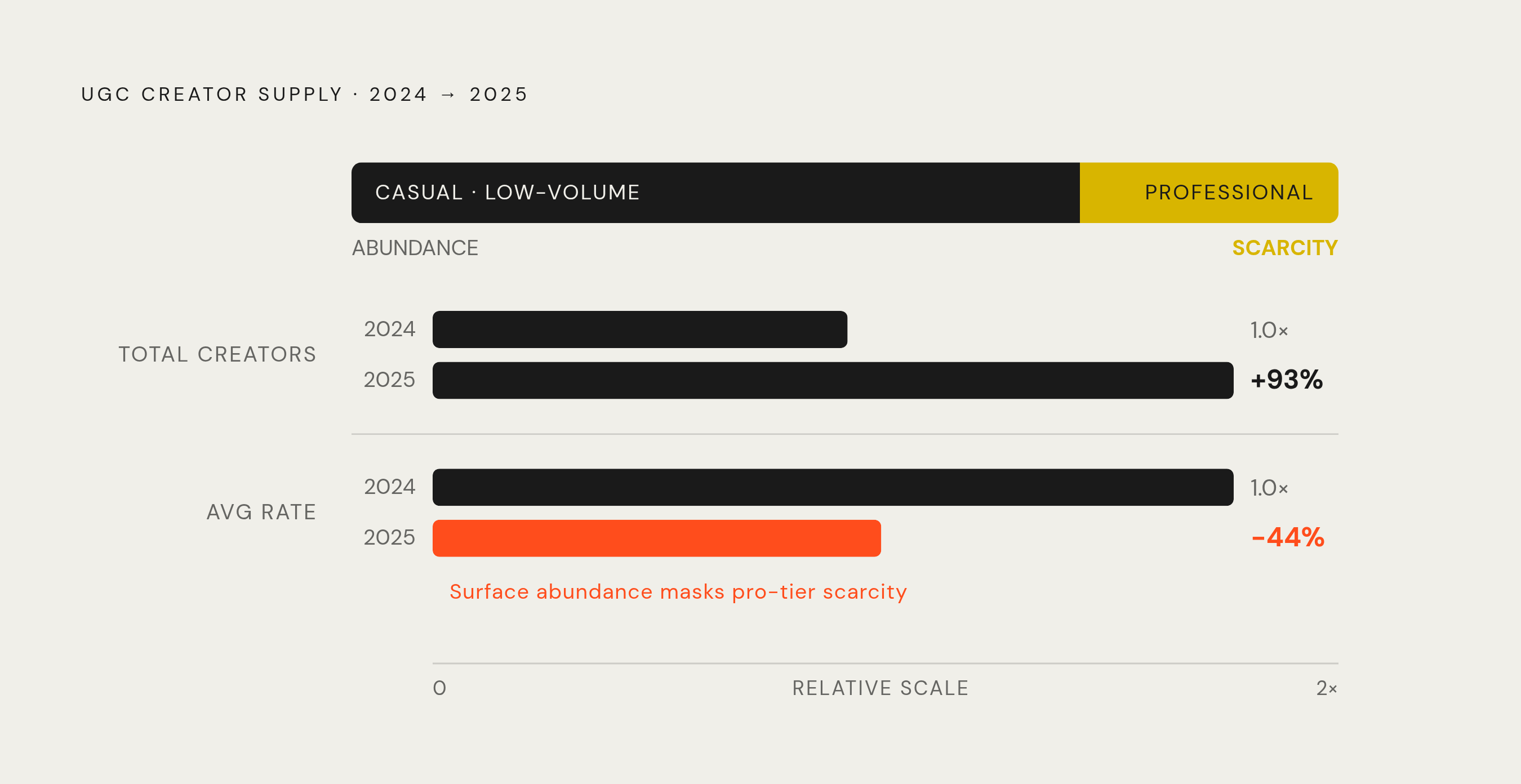
So here's the supply picture, because it's counterintuitive. The number of UGC creators grew 93% between 2024 and 2025. Looks like abundance. But growth is concentrated in casual, low-volume contributors. Professionalized creators, the ones treating UGC as a primary income source who can sustain consistent, high-quality output across months, are becoming scarcer and more contested. Average rates fell 44% in the same period, the steepest pricing decline the industry has seen, driven entirely by a supply glut at the low end. More creators. Lower average rates. And yet the creators brands actually need for high-volume, consistent work are harder to book than they were two years ago.
The surface abundance is actively misleading brands into under-investing in retention at exactly the moment they should be doubling down. The creator middle class is under particular pressure from algorithmic volatility and platform consolidation economics, and many will exit or go inactive rather than persist at unsustainable output levels. Wide, shallow rosters built on casual contributors are precisely the configuration most exposed to that thinning. The real sourcing challenge isn't finding creators; it's identifying which ones are consolidating around sustainable long-term partnerships versus which ones are quietly burning out before you've committed any budget.
The three structural drivers of creator churn in high-volume programs
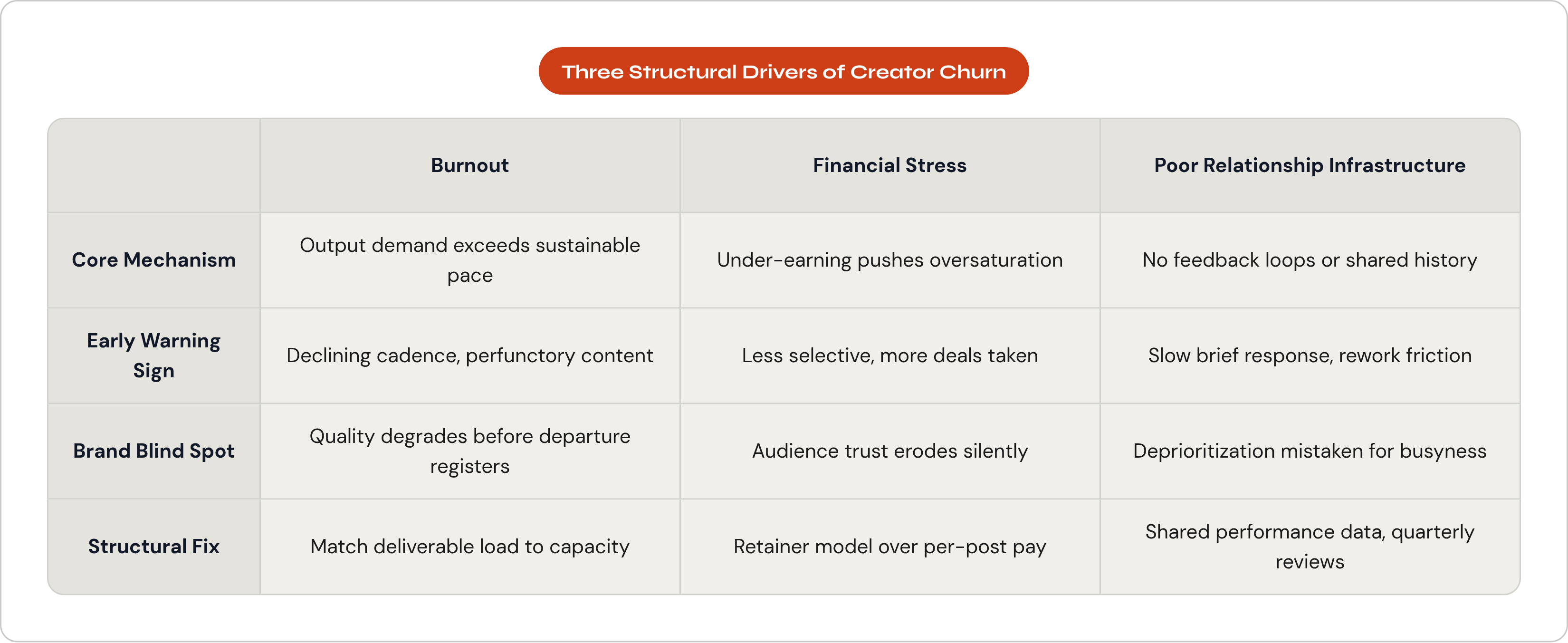
Burnout, financial stress, and poor relationship infrastructure. These three compound each other, which is partly why high-volume programs deteriorate faster than anyone expects.
Burnout
A 2025 survey of a thousand creators across the US and UK, conducted by Billion Dollar Boy, found that 52% reported burnout as a direct result of their careers. High-volume programs demand more consistent output than occasional campaign work by definition, so burnout risk amplifies considerably.
What makes this operationally difficult is that burned-out creators don't quit immediately. They become inconsistent first. Posting cadence drops. Content turns perfunctory. Creative quality degrades in ways that are hard to quantify until you're comparing performance data side by side over time. Audiences notice inconsistency before brands do; community trust erodes before the creator officially churns. By the time a brand registers the quality drop in reporting, the relationship is often too far gone to salvage. The damage precedes the departure by a considerable margin.
Financial stress and rate misalignment
More than half of creators earn under $15,000 a year from content, according to Influencer Marketing Hub's 2025 Creator Earnings Report, up from 48% two years prior. Financially stressed creators say yes more often. They take more deals, become less selective about brand alignment, and oversaturate their own feeds as a survival strategy. That isn't an opportunity for brands to exploit; it's a signal that the audience trust making the creator valuable in the first place is actively eroding. The creator becomes a rotating billboard, and their audience notices.
Rate misalignment is a quieter churn driver, and it's worth separating from burnout because the mechanism is different. Creators who feel underpaid typically don't renegotiate. They deprioritize. Briefs move to the bottom of the queue, response time slows, quality degrades incrementally. The 44% average rate decline has created real market confusion about what fair compensation looks like, which makes it harder for both sides to anchor on terms that can actually sustain a relationship through multiple cycles.
Poor relationship infrastructure
One-off deal structures mean every creator relationship starts from zero: no brand voice familiarity, no shared history of what messaging converts, no accumulated context on either side. There are no feedback loops. Creators don't know what performed, what the brand wants more of, or whether the partnership has any future at all. Slow or unreliable payments communicate, very directly, that the brand isn't operating like a professional partner. That signal drives departure faster than almost anything else.
What it actually costs to keep replacing creators instead of retaining them
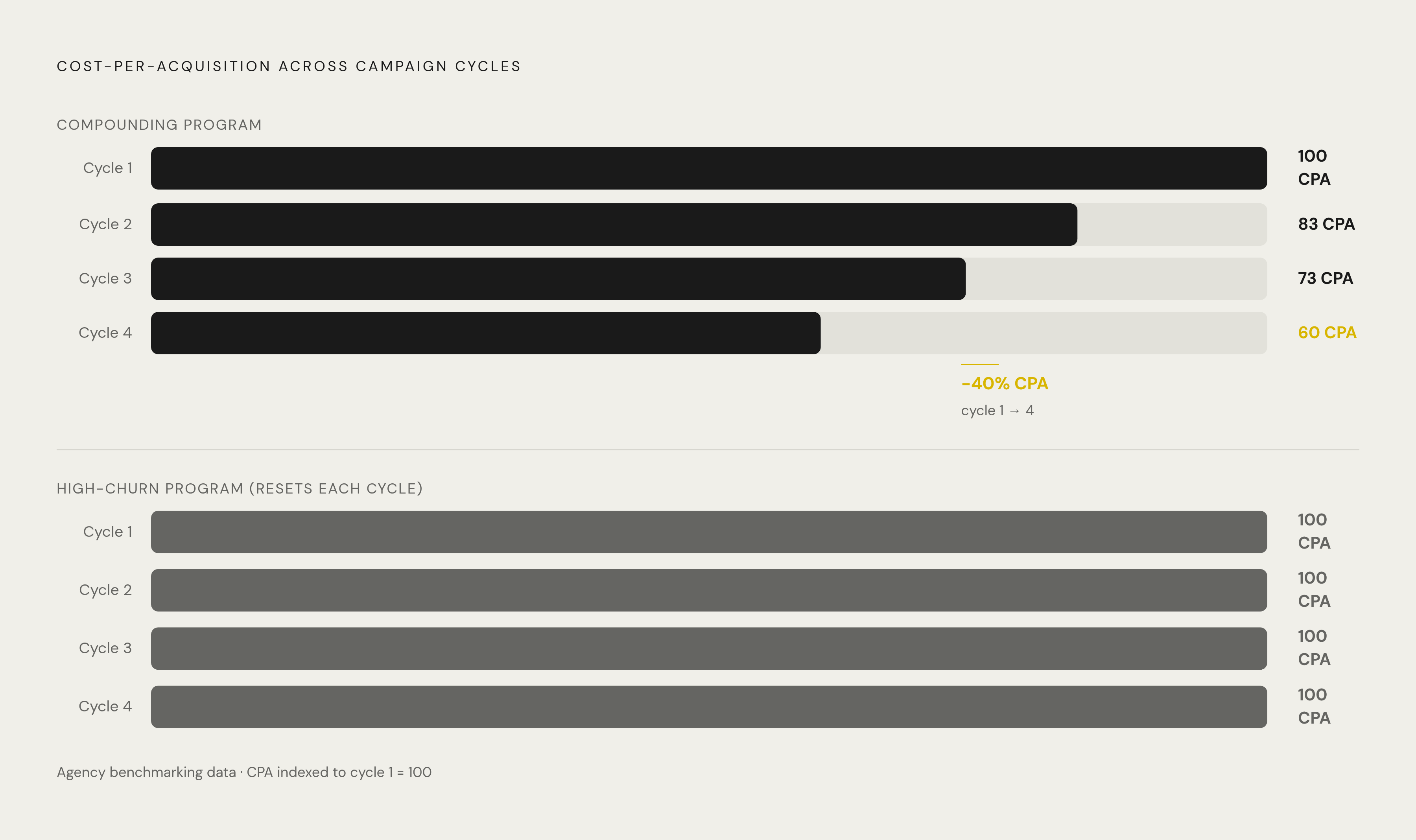
Every new creator relationship starts with a learning curve. No brand voice familiarity, no historical performance data, no pricing leverage built over time. Brands pay a discovery premium with every replacement. Fifty cold starts per quarter across a large roster means funding fifty separate learning curves simultaneously, and there's no compounding happening anywhere in that system.
The compliance exposure is real too. Each new creator onboarded represents fresh surface area: FTC disclosure training required from scratch, new potential for error. Retained creators who've been through the process are structurally lower-risk, and that matters more than most legal teams seem to communicate to the marketing side, given how much regulatory scrutiny on influencer disclosure has increased.
Agency benchmarking data shows cost-per-acquisition improvements of 30 to 50% between a creator's first and fourth campaign cycle. The inverse logic is what should concern brands running high-churn programs: they're paying full discovery cost repeatedly while receiving first-cycle performance. Systematically buying the worst version of every creator relationship, every single time.
The creative compounding effect is harder to quantify but equally consequential. A creator who knows your product, your audience, and your brand voice produces better-performing content faster, and that institutional knowledge disappears entirely when they churn. Research on long-term influencer-acquired customers suggests that 82% of respondents believe those customers demonstrate higher lifetime value and better retention rates than other acquisition channels. Brands measuring only first-purchase revenue are systematically undervaluing their best retained creators, because the downstream compounding doesn't show up in short-window reporting windows. The most valuable performance data sits beyond the measurement horizon most brands use, which means the program is optimizing against the wrong signal without anyone noticing until the numbers look strange.
How to structure a roster so retention is built in from the start
The architectural decisions matter more than the relationship management practices that come later. You cannot manage your way out of a fundamentally misaligned structure, and I've watched enough programs try to do exactly that.
Evergreen agreements over one-off deals. Pre-approved creators under standing contracts with defined deliverable cadences. This eliminates the ramp-up problem and signals to creators that the brand is committed to something ongoing rather than extracting value and moving on.
Retainer structures over per-post payments. Monthly retainers typically yield lower cost per piece of content than per-post rates at scale, and they create mutual commitment: predictable income for the creator, predictable output for the brand. Predictable income directly reduces the financial stress that pushes creators toward oversaturating their feeds, so retainers function as both an economic efficiency and a structural safeguard against the churn dynamics described above.
Roster composition requires deliberate thinking about roles. Micro-influencers in the 10K to 100K follower range generate 36% higher conversion rates than mega-influencers and meaningfully higher average engagement rates, per Influencer Marketing Hub's 2025 data. Each seat on the roster should carry deliverable loads matched to demonstrated capacity; overloading creators is how you manufacture the burnout you were trying to prevent. Amateur creators bring raw authenticity. More professionalized creators handle premium execution. Role clarity makes the whole system run cleaner and reduces the ambiguity that burns people out.
Vet for longevity before onboarding, not just current output quality. Creators already showing burnout signals, declining posting cadence, rising refusal rates, inconsistent quality, display those patterns before you commit budget. Engagement below 0.5% on Instagram or TikTok is a meaningful fraud signal; committing to a creator whose audience is substantially inauthentic isn't a risk, it's a sunk cost dressed up as a partnership.
The relationship management practices that keep reliable creators on the roster
Feedback loops are the most underutilized retention tool in creator programs, and I suspect that's because sharing performance data requires a degree of transparency that brands aren't accustomed to extending to vendors. But creators need to know what performed, not just what was approved. Sharing that data makes creators invested in the outcome in a way that approval alone can't achieve. Quarterly reviews to discuss results, adjust strategy, and align on upcoming goals create a rhythm that treats the relationship as a partnership rather than a procurement transaction.
Payment reliability communicates something far beyond the financial transaction. Creators managing multiple brand relationships will deprioritize the ones that create cash flow uncertainty, and they will not often tell you that's what's happening. How predictably and promptly a brand pays tells creators more about how that brand operates than most brands seem to understand.
Brief quality compounds over time in both directions. Ambiguous briefs create rework friction; repeated rework erodes the creator's experience of the partnership at a rate that isn't visible until they stop responding to messages. Specific, measurable briefs give creators a clear success target and reduce the back-and-forth that makes the relationship feel like more administrative labor than it's worth.
Compensation tied to performance, where appropriate, changes the incentive structure in useful ways. A hybrid model, base creation fee plus a performance commission with tiered bonuses at conversion milestones, aligns creator incentives with brand outcomes. Creators who see real upside in performance are considerably less likely to treat the relationship as transactional. Assembly Global and impact.com's research points toward this structure as one worth examining for programs at scale.
Burnout signals precede departure by enough time to allow real intervention, if someone is actually watching for them. Declining response time to briefs, dropping content quality, increasing renegotiation frequency: these are observable patterns, not mysteries. Brands that catch them early can restructure before the relationship breaks rather than after.
Treating roster retention rate as a performance metric alongside creative output
Most creator marketing measurement clusters around campaign-level metrics: reach, engagement, cost per acquisition, return on ad spend. These are necessary. They're also incomplete if you're running a high-volume roster program and not tracking the stability of the roster itself, because a roster that turns over constantly is a measurement problem before it's a relationship problem.
The metrics worth building into program reporting are fairly specific. Creator retention rate: what share of the roster is still active and delivering at 90 days, at 180 days. Response time to briefs, which slows measurably before creators officially disengage. Repeat participation rate, because creators who keep accepting work are telling you something worth understanding. Output consistency, because cadence drops well before departure.
You cannot track creative performance across campaign cycles if the creator pool keeps changing. Every churn resets the dataset. You're operating on incomplete information about what's actually working, and you're paying to re-learn things you already knew.
If cost per acquisition improves 30 to 50% between a creator's first and fourth campaign cycle, then retention rate is a leading indicator of future creative efficiency. It tells you, in advance, whether the program is building toward that improvement or continuously resetting to baseline. Tracking it alongside output metrics creates the ability to act before efficiency is lost rather than after. The programs that treat roster health as a measurable output, on par with conversion data and creative quality, build something that actually improves over time. The ones that don't are funding the same starting line, repeatedly, and calling it scale.