UGC Content Velocity Benchmarks by Channel

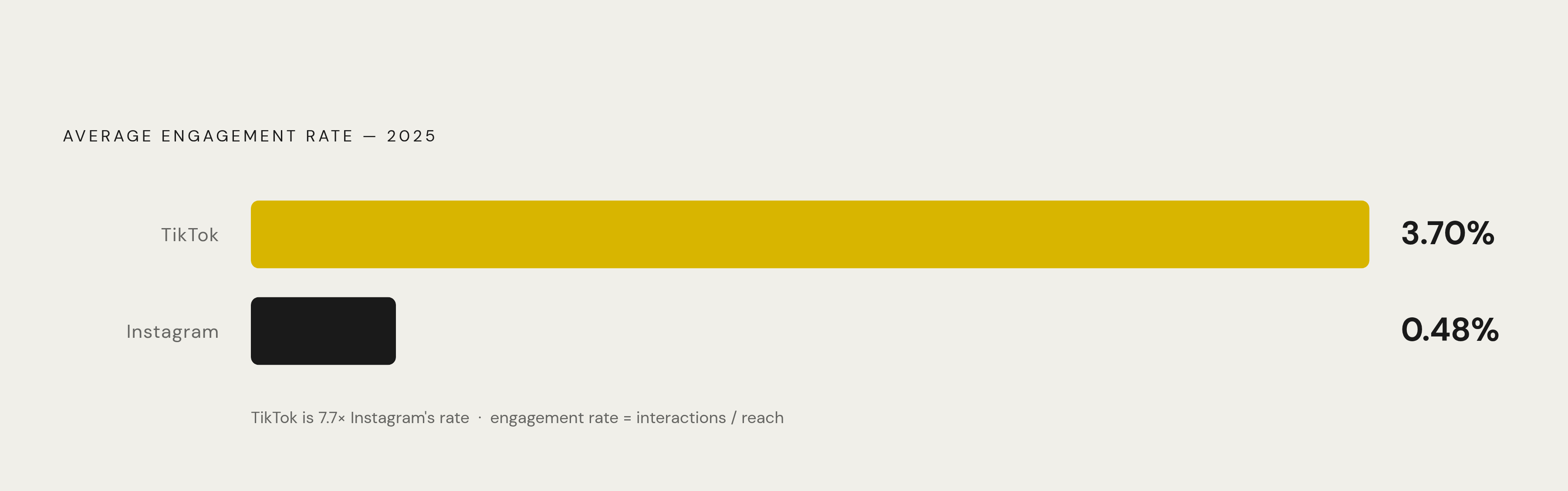
TikTok's engagement ceiling is unlike anything else available right now. Average engagement rates around 3.70% in 2025, compared to Instagram's 0.48%, means the opportunity cost of underperforming here is steeper than anywhere else. What you leave on the table on TikTok is simply worth more.
UGC is not incidental to how TikTok performs. It is the engine. It drives 60% of total TikTok brand engagement, and UGC-format content outperforms brand-produced video by 22%. The platform rewards content that reads like a person made it in their kitchen, not a media department with a shot list. Which puts a certain kind of brand in an uncomfortable position, specifically the kind with instincts toward polish. That instinct works directly against the algorithm.
The velocity number that keeps surfacing in TikTok performance data is three to four UGC posts per week, minimum. To understand why that frequency matters, we must first look at how the algorithm actually works: it surfaces novelty, not authority. Each new asset is evaluated on its own merits. There is no accumulated credit from yesterday's video. That is categorically different from search-based channels, and it demands a categorically different production posture.
For brands in paid social, TikTok anchors a significant asset requirement: 20 to 50 new creative pieces per month across short-form channels to avoid ad fatigue. That number sounds steep until you actually map it against the mechanics. You are not recycling. You are rotating.
Format specificity matters as much as frequency. Hooks and transformation content work in the five to seven second range. Tutorials and feature explanations perform well at 27 to 35 seconds. In-depth reviews with real context can sustain 55 seconds or longer. These are not arbitrary brackets; they reflect where audience retention actually drops and what the algorithm infers about content quality from that drop. Brief creators to shoot two to three hook variations per video. You multiply usable assets without adding briefing cycles.
There is a cost argument here that rarely gets surfaced directly. Organic creator CPM on TikTok, for brands running high-volume content, can reach as low as $1.62 across tens of millions of views, compared to paid in-feed CPMs ranging from $5 to $30. Volume of organic UGC is, in significant part, a cost-efficiency play dressed up as brand strategy.
TikTok cannot be sustained by one creator or by monthly campaign bursts. The algorithm penalizes a single voice posting at inconsistent intervals more than almost any other pattern. A roster producing concurrent assets across a continuous cycle is a structural requirement, not an optimization.
Instagram: Balancing Reels Velocity with Stories Frequency and Feed Quality
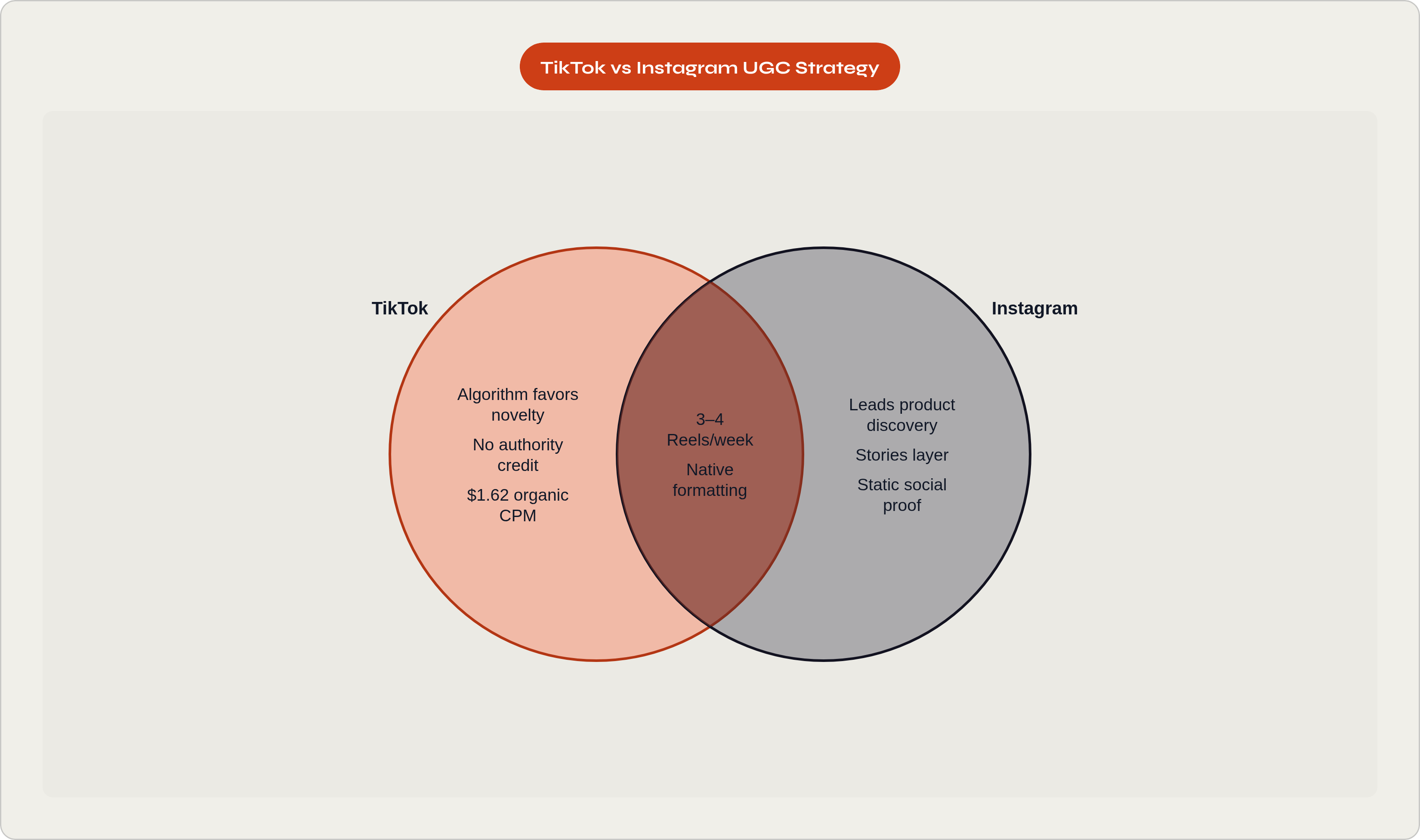
Instagram sits at an interesting intersection. It leads UGC-driven product discovery at 62%, ahead of Facebook at 53% and TikTok at 52%. The channel carries awareness and conversion weight simultaneously, and the format mix reflects that dual function in ways that are easy to misread.
Reels are the anchor. They outperformed single-image posts by 55% and standard video posts by 29% in 2024. That gap is large enough to settle the format debate. Velocity budget should concentrate in Reels, tracking close to TikTok's cadence: three to four per week for an active program.
Stories are a different layer, not a competing one. They deliver engagement rates 2.5x higher than benchmark in performance campaigns, and the format expectations are considerably lower, which matters a lot for production planning. The 24-hour lifespan means tolerance for repurposed or lighter-touch content is notably higher. Stories absorb frequency without the same creative burden Reels require.
Static UGC, customer photos, screenshot reviews, before-and-afters in a carousel, still earns its place for social proof. Posts with UGC are projected to earn roughly 70% more engagement than traditional brand posts in 2025. Static formats are not the velocity driver; they are the credibility layer underneath it.
One practical trap worth naming directly: re-uploading TikTok watermarked content to Instagram suppresses Reels reach. Instagram's algorithm penalizes content it can identify as originating elsewhere, because the platforms compete for the same creators and the same audience time. Velocity budgets cannot be shared one-to-one between TikTok and Instagram. Assets must be natively formatted for each, which means the brief and the production line are distinct, even when the creator is the same person.
Instagram needs a tiered brief. One cadence governs Reels production; a separate, lighter-touch cadence governs Stories repurposing and customer content reuse. Treating them as the same format bucket reliably produces mediocre performance in both.
YouTube and YouTube Shorts: Longer Cycles, Higher Proof Requirements, and a Different Kind of Velocity
YouTube operates on a fundamentally different clock. Conflating it with TikTok or Instagram is one of the more common and costly miscalibrations in UGC program design, and it usually shows up quietly, either as chronically underfunded YouTube content or as rushed reviews that actively damage credibility.
Long-form YouTube UGC, product reviews, tutorials, unboxings, before-and-after narratives, generates roughly 10x more views than branded content in some performance comparisons. Review-format videos earn three times longer watch time than traditional ads. More importantly, a well-indexed YouTube review compounds in value over months, sometimes years, because it is discoverable through search long after its posting date. It is the only UGC channel where a single asset keeps generating organic discovery traffic well beyond its publication window. That changes the return calculation considerably. One well-crafted YouTube review, indexed properly and earning steady session depth, can outperform a dozen rushed ones over an 18-month window.
Because of that durability, posting frequency matters less here. One to two substantive long-form pieces per month per creator relationship is defensible. The algorithm rewards watch time and session depth. Rushing the cadence at the expense of narrative quality is a bad trade on this platform in a way it simply is not on TikTok, where a mediocre 30-second clip gets deprioritized and the next one gets its own shot.
YouTube Shorts changes the calculus. Shorts follow short-form logic closer to Reels and TikTok: higher frequency, faster iteration, format expectations that prioritize hook strength over production depth. They should be treated as a separate content stream with their own brief structure, not as a preview or supplement to long-form reviews.
YouTube UGC briefs need to support longer narrative arcs. Creators need real prep time. Approval cycles are longer because the content is longer. Velocity here is constrained by the quality floor the format demands, not by a team's willingness to produce volume. That is a real constraint, not a workaround.
YouTube UGC works best inside a longer-term engagement model with creators. One-off briefs rarely generate the depth the format demands, and the search indexability of well-produced reviews makes that sustained relationship worth the investment.
Paid Social Amplification: When Organic UGC Becomes a Whitelisted Asset and What That Does to Velocity Requirements
Whitelisting is where organic UGC production connects directly to paid media performance, and the performance differential is not marginal.
Running a creator's organic post as a paid asset from the creator's handle, rather than the brand's, consistently outperforms equivalent brand-run creative. Meta's 2024 Creative Best Practices data found UGC-style ads produce 29% higher click-through rates and 4.5 times more comments than traditional brand ads, alongside a 50% reduction in cost-per-click compared to non-UGC ads. That is a structural performance difference, and it compounds as creative fatigue degrades older assets.
A whitelisted asset has a finite lifespan before audience fatigue degrades its performance. Media buyers know this empirically: running the same UGC ad creative for four or more weeks typically produces measurable decline. So a steady pipeline of fresh UGC is not optional for any brand running paid social at meaningful scale. The 20 to 50 asset-per-month figure is, in reality, primarily a paid social requirement. Organic posting alone does not exhaust creative that fast.
It is also worth considering a production model for paid pipelines: roughly 70% AI-assisted or high-volume UGC for testing and rotation, with 30% authentic creator UGC reserved for highest-converting placements. Traditional creator UGC maintains higher absolute conversion rates. AI-assisted UGC delivers cost efficiency and speed for the testing layer where you are buying data, not conversions. The split is an allocation strategy, not a concession.
Brands running paid social need to think of their creator program as a content production pipeline, not a series of campaign moments. Roster size and brief cadence should be calibrated against the asset volume the paid channel requires, not just what feels manageable for the organic calendar.
Email: The Under-Used Channel Where UGC Velocity Is Low but the Conversion Payoff Is Disproportionate
UGC in email boosts click-through rates by 78%, yet only half of marketers currently use UGC in email campaigns. That raises an important question: why does the gap between what the data suggests and what most programs actually do remain so wide? The most likely explanation is mundane — email teams and social teams rarely share the same asset library, even when they are working toward the same conversion goal. The assets exist somewhere in the organization. They just never make it into the send template.
Email UGC is structurally different from social UGC in one important way. Email audiences are opted-in, relationship-based, and sensitive to repetition in a specific manner. On TikTok, a repeated creative format is a test variation. In email, the same review appearing across multiple sends reads as lazy curation, and it erodes the credibility the review was supposed to build. Content fatigue in email looks like distrust, not just disengagement.
The practical velocity target reflects this: one to three fresh UGC assets per send cadence. What performs well in email is specific. Product reviews tied to the SKU featured in that send. Customer photos showing real-world use in a context relevant to the recipient's stage in the funnel. Short testimonials that address the objection most likely to block conversion at that moment. A generic five-star quote does far less work than a specific review that answers a real hesitation the reader already has.
Email is also one of the most direct attribution environments available. UGC click-through performance is measurable send by send, which makes it a useful calibration channel for understanding which UGC formats actually convert, not just which ones generate impressions.
The operational efficiency here is real. Email UGC does not require a separate creator brief or a parallel production line. It draws from the same asset library the paid and organic channels already produce. If the broader program is running, email becomes a near-zero-marginal-cost layer. The assets exist. Someone just needs to curate them into the send.
SEO and On-Site: The Slowest-Building UGC Channel with the Longest Compounding Return
The search landscape is shifting in a direction that should matter to any brand that has not yet thought of its UGC library as a search asset. Thirty-one percent of first-page search results are now user-generated content, up from 25% the prior year. Customer review pages and Reddit threads outrank brand pages in 44% of product keyword searches. That is a meaningful structural change in how search surfaces authority, and most brand SEO strategies have not caught up to it.
On-site, the performance data is direct. UGC boosts blog organic traffic by 45%. Product reviews increase on-site conversions by 74%, and revenue per visitor climbs significantly with UGC implementation. These numbers do not come from social reach or brand awareness. They come from people who arrived at a product page and were deciding whether to buy.
The velocity logic here is inverted relative to social. Volume is not the primary lever. But what if a brand chases volume anyway? A high volume of low-quality reviews produced quickly does less than a steady cadence of substantive, specific reviews that search algorithms and prospective buyers both find credible. Five hundred generic four-word reviews contribute noise. Thirty detailed reviews that describe specific use cases, name specific product features, and answer real objections contribute signal.
The practical target is about architecture, not sprint volume. Consistent review solicitation triggered automatically post-purchase, rather than manual asks clustered around campaign moments, allows review volume to compound continuously. The reviews accumulate. Page authority builds. Product keyword rankings improve over months without requiring a corresponding increase in production spend.
That long-compounding dynamic distinguishes this channel from everything else. A well-indexed product review page or UGC-rich Q&A section continues generating organic traffic and conversion lift for months or years after it is built. The velocity target is not about feeding an algorithm's weekly appetite; it is about building a durable asset base that does not depreciate.
On-site UGC collection should run as a continuous background process. It does not compete with social or paid channels for production resources; it feeds off the same customer base those channels activate, which means it scales as the broader program scales, without proportionally scaling the cost.
How Channel Velocity Targets Translate into a Production System
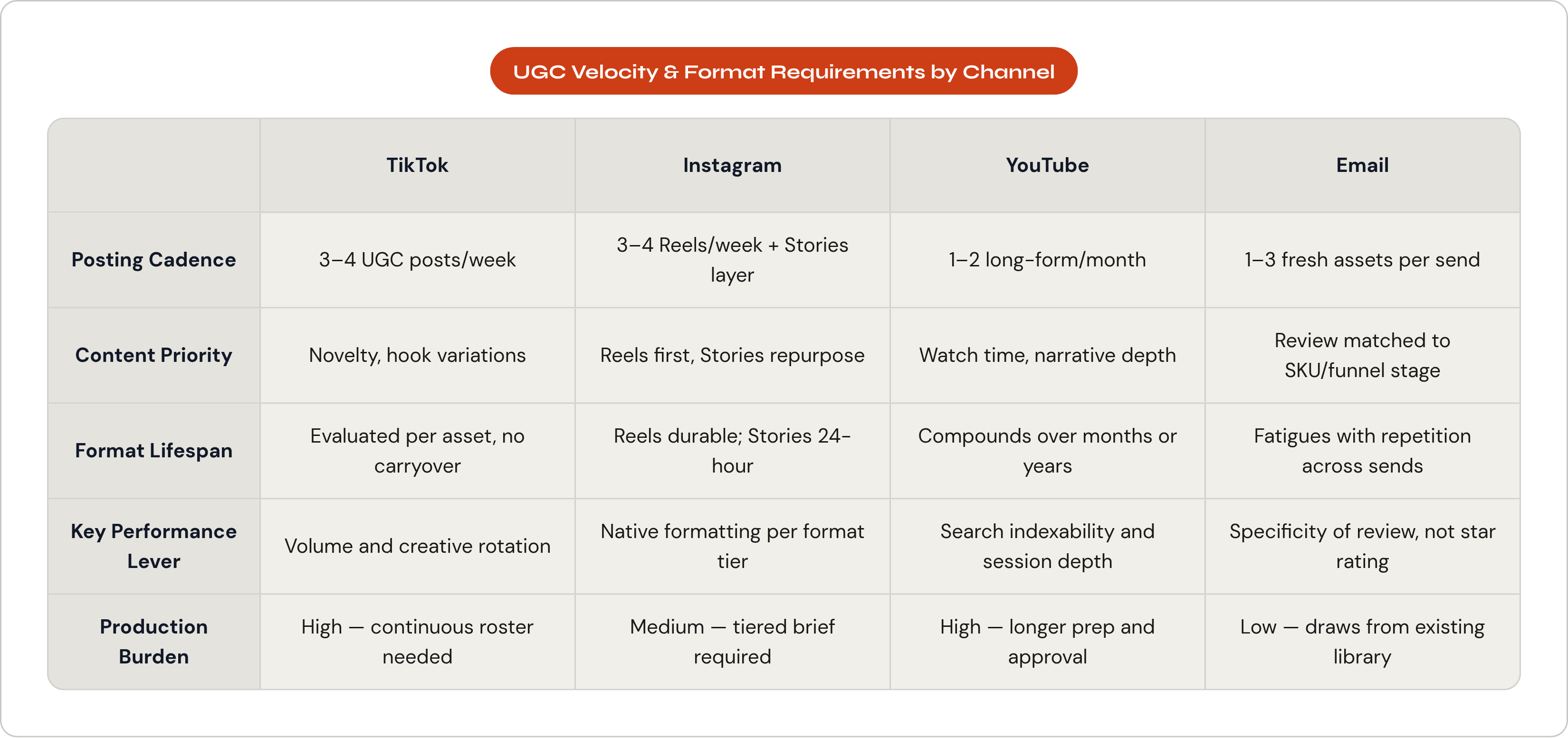
The channel targets above are only useful if there is a system behind them. The most common place that system breaks down is the brief, and it breaks down earlier than most teams expect.
Seventy-two percent of brand-creator disputes in 2025 research stem from vague or missing content guidelines. A bad brief does not just produce bad content; it slows the entire pipeline while revisions cycle back and forth, which is the part teams tend to underestimate. The brief structure that enables velocity without sacrificing quality has a specific shape: campaign goal, target audience, hook options rather than a locked script, scenario starters the creator can interpret, and format specifications per channel. Asking creators to produce two to three hook variations per video multiplies usable assets without multiplying briefing cycles. That single structural adjustment is among the highest-leverage changes a program can make.
Roster sizing follows directly from the velocity math. TikTok and Instagram Reels at three to four posts per week each, plus a paid asset rotation requiring 20 to 50 pieces per month, means a single creator cannot sustain the required volume. A roster of roughly ten micro-influencers typically outperforms one macro creator at the same budget, and it provides velocity resilience: if one creator underdelivers or churns, the others offset it.
Approval and payment friction are velocity killers that rarely appear on a content calendar until the damage is done. Forty-one percent of creators cite payment delays as their primary frustration with brand partnerships. Slow payment slows future delivery because it signals unreliability, and creators deprioritize unreliable partners in ways that are difficult to reverse once the pattern is established. Seventy-six percent of brands now use dedicated management platforms to organize creator relationships because the operational overhead of briefing, contracts, approvals, and payments is a real velocity constraint when it falls on an overextended brand team.
The brands that win on UGC are not those with the best individual asset. They are those with the best system for producing, testing, and iterating on assets at channel-appropriate cadence. A single great video is a moment. A production architecture that reliably generates channel-appropriate volume at a consistent rate accumulates. It is also, notably, much harder to replicate than any individual piece of content, which is precisely what makes it worth building.