How to Write a UGC Creator Brief That Gets On-Brand Content
Trust creators with context, not scripts, so recommendations feel genuine rather than manufactured.

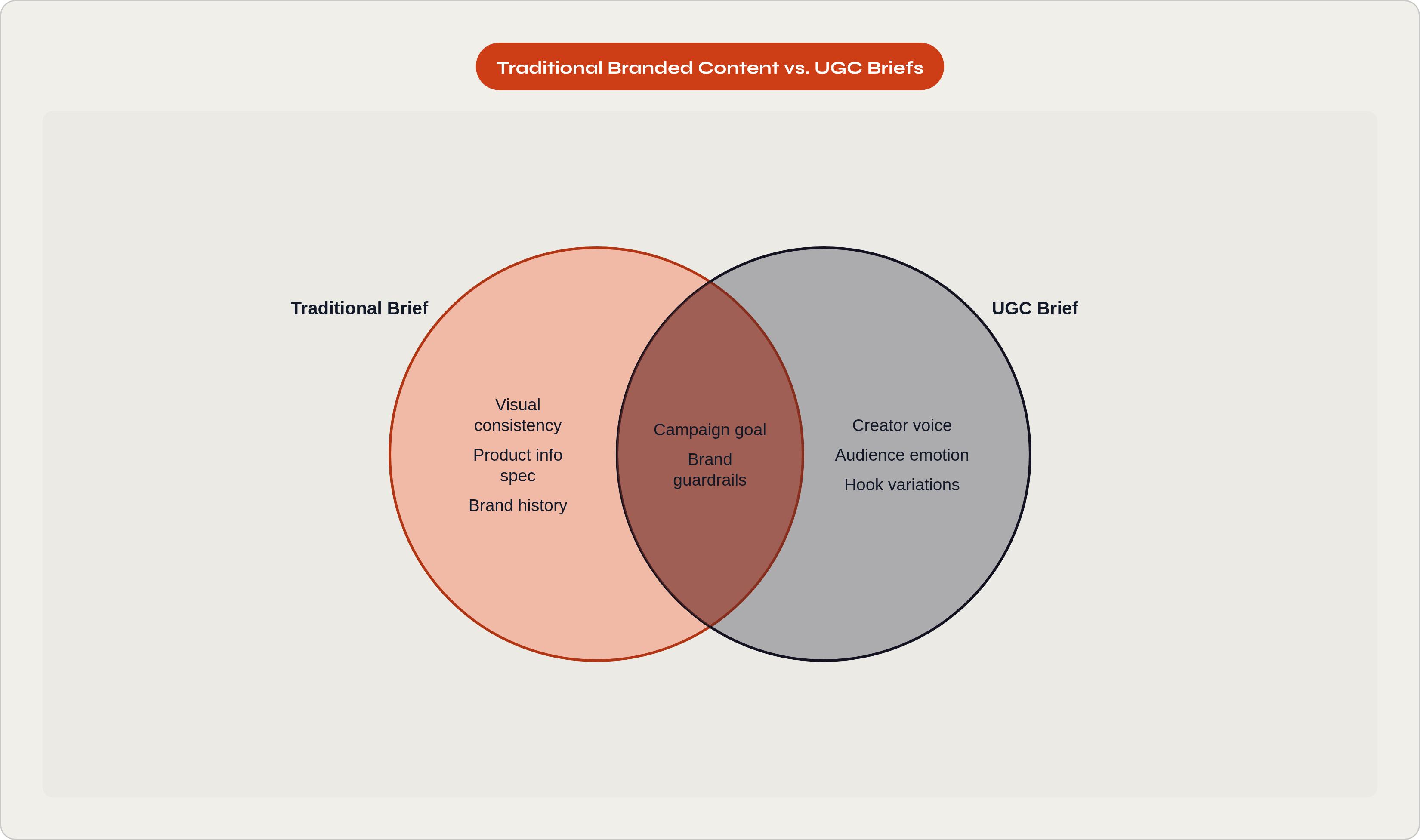
Traditional branded content briefs are primarily concerned with visual consistency and product information. A UGC brief has a different job. It's not trying to produce a controlled execution; it's trying to create conditions under which an actual person can make a genuine-feeling recommendation that happens to serve the brand's goals.
The entire value proposition of UGC rests on trust. Consumers trust peer recommendations at dramatically higher rates than they trust brand messages, and the moment content starts reading like a press release with a human face in front of it, that trust premium evaporates. You've seen this happen. The creator is clearly reading from something, or the product mention lands with the cadence of a legal disclosure, and you feel the artifice before you can even name it.
UGC creators are not art directors executing a visual spec. They are translators. They take a brand's goals, run them through their own voice and lived experience, and produce something that feels native to how people actually communicate on these platforms. Unlike influencers, they don't need a social following at all. The deliverable is the asset. You're not buying their audience; you're buying their ability to produce content that feels like a real person talking.
What this means practically is that a UGC brief has to trust creators with context, not just instructions. A creator who understands the audience's actual problem, the product's positioning, and the campaign's objective can make their own creative decisions, and those decisions will usually outperform a moment-by-moment script. The brief's job is to create conditions for good creative instincts to activate, not to choreograph every movement.
That distinction matters more than most brands realize when they sit down to write one.
Grounding the Brief in Audience and Campaign Purpose Before Any Creative Direction
Before you write a single creative spec, a creator needs to know three things: who the brand is, who the customer is, and what this particular campaign is actually trying to accomplish. Everything else in the brief is derivative of these.
Campaign purpose shifts creative instincts in ways that aren't always obvious. A brief driving trial looks different from one driving app downloads, which looks different from one building awareness among a cold audience. Pacing, emotional register, the amount of product detail, the urgency of the CTA: all of these calibrate differently depending on where in the funnel you're working. Leave this ambiguous and creators will guess, and they will guess differently from each other.
Audience definition is where most brands go wrong. They write demographic data: age, gender, geography, income range. None of that tells a creator why someone would stop scrolling. What you actually need to communicate is the emotional state of the target customer: the problem they're trying to solve, the language they use to describe it, what makes them trust a recommendation from a stranger online. A creator who understands that the viewer is a sleep-deprived parent who has tried four different products and been disappointed will write a fundamentally different hook than one who only knows the viewer is "adults aged 25 to 40."
What belongs in this section: a two- to three-sentence brand description, not a founding story; the specific campaign goal and how you'll know if it worked; a crisp audience sketch that includes emotional context; and the single most important thing you want a viewer to walk away believing or feeling.
What doesn't belong: exhaustive product catalogs, company history, vague adjectives like "innovative" or "passionate" that give a creator nothing to work from.
There's also something less tangible happening in this section. A creator who reads a brief and thinks, "this brand actually understands its customer," is going to invest meaningfully more in the execution. That's not a soft benefit.
Specifying Deliverables Precisely Enough That There Is No Room for Misinterpretation
Ambiguity in deliverables is expensive. This section of a brief should be written so that a creator who has never worked with your brand before can produce exactly the right asset without asking a single clarifying question.
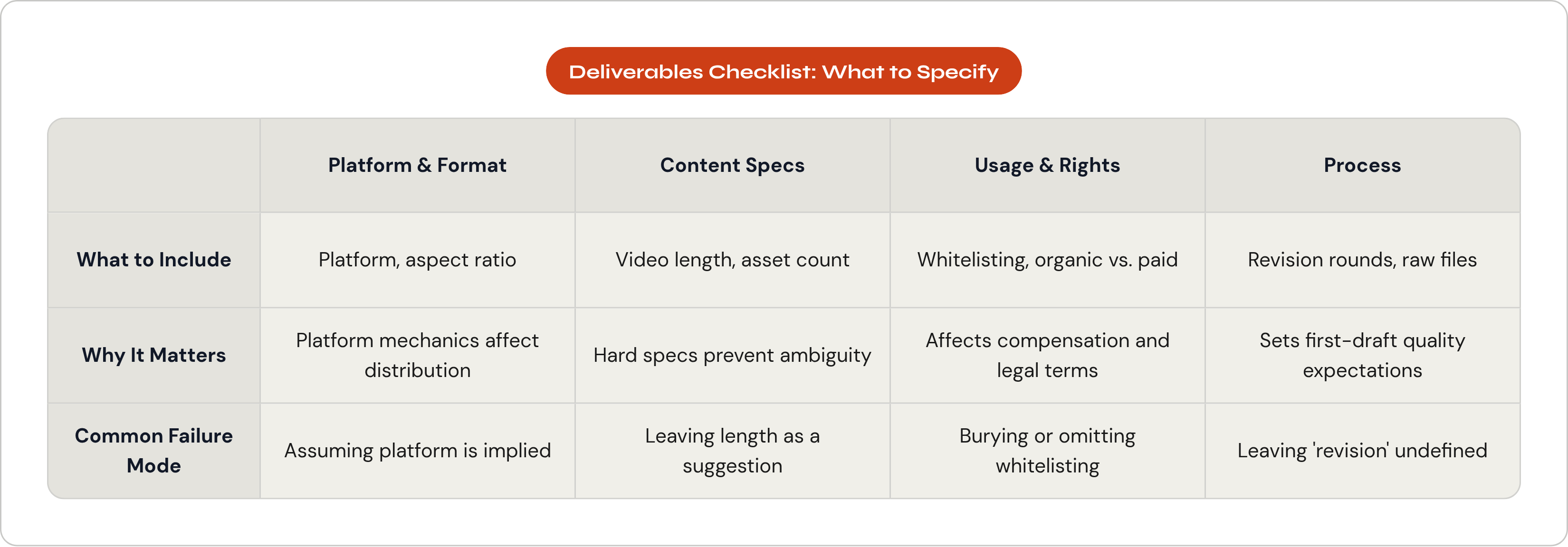
Platform-specific length norms belong here as hard specs, not suggestions. Narrative-driven content on TikTok performs in the 21 to 34 second range. Instagram Reels favors rapid visual pacing in the 15 to 30 second window. YouTube Shorts' looping behavior makes staying under 60 seconds critical. These are platform mechanics that affect distribution, not stylistic preferences.
Specify whether you need raw files, b-roll, multiple hook variations, or a clean ending for captioning. Specify whether you'll be using this content for paid amplification, including whitelisting. This is the detail brands most frequently bury or omit. It matters because it affects creator compensation expectations and legal agreements. Discovering at the end of a project that you want whitelisting rights when the creator assumed organic-only use is an expensive surprise for everyone involved, and it's entirely avoidable.
State your revision policy explicitly: how many rounds are included, and what constitutes a revision versus a new deliverable. A creator who understands that "one revision round" means one set of consolidated notes, not an ongoing back-and-forth, will produce more complete first drafts.
A checklist or table format works better here than prose. It's harder to misread a row in a table than a subordinate clause buried in a paragraph.
Writing the Hook Section of the Brief: The Highest-Leverage Creative Decision in the Document
The first three seconds of a short-form video determine whether it survives the scroll. Watch time signals to platforms that content is worth distributing, and watch time is lost or won in the opening moments. The hook section of a brief deserves its own heading and its own real estate, not a bullet point under "creative direction."
Ask each creator for three distinct hook variations for the same underlying video. This generates a testable pool of entry points before you commit paid amplification dollars to any single version, and it gives the creator room to explore rather than anchor on their first instinct. The hook that converts best is rarely the obvious one. The safe, expected hook underperforms the one the creator almost didn't submit. That pattern is consistent enough that you should build for it structurally rather than hoping for it accidentally.
A hook should run no longer than five seconds. Anything beyond that is already the body of the video.
Types of hooks worth suggesting or specifying: a bold visual action or physical movement that interrupts the expected pattern; a provocative question that names the viewer's specific problem; a surprising or counterintuitive claim about the product; direct address, as in "If you are a [specific identity], watch this."
Provide two or three hook concepts in the brief as starting points, framed explicitly as starting points. These show the creator the style of entry you want, the emotional register, the level of directness, without mandating the exact phrasing. A creator who writes their own variation on a provided concept usually produces a better hook than one who reads yours verbatim.
The thing to avoid: vague direction like "make it attention-grabbing." That tells an experienced creator nothing and gives a newer creator nothing to reach for.
Structuring the Video Arc, Body and CTA, So Creators Know What Must Happen and in What Order
The structural skeleton that consistently performs across platforms is: hook, then problem or context, then product as solution, then CTA. That order exists for a reason. It mirrors the cognitive arc of a persuadable viewer: you earn attention, you establish stakes, you offer resolution, you direct action. Deviating from this without a specific rationale usually produces content that feels disjointed.
In the body section of the brief, distinguish clearly between required talking points and flexible ones. Required means: a specific product claim, the product name mentioned at least once, a disclosure statement. Flexible means: which feature to lead with, how to demonstrate the product, what personal angle to take. This distinction tells the creator where they must stay in the lane and where the lane is wide open for their own voice.
The most common failure mode here is demanding that creators mention every product feature within a 30-second window while also being "authentic and raw." These are contradictory instructions. A creator who tries to honor both will produce stilted, rushed content that sounds like a press release someone memorized on the drive over. And consider what that costs: if the brief was supposed to create conditions for authentic content, overloading the talking points section quietly breaks that promise before a single frame is recorded.
The CTA should be five seconds or shorter and should specify the exact action: link in bio, use code X, swipe up. Do not leave this to creative discretion.
For newer creators, a scene-by-scene breakdown is useful scaffolding. For experienced UGC creators with a strong production instinct, a talking points list and a structural frame produces better results than moment-by-moment choreography, which tends to make their delivery sound performative rather than natural. Know which creator you're working with before you decide how granular to get.
Communicating Tone and Brand Guardrails Without Turning the Brief Into a Restrictions Manual
The most common guardrails failure is a long list of prohibitions that signals distrust and teaches creators what to avoid without showing them what to reach for. Creators who read a brief dominated by don'ts feel managed rather than partnered, and the content reflects that relationship.
Tone is better communicated through examples than adjectives. Link two or three reference videos that represent the creative energy you want. These don't need to be your own content; they often work better when they're not. "Feels like this" is more directive than "conversational but professional," which every brand thinks describes them and which means almost nothing in practice.
Guardrails that are legitimate and necessary: claims the brand legally cannot make; competitor mention policy; product use contexts that are off-limits; FTC disclosure requirements. State these briefly and clearly.
Then, immediately after, state explicitly what the creator owns: their personal story, their camera style, their pacing, the way they choose to demonstrate the product. Billo has documented from their creator network that what creators most want from brand partnerships is clear briefs, real creative freedom, and realistic expectations. The guardrails section is where brands either earn or lose that goodwill, and it shows up directly in the quality of the work.
Ending this section with what the creator controls isn't a nicety. It's what transforms a restrictions list into a brief a creator actually wants to work from.
Matching the Brief to the Creator: Why the Same Document Shouldn't Go to Everyone on Your Roster
Sending an identical brief to a first-time UGC creator and a creator with two years of brand partnership experience produces different problems in each direction. The first creator gets overwhelmed or misses the nuance; the second gets micromanaged and produces something that sounds scripted.
Nano-creators, those with smaller audiences and engagement rates that often climb into the high single digits or above, bring authenticity and audience trust. They typically need more structural scaffolding in the brief because they are less practiced at independently translating brand goals into content. Explicit structure helps them; it doesn't constrain them the way it does someone who has already internalized the format.
Experienced UGC creators often do their best work from a talking points list, a structural frame, and room to move. Over-directing them produces content that sounds like they're reading from something, because they are.
Before you brief anyone, verify: engagement quality, not just rate, since comments reveal whether the audience is actually paying attention; style alignment between what their content already is and what your brief will ask for; past brand work and whether this creator executes well on direction or does their best work unstructured; and audience demographic match with your target customer.
Sudden, dramatic follower spikes or engagement rates below one percent are disqualifying signals. No brief quality compensates for a creator whose audience is disengaged or inauthentic.
The brief is also the first real communication in a creator relationship, and its tone sets the dynamic. A brief that reads like a legal document communicates distrust. A brief that gives creators real context and real latitude produces higher acceptance rates and more invested execution. The difference usually shows up in the first draft.
Using the Brief as a Testing Instrument, Not a One-Time Document
The brief doesn't retire when the creator delivers. It becomes a hypothesis to evaluate against performance data.
Every structural element of the brief is a variable: hook approach, product claim sequence, CTA phrasing, tone, scene structure. Any of these can be isolated and compared across creator outputs. Asking each creator for three hooks isn't just good production practice; it generates a testable pool that reveals which entry points actually convert before paid amplification commits budget to a single version.
The feedback loop works like this: the brief goes out, content is produced, top performers are identified, the brief is updated to encode what worked, and the next cohort of creators starts from a higher baseline. This is how repeatable performance gets built, not by trying to replicate a single video that went well, but by reverse-engineering the brief conditions that produced it.
There's also a quieter failure mode worth naming. A brief that goes unrevised for months starts encoding outdated assumptions, locking in what worked six months ago while the platform and audience have shifted underneath it. Stale briefs are harder to spot than bad ones because the content still looks competent; it just slowly stops converting.
For teams running high-volume programs across multiple campaigns simultaneously, the brief needs to be modular. Core elements stay stable: brand overview, audience sketch, structural frame, legal guardrails. Hook and tone sections rotate based on what the data is actually showing. This keeps the template useful without letting it calcify.
Treated this way, the brief accumulates institutional knowledge. Every iteration captures something the brand has learned about what resonates with its audience, and that learning compounds.
What a Complete Brief Looks Like in Practice: A Working Template With Annotations
Here is how a complete, functional brief is structured, with notes on what each section is actually doing.
Brand Overview
Two to three sentences. Who the company is, what the product does, and why customers choose it over alternatives. Not a brand history, not a tagline. Orientation, written for someone who has never heard of you.
Campaign Goal and Success Metric
One sentence stating the objective, one sentence stating how you'll measure it. "Drive first-time purchases" is a goal. "Drive first-time purchases; success is measured by conversion rate on the landing page linked in bio" is a campaign goal with a success metric. Creators who understand how success is measured make better creative decisions about emphasis and urgency.
Target Audience Sketch
A short paragraph, not a demographic table. A person: who they are, what problem they're trying to solve, what makes them trust a recommendation. This section and the hook section are the two places in the brief where length is a feature, not a liability.
Deliverables
A table or checklist: platform, format, aspect ratio, video length, number of assets required, raw file requirements, b-roll requirements, usage rights including whether whitelisting is involved, revision rounds. The failure mode here is treating any item as self-evident. Nothing is self-evident to someone new to your brand.
Hook Section
Two to three starting concepts written out as examples of the style, not as mandatory scripts, plus an explicit instruction to deliver three variations. Providing examples shows creative register; requiring variations creates a testing pool. Both are doing specific work.
Video Arc: Talking Points by Section
Organized as: hook talking points (required), body talking points with required ones flagged and flexible ones labeled as flexible, CTA with exact phrasing or instruction. The failure mode is listing seven required product claims for a 30-second video. Choose. The creator cannot solve a problem you created in the brief.
Tone and Reference Videos
Two to three linked examples, one sentence of guidance if absolutely needed. If you've chosen the right reference videos, you almost don't need words.
Guardrails
A short list: what cannot be claimed, competitor policy, off-limits contexts, disclosure requirements. Immediately followed by what the creator owns: their voice, their camera style, their personal framing. Ending this section with what the creator controls is what transforms a restrictions list into a brief a creator actually wants to work from.
Timeline and Revision Policy
Dates, turnaround windows, revision round count, and a clear definition of what constitutes a revision. Mismatch between timeline and compensation is the most common reason experienced creators decline briefs. Catching it here is far cheaper than catching it after the brief is sent.
For teams managing twenty or more creators, or running campaigns across multiple product lines simultaneously, building and iterating this system in-house while also managing production, creator relationships, and performance analysis is a real operational load. Partners who integrate brief development, creator matching, and performance feedback as a unified function rather than three separate workstreams can meaningfully compress the iteration cycle. Billo operates as that kind of integrated system, which is worth knowing about if the internal bandwidth to build and maintain this infrastructure doesn't currently exist.
The brief is how a brand thinks out loud about its audience. Get that part wrong and everything downstream is already compromised.