UGC Creator Retainer Agreements for Consumer Brands
Retainer deals reward creative consistency, not follower count—here's how to structure them.

A UGC retainer is a recurring monthly agreement where a brand pays a creator a fixed fee for a guaranteed volume of content assets on a predictable schedule. That much is straightforward. What's less obvious, and where most brands lose the thread before they've even opened a contract template, is understanding what a retainer is not.
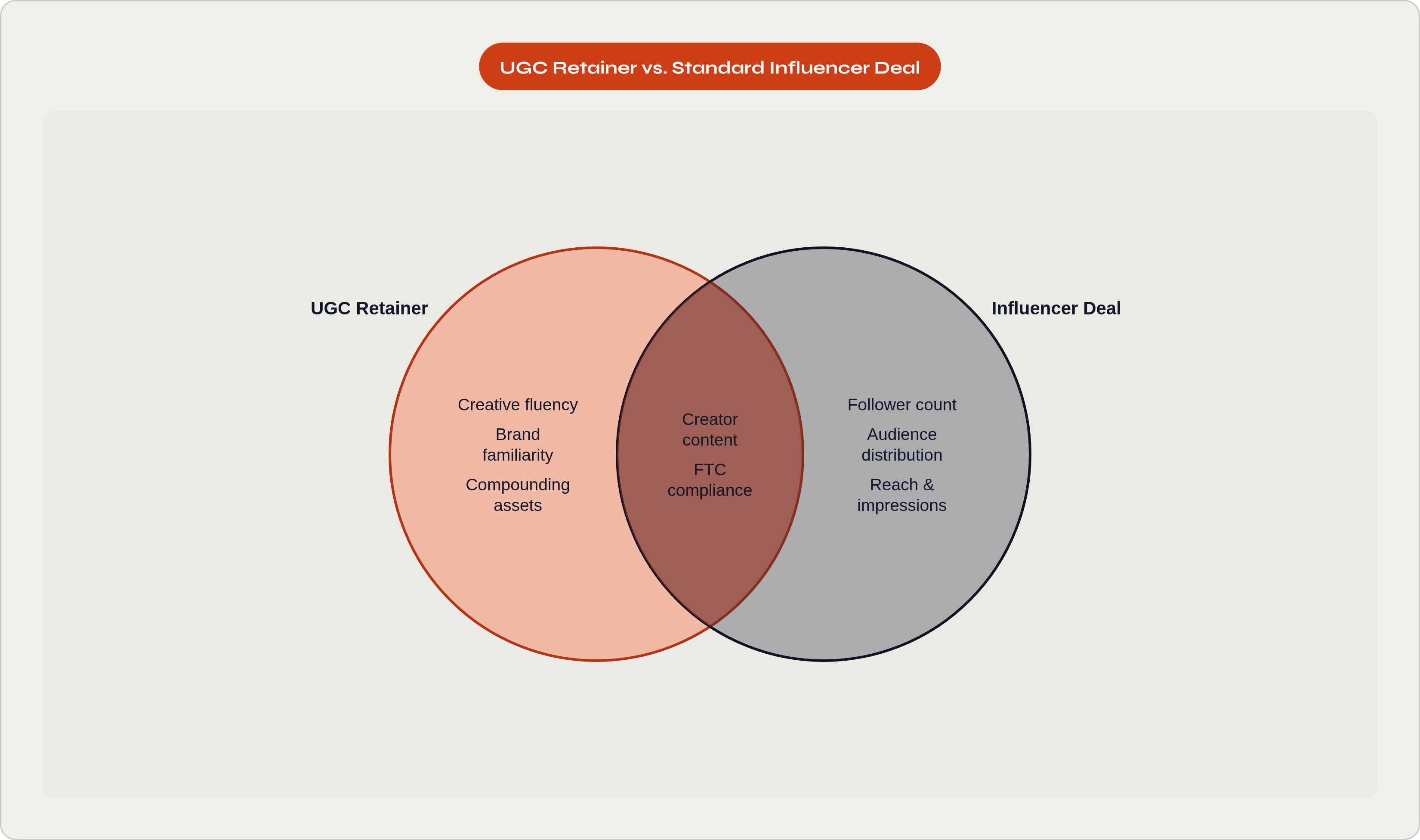
In a standard influencer deal, you are paying for distribution. Follower count is the lever. The creator's audience is what you're buying access to. A UGC retainer inverts this entirely. You're acquiring creative assets for your own channels and paid advertising. A creator with eighty thousand followers who produces specific, unscripted, converting content is more valuable under this model than someone with eight hundred thousand followers and a polished, generic aesthetic that looks like every other brand video on the feed. The creator's audience size is largely beside the point.
A per-deliverable contract pays for a file. A retainer pays for something considerably harder to price: creative fluency, genuine brand familiarity, and the iteration velocity that emerges from a creator who has already internalized your product, your tone, and what your buyer actually responds to. Those things take time to build, and starting over with a new creator every month means you are perpetually resetting to zero.
The supply side has already adapted to this reality. Working UGC creators now operate with pricing tiers, batch production schedules, standard operating procedures, content libraries. They quote retainer packages. They block production days. They function less like freelance gig workers and more like small production studios. The language has shifted.
Kate Scott-Dawkins of WPP Media noted that 2026 marks the first year ad revenue on user-generated content platforms will outpace ad revenue on professionally produced content. The market moved before most brands caught up. Brands still treating UGC as a campaign, a burst of content followed by silence and then another sourcing scramble, are structurally misaligned with how algorithms reward content and how modern buyers make purchase decisions. Algorithms surface high-signal, authentic content. Buyers want real proof from real people before they trust a brand. Neither dynamic is satisfied by a quarterly content drop.
Here is what the actual failure looks like: a brand launches a UGC initiative, contracts five creators for one video each, posts the results, and starts the sourcing process over again when creative fatigues. Every cycle costs the same. Nothing compounds. The brief never gets smarter from data. The relationships never deepen. The retainer exists to interrupt that cycle, not merely as a contract mechanism but as the structural foundation of a content system that builds on itself rather than resetting each time.
What makes the model work is mutual infrastructure. The creator gets predictable monthly income and the operational efficiency of producing for a client they already know. The brand gets a pipeline: consistent volume, improving creative quality, a relationship that deepens with each cycle. Neither side gets any of that from a one-off transaction.
The Three Pricing Tiers That Define the Retainer Market and What Each One Actually Buys
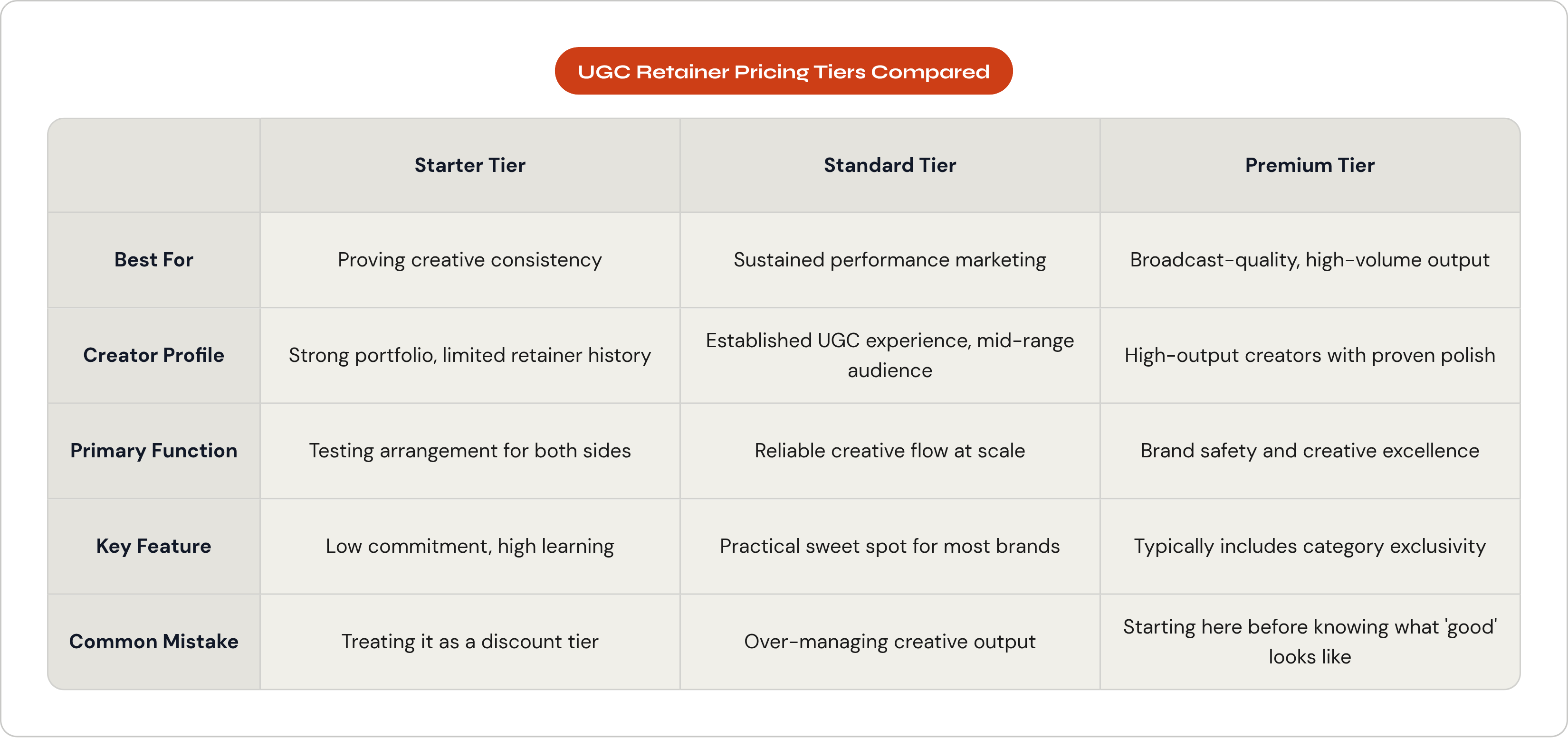
Too many brands approach retainer negotiations as though they're starting from scratch. They're not. There is a defined market structure, and knowing it saves time on both sides of the table.
The starter tier covers a handful of assets per month at a lower fixed fee. It suits creators with strong portfolios but limited retainer history, and it serves a specific strategic function for brands: proving creative consistency before committing to higher volume. This is not a discount tier. It's a testing arrangement, for both parties. The brand learns whether the creator's brief adherence and communication reliability hold up at volume. The creator learns whether the brand's feedback is actionable or chaotic. That second variable matters more than most brands anticipate.
The standard tier is the most common arrangement for creators with meaningful but not massive audiences and established UGC experience. It covers mid-range monthly asset volume and represents the practical sweet spot for performance marketing teams that need reliable creative flow without the operational complexity of a premium arrangement. Most brands that build sustainable UGC programs spend most of their time here.
The premium tier is for creators producing broadcast-quality content at high volume, and it typically includes category exclusivity clauses. It's appropriate when brand safety, creative polish, and consistent production quality justify the cost premium. This is not where most brands should start. Beginning here out of eagerness to work with a well-known creator, before you've established what good actually looks like in your specific category, is a reliably expensive mistake.
One useful calibration: compare the per-asset cost at any meaningful production volume under a retainer against the median cost of a single one-off UGC video. The math almost always favors the retainer. Management overhead drops with it, because you're coordinating with a known creator on a known schedule rather than sourcing, vetting, contracting, and onboarding someone new each month.
An analysis from IMHub found that the most efficient campaigns were driven not by the most viral creators but by the most consistent ones: those producing high asset volumes monthly under clear scopes with minimal creative lag. Consistency is the performance variable that retainers optimize for, not virality. That reframe changes which tier you prioritize and, more importantly, which creators you select.
How to Select the Right Creators for a Retainer Before Any Contract Is Signed
The most expensive mistake in UGC strategy is selecting for reach when the goal is creative performance. Follower count is the wrong primary variable for a retainer program. It's a remnant of influencer-deal thinking applied to a model where audience distribution is not what you're buying.
The engagement data supports this directly. TikTok's average engagement rate reached roughly 3.70% in 2025, up approximately 49% year over year and roughly seven times Instagram's 0.48% average. On TikTok specifically, nano-influencers averaged around 10.3% engagement compared to approximately 7.1% for mega-influencers. The curve runs toward smaller, more connected creators. For retainer selection, a creator with a modest, highly engaged audience is a stronger fit than one with broad reach and passive viewership.
A practical vetting framework has two parts. The quantitative side covers engagement-rate-by-view and audience location verification. The qualitative side covers brand-safety assessment, aesthetic alignment, integration authenticity, and the overall health of the creator's community, meaning comment quality and actual conversation patterns, not just comment volume. Both matter, but the qualitative side is where people consistently underinvest their attention.
On location specifically: a creator's physical location does not equal their audience's location. Request an analytics screenshot before committing to anything. A creator based in Los Angeles may have an audience majority in Southeast Asia, and that is a fundamental mismatch for a brand selling primarily in the United States. It's a basic step that gets skipped constantly.
Red flags that should disqualify a creator from a long-term retainer: a feed oversaturated with competing brand promotions, integrations that feel transactional rather than genuine, suspicious follower-growth spikes, bot-like comment patterns. And, separately, a slow or chaotic communication style. That last one is worth real attention. A creator who is difficult to reach or inconsistent in their responses will become an operational liability at the exact moments when you need reliable asset delivery. Communication reliability and creative talent are genuinely different qualities, and a retainer requires both.
Discovery should use all three available channels: platform-native marketplaces, manual browsing through FYP content and relevant hashtags, and third-party discovery tools. Creators sourced through dedicated UGC platforms tend to understand format requirements natively, including natural delivery, vertical framing, appropriate lighting, which reduces onboarding time considerably. Platforms worth considering include Billo, Insense, and Minisocial, among others, each with different creator pools and workflow tooling.
The relationship dynamic that actually justifies the retainer structure is this: long-term creator partnerships yield meaningfully higher engagement and creative quality than one-off collaborations. The retainer reinforces this dynamic, but only if the selection decision was made carefully before the contract was signed.
What a UGC Retainer Agreement Must Cover to Protect Both Sides
A vague retainer agreement is not a neutral document. It's a deferred argument, one you'll have at the worst possible time, usually when content you've already paid for can't be used the way you intended, or when a creator disputes what they were actually contracted to deliver. Every ambiguous clause is a negotiation you haven't had yet.
Deliverable scope comes first. Specify the exact number of videos per month, format requirements including aspect ratio and length, revision rounds permitted, and turnaround windows. If the contract says "approximately ten videos" and the creator delivers seven, there is no resolution mechanism. Be exact.
Usage rights and licensing is where most retainer agreements either protect the brand or fail it. Duration should be explicit: perpetual or time-limited. Most paid social use cases require perpetual rights, because an ad creative that performs well may run for eighteen months. Creators charge more for perpetual rights, appropriately, and this should be negotiated explicitly rather than assumed.
Channel scope specifies where the brand may run the content: owned social, paid advertising, website, email, retail, point-of-sale. Each is a distinct use case and should be named individually. Do not use catch-all language and assume it holds.
Paid amplification rights, specifically whitelisting on Meta and Spark Ads on TikTok, must be explicitly granted. A general usage-rights clause does not cover this. If the brand intends to run creator content as paid ads from the creator's handle, that access needs its own clause.
Exclusivity clauses fall into two categories. Category exclusivity restricts the creator from producing content for competing brands during the retainer period; this is standard in premium-tier agreements and commands a price premium. Platform exclusivity is less common but relevant if the brand is concentrating spend on one channel; define the scope narrowly or enforcement becomes unworkable. Both forms of exclusivity cost money. Factor that into tier selection.
Payment terms should specify the monthly fixed fee, payment timing, and late payment provisions. Net-15 is creator-friendly and builds goodwill. Net-30 is acceptable. Anything longer erodes motivation in ways that are subtle at first and obvious later. Retainers that pay late consistently are retainers that underperform, and the causality is direct.
Content ownership must clarify who owns the raw footage versus the finished edit. Brands that want to repurpose, re-edit, or remix assets downstream need explicit raw-file rights in the contract. This is not a default assumption.
Approval workflow should define how briefs are delivered, what approval looks like at each stage, what triggers a revision request versus a rejection, and whether rejected deliverables count against the monthly quota. If a creator delivers ten videos, the brand rejects three without triggering revision rights, and then claims only seven approved assets were delivered, you have a dispute with no resolution mechanism.
Termination conditions should include notice period required by either side, what happens to content produced but not yet paid for, and kill-fee provisions if the brand terminates early. These feel hypothetical until they aren't.
FTC disclosure requirements apply even when content runs on brand-owned channels, and the contract should assign compliance responsibility clearly.
IP and morality provisions establish brand-safety standards and define what constitutes a material breach justifying early termination. These provisions protect the brand from reputational exposure, but they should be specific rather than broadly worded. Overbroad morality clauses can be used to avoid payment in ways that are genuinely unfair to creators, and that creates legal exposure and relationship damage that isn't worth whatever drafting shortcut seemed appealing at the time.
Briefing Creators Inside a Retainer So Volume and Quality Compound Together
The brief is the operational document that determines whether a creator can batch-produce fifteen assets in a single day or needs back-and-forth clarification for each one. When the brief is tight, volume and quality reinforce each other. When it's vague, volume increases but quality regresses toward generic.
A retainer brief should cover brand voice and tone guardrails, product-specific claims the creator may and may not make, approved hooks and phrases that are off-limits, format and platform specifications, CTA requirements, and revision criteria stated in advance. That last element matters most. A creator who knows exactly what triggers a revision request will produce fewer revisions, because the feedback loop has been made legible before production starts rather than after.
The opening seconds are the fulcrum of the entire asset. Hook rate and watch-through rate are both determined in the first two to three seconds, and briefs should specify hook type rather than leaving it to the creator's instinct. A pain-point address, a bold claim, and a question-based open all perform differently depending on audience temperature, funnel stage, and product category. Give the creator a choice of three hook directions per batch rather than an open-ended invitation to start however they want.
Four format archetypes are worth assigning deliberately by funnel stage. The testimonial format, following a problem, skepticism, experience, outcome arc, is the workhorse for mid-funnel consideration. Avoid it on cold traffic where brand recognition is zero, because skepticism without brand context reads as purely negative. Unboxing generates strong hook rates across categories through a curiosity mechanic and is relatively easy to brief well. Day-in-life has the highest authenticity ceiling but is the hardest format to brief, because over-briefing kills the organic feel; it works best for lifestyle, food and beverage, and everyday-use products where natural integration is actually plausible. The honest review format addresses objections directly and pairs well with paid amplification targeting audiences who have already shown category interest.
Standardized brief templates, hook libraries, and clear editing guidelines are what allow a creator to produce high asset volumes without quality degrading. Eighty percent of brands, according to figures cited in the source data, report that human-created UGC outperforms AI-generated content for trust and relatability. A well-briefed retainer creator should clear that bar consistently. When they don't, the brief is usually the variable that failed, not the creator.
The retainer period should include a structured review point, monthly or quarterly, where hook performance, format win rates, and conversion data feed directly back into the next brief cycle. Without this loop, the brief never improves, and the retainer becomes a fixed expense rather than a compounding one.
Turning Retainer Content into Paid Media Assets Through Whitelisting and Spark Ads
Most brands running UGC retainers stop at organic posting and leave the most valuable part of the model untouched. Running retainer content as paid ads is where the financial logic of the arrangement fully reveals itself, and the retainer structure creates the exact conditions that make paid amplification efficient.
Whitelisting on Meta allows the brand to run paid ads from the creator's handle rather than the brand account. The creative appears to come from a person, not a brand, which preserves the authentic quality that makes UGC convert at higher rates than conventional branded creative. This access requires explicit contractual authorization. A general usage-rights clause does not cover it. The grant needs to be specific and negotiated before production begins.
Spark Ads on TikTok work analogously. The brand boosts an existing creator post as a paid ad using the creator's account. What makes this format particularly valuable is that engagement on the boosted post, likes, comments, shares, accrues to the organic post, compounding social proof over time. A creator post that has been Spark Ads-boosted and accumulated significant engagement becomes a more credible asset than one posted organically and left alone. That accrual is real and it matters.
Retainer creators outperform one-off creators for paid amplification for several reasons that reinforce each other. Brand familiarity reduces reshoots; the creator already knows the product claims, the tone, and the format requirements. The whitelisting relationship requires ongoing trust, and a retainer structure builds that trust naturally. High monthly asset volume creates a genuine testing pool, and only the top performers get amplified, which improves paid media efficiency with each cycle rather than resetting it.
The contract implication deserves emphasis: whitelisting and Spark Ads access must be negotiated into the retainer from the start. Retrofitting these rights after content is produced is expensive and sometimes legally complicated. The creator may not agree to grant them at the original rate, and there is no leverage to compel them.
A program that produces consistent volume, feeds a testing loop, and amplifies its winners creates a paid social engine that improves with each iteration cycle. This is the structural advantage the retainer creates over the campaign model, and it only activates if the paid amplification rights are in the contract.
Measuring Retainer Performance So the Program Improves with Each Cycle
The measurement failure that plagues most retainer programs is not a lack of data. It's a lack of connection between the data and the decisions. Brands track impressions and engagement on creator content but don't route those signals back to the brief, the creator, or the contract terms. The program keeps running but never gets smarter.
The KPIs that matter operate at different stages. Hook rate and watch-through rate are leading indicators: low hook rate means the opening seconds are failing, and the brief or the creator's execution of the brief is the variable to examine first. Click-through rate and conversion rate are the downstream metrics that justify the retainer spend. UGC-based ads have demonstrated meaningfully higher CTR than conventional branded creative across the research that informs this category, and holding retainer content to that standard is reasonable.
Cost per asset, calculated as the total retainer fee divided by assets delivered, is the efficiency metric that shows whether you're in the right tier for the volume the program actually requires. If the per-asset cost under the retainer exceeds what you'd pay sourcing one-offs, the tier is wrong or the scope is underspecified.
Creative fatigue is the signal most brands miss until performance has already cratered. Track when a high-performing asset begins declining in CTR so the iteration cycle begins before it fails, not after. The goal is to refresh the brief with a new hook variant or format shift proactively, and that is only possible if you're watching the leading indicators regularly, not just the monthly summary.
The renewal decision should be made on asset-level performance data alongside delivery reliability and brief adherence. A creator who delivers volume but produces low-converting content is not a renewal candidate. A creator who delivers fewer assets but produces consistently high-converting creative is exactly who you should retain and potentially expand. Total output is not the metric. Output quality relative to spend is.
When a creator consistently produces top-performing assets and demonstrates clear brand fluency, that is the signal to expand scope, add whitelisting rights, or move them to a higher-volume tier. It is not a reason to rotate in new creators to "keep things fresh." Consistency and familiarity are the competitive advantage the retainer builds. Disrupting them voluntarily surrenders it.
How to Build This Program When You Are Starting from Zero
Early-stage consumer brands often assume retainer programs require large budgets, an in-house creator team, or an existing content library. None of these is true, and the assumption causes brands to delay building this infrastructure until they feel "ready," which mostly means they delay it indefinitely.
Start with one or two creators at the starter tier. The goal in the first ninety days is not high volume. It's learning: what brief structures produce usable assets, which hook types perform in your category, how your product reads on camera, whether the creator relationship has the communication quality a long-term retainer actually requires. Use this phase to build the hook library and format templates that will scale the program later. The templates are the infrastructure. The early creator relationships are the proof-of-concept. Neither can be rushed, but both can be started small.
The operational overhead problem is real and worth acknowledging plainly. Managing creator outreach, vetting, contracts, revision cycles, payments, and performance reporting across even a small retainer roster places meaningful demands on brand teams that are already stretched. This is where many early-stage programs stall: not because the strategy is wrong, but because the operational weight exceeds internal capacity and no one owns the process clearly enough to keep it moving.
Two practical paths through this. First, a purpose-built UGC platform that manages creator sourcing and workflow coordination, allowing the brand team to focus on briefs and performance analysis. Platforms like Billo, Insense, and Minisocial offer different combinations of creator pool depth and workflow tooling depending on what a brand needs. Second, a UGC-specialized agency that manages the full creator relationship stack, including sourcing, contracting, briefing, and revision management, on the brand's behalf. For teams without a dedicated content operator, the agency path often removes the overhead problem entirely and accelerates the learning curve.
The underlying structure you're building toward: a stable creator roster on clear retainer terms, a brief that improves with each cycle, paid amplification on top performers, and a performance loop that makes the program smarter over time. The first ninety days require patience. The measurement afterward requires discipline. The compounding effect is real, and it is the thing the one-off model structurally cannot produce.