UGC Content Strategy for Food and Beverage DTC Brands
Peer reactions beat product specs when sensory proof is impossible online.

Start with the problem no ad budget can solve directly: you cannot let a viewer taste the product.
Every other category has some version of a digital proof mechanism. Software has demos. Apparel has fit guides and body-type filters. Electronics have spec sheets and teardown videos. Food has none of that. So what substitutes? Watching a real person eat or drink something and deciding whether you believe them. That is the closest analog the medium offers to sensory experience. It is imperfect, which is part of why getting it right matters so much.
Nielsen has documented that 84% of consumers trust peer recommendations above all other forms of advertising. In a category where sensory proof is impossible to deliver digitally, that figure carries different weight than it would for, say, a mattress brand. Firmness ratings and material specs can approximate a mattress experience well enough. A Scoville number cannot approximate what that hot sauce does in your throat. The gap between description and experience is just wider in food and beverage, and peer content is what closes it.
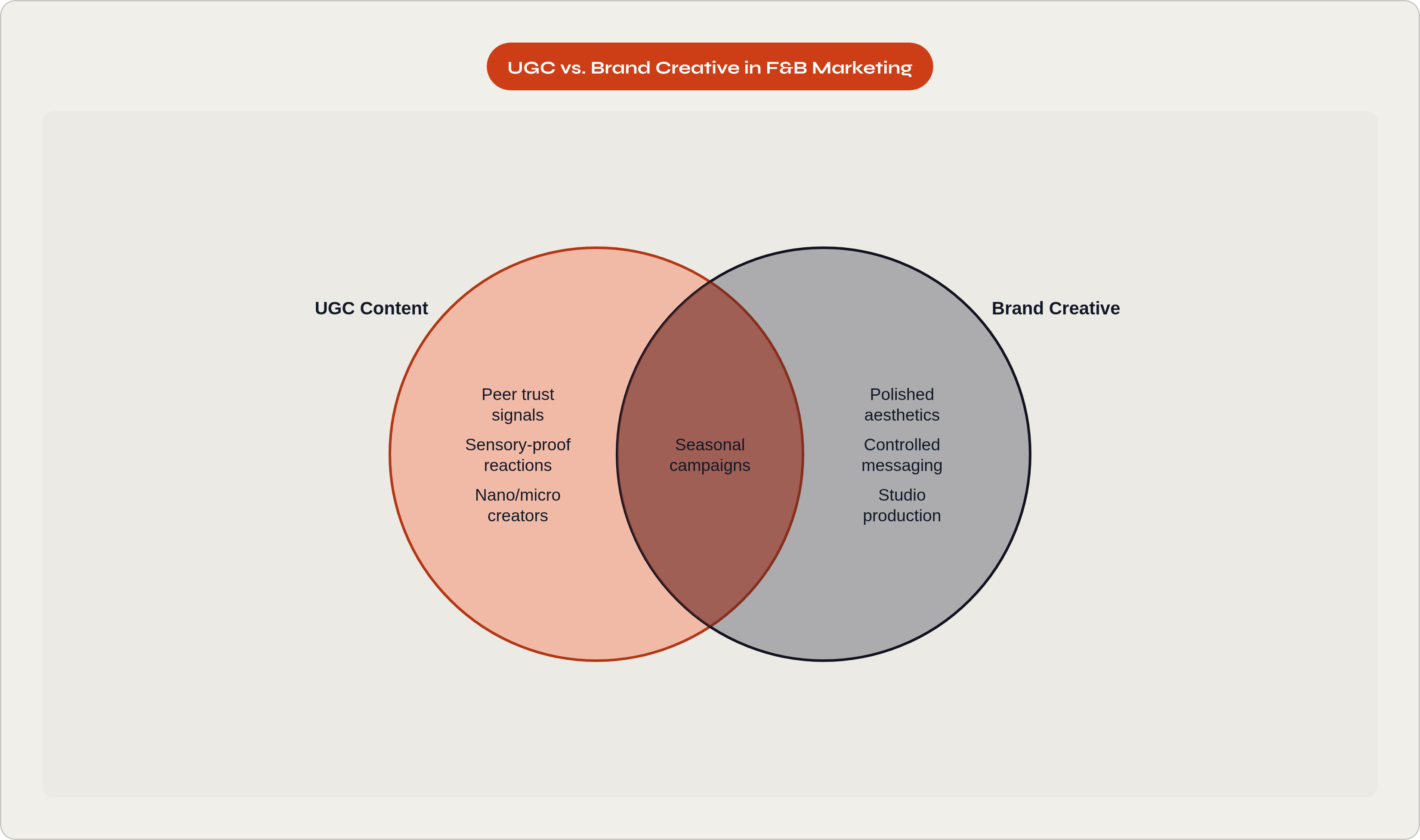
This has a specific, routinely violated implication for program design. Authenticity is not an aesthetic choice. It is the mechanism by which the content works at all. The kitchen counter with the errant kettle in the background outperforms the marble surface with the perfectly lit product arrangement because it mirrors the viewer's own context. It signals: this person is like me, and this is real. Brand photography optimizes for beauty; UGC optimizes for believability. When those two values compete, believability wins, because believability is the thing doing the actual persuasive work.
Over-scripting a creator destroys the effect for the same reason. A creator who sounds like they memorized a brief sounds like a brand, and the viewer has already decided they trust the person more than the brand. Give them a reason to make that decision in your favor, which means giving the creator enough latitude to actually speak for themselves. You cannot brief your way into authenticity. You can only brief yourself out of it.
The four content formats that actually convert in food and beverage UGC, and how to brief them
Not all UGC formats perform equally in this category. Treating them as interchangeable is one of the fastest ways to produce a lot of content that does very little.
The first is the first reaction and taste test. This is the sensory-proof format. The creator opens, tastes, and reacts, and that reaction does the persuasion work the product page cannot. When it is genuine, the viewer's mirror neurons do the rest. The brief should ask for a real first-impression moment, not a scripted endorsement. A creator who has tried the product a dozen times and is now performing surprise reads exactly that way, and anyone who has watched enough sponsored content will recognize it immediately.
The second is recipe creation. Recipe content earns disproportionately high save rates, a meaningful leading indicator of purchase intent, and it repurposes across channels with unusual efficiency. Printed on packaging, embedded on a product detail page, sequenced into an email onboarding flow, a creator's recipe extends its useful life well past the original post. Co-creation with private chefs or nutritionists adds a credibility layer that lifts the format beyond lifestyle territory.
The third is daily routine integration. This format works because it answers the viewer's real friction: not "does this taste good?" but "would I actually use this?" A creator showing a product fitting naturally into a Tuesday morning, not a special occasion, resolves that friction faster than any feature description. The brief should specify the setting and the emotional register, not a list of talking points.
The fourth is gifting and occasion content, the seasonal spike format. Benchmark data from Billo's H2 2025 analysis of F&B ad performance put December ROAS at 3.07, the highest of the half. Gifting and occasion content is the creative vehicle for capturing that window, which means briefing it earlier than feels intuitive.
Beyond format selection, the brief itself determines whether the content converts or merely occupies a feed slot. "Use this at breakfast" is not a brief. "The quick weekday breakfast you actually make when you have twelve minutes" is a brief. The former gives the creator nothing to work with. The latter gives them a scene, a time constraint, a viewer to speak to, and an emotional note to hit. That specificity is not about controlling the output; it is about giving the creator enough context to produce something that feels particular rather than generic, and generic does not convert.
Video dominates this category, and short-form leads within video. Platform-native production matters more than most brand teams want to hear. Polished brand advertising aesthetics actively underperform on TikTok, where the algorithm and the audience both reward content that looks like it belongs there. For subscription DTC products like coffee, wine, or snack boxes, the unboxing reel deserves to be treated as its own discipline. A six-second product-opening video communicates anticipation and delight in a way that a feature list on a subscription landing page simply cannot replicate.
How the F&B category's seasonal rhythm should govern the entire content calendar
Food is the most seasonal consumer category in existence, and not in the abstract way that word usually implies. The purchase occasions are real, recurring, and largely predictable: summer grilling, back-to-school, holiday hosting, game-day gatherings, the new-year health pivot. These are not optional campaign moments a brand can participate in if it feels inspired. They are the occasions on which purchase decisions actually get made.
The lead times feel counterintuitive until you have missed a season because of them. If you need paid amplification assets ready for July and August grilling content, you need to brief creators in April or May. Autumn transition content has to be briefed in July. December hosting and gifting campaigns cannot wait until November because by November the creative production window has closed. The spend window and the creative window are not the same window, and conflating them is how brands end up producing summer content in June and holiday content in December, which is to say, too late to matter.
There is a specific diagnostic worth examining in the benchmark data. The F&B category averages a strong hook rate compared to other verticals, meaning the content earns attention reliably, often through a sensory or seasonal promise in the opening seconds. But click-through rate runs slightly behind the overall cross-category average. That gap is worth sitting with for a moment: why does content that earns attention so reliably fail to convert it into clicks?
The pattern is consistent enough to name. Content earns attention with a seasonal hook, then abandons the emotional context the moment it pivots to a product pitch. The seasonal warmth that opened the video evaporates, and the viewer is left with what feels like a bait-and-switch. The fix is not a stronger call-to-action; it is sustaining the seasonal emotional context through the entire piece of content so the product feels like a natural conclusion to the story rather than an interruption of it.
Planning ahead is also an operational prerequisite when running a creator program at volume. Briefing a roster of creators requires outreach time, negotiation time, production time, and review time. Brands that plan reactively will be a cycle behind, every single season.
Choosing creators who can actually move product, vetting beyond follower count
Follower count is a seductive selection criterion because it is easy to see and easy to compare. It is also a poor predictor of whether a creator will actually influence purchase behavior.
What actually predicts performance in this category: engagement rate relative to the creator's tier, audience demographics that map to the brand's buyer profile, content style that aligns with how the brand's target consumer understands their own kitchen, and some evidence of genuine affinity for the category. That last criterion is harder to quantify and easier to spot than people tend to give themselves credit for. You can usually tell within thirty seconds of watching someone's content whether they actually care about food or are performing caring about food.
The nano and micro tiers outperform on the metrics that matter for conversion. Nano-influencers, those with roughly one thousand to ten thousand followers, often average engagement rates well above what macro accounts achieve. A campaign built around ten micro-influencer relationships can outperform a single mega-influencer deal at equivalent budget while also producing more raw creative assets to test. Seventy-three percent of brands now report preferring micro and mid-tier creators for exactly this reason: more content, stronger audience connection, better engagement per dollar.
Brand safety is a vetting consideration that brands frequently skip and reliably regret. Inauthentic engagement, prior controversial posts, and values misalignment can all become liabilities, and they are harder to detect without a systematic review process. Platforms like CreatorIQ and HypeAuditor provide the audience analytics and brand safety signals that manual review at scale reliably misses.
It is also worth expanding the creator pool beyond those who self-identify as food content producers. Parenting creators, fitness creators, lifestyle creators, and travel creators can all integrate F&B products authentically into their existing content ecosystems when the brief is written thoughtfully. HelloFresh used data analytics to identify audiences adjacent to the traditional "foodie" designation who demonstrated strong meal-kit purchase intent. The product did not change. The audience mapping did.
Finally, creator outreach requires persistence that most brand teams underestimate. Most creators do not respond to a first contact. A systematic outreach cadence, with clear follow-up timing and a coherent value proposition, is part of the program infrastructure, not something to delegate informally.
Moving from one-off sponsored posts to sustained creator relationships that compound over time
The transactional model is the most common structure in influencer marketing and, in this category, the least effective one. One brief, one post, one fee, move on. The problem is not that it produces bad content. The problem is that it produces content that looks exactly like what it is: a first use.
A creator who has been using a product for three months has developed their own vocabulary for it. They have found the specific use case that fits their life, the moment of the day when they actually reach for it, the way it slots into something they were already doing. That specificity cannot be scripted into them at the briefing stage. It accumulates through repeated use, and it is audible and visible in the content they produce. The skeptical viewer, the one who has seen enough sponsored posts to recognize them on sight, notices the difference immediately.
Only 16% of businesses operate a dedicated, systematic strategy for creating UGC ads. The vast majority of brands that consider themselves active in influencer marketing are running the transactional model and calling it a program. A transactional model does not compound. Every campaign starts at zero. A sustained roster starts each new season with creators who already understand the product, already have an audience that has seen them use it, and already have a track record of content the brand team can draw on to predict what to brief next.
What that compounding advantage looks like over two or three seasons is worth spelling out: the brand team is no longer re-educating creators from scratch each cycle, but refining briefs from a base of shared product knowledge and actual performance history. Sustained partnerships also solve the volume problem that brand teams rarely account for at the outset. A paid media program that tests multiple creative variants needs a continuous feed of raw assets. A roster of long-term creator relationships produces that feed. A one-off campaign batch exhausts itself quickly.
Contracts and payment infrastructure are not a footnote here. Usage rights must be negotiated before the content is produced, not after it is already live on a creator's channel and the brand team realizes they cannot legally amplify it. Ad hoc payment structures and informal agreements do not scale across a multi-creator roster without creating administrative overhead that slowly consumes the brand team's operational capacity. These are the details that kill good programs when left unhandled.
Turning organic creator content into paid media assets, the amplification loop that scales revenue
Organic UGC earns trust. Paid amplification earns reach. The program needs both running simultaneously, because organic trust without reach is a limited asset, and paid reach without trust is expensive and increasingly ineffective.
The performance gap between UGC creative and traditional brand creative in paid media is not marginal. UGC ads achieve substantially higher click-through rates and meaningfully lower cost-per-click compared to brand-produced creative. The content looks like it came from a person rather than a corporation, and the viewer extends it the trust they extend to people rather than the skepticism they extend to advertising. Same mechanism as organic UGC, different distribution channel.
Whitelisting extends that trust signal into the paid environment. When a brand runs paid media through a creator's handle rather than its own brand account, the ad retains the visual and tonal identity of the creator's content. It does not read as an ad engineered to look organic. It reads as content from someone the algorithm has determined the viewer already trusts. That requires negotiating creator usage rights and whitelisting permissions at the contract stage, which is another reason those operational details matter long before any content goes live.
The testing loop is where the compounding actually happens. Not every piece of organic UGC becomes a paid asset. Content that earns strong hook rates, high watch time, meaningful save rates, and positive comment sentiment gets identified and amplified. Underperforming variants get replaced with new creative from the same or different creators, informed by what the data showed was missing. The brief for the next production batch is written from that data.
Non-alcoholic beverage brands have demonstrated the power of pairing-context UGC, content that shows the product in a specific, identifiable lifestyle moment, as both an organic trust vehicle and a paid unit that can be targeted to the precise audience segment that shares that lifestyle context. Brands like Ghia, Aplós, and Recess have built significant DTC momentum this way. The organic content and the paid creative are, functionally, the same asset, which is an efficiency that brand-produced creative rarely achieves.
The F&B category ROAS benchmark across Billo's H2 2025 data sits at 2.57 on average, with December at 3.07. The gap between a well-timed, well-briefed paid amplification program and a reactive one is visible in those numbers.
The measurement framework that tells you whether the program is working, and what to change when it isn't
Measurement in a UGC program is not a single number. It is a funnel, and different metrics become meaningful at different stages of the purchase journey.
At the top of the funnel, hook rate and video completion rate tell you whether the content is earning and holding attention. The F&B category averages a hook rate above the cross-category mean; food content is visually compelling in ways that many other categories are not, and that is a genuine structural advantage. If a brand's content is falling below that benchmark, the problem is almost certainly in the first three seconds, and the brief for the next batch needs to address the opening specifically.
At the mid-funnel level, CTR, saves, shares, and comment sentiment tell you whether earned attention is translating into genuine interest. The F&B category's CTR runs slightly below the overall average across verticals, a gap that is actionable. As noted in the seasonal section, the typical cause is a tonal disconnect between the hook and the product pitch. That gets corrected at the brief level, not in editing.
At the bottom of the funnel, ROAS, cost-per-click, attributed conversions, and for subscription DTC brands, retention rates tell you whether interest is becoming revenue. Creator-level analysis at this stage is as important as campaign-level analysis. Which creators are producing assets that survive into paid rotation across multiple seasons? Which are producing content that performs once organically and then disappears? Understanding why that gap exists between two creators shapes how the next roster selection happens.
The iteration cadence is what separates a measurement framework from a measurement exercise. Data without subsequent creative adjustment is documentation. Each new brief should reflect what the previous batch's data showed was missing or underperforming. Not "what should we make next?" but "what did the last round of content fail to do, and how does that change what we brief for this round?"
A single viral post is an event. A creator program that consistently produces above-benchmark performance across multiple creators, multiple formats, and multiple seasons is a growth channel. Brand teams often celebrate the event without doing the structural work that would turn it into the channel. That is the rut worth getting out of.
What a functioning F&B UGC program looks like from the outside, and what it takes to build one from the inside
From the outside, a mature F&B UGC program looks almost effortless. There is a continuous stream of creator content across channels. The seasonal moments are covered early. The paid media creative looks native to the platforms where it appears. The brand's product detail pages show real people using the product in recognizable contexts. The whole thing feels organic, which is, paradoxically, the result of a significant amount of structure underneath it.
From the inside, that program is built on a tiered creator roster. Nano and micro creators produce high-volume organic content with strong engagement rates. A smaller number of sustained partners produce evergreen creative assets for paid rotation, having accumulated enough genuine product knowledge to speak about it with specificity that first-use content cannot replicate. The seasonal calendar is briefed two to three months ahead of any given spend window. Creator agreements specify usage rights and whitelisting permissions from the outset. A measurement infrastructure connects creator content to paid performance data so that brief iteration is driven by evidence rather than instinct.
Most brand teams do not have the bandwidth to manage all of that internally while also running a DTC business. The operational overhead of creator outreach, contract management, payment processing, and performance analytics, connected end-to-end, is typically the first thing that breaks down when brands try to manage it in spreadsheets. This is where Billo offers a structural advantage, handling the production pipeline, creator vetting, and creative testing loop as an integrated system rather than a collection of disconnected vendor relationships.
Building the program is harder than the category's natural enthusiasm makes it appear. The enthusiasm is real: #food content is not going to slow down, and the DTC market around it will continue to grow. But the brands that convert that volume into revenue are the ones that stopped treating organic enthusiasm as a strategy and started building a repeatable system around it. Briefing calendars. Creator contracts. Measurement dashboards. Iteration cycles. Operational scaffolding. The distance between what it looks like from the outside and what it takes to build from the inside is exactly where most brands get lost, and knowing that gap exists is at least half the work of closing it.