UGC for Subscription Box Brands on Social Media
UGC creators produce owned assets that perform better than studio shoots at a fraction of the cost.

The confusion between UGC creators and traditional influencers is more than semantic. It shapes contracts, budgets, and whether the program you're building actually works at scale, so let's get the distinction clear before anything else.
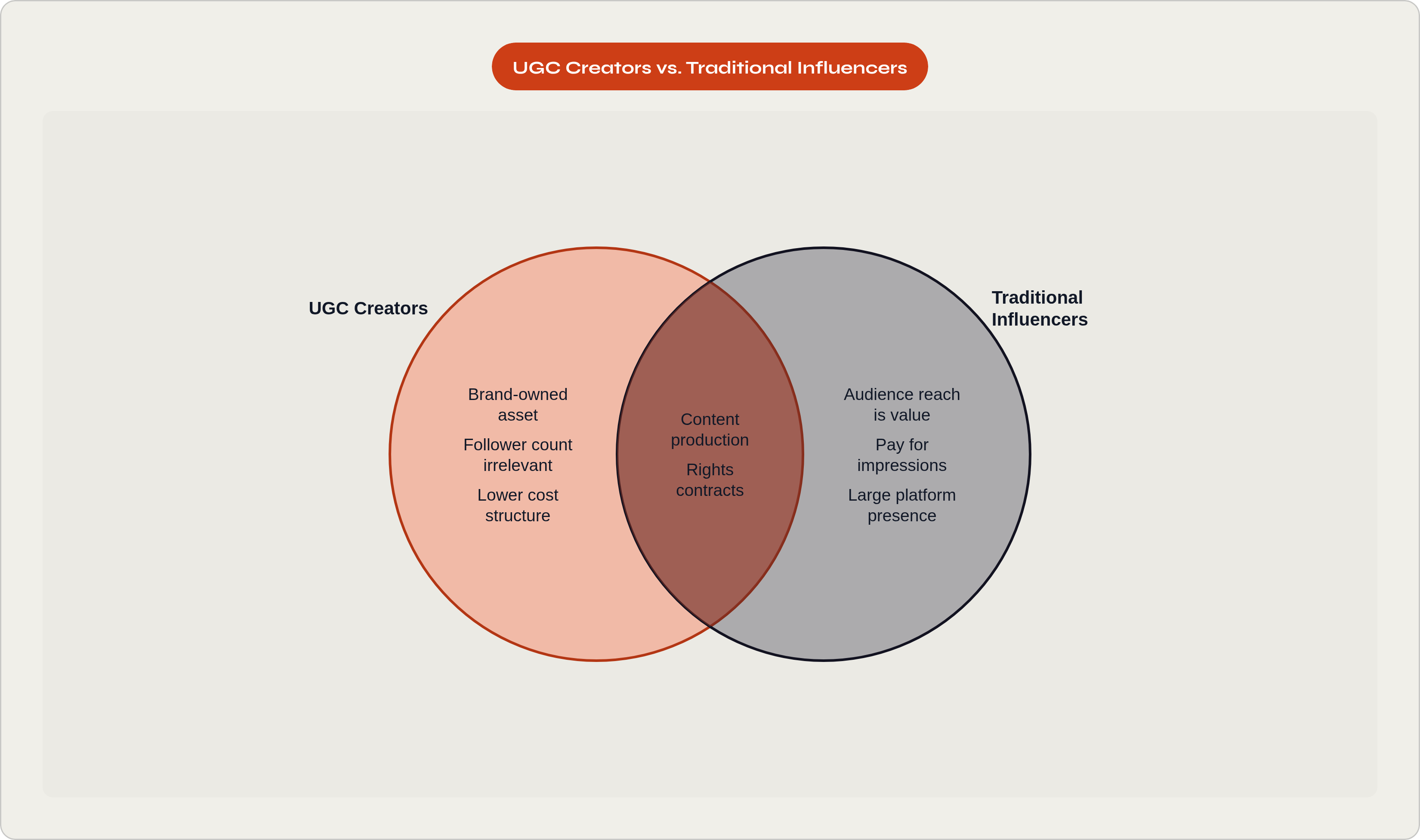
A traditional influencer's primary value is audience access. You pay for reach. The implicit deal: put your product in front of their followers and hope something converts. A UGC creator's value is categorically different. They produce a content asset the brand owns or licenses. Their follower count is functionally irrelevant to the transaction.
For subscription boxes, this plays out in a very specific way. Unboxings, "what I got this month" recaps, product reveals: none of these require elaborate production or a large platform presence to be compelling. The box does the narrative work. A creator with 800 followers who films an enthusiastic unboxing and holds the camera steady for 45 seconds has produced something a brand can run as a paid ad, seed across affiliate channels, or post natively to its own feed. The content has value that has nothing to do with the audience that creator happens to have built. I've seen brands dismiss a creator for having 600 followers and then watch a nearly identical video from that same creator, boosted as a Spark Ad, outperform a $12,000 studio shoot. The follower count was never the point.
The economic implications follow directly. Because you're paying for the asset rather than the reach, cost structures are lower than traditional influencer fees. But the rights question becomes more urgent, not less. When a creator posts to their own audience and you simply benefit from the awareness, rights are a minor concern. When you intend to run their face and voice in paid media at scale, rights are everything, and that question needs to be answered in the contract before a single piece of content is produced.
One figure worth understanding: by the mid-2020s, roughly 65 percent of Gen Z identified as creators in some capacity, per YouTube's own culture and trends research. The pool of potential UGC producers already living inside your subscriber base is almost certainly larger than your team assumes.
How to Generate a Steady Stream of Unboxing Content From the Subscriber Base You Already Have
The easiest UGC pipeline requires no outreach budget. Your paying subscribers are already opening boxes every month. The question is whether you've built anything that converts that private moment into a public asset, and most brands haven't.
Start with the ask. An automated post-shipment email or SMS sequence requesting a video review is obvious until you realize how few brands execute it well. Timing is everything. Send when the box arrives, not two days later when the excitement has dissipated. And be specific in the prompt. "Show us how you unbox it" produces different content than "Tell us what you got." "Share the problem this item solved for you" produces something usable in paid media; "Tag us if you loved it" produces noise. I've reviewed content libraries from brands whose call-to-action was so vague that virtually nothing they received survived creative review. Vague asks produce vague content.
Incentive structure requires care. The goal is to motivate without corrupting the signal. A discount on next renewal, loyalty points, or entry into a monthly giveaway is tangible enough to drive action without making the creator feel like a transaction. What you want to avoid is a structure so explicitly transactional that the resulting content feels performed. Authenticity is the asset; anything that undermines it undermines the program.
The repost loop is underrated. Any subscriber who tags the brand publicly and gets reshared receives social recognition at essentially zero cost. The effect on others watching is that the brand pays attention, that it celebrates its customers in public. That loop is self-reinforcing, and it costs very little to maintain once you've established the habit internally.
Don't overlook the physical insert. A card inside the box with a QR code linking to submission instructions converts an offline moment, the precise moment when the subscriber is delighted, into an online content act. That QR code is doing real work. Most brands use it for a discount and nothing else.
The output of this layer is not just organic reach or a few reposts. It is a library of raw assets that feeds every stage of what follows.
Building a Micro-Creator Seeding Program Around Your Niche
Subscriber-generated content is your base layer. The next layer is a structured seeding program, and the selection logic is where most brands go wrong.
The repeatable model is straightforward: identify somewhere in the range of 100 to 300 micro and niche creators per quarter in your specific category, send a free box, and offer a modest paid bonus for posts that hit agreed performance targets. Product cost plus shipping per creator sits well below the cost of traditional influencer placements, plus whatever paid amplification you layer on top of the assets you actually want to run.
Creator selection should be governed by category alignment, not follower count. A creator whose entire channel is devoted to hobby craft content is worth more to a craft subscription box than a generalist lifestyle creator with ten times the following. The audience is already self-selected. Category alignment means less convincing and more resonance, which shows up in the creative.
Beyond alignment, look at what the creator has actually done with unboxing or product review content in the past. Do they build anticipation before the reveal, or do they just hold the product up? Do they show the item in context? Are the comments reflecting genuine reactions, or are they generic emoji stacks that suggest low-signal engagement? Platform-format fit matters too. A creator who posts primarily static photography on a short-form video platform is not the same asset as someone who produces vertical video natively.
No formal contract is required for an initial seed send. But the moment you plan to run a creator's content in paid media, you need rights in writing before you boost anything. This is the most common oversight in early-stage seeding programs, and it surfaces at the worst possible moment, usually when you've found a piece of content that's performing and someone in legal flags that you never secured amplification rights.
The graduate system is where the program starts compounding. Identify top performers from each quarterly cohort and move them into longer-term affiliate or ambassador arrangements. They become your stable core roster. New cohorts keep fresh voices rotating in. One subscription wellness brand tracked referral codes by creator and found that influencer-acquired customers cancelled at significantly lower rates than the average subscriber. They scaled the program accordingly, because for subscription boxes, creator impact on subscriber LTV, not just acquisition volume, is the right signal for which creators to invest in further.
Platform Strategy: Where to Produce, What Format Wins, and How Volume Requirements Differ by Channel
Short-form vertical video is not a trend at this point; it is the dominant format for the category. Under 30 seconds, often as short as 15, with the unboxing reveal mapping well to the arc these platforms reward. Completion rates for vertical video run substantially higher than horizontal formats, and for subscription boxes where the payoff is the reveal, completion rate is one of your core indicators.
What brands consistently underestimate is how different the volume requirements are across platforms, and how much that shapes the program architecture.
TikTok rewards volume and frequency. Seeding at scale across a quarterly cohort, producing a meaningful number of shoppable videos per phase: one exceptional video does not substitute for consistent output. The algorithm distributes content based on signals it can only generate through volume, and you cannot shortcut that.
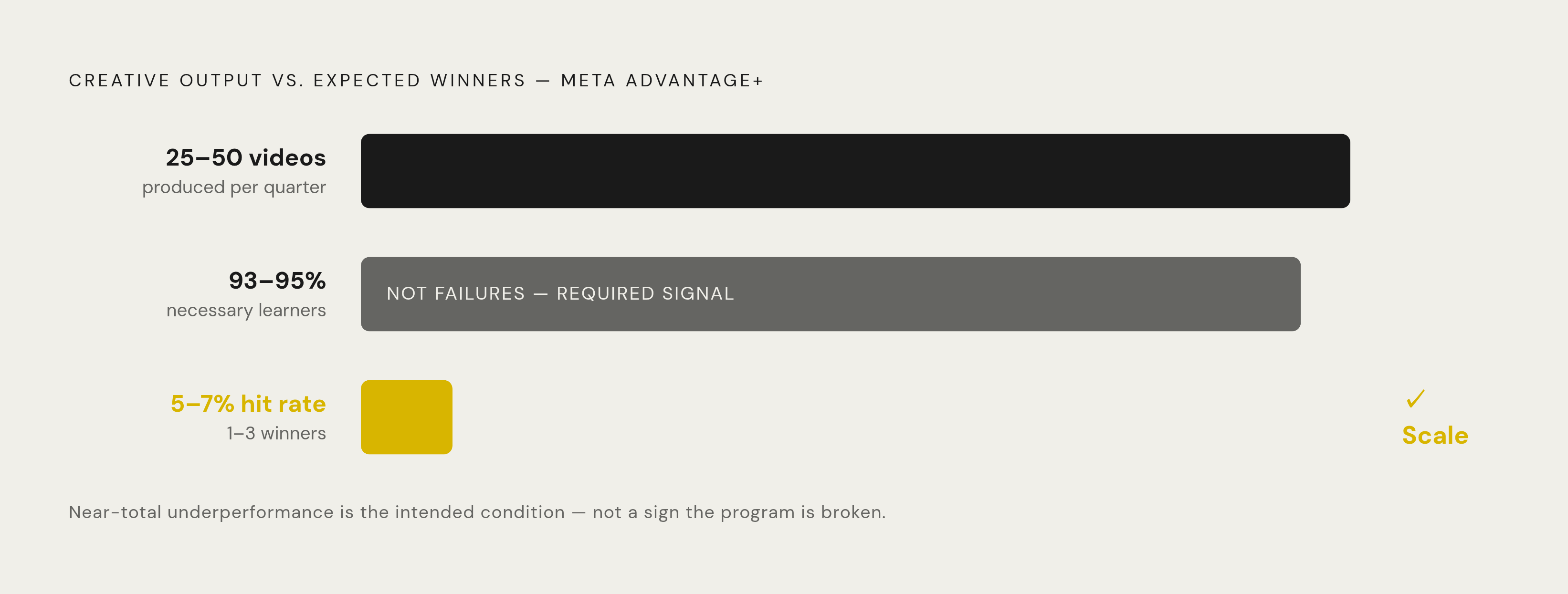
Meta's paid environment, particularly Advantage+, requires roughly 25 to 50 distinct creative angles per quarter to perform properly. The expected hit rate across that volume is somewhere around 5 to 7 percent. That means the majority of variants you produce are learners, not winners, and you need to plan for that from the start rather than treat it as program failure. I've watched teams pull the plug on a UGC program because 90 percent of their variants underperformed, not realizing that 90 percent underperforming is the normal condition for the format to work.
Instagram Reels overlap substantially with TikTok assets in raw format, but native posting rhythm and caption strategy diverge in ways that matter. YouTube Shorts supports longer unboxing formats, full hauls, multi-month retrospectives, in ways TikTok and Reels don't accommodate as naturally. The discovery value there is real for subscription boxes, even if direct conversion is harder to track.
Price point shapes platform selection in a way that doesn't get discussed enough. Shoppable content on TikTok Shop performs best in a specific price range. If your subscription box sits outside that range, you are driving awareness rather than direct conversion on that platform, which is still valuable but requires different KPIs and different expectations internally.
The operational implication is that a brand producing one polished monthly piece of content cannot feed these requirements. The program must be designed to generate volume from the start. AI tools for trimming, captioning, and reformatting UGC across platforms have matured to the point where a substantial share of brands now use them to adapt the same asset for each channel's native dimensions, without commissioning new shoots.
Turning Organic Creator Content Into Paid Media Assets
The most common and expensive leak in creator programs goes like this: a piece of organic unboxing content performs unusually well. Someone on the media team flags it and wants to boost it. Legal or operations looks at the creator agreement and discovers that paid amplification rights were never included. The asset is unusable until a new agreement is negotiated, and by that point the moment has passed. I have seen this happen to the same brand twice in the same year.
Rights must be contracted before content is created.
The specific terms matter more than teams often realize. Duration should be explicit: a six-month license, twelve-month, or perpetual. Perpetual licenses cost more upfront but eliminate the overhead of tracking expirations across a growing asset library, which becomes genuinely burdensome at scale. Channel specificity matters: "paid media" as a category is too vague. Contracts should specify Meta ads, TikTok Spark Ads, YouTube pre-roll, and any other specific placement by name, because those rights carry different implications and different rates.
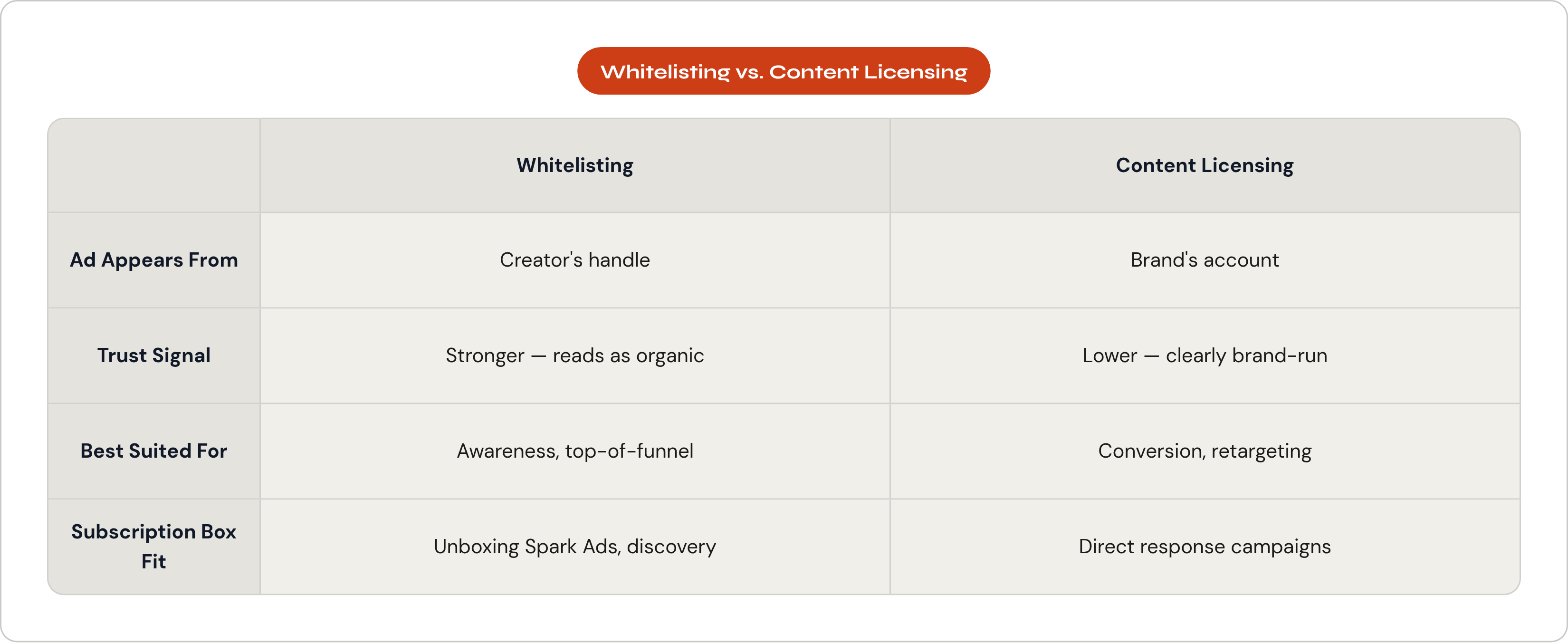
The distinction between whitelisting and content licensing is worth understanding clearly. Whitelisting runs ads from the creator's own handle. The post appears to come from them, not from the brand, which produces a stronger trust signal and performs better for awareness and top-of-funnel objectives. Content licensing deploys the asset from the brand's account, which is often better suited for conversion campaigns and retargeting. For subscription boxes, whitelisted unboxing content is particularly powerful at the top of the funnel: a real subscriber opening a real box, served as a Spark Ad, reads as organic discovery rather than advertising.
The economic case for treating UGC as primary paid creative is straightforward. Brands save substantially on content creation costs relative to studio production, and the assets frequently outperform polished brand creative in paid auction because they match the native feel of the platform. Meta's own research has shown that creator-led content drives stronger paid performance than brand-produced ads. The trust signal that makes UGC effective organically is preserved when it runs as paid, provided the format stays native.
High-volume UGC production becomes a structural advantage in paid media: more variants in rotation means more data on what works, faster creative refresh when fatigue sets in, and lower CPMs from assets that don't read like ads.
The KPIs That Actually Measure Whether the Program Is Working
The foundational error in measuring UGC programs is evaluating them with organic social metrics, concluding they didn't prove out, and pulling back before the program has had a chance to function as a paid creative engine. UGC's job in a mature program is to feed paid media. It needs to be measured accordingly.
Campaign-level CPA tells you whether spend paid back in aggregate. Creative-level CPA, segmented by creator type, hook style, and format, tells you why. More importantly, it tells you what to brief next. A creator scorecard tracking which profiles consistently beat your account CPA is one of the most actionable tools you can build, because it enables smarter re-booking and better briefs over time, rather than cycling through new cohorts without any institutional memory of what actually worked.
Conversion rate by creator, tracked through unique codes or UTM parameters, reveals variance that aggregate metrics obscure entirely. Two creators can drive comparable traffic volumes at widely different conversion rates. That delta only becomes visible when you instrument at the individual level.
Subscriber LTV by acquisition source is the metric most subscription box brands under-track, and it is the most consequential one in the set. Industry-average annual churn for subscription boxes sits around 60 percent. Brands that reduce that meaningfully roughly double LTV, which in turn roughly doubles the CAC they can profitably spend on creator programs. If creator-acquired cohorts churn at lower rates than direct or paid search cohorts, that justifies higher upfront creator fees. But it is a decision you cannot make without the data to support it, and most brands are not collecting it.
Iteration speed functions as a forward-looking indicator. ROAS tells you what already worked. How quickly you can convert a winning insight into the next test predicts what will work. A program generating a substantial volume of paid creative variants per quarter can learn and adapt in ways a monthly-shoot model simply cannot.
Branded search lift and direct traffic share in the weeks following major UGC pushes capture brand-building effects that paid attribution surfaces poorly, but that drive long-term subscription growth in ways that eventually appear in LTV data.
Track UGC volume and reusability as a supply metric. How many assets from each campaign are actually usable in paid rotation? This number forecasts your creative capacity and flags well in advance when your seeding program needs to expand.
Making the System Repeatable: How to Iterate Rather Than Restart After Each Campaign
The difference between a viral moment and a growth engine is whether the learnings from one cycle materially inform the next brief. Most subscription box brands achieve a breakout unboxing video and then attempt to recreate it by feel, adjusting aesthetics, tweaking the hook, hoping the lightning strikes again. That is how programs stagnate.
The creator scorecard is your iteration engine. After each quarter: which creators beat CPA targets, which formats produced the highest completion rates, which hook structures drove conversion. Those findings update the brief for the next cohort. Top performers graduate into longer-term arrangements; the brief for their next activation is built from what their first asset actually taught you about your audience, not from intuition about what felt good.
Creative fatigue on Meta and TikTok is a structural reality, not an anomaly. Performance degrades within days of an ad reaching meaningful scale. A team that can ship fresh creative variants continuously will outperform a team that ships one polished quarterly spot, even if that spot has a higher peak ROAS when it launches. Volume and refresh rate compound over time in ways that a single-shoot model never can.
The subscription box calendar is a built-in iteration schedule that most brands under-use. Each monthly drop is a new brief, a new theme, a new content hook. Brands that plan creator activations around the monthly drop, rather than treating them as standalone campaigns, naturally generate the volume and variety required to feed a genuine learning loop. The calendar does the structural work for you if you let it.
Operational infrastructure is where programs collapse under their own weight. Contracts, rights clearance, creator payments, and performance tracking each become bottlenecks at scale if they aren't systematized from the start. Brands that absorb these operations into core team bandwidth tend to cap their creator program at whatever that team can manually manage, which is rarely the volume required to feed a paid creative engine at meaningful scale. I've watched scrappy programs hit a ceiling not because the strategy was wrong but because the ops layer was held together with spreadsheets and goodwill.
Platforms like Insense, Billo, and Minisocial have emerged to address specific parts of this operational challenge, covering creator sourcing, briefing, and asset delivery in more systematized ways than manual outreach allows. Each has a different model and different strengths; fit depends on your category, volume requirements, and how much of the rights and analytics infrastructure you want bundled versus managed internally.
A creator program that generates a growing licensed asset library, a graduated roster of creators who reliably drive low-churn subscribers, and briefs informed by real performance data is worth substantially more in month twelve than in month one. No single unboxing video, however viral, produces that. The compounding does.