UGC vs Influencer Content for Consumer App Growth
Skip the either-or: map UGC and influencer content to where each converts best in your funnel.

There is a version of this debate that happens in almost every consumer app marketing meeting, usually around budget season. Someone points to the cost of a mid-tier influencer campaign and asks why the team isn't just making more UGC instead. The influencer advocate fires back with reach numbers. The UGC advocate pulls up conversion rates. Nobody wins, and the budget allocation ends up reflecting whoever argued louder rather than any coherent growth logic.
That framing, UGC versus influencer content as competing line items, is the problem. It treats two fundamentally different tools as interchangeable, then asks which one to keep. The brands that scale consumer apps fastest don't pick a winner. They map each format to the specific job it does well at each stage of growth, and they allocate accordingly.
That's the argument here. Let's build it properly.
What Actually Separates UGC from Influencer Content Once You Strip Away the Overlap
The surface resemblance is real, and it's worth acknowledging before dismissing it. Both formats involve real people talking about real products. Both live on the same platforms. Both can appear in a paid social feed. If you scroll past either one at speed, they can be nearly indistinguishable.
But the distinction that matters for app marketing isn't aesthetic. It lives in three places: origin, ownership, and what the brand is actually purchasing.
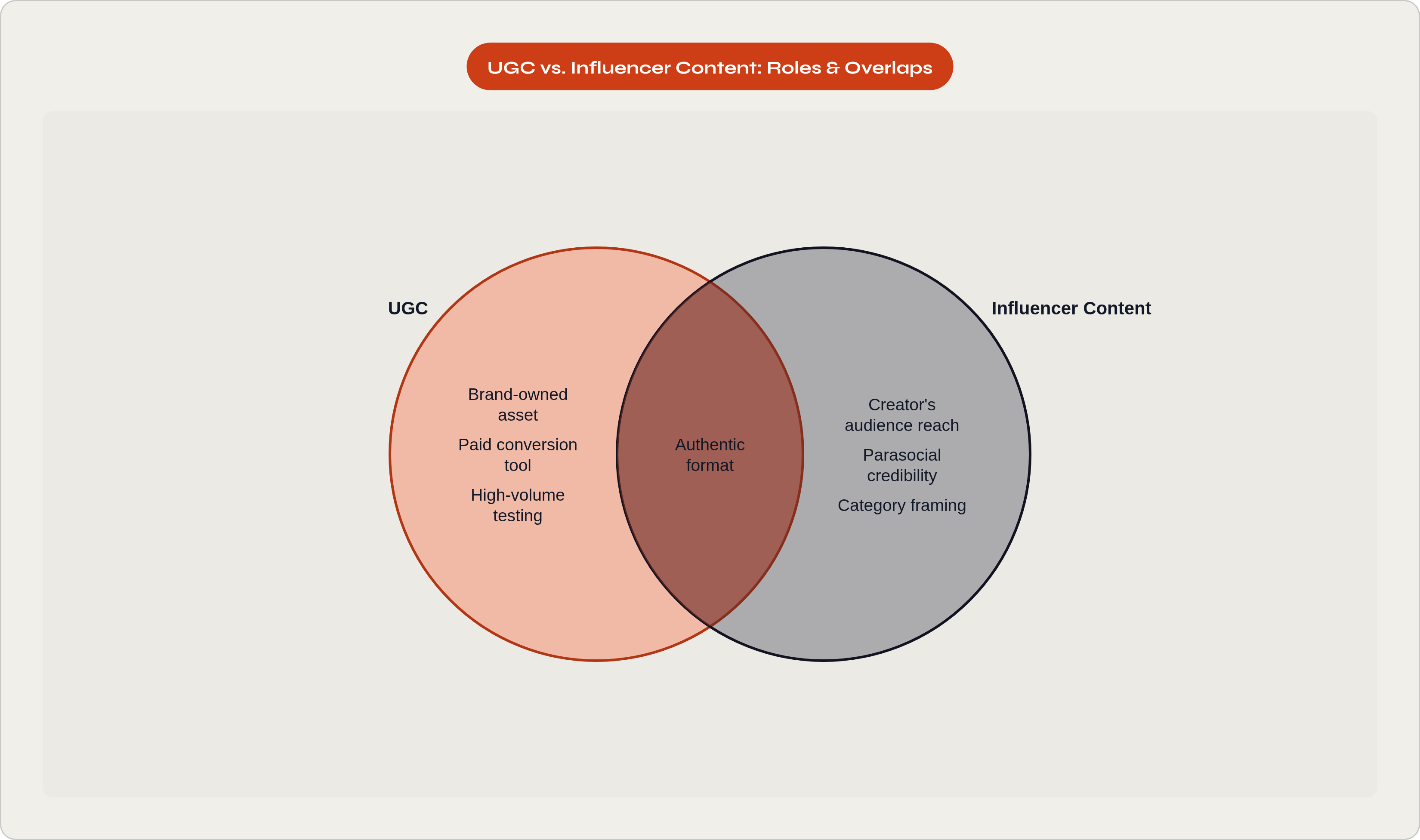
UGC, for our purposes, is content created by customers or paid creators who bring no meaningful distribution of their own. The brand owns the asset outright. It runs from the brand's ad account, against the brand's conversion pixel, and it's designed to be produced in volume, iterated quickly, and retired when it fatigues. The creator's identity matters as a trust signal, not as an audience delivery mechanism.
Influencer content is structurally different. The creator publishes to their own audience. The distribution is the product. When a brand pays an influencer, it is borrowing an established relationship between that creator and their followers, a relationship built on trust, familiarity, and a shared sense of taste. That trust doesn't transfer to a brand ad running from a brand handle. It lives specifically in the creator's channel, which is exactly why whitelisting and licensing arrangements complicate the category in interesting ways.
The trust dynamics also differ mechanically, not just in degree. Research from Forrester puts consumer identification of UGC as the most authentic content format at 68%, which tells you something meaningful about how viewers process creator-generated testimonial content. But influencer trust operates differently: it works through parasocial credibility, the sense that the creator has already vetted the recommendation and the audience has reason to believe them. Neither mechanism is superior. They are suited to different conversion moments.
Neither format wins in the abstract. The question is always: what job needs doing right now, at this stage of the app's growth?
What the Funnel Looks Like for a Consumer App and Where Content Type Fits In
Consumer app funnels have a distinct shape: awareness leads to install, install leads to activation, activation leads to retention, retention leads to referral. Most growth teams know this model. Fewer apply it rigorously to content allocation decisions.
Each stage has a different primary job. Awareness is about reaching people who have no existing reason to seek out the app. Install is about converting a warm viewer into a tap; the stakes are high and the decision window is short. Activation is about the first meaningful use, the moment a new user encounters the app's core value and decides to come back. Retention and referral are about sustaining behavior and generating organic word-of-mouth that compounds over time.
Apps are a harder test case than physical products for one underappreciated reason: there's nothing to hold. The entire value proposition must be conveyed through content, which places enormous creative weight on whatever format is carrying each stage. Attribution from a content view to an install is technically trackable but fragile across platforms, and the economics of customer acquisition cost versus lifetime value make the top-of-funnel and bottom-of-funnel balance genuinely high-stakes. A misallocation at the wrong growth stage doesn't just waste budget; it can distort the CAC math for a quarter.
The framework question worth carrying through the rest of this piece: which content type does more work at each stage, and when does the answer flip?
Where Influencer Content Earns Its Place: Awareness and Category Entry for Apps with No Audience Yet
The core job at awareness is to reach people who have no reason to look for the app, and to do so with enough credibility to generate genuine interest. That job description almost writes the format prescription by itself.
What influencer content provides at this stage is something UGC structurally cannot replicate: an existing, trusted relationship between the creator and their audience. The brand doesn't have to earn that trust from scratch. It borrows it. The creator introduces the app in a voice and format their audience already accepts, in a context that feels like a recommendation from someone they follow rather than an advertisement they're being served.
For category-creating apps, this matters even more. When an app is genuinely new, when it's solving a problem the audience hasn't consciously articulated yet, an influencer can explain "why this exists" in a way that a raw UGC testimonial ad rarely does efficiently. Testimonial content works when the viewer already understands the category. Influencer narrative content builds the category frame first.
Tier selection is where most early-stage teams get this wrong. The instinct is to reach for the largest possible creator, but reach volume and genuine audience response are different things, and for an early app with a limited budget, the latter matters more. Nano and micro creators, roughly 10,000 to 100,000 followers, consistently drive higher engagement rates than macro accounts. The cost-per-engaged-viewer math often works decisively in their favor.
Macro and celebrity tiers have a legitimate place, but only when the app needs to establish cultural legitimacy quickly and the cost-per-install math closes. That's a narrow condition. Most apps in early growth should resist the temptation.
The ROI case for influencer content at this stage is well-established in the industry, with documented figures suggesting meaningful outperformance versus brand-owned organic content. But those figures are only meaningful if the attribution is being done at all, and a majority of advertisers still evaluate creator performance through platform-native metrics like views and likes rather than downstream install lift or CAC contribution. That gap distorts the perceived value of influencer content in ways we'll return to.
A reliable practical signal: influencer content is earning its place when install volume lifts in the two to three days following a creator post, even without a direct tracked link. If that signal isn't visible, the creative or the creator selection needs to be interrogated before the spend scales.
Where UGC Earns Its Place: Converting Warm Audiences and Fueling Paid Performance at Scale
Once a consumer knows the app exists and has some reason to be interested, the job shifts. It's no longer about earning attention; it's about earning the tap. That's a fundamentally different creative requirement, and it favors a different format entirely.
UGC's structural advantages at this stage are practical, not just philosophical. It runs in the brand's ad account, which means full conversion tracking, real CAC data, and the ability to A/B test hooks, faces, and formats against each other. The creative testing infrastructure that performance teams depend on simply works better when the asset is owned outright.
The conversion performance data for UGC in paid contexts is meaningful. Research from Emplifi tracked UGC-driven conversions reaching 6.73x in Q1 2026, up sharply from 4.27x the prior quarter, which suggests the format's effectiveness in paid placements is accelerating, not plateauing. Click-through rates for UGC consistently outperform traditional ad creative, sometimes by a factor of four.
Volume is the mechanism that makes this work in app install campaigns specifically. Paid social creative fatigues quickly; an audience that sees the same ad repeatedly disengages and conversion rates fall. A batch of UGC assets, built with multiple hooks, different faces, varied angles and formats, lets the algorithm find the best performer and rotate to it before fatigue sets in. The cost economics support this model: average UGC campaign costs have come down significantly, with Collabstr putting the per-campaign average at $197 in 2025, which means per-asset cost is low enough to justify real volume production.
The authenticity signal matters specifically at the install decision point. Gen Z and millennials consistently report that peer content influences their purchasing choices more than polished brand creative, and app install decisions follow the same psychology. A real user, clearly not a professional actor, explaining why they kept using the app for three weeks lands differently at the decision moment than a high-production influencer integration does. The rougher the edges, often the more persuasive.
UGC also earns its place in activation. Content that shows the app's first-use experience, the specific "aha" moment, reduces uncertainty for new installers who haven't yet committed to the habit. It answers the question every new user is silently asking: "Will I figure this out?"
How the Allocation Between the Two Formats Should Shift as an App Moves Through Growth Stages
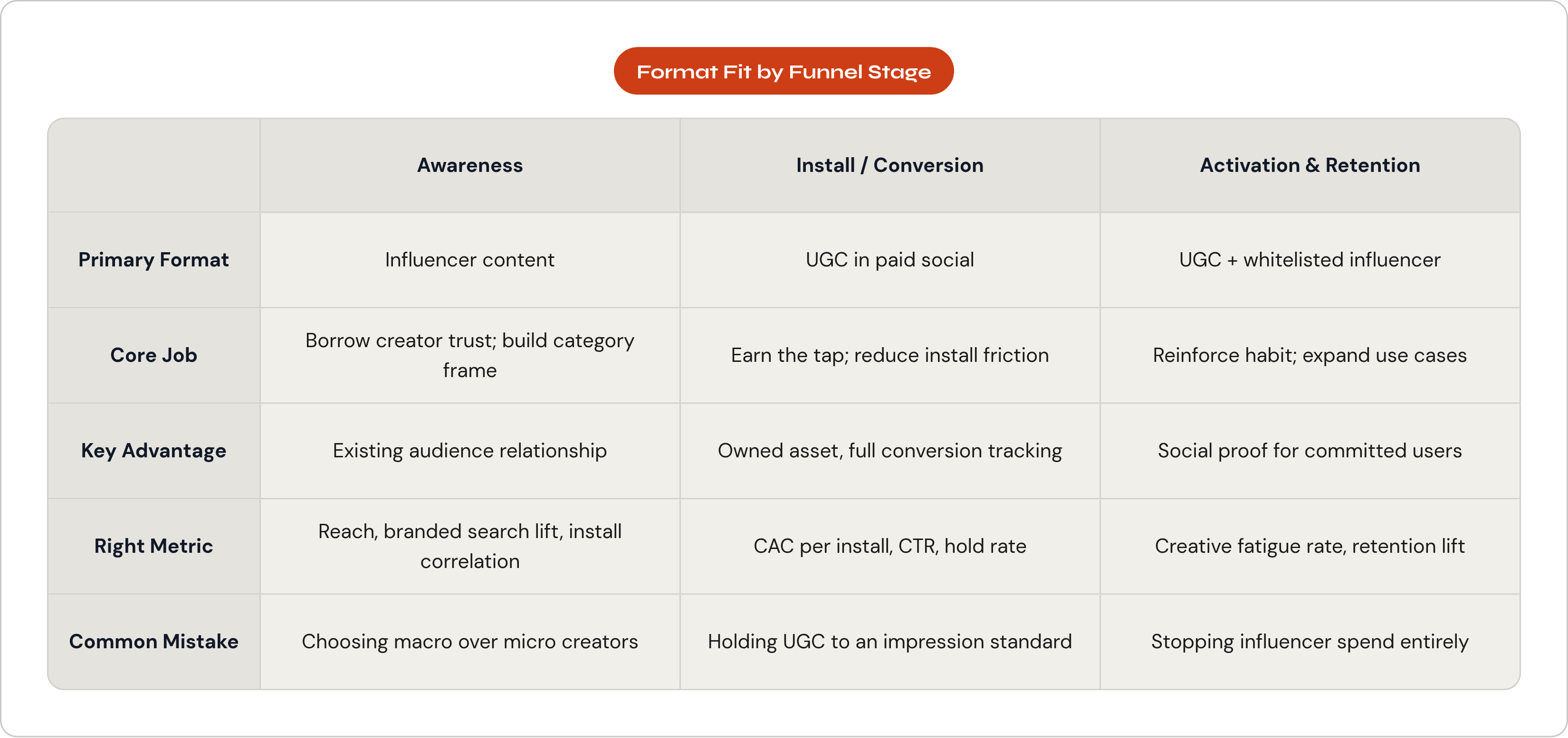
Early stage, pre-product-market fit, sub-50,000 users: influencer content does the heavier lifting. The app has no user base to generate credible authentic UGC at scale, and awareness is the binding constraint. Micro and nano creators are the right tier, affordable, high-engagement, and authentic enough to feel like a genuine recommendation rather than a sponsored post. UGC at this stage has a role, but it's modest: small seeded batches to test messaging and identify which angles resonate, not yet a paid volume play.
Growth stage, scaling installs, building retention loops: the center of gravity shifts. UGC moves into the core of paid social, with volume production, rapid creative testing, and algorithm-driven iteration as the primary mechanism. Influencer content doesn't disappear, but its role changes. It's no longer the primary install driver. Instead, it becomes a source of raw creative assets that get whitelisted and amplified into paid placements. This is where whitelisting earns its place in the allocation model: it bridges the two formats by turning high-performing organic influencer posts into paid units with creator credibility intact, running from the creator's handle but with brand-level conversion tracking behind them.
Scale stage, established audience, retention and referral as the priority: UGC shifts toward serving the existing user base, showing continued use cases and community behavior, providing social proof that reinforces the habit for people already in the funnel. Influencer content moves toward category reinforcement and audience expansion into adjacent demographics. At this stage, sustained influencer presence on platforms like TikTok, where product discovery behavior among younger audiences remains concentrated, maintains category visibility even when paid performance spend is operating efficiently elsewhere.
The allocation is never static. It responds to CAC trends, creative fatigue signals, and what the platform algorithm is rewarding in a given quarter. The framework isn't a formula; it's a way of asking the right question each time: what's the binding constraint right now, and which format addresses it directly?
Why Treating Influencer Content as a Paid Asset Pipeline Changes What You Buy from Creators
The traditional influencer buy has a built-in structural weakness. You pay for the post and the audience reach. The content lives on the creator's page for a few days, accumulates engagement, and then disappears into the feed. The brand has no durable asset. The performance data, if it exists at all, lives in the creator's analytics dashboard, not in the brand's ad account.
Whitelisting breaks this dynamic. The creator grants the brand permission to run paid advertising directly from the creator's handle. The post runs in the brand's ad account with creator credibility intact, meaning the audience sees it as coming from a person they follow, not from a brand they're scrolling past. The brand gets conversion tracking, CAC data, and the ability to iterate on the creative in the same way it would with a UGC asset.
The economic logic shifts when you think about it this way. Content that performs well organically on the creator's page, that earns high engagement and drives genuine audience response, becomes a candidate for paid amplification rather than something left to decay. The brand is no longer buying an impression; it's buying a performance asset with audience trust pre-baked into the unit.
This changes creator selection criteria at the growth stage in a meaningful way. The question is no longer primarily "how big is their audience?" It becomes "how good is their creative, and will they grant whitelisting rights?" A micro-creator with 15,000 highly engaged followers whose content converts at a strong rate in paid placements is more valuable in this model than a macro-creator who won't license. That's a genuine inversion of how most influencer programs are currently structured.
The practical implication extends to how briefs are written. If paid amplification is part of the plan from the start, the creator brief needs to account for it. The hook needs to work in the first three seconds as a paid unit, not just as organic content that gets algorithmic lift because of creator credibility. The CTA needs to be explicit. The format needs to survive platform ad placement without losing the authenticity that made it worth buying.
The Measurement Gap That Causes Brands to Misread Which Format Is Working
More than half of advertisers still evaluate creator performance entirely through social platform reporting: views, likes, shares, comment sentiment. That measurement choice creates a systematic bias that compounds over time.
Here's how it plays out. A single influencer post with 200,000 views looks like a decisive win in a platform analytics report. A batch of UGC ads with a fraction of that reach but a conversion rate four times higher than traditional creative looks underwhelming in the same report. Teams optimizing for visible metrics will consistently over-invest in awareness formats, not because the allocation is strategically correct, but because the numbers they're looking at reward it.
The right metrics differ by format and funnel stage, and treating them as interchangeable is where the measurement failure originates. Influencer content at the awareness stage should be measured through reach, share of voice, branded search lift, and downstream install correlation, not through direct conversion rate. Holding influencer awareness content to a CAC standard will make it look like it's failing when it's actually doing its assigned job. UGC in paid should be measured through CAC per install, creative fatigue rate, CTR by hook variant, and hold rate, the proportion of viewers who watch long enough for the message to land. Whitelisted influencer content running in the brand's ad account should be measured the same way as UGC, with the addition of engagement rate on the creator's handle to confirm the paid amplification isn't degrading the organic relationship.
The deeper problem is timing. If the attribution infrastructure isn't in place before the content goes live, the data to inform the next allocation decision simply doesn't exist. Too many teams build measurement retroactively, after the campaign has already run, which means they're allocating the next round of budget based on incomplete or misleading signals.
What good measurement looks like in practice: each format is given credit for the job it was assigned, with metrics chosen to reflect that specific job, and the overall picture is a composite that shows which stage of the funnel is performing and which is breaking down, not a single blended metric applied uniformly across both formats.
The Operational Reality of Running Both Formats Simultaneously, and Why Most Teams Can't
The honest reason most app marketing teams default to one format isn't strategic conviction. It's operational bandwidth.
UGC and influencer programs are distinct operational tracks, and each requires its own infrastructure. UGC involves creator sourcing, briefing, content review, usage rights management, and paid trafficking. Influencer programs involve relationship management, contract negotiation, FTC compliance workflows, content approval, whitelisting setup, and performance tracking. A single social media manager running a manual UGC program can handle somewhere between 30 and 60 pieces of creator content per week at a sustainable pace, adequate for a single brand with modest paid spend, but not for the kind of aggressive creative testing that drives meaningful CAC improvement.
Running both simultaneously doesn't just double the workload. It compounds it. The tooling is different. The skills required are different. The cadence of decision-making is different. Most growth teams at consumer apps are already stretched across product, paid, and organic. Adding the operational overhead of a serious dual-format content program without dedicated capacity is how brands end up doing both poorly instead of one well.
The fraud surface area is a further complication. An estimated $1.3 billion was lost to influencer fraud globally in 2024, and a substantial majority of brands lack any formal creator vetting process. Teams running influencer programs alongside UGC without systematic vetting on the influencer side are carrying risk they likely haven't quantified.
The teams that crack the operational challenge typically do so in one of two ways. Either they build genuinely separated workflows with dedicated capacity and accountability for each format, or they work with a partner that absorbs the operational overhead across both tracks so the internal team can stay focused on product and growth strategy.
Pebble operates this way by design. The end-to-end model covers creator sourcing, briefing, contracts, payments, and analytics across both UGC and influencer programs, specifically for consumer brands trying to run both formats without the internal headcount to execute either one cleanly. It's built around the operational gap, not around the creative.
A Practical Decision Guide for App Marketers Choosing How to Allocate Between the Two Formats
A few diagnostic questions, worked through honestly, will do more to clarify allocation than any general framework.
What is the binding constraint right now? If the app has no audience and no awareness, the constraint is reach and credibility. Influencer content addresses that directly. If the app has awareness but a leaky install funnel, the constraint is conversion. UGC in paid addresses that directly. If both are problems simultaneously, that's an argument for the allocation shift, not an argument for picking one format and hoping.
What stage of growth is the app in? Early-stage apps without a user base can't generate credible UGC at volume. Scaled apps with a large install base have a natural UGC production engine if they activate it. The stage shapes what's even possible, before it shapes what's optimal.
Can the team actually measure what the content is doing? If the attribution infrastructure isn't in place, whatever format the team chooses will generate inconclusive data, and the next allocation decision will be made on instinct. Build the measurement layer before the content program, not after.
Is influencer content being purchased as an impression or as an asset? If the answer is an impression, that's a legitimate awareness buy, but it should be budgeted and measured accordingly. If the answer is an asset, whitelisting rights need to be in the brief from the start.
What does the CAC trend look like over the past 90 days? Rising CAC in paid social is often a creative fatigue problem before it's an audience saturation problem. The fix is new creative variants at volume, which is UGC's structural advantage. If CAC is stable but install volume is plateauing, the top-of-funnel awareness work may be the constraint.
The underlying principle is simple even when the execution is complicated. UGC and influencer content aren't competing strategies. They're tools with distinct jobs at distinct stages of a growth funnel. Brands that scale fastest figure out which job needs doing first, assign the right format, measure it against metrics appropriate to that job, and adjust the allocation as the constraints change.
Everything else is noise.