UGC Creative Strategy for Beauty and Skincare DTC Brands
Beauty shoppers need to see real skin solving their actual problems, not polished ads.
The beauty industry has a funny relationship with trust. A $40 moisturizer requires more deliberation than a $400 flight. Why? Because the flight works the same for everyone. The moisturizer absolutely does not.
Skin type, tone, texture, sensitivity, climate, hormonal fluctuation, the twelve other products already in a routine: all of it shapes whether a formula will work for a specific person. That variability is why beauty shoppers don't just want to see a product. They want to see it on someone who looks like them, dealing with the problem they have. Not a model. Not a flawlessly lit before-and-after. A real person, with their actual skin, being honest about what happened.
That's the underlying logic behind why UGC has become so consequential in beauty and skincare. And it explains why brands that treat UGC as a brand awareness add-on are misreading how their category actually works.
TikTok Shop surpassed $2 billion in U.S. health and beauty sales in its most recent 52-week period, per NielsenIQ 2025 data. Seventy-eight percent of TikTok users report having purchased after seeing creator content. Online beauty spending grew from 14% of category spend in 2015 to 26% in 2024, with analysts projecting 33% by 2030. The channel where UGC lives is also where the dollars are going. That compression of the funnel, awareness to cart in a single scroll, means creative has to do far more work than a traditional ad. It must establish trust, demonstrate the product, and create urgency simultaneously. That's not a small ask.
So the question isn't whether UGC matters in beauty. It's whether a brand's UGC program is actually built to convert.
Why TikTok and Instagram reward UGC differently, and what that means for format planning
Here's where a lot of brands make an expensive mistake. They produce one version of a UGC asset and push it everywhere. The performance gap that follows isn't a creator problem or a product problem. It's a platform problem.
TikTok and Instagram reward different things, and they reward them for structurally different reasons.
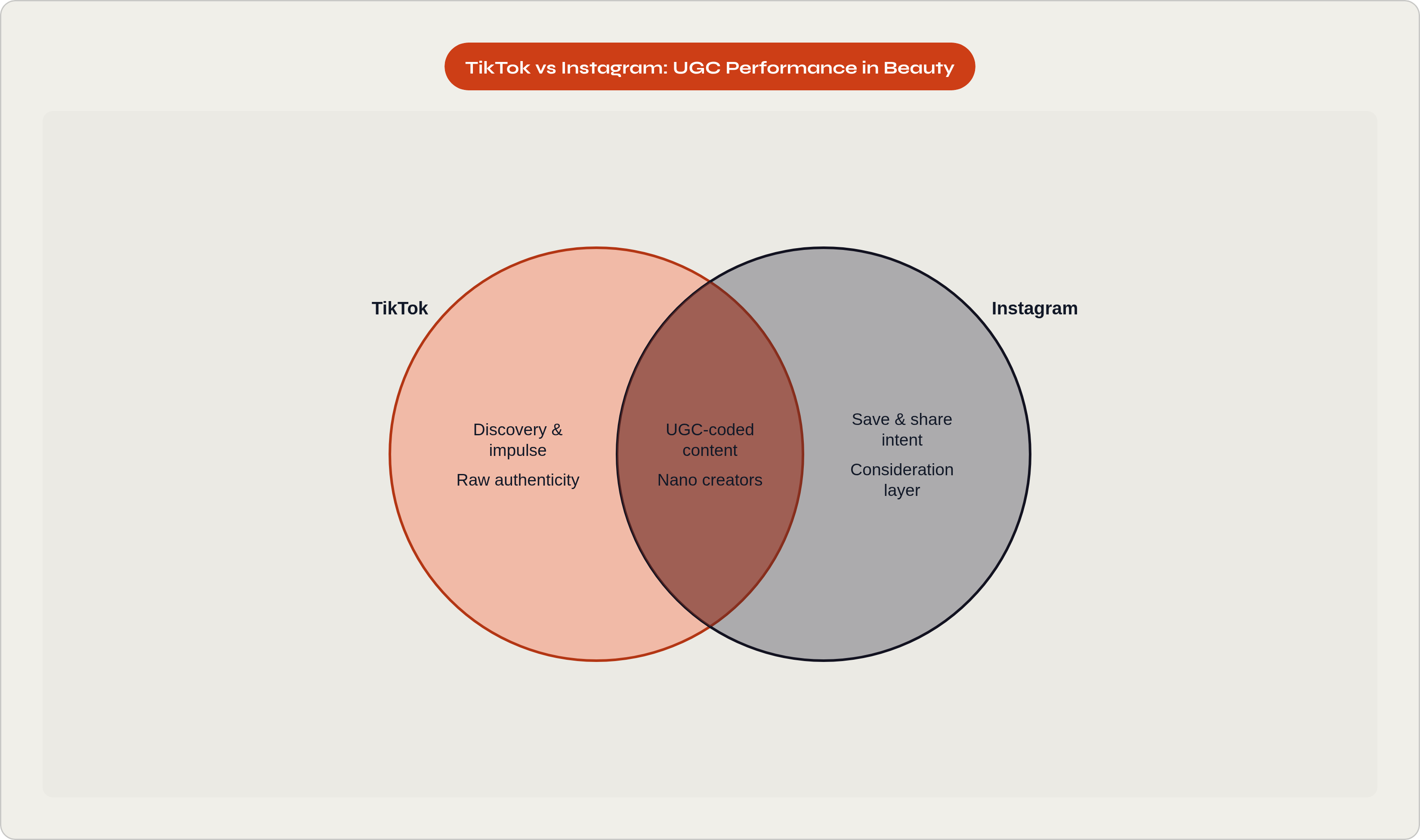
TikTok's algorithm amplifies content based on resonance, not follower count. A video from a 3,000-follower creator can reach millions in hours if watch time and share behavior signal relevance. The #TikTokMadeMeBuyIt hashtag has accumulated over 77.8 billion views, every single one of them driven by content that felt spontaneous rather than produced. TikTok favors raw authenticity, fast hooks, and reproducible formats. The viral vectors are message simplicity, creator credibility, and format reproducibility. This is a discovery-and-impulse environment. Content should feel native to it.
Instagram operates differently. Saves and shares matter more than likes because they signal intent to revisit or buy. Traackr's 2025 Beauty Benchmark found nano creators delivering a 35% year-over-year rise in save-and-share rates. That's a meaningful signal: Instagram's highest-value engagement is the user bookmarking something for later, which means the platform is functioning more like a consideration and decision layer than a pure discovery layer. Stories and Reels run parallel roles: Reels for reach and initial engagement, Stories for retargeting and social proof stacking.
Top-performing beauty brands average eight weekly posts on TikTok and five on Instagram, according to Dash Social's H2 2025 data. That cadence gap reflects each platform's appetite for content freshness. TikTok's feed moves faster and tolerates more volume before it starts feeling repetitive. Instagram rewards slightly more curated consistency.
Practically, this means the production brief needs to diverge by platform. TikTok content should be native-feeling, raw, trend-adjacent, fast-cut. Instagram Reels can carry slightly more polish, but should still read as UGC-coded rather than produced. A brand-produced asset with a creator's face on it doesn't fool either algorithm or audience.
Brands that produce one version and post it everywhere are leaving performance on the table. Platform-native production is not optional at this stage of the market.
The five creative formats that consistently convert beauty shoppers
Not all UGC formats are equal in beauty. Five have demonstrated consistent conversion performance, and they work for reasons that are worth understanding rather than just copying.
Before-and-after transformations are the highest-engagement format in beauty UGC because they do something no amount of copy can replicate: they show visible, specific proof. The critical variable is specificity in the "before." Hyperpigmentation. Cystic acne scarring. Dryness that flakes through foundation. A relatable, granular problem statement makes the before-and-after feel like evidence. A generic before-and-after feels like an ad. Staged or implausible transformations erode trust fast in an audience that has seen enough edited images to develop a calibrated skepticism.
GRWM (Get Ready With Me) and self-care routine content normalize the product as part of a daily ritual rather than a singular purchase event. This matters for repurchase and for overcoming the inertia of a shopper who already has "a routine." The implicit argument is: this fits into how you already live. Product-pairing within GRWM content subtly upsells through real routine sequencing rather than scripted pitching. For skincare specifically, the cleanser-to-toner-to-serum structure mirrors how shoppers actually think about their regimen, which makes the format feel instructive rather than promotional.
Ingredient-led and education-first content consistently outperforms generic product showcases in skincare because shoppers want to understand the mechanism, not just accept the claim. Creators who explain why niacinamide reduces pigmentation, or how retinol turnover works, produce content with rewatch and reference value. That drives save rates. Derm-adjacent creators, not necessarily licensed dermatologists but creators with a track record of explaining ingredient science credibly, are disproportionately valuable here. Brands competing on formulation should be actively briefing for this format.
Honest reviews and first impressions work because they replicate word-of-mouth. The reviewer has no apparent production budget, no apparent incentive to oversell, and no stylist lighting the shot. The 2025 Social Media Today data points in the brief are worth sitting with: UGC is 8.7x more powerful than influencer content and 6.6x more influential than branded content. The format's power is the absence of polish. Unboxing content specifically mirrors the shopper's own potential experience, which creates a kind of vicarious first use that reduces purchase risk perception.
Duets, responses, and trend-native content allow brands to enter existing conversations rather than creating new ones from scratch. Audiences already in a trend are already in an engaged, discovery mindset. The production cost is lower because the format structure is borrowed from the trend; the creator's job is to fit the product naturally into that shell. The risk is timing. Trend cycles in beauty move fast, and content produced three weeks into a trend often arrives after peak. The execution window for trend-native content is narrower than it looks.
The creative structure inside a converting UGC video
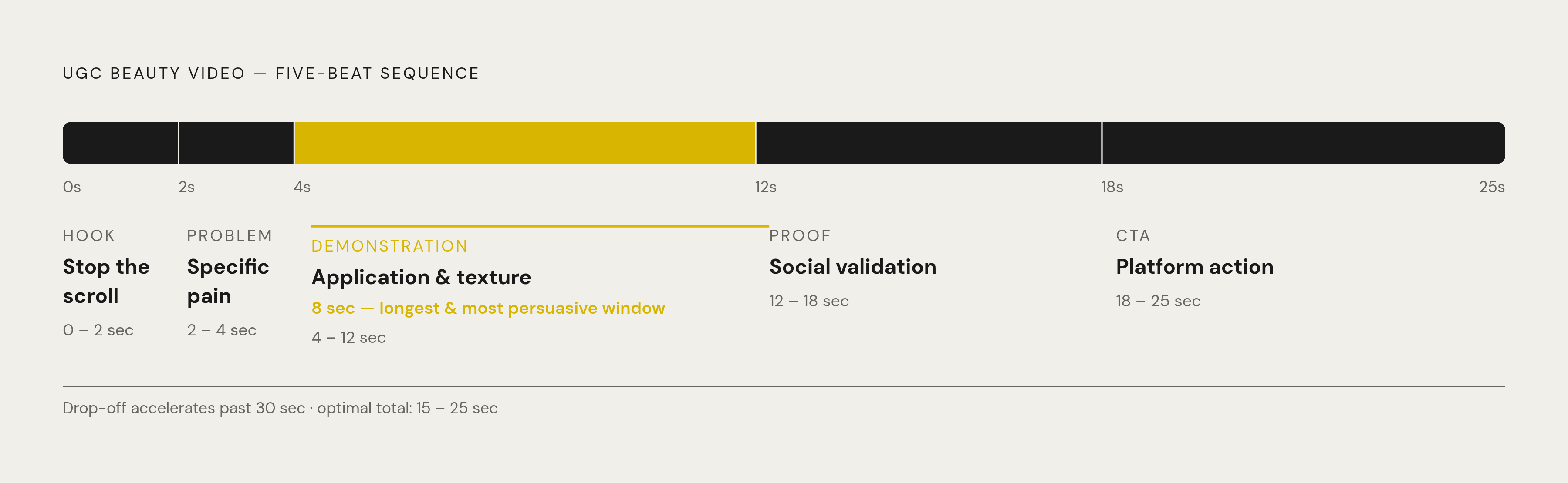
Volume matters, but structure matters more. A lot of UGC programs produce content that has the right aesthetic and the wrong architecture. Here's the five-beat structure that the highest-converting beauty UGC tends to follow, and why each beat exists.
Hook, seconds zero to two. The video's only job in this window is to stop the scroll. Not introduce the product. Not state a claim. Stop the scroll. A visual pattern interrupt, an unexpected statement, a counterintuitive question. "I've spent $600 on serums in the last year and this $28 one is the only one that actually did anything" is a hook. "Hey guys, today I'm reviewing a new skincare product" is not. The hook is also the most testable variable in a paid UGC campaign. Brief every concept with at least two or three different opening hooks to isolate what's actually stopping the scroll.
Problem, seconds two to four. Specificity here is what converts a general viewer into a prospective buyer. "My skin is so dry it flakes through foundation" reaches the person who has had exactly that experience. "I have dry skin" reaches everyone and no one simultaneously.
Demonstration, seconds four to twelve. Show, don't describe. Application, texture, how it spreads, coverage, skin reaction in real time. The camera is doing the selling. A creator narrating while barely showing the product is wasting the most persuasive interval in the video.
Proof, seconds twelve to eighteen. Social validation, visible results, or a credible reference. This is where specific figures earn their place. Directing a creator to reference "4.9 stars from 8,400 reviews with your own experience as context" produces a testable asset. Telling them to "include some social proof" produces nothing usable.
CTA, seconds eighteen to twenty-five. Direct and platform-appropriate. "Link in bio," "tap the product tag," "comment 'glow' and I'll DM you the discount." The CTA should match where the viewer is in the session, not where the brand wishes they were.
Optimal length sits in the 15-to-25-second range: long enough to show a transformation, short enough to maintain retention. Drop-off accelerates past 30 seconds. Non-negotiables for paid-media-ready assets: vertical format, speaking to camera for at least 80% of runtime, CTA at close. Creators who primarily produce horizontal YouTube content will not default to this without explicit briefing. The brief's job is to specify the argument and the proof, not to script the language. Scripted creator content loses exactly the authenticity that makes the format work in the first place.
Choosing creators whose audiences will actually buy: selection criteria for beauty specifically
The follower-count instinct is understandable and largely wrong for most beauty DTC brands.
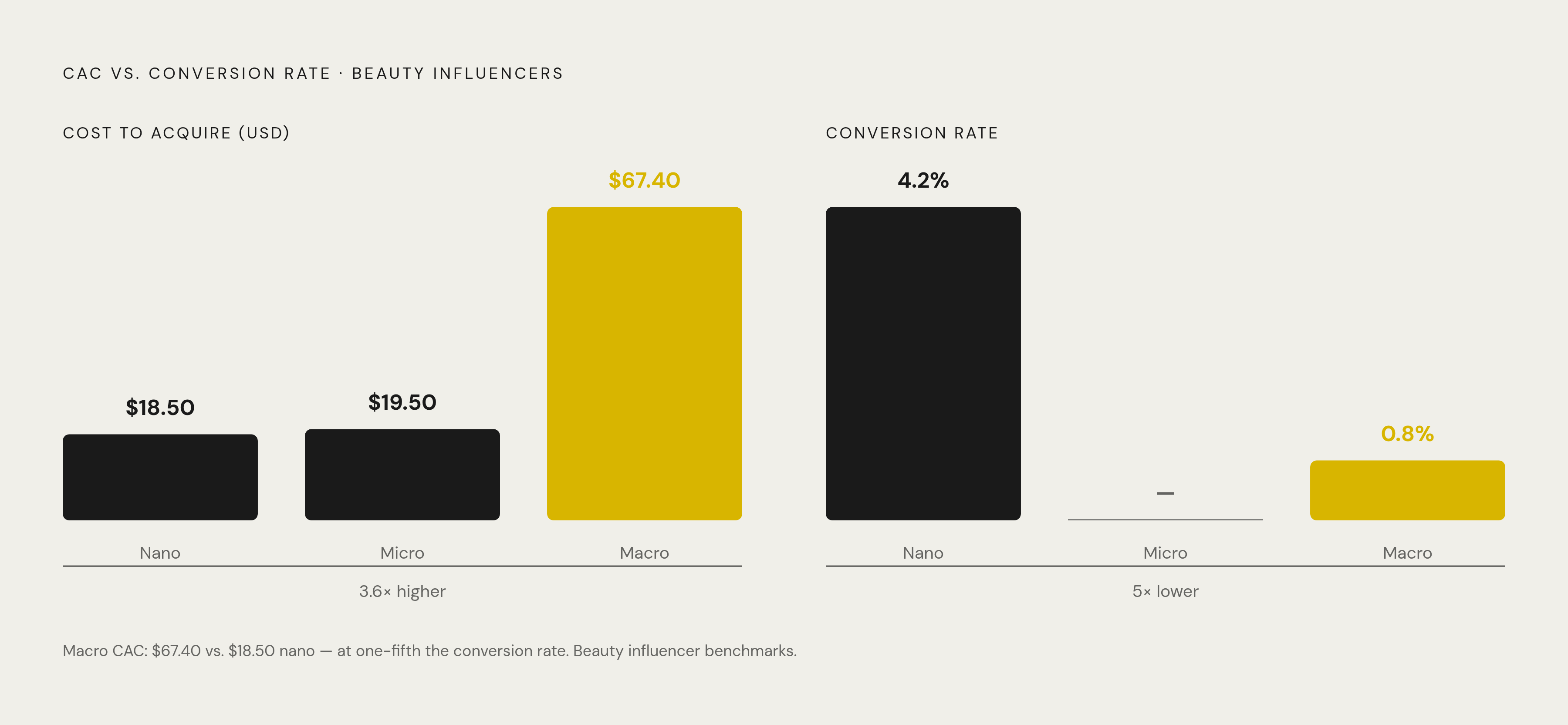
The economics are direct. Nano-influencer CAC in beauty averages $18.50 with a 4.2% conversion rate. Macro-influencer CAC averages $67.40 with a 0.8% conversion rate. Micro-influencer beauty tutorials show a 67% tutorial completion rate at a CAC of $19.50, versus 31% completion and an $89.25 CAC for macro-influencer beauty content. Seventy-three percent of brands now favor micro and mid-tier creators over celebrity partnerships, per Archive's 2026 data. The math is not ambiguous.
But engagement rate alone is an insufficient filter for beauty. These are the selection criteria that actually matter.
Skin tone and skin type representation. A rosacea treatment brand needs creators whose skin type is visible and contextually relevant. Aspirationally clear skin undermines the credibility of a problem-solution product. The creator's skin on camera is the product's proof of concept.
Aesthetic alignment. Clean girl, K-beauty, derm-led, maximalist glam: each carries distinct audience expectations, and misalignment reads as inauthentic immediately. A hyper-clinical skincare brand placing product in a maximalist glam GRWM will confuse the audience about what the product is and who it's for.
Content history with ingredients and formulations. A creator who has spontaneously explained retinol turnover or double-cleansing methodology unprompted is a more credible vehicle for ingredient claims than one who reviews packaging aesthetics. Check their archives, not just their metrics.
Category context for skincare versus color cosmetics. Skincare benefits disproportionately from micro-influencer authenticity because the purchase decision is more analytical and more personal. Color cosmetics are more aspirational and more visually driven, so the calculus shifts slightly toward creators with strong aesthetic sensibilities.
On fraud signals: an unnatural follower spike, gaining 50,000 followers in two weeks then reverting to baseline, suggests purchased followers. Plot growth over six months, not a snapshot. An audience demographic mismatch, a creator claiming to reach female beauty consumers while their audience skews heavily male, is an immediate disqualifier. A save-to-like ratio under 1% across multiple beauty tutorials contradicts Traackr's 2025 benchmark for nano-creator performance and signals shallow engagement. A 2025 Statista study found fake influencer partnerships waste approximately $1.3 billion annually globally; 67% of brands experienced influencer controversies that were preventable with deeper vetting, per Influencer Marketing Hub 2025. HypeAuditor, Social Blade, and Traackr are practical tools for this work.
The downstream implication matters: skincare clients integrating vetted micro-influencer UGC into paid creative have reported 30-60% reductions in paid social CAC. The creator selection decision isn't upstream of media efficiency. It is media efficiency.
How volume, testing cadence, and briefing structure work together at scale
Volume is a strategic input, not a vanity metric. The more assets entering the testing pipeline, the faster a brand finds out which hooks, formats, and creators produce actual paid performance. A brand producing four UGC assets per month and drawing conclusions from them isn't testing anything. It's guessing with a small sample.
A practical framework by spend level: at $30,000 to $75,000 per month in media spend, the working range is eight to fifteen creators producing two assets each per month, which puts sixteen to thirty assets in the testing pipeline. Creator program budget runs $8,000 to $20,000 monthly, including fees, product, and management overhead. At $75,000 to $200,000 per month in spend, the creator roster expands to fifteen to thirty in a mix of retainer and one-off arrangements, with a monthly budget of $20,000 to $50,000. A dedicated creator program manager is justified at this scale, not because management is complicated, but because the testing discipline requires someone whose primary job is maintaining it.
The testing logic should follow a clear hierarchy. The hook is the highest-leverage variable, so brief each concept with two or three different opening lines to isolate what stops the scroll before testing anything else. Format, creator identity, and offer or CTA are secondary variables tested once hook winners emerge. Ads featuring UGC see a 4x increase in click-through rates and a 29% boost in web conversions compared to brand-produced creative, per Billo's 2025 data. The raw material has a structural advantage before optimization even begins.
On briefing as a production discipline: the brief specifies the structural argument, the proof points, and the technical format requirements. Not the language. Not the delivery style. "Show the results" produces unusable assets. "Reference the 4.9-star rating from 8,400 reviews in the context of your own two-week experience" produces a testable asset. Vertical format, on-camera for 80% or more of runtime, CTA at close: these specifications need to be explicit, not assumed.
Whitelisting is where the investment compounds. Top-performing organic UGC assets should be whitelisted and run as paid, because the creator's handle adds authenticity signals that a brand ad account cannot replicate. Eighty-two percent of customers trust brands more when they include UGC-style ads on TikTok, per Influee 2026. Whitelisted posts blend into the feed in ways that standard dark posts don't. One well-briefed creator asset can serve organic discovery and paid conversion simultaneously. That's not a minor efficiency. That's the program paying for itself twice.
The KPIs that reveal whether a beauty UGC program is actually working
Measurement clarity is where a lot of UGC programs quietly fall apart. The evaluation criteria need to match how the asset is being deployed, and conflating organic and paid metrics produces misleading conclusions about what's working.
For organic influencer content, the relevant metrics are reach, impressions, and engagement rate. The value being measured is audience access and brand association. For creator content running as paid, the relevant metrics are CPA and ROAS in the ad account. The asset is being evaluated as creative, not as an influencer partnership. A video with 200,000 organic views and no conversion history is not the same as a video that produces a $19 CPA at scale. They're different instruments measuring different things.
Engagement rate benchmarks for beauty by platform and tier provide context but require careful interpretation. On TikTok, a 2.0 to 3.0% engagement rate is a reasonable target for beauty brands at the brand account level; nano influencers average 10.3% per Influencer Marketing Hub 2025 data, though this narrows as audiences grow. On Instagram, U.S. beauty nano influencers average 6.64% engagement. These numbers are useful as directional benchmarks, not absolute standards. A creator with a 4% TikTok engagement rate whose audience is 80% geographically or demographically misaligned with the brand's buyers is less valuable than a creator with 2.5% engagement and a highly qualified audience.
Save rate deserves separate attention in beauty, particularly on Instagram. Traackr's 2025 benchmark for nano-creator save-and-share performance reflects that beauty shoppers frequently bookmark content for future reference, for the product name, the routine, the ingredient explanation. High save rates on ingredient-led or tutorial content indicate an audience that is researching rather than passively scrolling. That's a purchase-intent signal, not just an engagement metric.
For brands running paid UGC through whitelisted creator accounts, the most important diagnostic is creative fatigue tracking. UGC assets performing well in paid generally have a shorter peak window than brand-produced creative because the authenticity signal that makes them work is also what makes them feel repetitive when overserved. Rotating hooks and creators based on frequency data prevents the program's most effective assets from burning out before they've captured the full addressable audience.
The underlying principle across all of it is this: a UGC program that can't tell you which specific formats, hooks, and creators are driving conversion isn't a program. It's a content calendar. The brands compounding growth in beauty are the ones treating UGC as a disciplined creative testing system, not as a supplementary content stream. Pebble, a data-driven creator marketing agency that runs high-volume, creator-led organic campaigns on TikTok and Instagram for consumer brands, is one resource for teams that want that kind of structured program without building the operational infrastructure in-house.