Building a UGC Library for Omnichannel Consumer Brands

Start with the market signal, because it is hard to argue with. The global UGC market was valued at $4.45 billion in 2024 and is projected to reach $18.6 billion by 2031, growing at roughly 27% compounded annually. That is not a trend brands are experimenting with at the margins. That is a structural reallocation of creative spend, and it is still accelerating. But what if that number is less a prediction and more a reflection of something brands have already decided?
The demand is coming from consumer behavior, not from marketing ideology. Sixty-five percent of global shoppers rely on UGC, ratings, reviews, customer photos, short-form video, when making purchase decisions. Eighty-six percent engage with creator content before they buy. And 93% of marketers, when surveyed, report that UGC outperforms traditional branded content on performance metrics. You can debate which benchmark matters most, but the directional consensus is difficult to dismiss.
What makes this particularly complex for an omnichannel brand is that the pull is not coming from one channel. It is coming from all of them simultaneously, and each one is hungry in a different way.
Paid social has the most voracious appetite. Creative fatigue on Meta and TikTok can set in within days at scale. The paid team is not looking for one great asset; it needs a continuous stream of fresh variants to test against a control, rotate before performance degrades, and reintroduce once an audience has had time to reset. Email is a different need entirely: social proof embedded in promotional sends, customer photos inside lifecycle sequences, short testimonial pulls that make a discount feel earned rather than desperate. Product pages need UGC that converts. Pages with customer photos and reviews convert at 29% higher rates than pages relying exclusively on branded imagery, and UGC embedded on e-commerce pages has been associated with conversion lifts of 161%. Retail partners, whether online marketplaces or physical endcaps, increasingly expect authentic imagery at the point of decision, not studio photography that announces itself as advertising.
Here is the thing that took me a while to see clearly. One piece of UGC, planned correctly, can simultaneously serve paid, email, a product page, and an organic social post. If that asset was produced without a library in mind, it serves one channel and then disappears. If it was produced with structure, it gets tagged, cleared, and deployed across every channel it's eligible for.
The library, not the asset, is the competitive advantage. Early-stage brands with modest creator budgets can punch well above their production volume if they architect the system correctly from the first activation. Most don't, and that is precisely why the Thursday-launch scramble keeps happening.
The Taxonomy That Makes a UGC Library Actually Usable
Here is the paradox every brand team eventually discovers: adding more assets to a poorly organized library makes it harder to use, not easier. Volume without taxonomy is just noise. Most UGC libraries collapse under their own weight because they were built without a tagging architecture. They were built with folders.
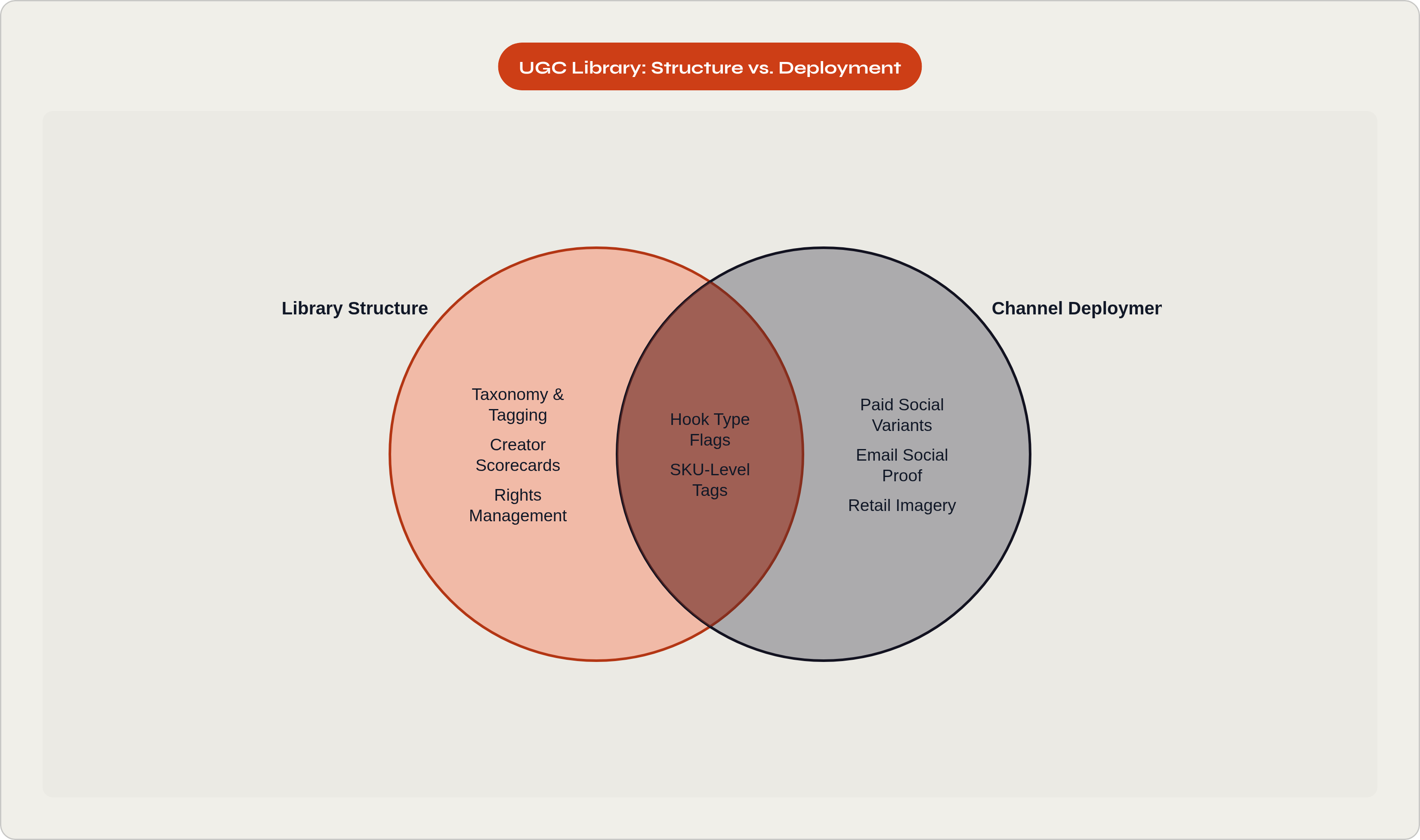
The architecture that actually works has two distinct layers, and the distinction between them matters more than most teams realize.
The first layer describes what the content is. Format: short-form vertical video under 30 seconds, long-form video, static image, carousel, or text testimonial. Creator tier: nano, micro, macro, or a UGC creator with no audience who produces purely for brand use. Production style: lo-fi smartphone capture, lightly edited, or polished. And then product tagging, which needs to go to the SKU level. "Skincare" is not useful. "Hydrating SPF Serum, 1 oz" is useful.
The second layer describes what the content does. This is where most libraries fail, because teams tag assets on ingestion and then don't touch the metadata again. The second layer should carry: which channels this asset has run on, what hook type it uses (question, bold claim, problem-agitate, demonstration, transformation), which audience segments it has been tested against, its current performance flag (control, winner, fatigued, untested), and its rights status with an expiration date.
It is also worth considering what happens to format mix when channels evolve faster than the taxonomy does. Short-form vertical video under 30 seconds is the highest-demand format in most paid and organic programs. Short-form engagement runs roughly 2.5 times that of long-form, and 47% of marketers describe it as more likely to generate virality. Lo-fi content, unedited smartphone video, behind-the-scenes footage, is not a quality tier below polished content. It is a distinct category with a distinct creative function: it signals authenticity in a register that produced content simply cannot. Tag it separately and surface it separately, because some channels want it specifically. Static imagery and testimonial pull-quotes remain high-value for email and product pages even as video dominates social, and a library that doesn't actively surface them will leave those channels underserved.
Naming conventions matter as much as the tag fields themselves. A consistent file naming structure, something like SKU plus creator tier plus format plus date plus performance status, means a new team member can understand what they're looking at without asking anyone. The goal: any team member on any channel should be able to pull the right asset in under two minutes. If the answer is still "ask someone who knows the library," the taxonomy has already failed.
How to Source Content That Fills Every Channel's Needs From the Start
Most brands think about creator sourcing as a campaign question: who do we want representing the product this quarter? The library reframe turns sourcing into a production planning question: which tags does the library need to fill, and what kind of creator produces each one?
The brief becomes the library planning document. Before a creator is booked, the brand should know exactly which format, hook style, product, and channel destination the resulting asset needs to serve. Booking a creator without that clarity produces content that may be strong but doesn't fill a specific gap. Booking a creator with that clarity produces library-ready assets by design.
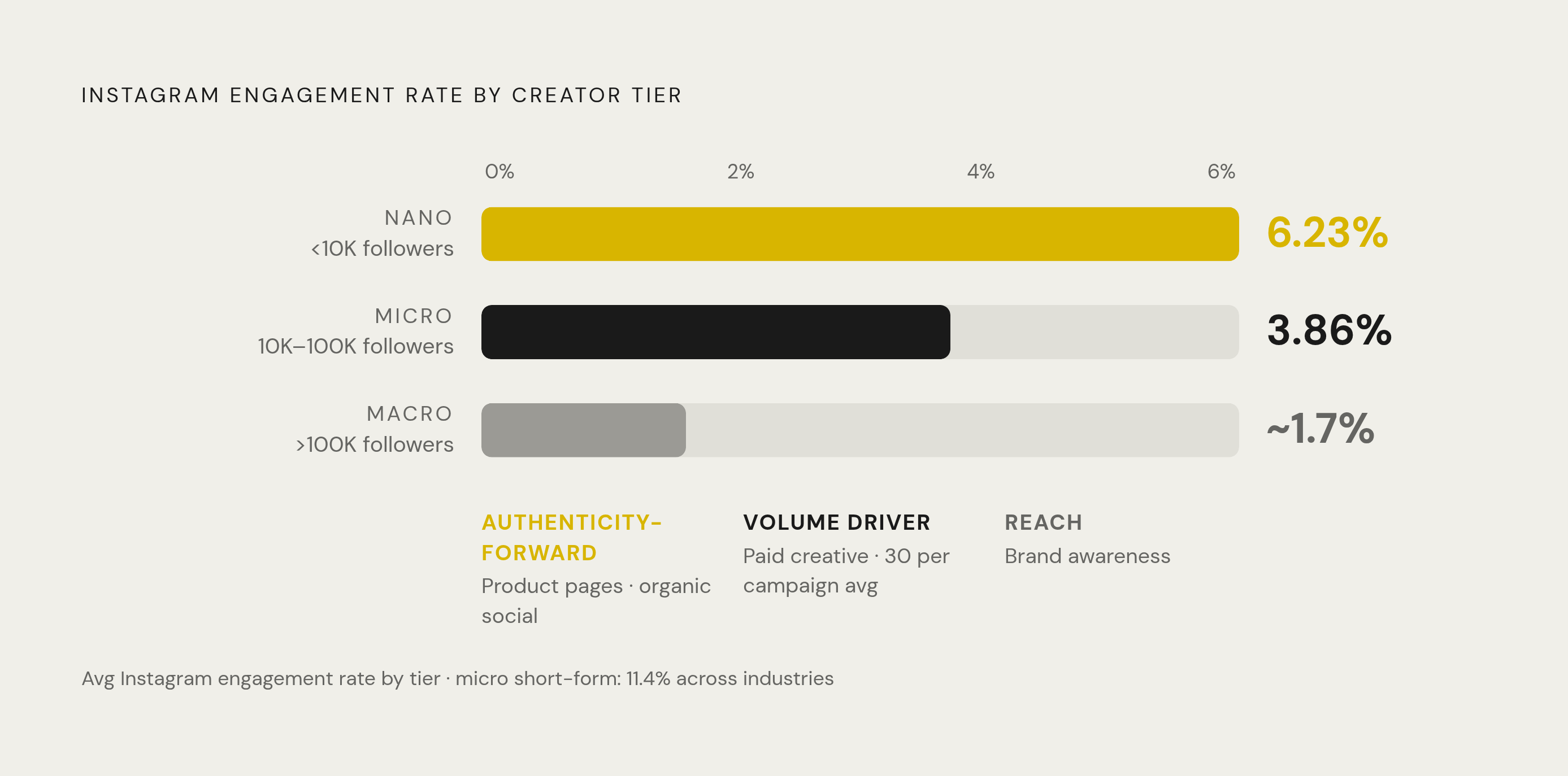
Creator tier strategy matters because different tiers produce different things. Nano-influencers, those with under 10,000 followers, generate the highest engagement rates, averaging 6.23% on Instagram per Influencer Marketing Hub's 2025 data. Their production is lower cost, more lo-fi, and most useful for authenticity-forward content on product pages and organic social. Micro-influencers in the 10,000 to 100,000 follower range average around 3.86% engagement and produce the core volume of paid creative variants. Short-form video from this tier averages 11.4% engagement across industries. Brands are now collaborating with an average of 30 micro-influencers per campaign, a 36% year-over-year increase. That volume is what fills a replenishment-ready library. Without it, the library thins out faster than the channels can tolerate.
Before any creator reaches the brief stage, vetting is non-negotiable. Fraudulent or bot-inflated creators waste library slots as much as they waste budget, because the content they produce either underperforms in testing or surfaces during rights disputes. Red flags are fairly consistent across platforms: sudden follower spikes, engagement patterns that don't match audience size, generic comments suggesting engagement pods, high like-to-comment ratios with shallow response quality. AI-assisted vetting caught an average of 18% of shortlisted creators with bot-inflated audiences in recent campaign analyses, saving roughly $11,200 per campaign in misdirected spend. For micro-influencers specifically, a practical threshold is a 3 to 6% or higher engagement rate; a creator with 50,000 followers should be averaging well over a hundred thousand views per video on TikTok.
Brief structure is where the compounding logic begins or doesn't. Specify the hook type, not just the product talking points. Define the format and length required for each destination channel. Request multiple deliverables from each creator in a single activation: a 15-second cut, a 30-second cut, and a static image from the same session. Include usage rights language in the brief, not in a negotiation after delivery. A creator who produces three format variants in one activation fills three library slots simultaneously.
The operational benchmark of roughly 50 unique content assets per month to keep a multi-channel library replenished gives a useful sense of scale. That is not 50 separate creator activations. It is a production architecture where every activation generates multiple deliverables, every deliverable gets tagged on delivery, and the library's gaps inform the next sourcing cycle.
Rights Management and the Compliance Layer the Library Can't Function Without
Rights management tends to get treated as a legal afterthought. The creative team finds an asset they love, someone asks about the rights, and a mild panic ensues. That mental model doesn't survive contact with a multi-channel library operating at scale, because an asset with unclear rights is a dead slot regardless of how strong the creative is.
Every entry in the library needs to carry a clear rights category. Organic-only rights mean the asset can appear on the brand's owned social channels but cannot be used in paid amplification. Paid usage rights, licensed for dark posts, whitelisting, or paid social, need to specify which platforms and for how long. Product page and retail rights are a separate category, and this is where many brands are often caught off guard: most standard creator contracts don't cover product page or retail partner deployment by default. Every rights entry needs an expiration date as a live field, not a note buried in a spreadsheet, so that assets approaching expiration get flagged automatically before a campaign launch.
Whitelisting deserves its own consideration because it is one of the highest-leverage strategies a library can support. Whitelisting turns a creator's organic post into a paid ad running from the creator's handle, reaching audiences who distrust brand accounts in ways brand-handle ads simply cannot. UGC ads deliver four times higher click-through rates while cutting cost-per-click by 50% compared to standard brand creative. Whitelisted creator content captures a significant share of that advantage. The operational requirement is explicit creator agreement secured at the contract stage, before the content is published. Retroactive whitelisting negotiation is slower, more expensive, and often unsuccessful.
FTC compliance is a trackable field, not a judgment call. The 2025 penalty for non-disclosure runs into the tens of thousands of dollars per violation. The library should carry a disclosure-status tag for every asset: confirmed compliant, pending review, or non-compliant and quarantined from paid use. Non-compliant assets don't disappear from the library; they get flagged so no one accidentally routes them into a paid campaign.
Here is the operational reality that most teams don't say out loud: rights and compliance metadata is the overhead that internal brand teams quietly let degrade over time. Expiration dates slip. Rights categories get assumed rather than confirmed. Disclosure status doesn't get updated when content moves between channels. That raises an important question: who, specifically, owns the metadata? A structured agency partner, or a dedicated internal role with explicit accountability for metadata maintenance, is what keeps the library clean. The library is only as trustworthy as its least accurate record.
Deploying UGC From the Library Into Paid, Email, and Retail Without Starting From Scratch Each Time
The core deployment principle is channel-specific adaptation rather than channel-specific production. One 30-second creator video, if the original brief requested raw files and multiple aspect ratios, yields a 15-second Meta variant, a 6-second hook cut for TikTok pre-roll, a thumbnail still for an email header, and a testimonial pull-quote for a product page. Four channel-ready assets from a single activation. But how does this affect our original promise? Only if the brief only requested the finished deliverable does that compounding collapse, sending the team back to starting from scratch.
Paid social is the highest-demand channel and the most operationally visible test of whether the library works. When creative fatigues, the response is not to immediately brief new content; it is to surface untested variants from the library first. If a problem-agitate hook is the current control winner, the library should surface every untested asset of that hook type within minutes, not within a week of someone remembering to look. Whitelisted assets run from the creator's handle alongside brand-handle variants, and performance comparison between the two informs what the next brief should request.
Email is where library discipline pays dividends under deadline pressure. Seasonal sends, promotional campaigns, and lifecycle sequences all need social proof, and the teams running them are almost always operating against a hard calendar. A library tagged by product SKU means the email team can pull UGC for a specific SKU weeks in advance rather than requesting new content at the last minute. Reviews, customer photos, and short testimonial clips embedded in sends do measurable work; social proof in promotional email lifts click-through rates in a consistent and documented direction.
Product pages and retail placements represent the highest-conversion deployment for most consumer brands. The 29% conversion lift associated with customer photos and reviews on product pages, and much larger lifts associated with UGC across e-commerce pages broadly, means that a library stocked with retail-rights-cleared assets and properly tagged by SKU can be routed directly to the web team without additional production spend. For retail partners, whether Amazon, Target.com, a specialty beauty retailer, or a marketplace platform, creator imagery and review content can meaningfully differentiate a listing from a competitive set relying on studio photography.
Organic social is often where library assets extend their shelf life rather than where they originate. Assets flagged as organically cleared and not yet posted can be scheduled months after initial production. Strong performers from paid, once they've fatigued in that context, can be repurposed into organic social with a different frame. That continuity between channels, the same creative ecosystem flowing across paid and organic rather than treating them as separate content tracks, is what builds recognizable brand presence rather than disconnected output.
Seventy percent of Gen Z say UGC plays an important role in their buying decisions. A library stocked with creator content and deployed systematically across every touchpoint is the infrastructure that produces that influence. Studio photography cannot replicate it.
Measuring Library Performance So the System Improves With Each Production Cycle
The measurement mistake most brand teams make with UGC is quarantining it inside organic social analytics, where it gets judged by reach and engagement and can never demonstrate its contribution to paid conversion. UGC that runs in paid channels belongs in the paid creative dashboard, evaluated by the same KPIs as every other paid asset: cost per acquisition, return on ad spend, click-through rate, conversion rate. The library's tagging is what makes it possible to segment those results by creator tier, format, and hook type.
That segmentation is where the library starts generating institutional knowledge that actually sticks. The same campaign budget deployed against a mix of nano creator lo-fi video, micro creator polished short-form, and static testimonial pulls will produce a wide CPA spread across those segments. Most brand teams running the same creative mix don't see that spread because their reporting doesn't break it down. A tagged library with UTM parameters tied to creator IDs at the asset level, not just at the campaign level, makes that spread visible. It tells you which creator tier produces the most efficient CPA for this specific brand, which hook type is winning against the current audience, and which format is aging out of the rotation.
Iteration speed is the second metric worth tracking explicitly. How quickly does a winning insight, a hook type that beats control, a creator style that outperforms the account average, translate into the next test variant? Creative fatigue is a library replenishment problem before it is a creative problem. If the library can surface five untested variants of a winning hook type within an hour of a performance insight, the team can extend a winning approach without waiting for a new production cycle. If the library can't do that, fatigue wins by default.
Creator scorecards are the third layer. Which individual creators consistently produce assets that beat the account's average CPA? That question, answered systematically over multiple production cycles, directly informs who gets re-booked and what the next brief looks like. Attribution tooling connects the dots: platform-native conversion tracking through whitelisted partnership ads, multi-touch attribution tools like Triple Whale or Northbeam to capture cross-channel contribution, and brand search lift via Google Search Console as an upper-funnel signal for awareness-level content.
The feedback loop that emerges from all of this is the part that justifies the investment in taxonomy and tooling, and it's worth being direct that most teams don't get there quickly. Performance data writes back to the library tag. Winning hook types get flagged and prioritized in the next sourcing brief. Fatigued assets are retired from paid rotation but remain eligible for email or organic, where they haven't been seen. Creator scorecards inform sourcing decisions, which improves the quality of production inputs, which improves the quality of the library's output. Over time, the library accumulates a body of evidence specific to this brand, this audience, and these channels. Institutional knowledge that lives in the system rather than in any single team member's memory.
Teams change. Campaigns end. Agencies rotate. A UGC library built with real taxonomy, real rights management, real performance tagging, and a functional feedback loop doesn't reset when any of those things happen. It keeps accumulating. The brands that will be hardest to compete with in five years are not necessarily those with the biggest creator budgets. They are the ones that started building the system early enough that the system itself became the advantage.