When to Switch from Organic UGC to Paid UGC Production

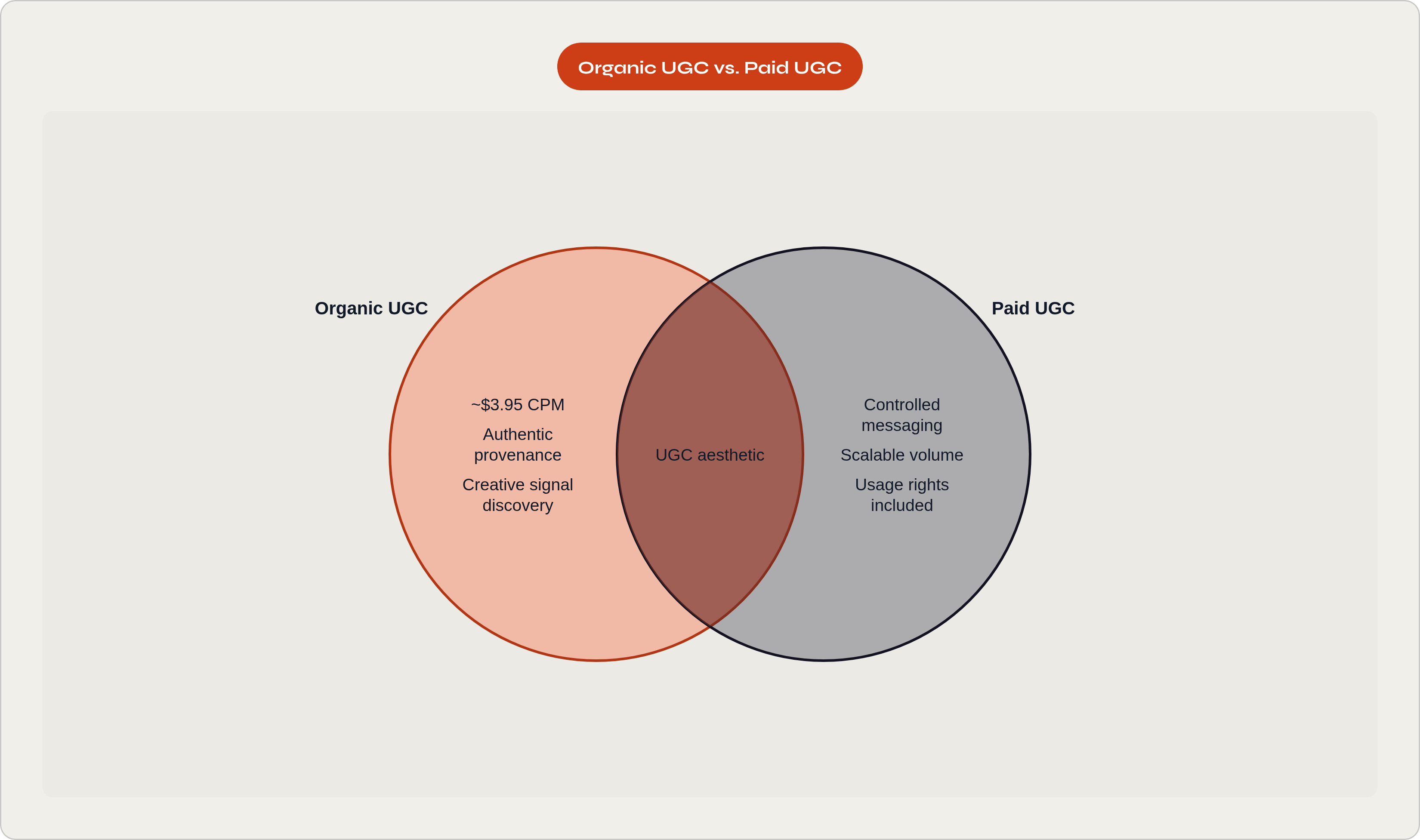
Start with the unit economics, because they're stubborn. Organic UGC runs at an effective CPM around $3.95, compared to Meta's average north of $11 in 2025. A single piece of content costing between $50 and $300 to produce can generate hundreds of thousands of impressions at zero incremental distribution cost if the algorithm picks it up. Before anyone has thought seriously about creative testing, the math already favors letting organic do its work.
But the CPM comparison, useful as it is, isn't the real structural advantage. The advantage is in how each model scales. UGC scales linearly: more content creates more independent distribution events, each competing on its own merits. Paid ad spend does the opposite. Push more money through auction-based inventory and you're competing harder against yourself and everyone else, driving CPMs upward. You're buying more exposure at progressively worse rates, with less efficiency at each step.
So going organic-first isn't just frugal. It inverts the traditional model of paying to discover what works. The hooks that stop the scroll, the formats that generate saves instead of passive views, the angles that make someone tag a friend. Those surface naturally, at no cost. What organic is doing during this phase, whether a brand recognizes it or not, is building a creative intelligence base. Every post is a free experiment. That accumulated signal is exactly the raw material paid production will need to work from later.
There's one more thing organic UGC does that paid production structurally cannot replicate: it carries provenance. A real buyer, a real environment, no commercial incentive toward enthusiasm. That signal performs differently in consideration-stage ad sets because audiences read it differently. The authenticity isn't an aesthetic choice; it's a structural property. Paid UGC can approximate the look. The underlying signal is different, and performance data (run long enough) reflects that.
The Structural Pressure That Makes Organic-Only a Temporary Position
Organic reach has declined significantly over the past several years, and not as a temporary platform fluctuation. The decline is a deliberate structural shift. Platforms are optimizing for paid inventory. Organic is the residual, not the feature. The same creative quality that drove meaningful reach a few years ago now produces a fraction of that reach without paid amplification behind it.
What this means operationally: the effective CPM of organic content rises over time even though the brand isn't paying for distribution, because reach per post keeps shrinking. You're still paying in production time and creator energy. You're just getting less distribution per unit of input.
Then there's the cadence problem. At serious testing velocity, winning assets need replacement on roughly a 7 to 14 day cycle. An engaged community of real buyers, even an enthusiastic one, cannot be relied on to produce content at that pace reliably. The organic supply is real but erratic. Gaps in the creative pipeline become gaps in paid performance, and those gaps compound in ways that are easy to misattribute to audience fatigue or budget inefficiency when the actual culprit is simpler: you ran out of content.
Organic UGC is not a permanent operating mode. It's a phase with a natural expiration. The question isn't whether a brand will eventually need to supplement it with paid production. It's whether the brand will recognize the right moment to make that move, or will overstay out of inertia, or jump to paid production before it has anything worth systematizing.
The Specific Signals That Indicate Organic UGC Has Done Its Job
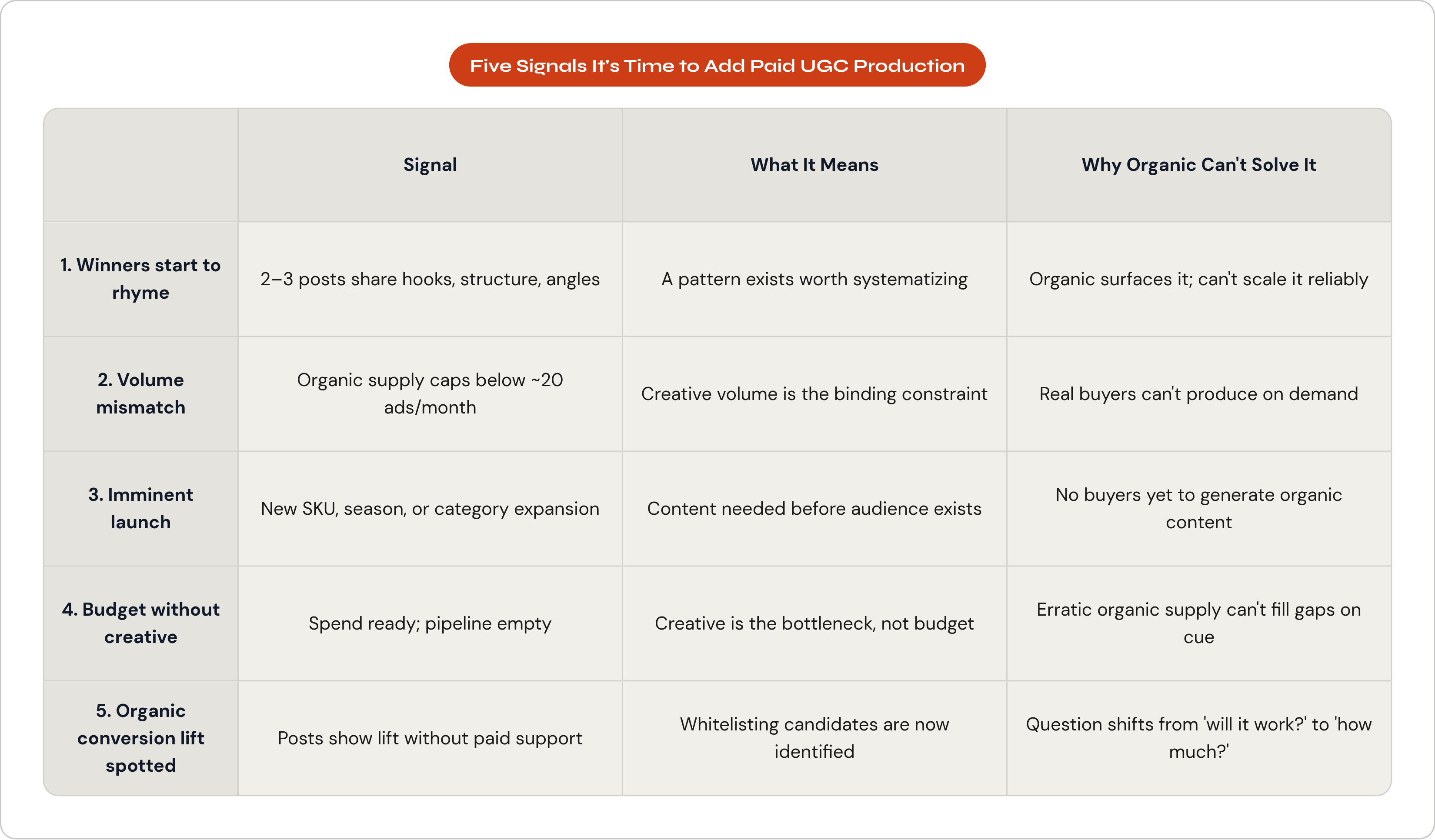
One viral video is luck. Two or three performing well with similar hooks, similar structures, similar angles is something else: a pattern. And a pattern is something a brief can actually systematize. Without that, paid UGC production is guessing at volume, which is precisely the wrong kind of scale. With it, you're commissioning against a proven creative hypothesis. The first signal you're looking for is that your winners have started to rhyme with each other.
The second signal is a volume mismatch. Brands testing more than 20 new ads monthly achieve meaningfully higher ROAS than those testing fewer than 10, according to analysis of over a thousand Meta accounts. If your organic supply reliably caps below that threshold, you're not constrained by budget or audience size. You're constrained by creative volume. That's a production problem, and paid UGC solves it directly.
The third signal is an upcoming launch that organic cannot cover on schedule. New products, seasonal campaigns, category expansions. These require content before an audience for that product even exists. Waiting for organic UGC on a new SKU means waiting for buyers you haven't acquired yet to create content about something they haven't purchased. The timeline simply doesn't work.
The fourth is the clearest economic signal of all: money available to spend, no creative to spend it on. Ad frequency rising, performance declining, and you're watching it happen in real time while waiting for new content to enter the pipeline. When the bottleneck is that legible, paid production is the obvious answer.
The fifth is subtler. When specific organic posts show measurable conversion lift without any paid support, those posts are whitelisting candidates. The question shifts from "will this work in a paid context?" to "how much should we put behind it?" That's a meaningful shift. It means organic has done what organic is for, and the brand is ready to use it differently.
What Paid UGC Production Is Actually Buying, and Why Volume Is the Point
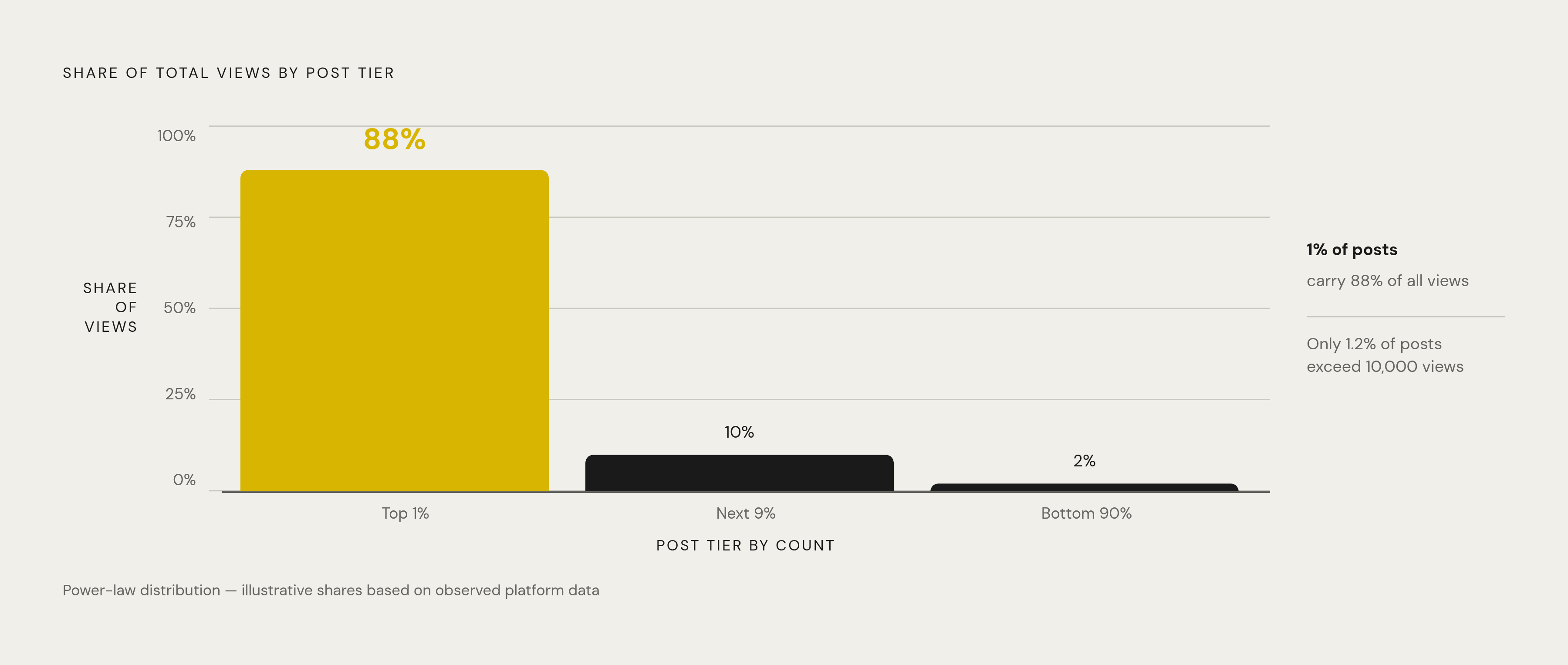
Roughly 1.2% of posts cross 10,000 views. The top 1% of posts drive approximately 88% of total views. Sit with that distribution for a moment, because it determines the entire structural logic of how paid UGC production should work. In an environment that skewed, high-volume production isn't wasteful. It's the only response that makes sense.
The shots-on-goal model isn't a motivational metaphor. It's the actual operating logic. A brand spends $5,000 on 50 raw UGC concepts. Most of them underperform. A handful break through. The winners carry the account. The unit economics work because base-level paid UGC, at volume, runs at a fraction of what traditional branded production costs per asset. The goal is not fewer expensive hero pieces. It is more creative experiments at lower per-unit cost, running simultaneously rather than sequentially.
What is actually being purchased is testable creative variety, controlled messaging, and usage rights that allow whitelisting and paid amplification. The aesthetic (handheld camera, casual voiceover, real-looking environments) approximates organic authenticity. But the real mechanical advantages are control, speed, and testability. Those are the things organic structurally cannot deliver. Impress Lash is worth examining here: 24 ad variations per month, running across TikTok and Meta, achieving a sub-$70 CPA. The efficiency came from volume enabling creative selection, not from any single exceptional asset.
Paid UGC and organic UGC are not better and worse versions of the same thing. They solve different problems. Conflating them is how brands either stay in organic mode too long or jump to paid production before they have any creative intelligence to brief against.
How the Two Modes Work Together After the Switch: The Hybrid Flywheel
The switch is not a replacement. It is an additional layer running on top of a still-operating organic engine. Organic continues to surface new creative signals and maintain community credibility. Paid production systematizes the formats organic has already proven, and fills the volume gaps organic cannot reliably cover.
The cycle, once you've seen it work a few times, becomes intuitive. Seed organically to identify winning formats. Commission paid UGC built around those formats. Whitelist the best performers. Use organic response to those whitelisted posts to refine the next brief. Each iteration makes the next brief smarter instead of resetting from scratch.
Whitelisting is the mechanism that connects the two modes rather than just running them in parallel. Organic creator content that earns strong engagement can be amplified via the creator's own handle, carrying the provenance signal (the trust signal) into a paid placement. This is where organic credibility and paid reach are combined rather than traded off against each other. It's the point where the two-mode system produces something neither mode could produce independently.
Creative fatigue management also becomes systematic rather than reactive. The paid production pipeline refreshes assets on a cadence that matches algorithm requirements. Organic posts continue generating new whitelisting candidates. That 7 to 14 day replacement cycle is only manageable when a commissioned pipeline sits behind it. Organic alone cannot sustain the rhythm. The hybrid structure can, if the operational side is built to support it.
The Operational Complexity That Arrives With Paid UGC Programs, and Why It Matters for Timing
Here's where a lot of brands quietly underestimate the transition. Paid UGC introduces operational overhead that organic never required: creator sourcing, briefing, contracting, payment, usage rights, performance tracking. At organic scale, a brand responds to a handful of mentions. At paid production scale, it's actively managing dozens of creator relationships simultaneously. That is a different operational posture, not just more of the same one.
Creator vetting becomes significantly more consequential at paid scale. According to Sprout Social's Q2 2024 Pulse Survey, 42% of consumers will distance themselves from brands associated with influencer controversies even after a public statement. Yet according to a separate survey by EMARKETER and Viral Nation, more than half of marketers spend 30 minutes or less vetting a single creator. At organic scale, an occasional oversight is a manageable risk. At paid production volume, the same oversight compounds.
Usage rights are the operational detail brands most reliably mishandle. Paid UGC content is commissioned for specific uses: organic posting, paid ads, whitelisting. Rights must be negotiated and documented per deliverable, before production begins, not after you've identified a winner you can't legally run. It's an obvious point that gets missed with surprising regularity, often by people who have been through it before.
Brief quality determines production quality, and this is consistently underestimated. The more creators being briefed simultaneously, the more precisely the brief itself needs to carry the creative hypothesis. Vague briefs at volume produce vague content at volume. The operational discipline of briefing is as consequential as creator selection. More so in some cases, because a bad brief undercuts even a good creator.
What all of this implies for timing: the signals that tell a brand it's ready to switch also signal that operational infrastructure is now required that organic mode never demanded. Reading the creative signals correctly is necessary. Having the capacity to execute when those signals appear is equally necessary. Brands that underestimate the second half of that equation make the move too early, sustain it poorly, and then attribute the results to the wrong variable entirely. Usually the creators. Sometimes the platform. Rarely themselves.