Managing Creator Output Consistency at Scale

Most briefs describe what the brand wants to say. The effective ones describe what the creator needs to produce. With five creators, that gap is annoying. With a hundred, it's where programs quietly collapse.
Here's what actually happens when a brief is vague: you don't get bad content. You get fifty different, individually defensible interpretations of what the content should be, which together form an incoherent mess. The creator isn't wrong. They made a reasonable judgment call with the information they had. The brief just didn't give them enough of it.
A precision brief works at the execution level. Not "a short video showcasing the product," but "a 15-second hook followed by a 30-second product demonstration." It names deliverables explicitly, revision rounds included, specifying whether raw files or edited cuts are expected. It lists required on-screen elements and anything that's off-limits. It tells the creator where the asset is going, because a creator calibrates tone very differently for paid whitelisting versus an organic post versus a product page. And it includes reference examples, not as templates to clone, but as anchors for aesthetic expectations that words alone can't fully establish.
There's a persistent misconception worth addressing directly: lo-fi, authenticity-forward formats, unboxings, first-reaction clips, smartphone footage, require less rigor in the brief. They don't. They require a different kind of precision. You have to specify what not to over-produce, which environmental details to preserve, what level of polish actively undermines the format's credibility. Leave that out and a brand that asked for authentic content gets thirty videos that look like corporate productions with shaky cameras.
There's also a practical cost to vague briefs that doesn't get talked about enough. Every unnecessary revision round eliminated across a hundred-creator activation is a real compounding saving, in time, in coordinator bandwidth, in relationship goodwill with creators who have other work to get to.
One underappreciated function of a brief is how well it works as a vetting instrument before anyone has pressed record. Creators who ask clarifying questions before they begin reliably produce more on-spec content than creators who just submit. The brief surfaces that behavioral signal early, and that's worth paying attention to.
How Creator Selection Shapes Output Before a Single Piece of Content Is Made
The most common selection error is optimizing for follower count or a visually cohesive grid when the actual predictor of output consistency is execution behavior. A creator with a beautiful aesthetic and a large following can be a genuinely unreliable partner on a brief-constrained deliverable. A creator with a smaller, highly engaged audience and a demonstrated history of format fluency is often operationally excellent. Conflating those two things is expensive.
Per a TikTok and BSI Creator Suitability Report from March 2026, creator fit ranked as the top selection factor for both brands and agencies, each at 22%; follower count ranked last at 8% for brands. So stated priorities have shifted. Actual practice lags considerably, which is the least surprising finding in the report.
Two dimensions of fit actually predict output consistency, and they're distinct enough to be worth separating. Brand-values alignment means a creator who genuinely uses or cares about the product category will produce content that needs fewer corrections; they bring an inherent interpretive accuracy to the brief that you can't brief into someone. Format fluency is different from general content creation ability; a creator who has made dozens of tutorials is not automatically equipped to produce a compelling lifestyle integration video, and treating those as interchangeable skills creates friction downstream.
The vetting depth problem is real and underappreciated. Over half of marketers spend 30 minutes or less vetting a single creator. At that depth, the behavioral signals that actually predict delivery reliability are essentially invisible. Irregular posting cadence on a creator's own channels, for instance, is one of the cleaner predictors of irregular delivery on branded work. You can't observe that pattern meaningfully in under 30 minutes. You're sampling, not vetting.
The most reliable vetting tool is a paid test project: one to three videos assigned under the same brief conditions as a full engagement. It replaces inference with direct brief-to-output data. The cost is modest. The information density is high.
One more thing worth noting: micro and nano creators, those with under 5,000 followers, convert 20% better than larger accounts. Programs that over-index on reach are systematically bypassing the most operationally productive tier.
The Accountability Structures That Keep a Large Roster On Spec and On Time
A brief sets expectations. Accountability structures are what actually enforce them. At the scale of dozens or hundreds of simultaneous creator relationships, expectations set without enforcement mechanisms are essentially aspirational, and aspirational isn't a program structure.
The core mechanisms are staged delivery checkpoints, documented timelines with hard submission windows, and rights and usage terms specified in writing before work begins. Staged checkpoints, specifically concept approval before filming and rough-cut review before final edit, catch drift when correction is cheap, not after the asset is finished and everyone's time has been spent. Hard submission windows prevent accountability from diffusing across a large roster, which it will do if you let it. Usage ambiguity is one of the most common sources of post-delivery disputes that delay asset deployment; resolving it upfront eliminates an entire category of friction before it starts.
Contracts serve an operational function that goes beyond legal protection. Base rate, payment schedule, covered expenses, revision scope, performance bonuses: when those are documented upfront, both parties share the same understanding of what the engagement actually covers. Net-30 payment terms deserve specific attention here. They're standard across many industries, but they function as a meaningful friction point in creator relationships. Slower, less predictable payment degrades creator prioritization of brand work over time, quietly and without anyone naming it. Net-10 or net-15 terms aren't courtesies. They're operational decisions with real effects on responsiveness.
A tiered creator structure makes volume manageable in a way that flat rosters don't. Anchor creators with proven delivery history establish the program's consistency floor. New creators rotate through a test-and-evaluate layer. Underperformers exit without disrupting the core roster. That's not sophisticated architecture; it's basic operational logic applied to a domain that tends to resist systematization for reasons that are more cultural than practical.
Centralized communication is less glamorous, but equally consequential. When briefs, feedback, revisions, and approvals move simultaneously through email, DMs, Slack threads, and shared documents, accountability diffuses and nobody is certain what was actually agreed or when. One channel of record per creator relationship is the minimum condition for accountability to function at all.
Why Only 3 to 5 Percent of Creator Activations Drive Sales, and What a Volume Strategy Does About It
Only 3 to 5 percent of seeded creators produce content that actually drives sales. Not 30 percent. Not 15 percent. Three to five.
Brands that treat this as a selection failure are misreading what the data is actually showing. This isn't an anomaly to be vetting-optimized away; it's a structural property of creator programs, a base rate that sound operational systems are built around rather than blindsided by. The implication isn't that vetting should keep improving until every creator converts. The implication is that the program needs a pipeline of sufficient volume to make the math work in your favor.
If 3 to 5 percent of activations produce meaningful sales-driving content, a program seeding 100-plus creators per month generates a reliable pool of high-performing assets. A carefully curated roster of ten creators, even one with genuinely strong average quality, produces fewer total wins. Volume isn't the enemy of quality at scale. Volume without operational infrastructure is, and that's the only version of this argument worth having, because the second version is just mismanagement with a philosophy attached to it.
Several tools make this tractable. Creator marketplaces enable simultaneous activation, brief distribution, and rights management at scale. AI-powered vetting can scan full content histories in minutes, meaningfully reducing per-creator assessment time without sacrificing thoroughness. Templated contracts with variable fields replace bespoke agreements without losing the operational specificity that accountability requires.
The economics support the model. Average UGC video pricing dropped to around $198 per video in 2025, a 44 percent decline from prior levels. At that price point, the cost of identifying high-performing assets through volume is calculable before you start. The risk isn't running volume. The risk is running volume without the operational layer to capture and act on what works, which is just spending money on a process you haven't finished building.
How Performance Feedback Loops Turn One-Off Wins Into Repeatable Output
The gap most programs leave open is between producing content and learning from it. Content goes up. Results are noted loosely, or not at all. The next activation begins. No data flows back to change briefs, rotate creators, or refine formats. Every program operating this way treats each activation as a self-contained event, which means each one carries the full uncertainty of the first, indefinitely.
A functional feedback loop ties post-activation review to specific creative variables: hook format, content length, product demonstration style. Attribution sits at the creator level where useful, at the format level where more useful. Brief updates follow a defined cadence based on what performed. Creator-level performance scoring informs roster tiering decisions, rather than gut feel about who "is a good partner."
The measurement framework that makes this possible operates across three layers, and it matters that you think of them as distinct. The awareness layer covers reach, impressions, and video completion rate. The engagement layer covers saves, shares, and comment quality, which is a qualitative signal that quantitative metrics alone consistently miss. The conversion layer covers cost per acquisition, return on ad spend, and conversion rate. By 2026, 74% of brands are measuring creator programs against the same standards as paid media: customer acquisition cost, average order value, and return on investment. That shift matters because it means creator programs are now being held to the same accountability as channels that have had to prove their numbers for years, which is either clarifying or uncomfortable depending on where your program stands.
Last-click attribution systematically undervalues creators because creators typically initiate rather than close the purchase journey. A creator-influenced view on Tuesday converts through a retargeting ad on Saturday, and the creator gets nothing. Multi-touch attribution corrects this; it's improved ROI measurement for roughly half the brands that adopted it, per a 2025 analysis of the practice. Accurate measurement isn't a courtesy extended to creators. It's a prerequisite for rational budget allocation.
Sharing performance data with creators, specifically what worked and why, produces better content in the next round. This is obvious, but most programs don't do it. A creator who understands what their audience actually responded to will replicate it more reliably than one who received silence and is essentially guessing again from scratch.
A 12-week creator-led series at a subscription brand called Kenko produced a 37% lift in subscriptions, with each round of content improving because of the data generated by the prior round. That compounding doesn't come from creative inspiration. It comes from operational discipline applied consistently over time.
What Changes When the Operational Layer Handles Consistency Rather Than the Brand Team
The hidden cost of decentralized creator operations doesn't surface clearly on any single activation. Briefing, vetting, contracting, payment processing, rights management, performance tracking: each is a discrete operational function. Together they represent significant recurring overhead that scales directly with creator volume. When that overhead lands on whoever has bandwidth on the brand team at a given moment, it consumes precisely the attention that should be going toward campaign strategy, product positioning, and channel decisions.
The fragmentation problem compounds this in ways that aren't always visible until they've already cost something. Most marketers vetting creators average around three separate tools per vetting process. Fragmented tooling produces data silos. Data silos make cross-creator performance comparison unreliable. Unreliable comparison makes ROI attribution difficult to defend. And budget decisions made on incomplete attribution are, at best, educated guesses presented with more confidence than they've earned.
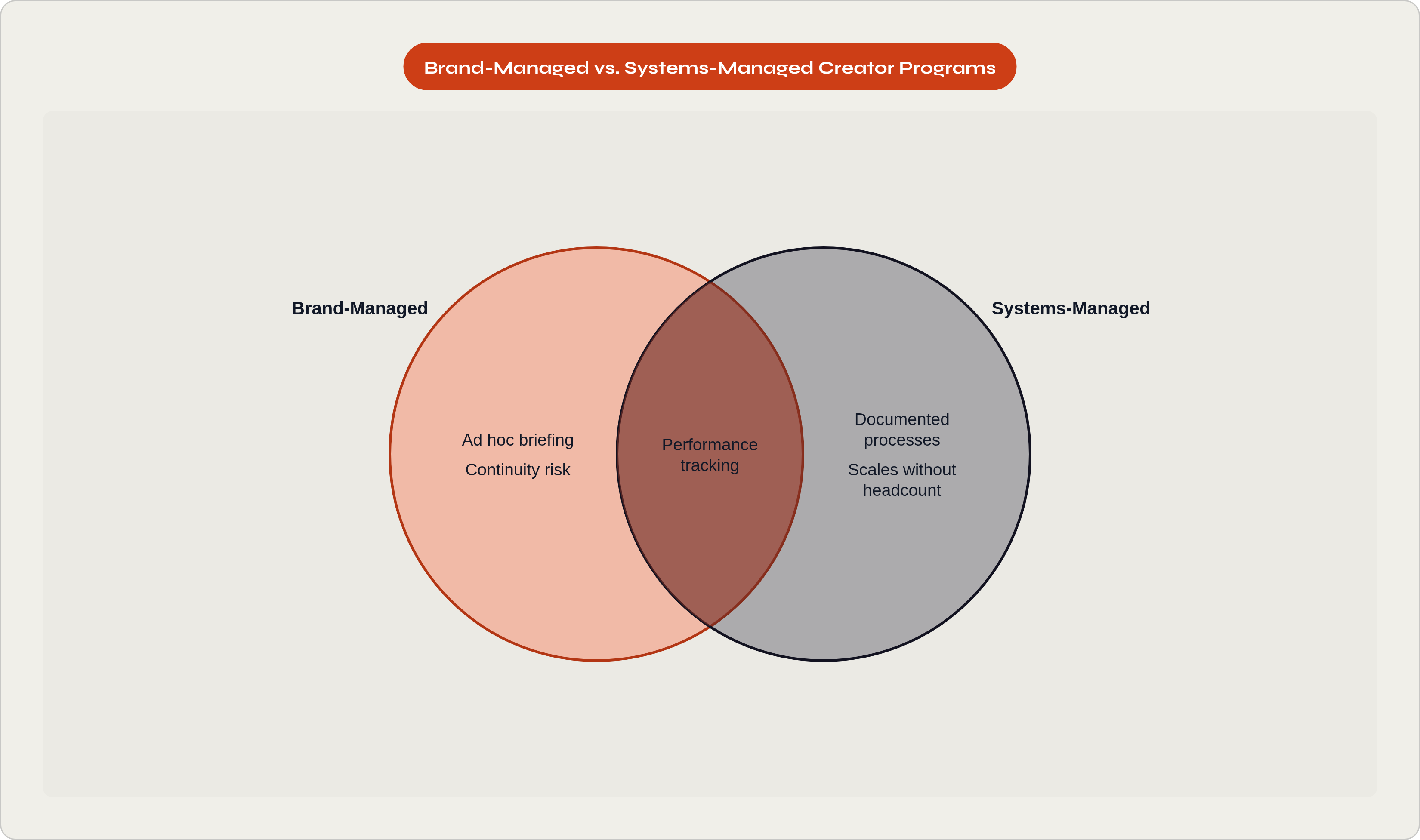
There's a meaningful structural difference between brand-managed programs and systems-managed programs, and it's worth being direct about it. In a brand-managed program, creator relationships, briefs, and performance data are owned by whoever is currently responsible for them. That creates real continuity risk when team members change and genuine scaling risk when volume increases. In a systems-managed program, documented processes, centralized data, and defined accountability structures survive personnel changes and scale without proportional headcount growth. The difference isn't philosophical. It's the difference between a program that effectively restarts with each team transition and one that accumulates institutional knowledge across every activation.
When operational infrastructure matures, each activation adds to the brief library, sharpens the creator scoring model, and contributes to the performance feedback loop. The next activation benefits from everything that came before it. Whether a program actually builds that kind of compounding institutional knowledge, or whether it relearns the same lessons repeatedly under different team members, is largely an operational question, not a creative one.