UGC Contract Clauses Every Brand Should Include
Protect your brand's legal rights and content ownership before paying creators for videos.

The UGC contract decides whether a brand actually owns the videos it paid for, or just rented a headache. Most brands treat it as boilerplate, something legal skims and signs off on, when it's actually the document doing most of the real work in the relationship.
Only 16% of brands have a documented UGC strategy, even as US brands are set to spend over $10 billion on this content and the broader creator economy crosses $20 billion by 2026. That gap between spend and structure is exactly where legal exposure lives, and it's not a small gap. It's the whole ballgame.
The trust numbers explain why brands keep pouring money in anyway: 84% of consumers say they trust a brand more when it features content from its own community, and product pages with UGC convert 74% higher than pages without it. So the incentive to scale is real. But scaling without a contract just means scaling confusion: every new creator, every new platform, every new paid placement becomes a fresh legal question mark instead of a repeatable process.
What a UGC contract actually governs, and how it differs from an influencer agreement
A UGC contract governs the making and handing over of an asset. It has nothing to do with renting somebody's audience for a day, and treating it like an influencer deal is the first mistake most brands make.
The two parties are the brand, or an agency working on the brand's behalf, and the creator, who might have a following of twelve people or zero. That's the point. At minimum, the contract needs to spell out deliverables, who owns the intellectual property, usage rights, payment, compliance duties, and how either side gets out of the deal.
An influencer agreement pays for reach. A UGC contract pays for footage, full stop. The creator isn't obligated to post anything on their own page, and follower count doesn't factor into the deal at all. What matters commercially is the brand's ability to take that content and run it across paid ads, organic posts, and whitelisted placements, so the rights language has to cover far more ground than a standard influencer deal ever would.
Here's the assumption that costs brands the most money: paying a creator for a video does not hand over the copyright. Legal guides across the industry flag this as the single most expensive misunderstanding in the space. Payment covers the work. It doesn't cover the rights, unless the contract says so in plain words.
Think of the contract as the creative brief translated into language a court can enforce. A vague brief produces vague content; a vague contract produces disputes, and usually the expensive kind.
Deliverables clause, specifying exactly what the creator must produce
"Three videos" is not a deliverable. It's a wish, and wishes don't hold up when a creator hands over something nobody expected.
A real deliverables clause spells out the number of final edited videos, the length range (15 to 30 seconds, say), and whether the orientation is vertical for TikTok and Reels or horizontal for YouTube. It names the file format and resolution. It says whether raw footage ships alongside the final cut, and how many alternate hooks come with each video, since two hooks per video for A/B testing is standard in the industry now. It also settles whether the brand hands over a script or the creator builds messaging off a product brief, and whether stills ride along in the same package.
Then there's timing. When is the work due, and how many rounds of revision are baked into the fee before extra charges kick in? Who signs off on approval, how long does the brand have to respond, and what happens if that window closes with silence?
The more precisely this gets written down, the less room there is later for someone to argue the work wasn't finished. And the deliverables language should read like a direct echo of the creative brief, not a separate document running on its own logic.
Intellectual property and ownership clause, resolving who actually holds the copyright
Under US law, copyright in an original creative work sits with the creator the moment it's made. Payment by itself doesn't move that ownership anywhere, no matter what the invoice says.
Brands have to pick one of two paths and say so outright. Work-for-hire means the brand owns the copyright from the moment the content exists; it's the strongest form of protection and usually costs more upfront. A license agreement lets the creator keep the copyright while granting the brand a defined right to use the work; this shows up more often in UGC deals, but it only holds up if the usage clause underneath it is airtight. Work-for-hire is the one worth pushing for whenever the budget allows it. A license can get the brand most of the way there, but it leaves a door open that work-for-hire simply closes.
If a brand wants work-for-hire, the contract needs those exact words on the page. Ambiguous language tends to favor the creator rather than the brand, and that surprises a lot of marketing teams who assumed otherwise.
Skip this clause, and here's what actually happens: the creator assumes they can license that same video to a competitor next month, while the brand assumes it can run the footage in paid ads forever, on every channel it wants. Neither assumption is wrong, exactly, because nobody wrote anything down to make either one wrong.
Two more things worth locking down early. Some creators, even under work-for-hire terms, want attribution, so put that in writing before delivery, not after the content is already live. And if AI tools touch any part of production, ownership of that AI-assisted output needs its own line; most standard UGC templates still don't address it.
Usage rights clause, defining where, how long, and on which channels content can run
Ask around about what actually triggers disputes in this space, and it's rarely non-payment. It's brands running content somewhere they never got permission to run it.
The clause needs to name every permitted channel outright: paid social across Meta, TikTok, and YouTube, organic brand pages, email, the website, out-of-home, retail displays. List them one by one. Don't imply, and don't assume "social media" covers everything, because it doesn't hold up in a dispute. The clause also needs geographic scope (domestic, specific countries, or worldwide), a duration (a time-limited license running six or twelve months, or perpetual rights), and a line on exclusivity, meaning whether the creator can make similar content for a rival brand during or after the license runs.
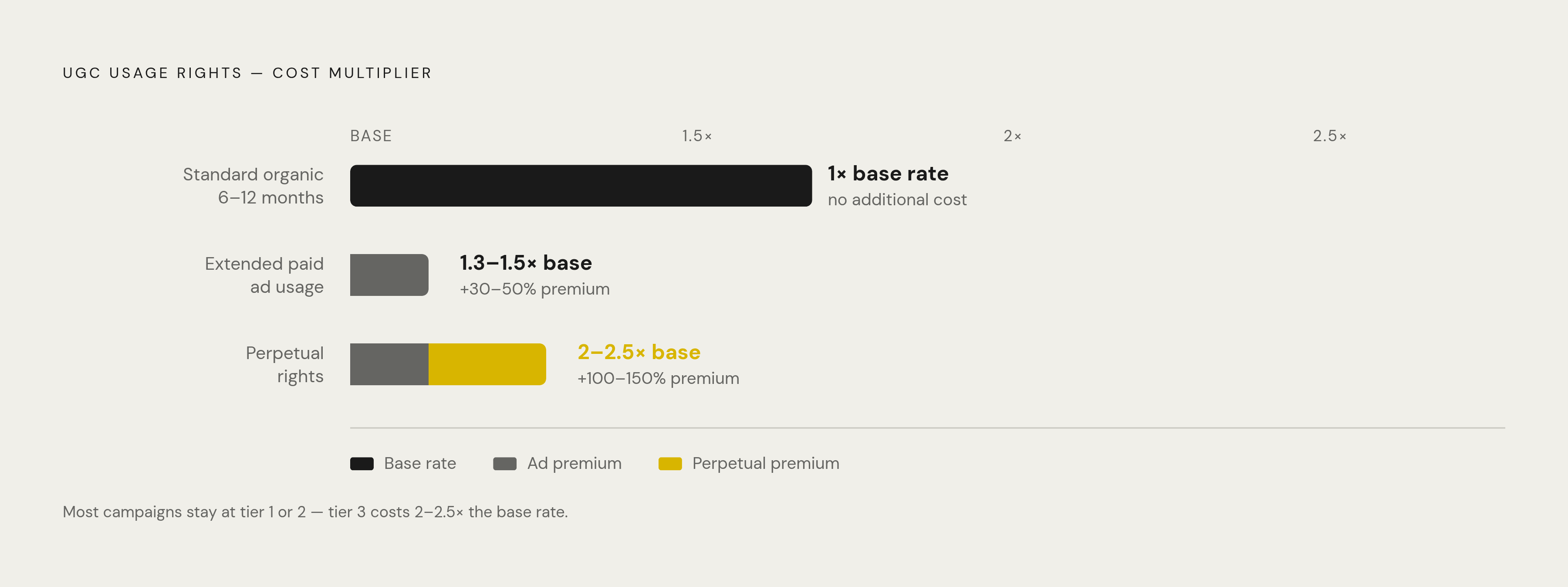
Market pricing for 2025 and 2026 tends to follow a pattern. Standard organic use for six to twelve months is often folded into the base rate. Extended paid ad usage typically adds 30 to 50% on top of that base rate. Perpetual rights usually run another 100 to 150% above base. Perpetual rights sound appealing until a brand actually prices them out; most campaigns don't need footage forever, they need it for a quarter or two, and paying double for permanence nobody uses is money left on the table.
Smart contracts build in extension paths at signing, so nobody has to renegotiate under pressure once a video starts performing well. That might look like an auto-renewal clause with a set monthly fee and a clear cancellation notice period, a buyout option a brand can exercise within 30 days of signing, or pricing that steps down per quarter after the first 90 days.
The real risk lives in the gap between what the contract allows and what the brand actually does with the content. Every extra channel, every additional month of runtime, needs to trace back to something written down. Otherwise that gap is where the exposure quietly builds, month over month, without anyone noticing until a creator's lawyer does.
Whitelisting and paid amplification clause, giving the brand ad-serving access through the creator's handle
Whitelisting means the brand runs paid ads that appear to come from the creator's own handle, even though the brand is the one paying for the media behind it. Ads served this way tend to outperform standard branded ads on trust and engagement by a wide margin, which is exactly why whitelisting has become such a valuable lever for paid amplification, and exactly why the terms around it need to be tight.
The clause has to nail down several things at once. Duration of access, whether that's 30 or 90 days, usually priced at a meaningful premium above the base rate per month. A spending cap, meaning the maximum daily or campaign-level ad budget the brand can push through that account. Restrictions on audience targeting, so the brand can't aim at groups that clash with the creator's stated values or existing audience. Which specific ad accounts and platforms are covered. A revocation right, letting either side pull access with 48 hours' written notice. And whether the creator gets to approve specific ad creatives before they run under their own name.
Loose whitelisting terms burn both sides eventually. The brand might run an ad the creator finds embarrassing; the creator might yank access mid-campaign with no clear process for what happens next. On top of the bilateral agreement, the contract should point back to Meta's and TikTok's own partnership ad frameworks, since those platform rules sit underneath whatever the brand and creator agree to privately.
FTC disclosure and compliance clause, making regulatory requirements contractually enforceable
The FTC's rule is simple in theory: any material connection between a brand and a creator, whether that's payment, free product, or anything else of value, has to be disclosed clearly in the content itself.
The penalties aren't hypothetical anymore. The FTC has moved to formalize and strengthen its enforcement posture, issuing updated guidance on disclosure requirements and finalizing rules banning fake reviews, including AI-generated ones, with penalties for fake followers and inflated view counts tied to that framework. That raises the stakes on compliance language considerably, and it means the clause can't stay vague anymore either.
So what does the clause actually need to do? It should put the disclosure duty squarely on the creator's shoulders for anything they post themselves. It should name the exact format that counts: "#ad" or "#sponsored" placed in the first line of a caption, a spoken disclosure inside the video, or the platform's built-in branded content label. It should address AI use directly, since disclosure obligations shift depending on how much of the content AI touched. And it needs indemnification language, protecting the brand from claims tied to a creator's failure to disclose, and protecting the creator when the brand is the one directing the content.
The same clause should flatly prohibit fake reviews, inflated engagement numbers, and undisclosed free product. Worth noting: the BBB's Institute for Responsible Influence is already building creator certification programs around the FTC's Endorsement Guides, a sign that compliance is turning into a formal vetting standard, not just fine print buried on page four.
Exclusivity clause, protecting the brand's investment from competitive dilution
Exclusivity stops a creator from turning around and making near-identical content for a direct competitor, both during the engagement and for a set stretch afterward.
The scope has to be defined carefully, because vague exclusivity language is basically unenforceable. Category exclusivity keeps the creator out of the exact same product space, so no other protein supplement brands, for instance. Vertical exclusivity casts a wider net, ruling out fitness nutrition brands broadly. Duration should scale with what the creator is being paid; a reasonable window covers the campaign length plus a short tail afterward. Geographic limits apply too, where relevant.
Push exclusivity too far, though, and creators start walking away from deals, or pricing them so high the math stops working for the brand. Category exclusivity is almost always the smarter default; vertical exclusivity should be reserved for creators getting paid enough to make the restriction worth their while. The clause needs to stay narrow enough to feel fair while still protecting what the brand is actually paying for. Worth requiring, too: creators should disclose any existing competitor partnerships before signing, so conflicts surface on day one instead of after the content's already shot.
For longer-term ambassador arrangements, the kind of ongoing relationship brands like Gymshark have built with their roster, exclusivity stops being a boilerplate line and becomes a real economic variable. At that point it deserves its own negotiated line item, priced on its own terms rather than folded into the base rate.
Content approval and revision clause, giving the brand control without grinding production to a halt
This clause decides how the brand reviews work before it goes live or gets pushed into paid media.
It should set a review window, meaning the exact number of business days the brand has to approve, request changes, or reject a submission. It should include a deemed-approval rule too: no response inside that window means the content counts as approved, which stops a submission from sitting in limbo indefinitely. It needs to state how many revision rounds are included in the base fee, and draw a hard line between a revision and an entirely new deliverable. Swapping out a hook is a revision. Changing the whole concept is a new job with a new price tag, and the clause should say that explicitly.
Rejection criteria matter just as much. The brand can reject work that breaks the brief, violates brand guidelines, or fails compliance rules, but not because someone on the marketing team doesn't personally like the vibe, unless that preference was already spelled out in the brief itself.
Weak briefs generate more revisions, and more revisions cost both sides time and money they didn't budget for. Most disputes on this clause trace back to the brief, not the creator, and any brand that skips straight to blaming the talent is looking in the wrong place. So the clause should also protect the creator from open-ended revision requests that never end and never get paid for. That kind of scope creep is one of the more common flashpoints in UGC work.
Payment, kill fee, and late delivery clause, building accountability into the commercial terms
Payment structure usually takes one of three shapes. Full payment upfront keeps friction low and tends to be the preferred setup for smaller jobs with creators who have a track record. A 50/50 split, half upfront and half on delivery, is the more standard approach for bigger projects or a first-time working relationship. Milestone-based payment, tied to sign-off on specific deliverables, works well for high-volume programs running across multiple phases.
Then there's the kill fee. If a brand cancels a project after a creator has already started work, a kill fee, usually a percentage of the total contract value, compensates the creator for time and resources already spent. It protects the creator and gives the brand a reason to think twice before pulling the plug on a whim.
Late delivery needs its own definition too: what actually counts as missing a deadline, how much notice the creator owes before that deadline if delays are coming, and whether a late delivery triggers a reduced fee or gives the brand grounds to walk away from the contract entirely. Spell it out now, while both sides are still calm and reasonable, because that's the only point in the relationship when anyone actually reads the fine print carefully.