Where to Find UGC Creators for Consumer Product Brands

Finding UGC creators isn't one search, it's a sourcing decision. The channel you pick, whether that's a marketplace, a managed platform, organic discovery, or an agency, should match your brand's stage, your volume needs, and your quality bar; get that match wrong and your program stalls before it starts.
The creator pool has grown fast. Collabstr's 2025 report puts year-over-year UGC creator growth at 93%, and that supply surge has pushed average content costs down 44.37% over the same period. More creators and lower prices mean the hard part now is knowing where to look and why.
What makes a UGC creator different from an influencer, and why that distinction shapes where you look
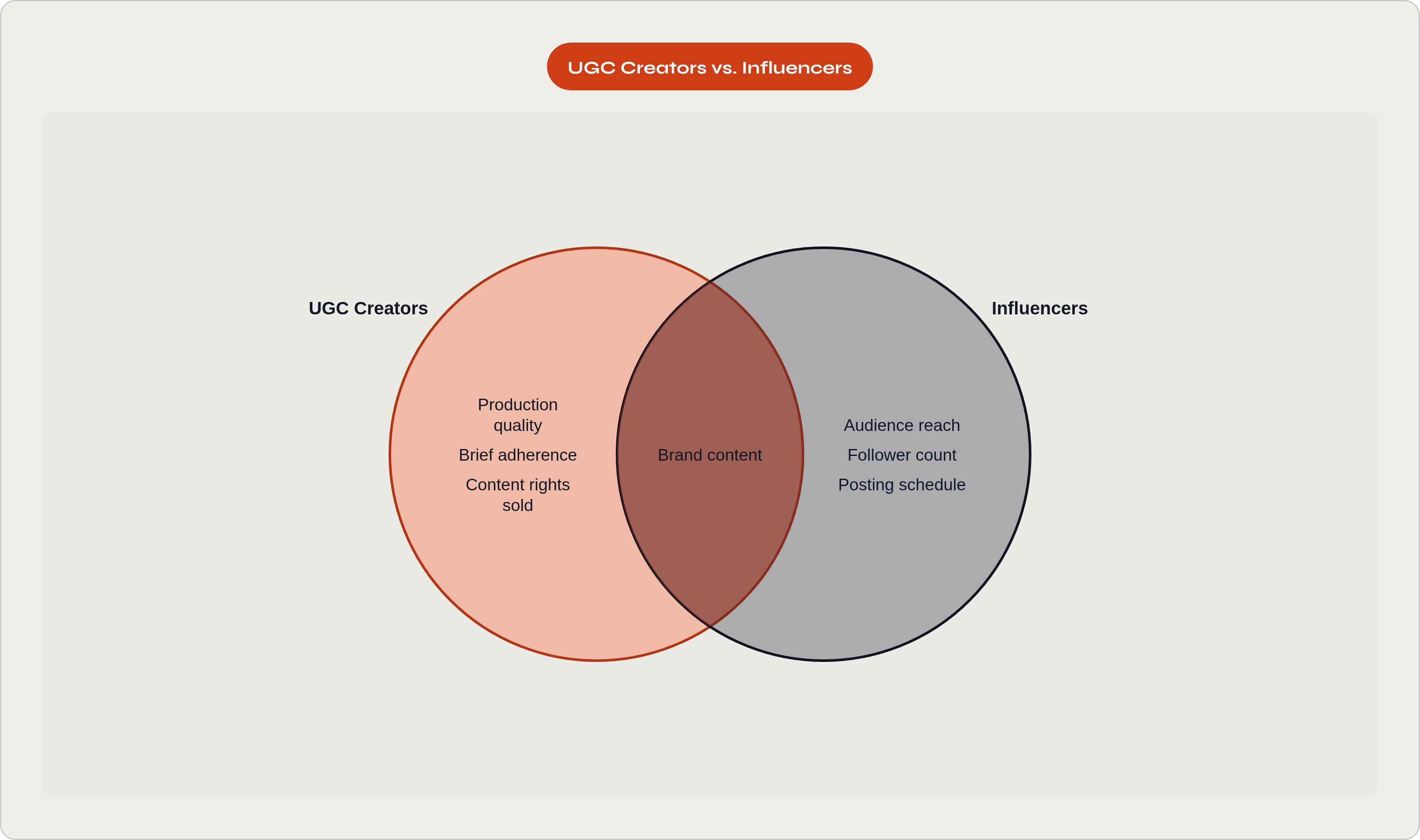
Two kinds of platforms exist because two different things are being sold. UGC platforms sell content, the actual video or photo, plus the rights to use it, while influencer platforms sell reach: an audience, a posting schedule, sometimes attribution tied to a discount code.
That distinction changes what you're actually vetting for. A UGC creator gets hired for what they make, not for who's watching. So when I look at a UGC creator's profile, I'm checking production quality, how they perform on camera, and whether their past work shows they can follow a brief closely. A creator with 2,000 followers can shoot ad creative that outperforms a macro-influencer's post, because the follower count was never the point. The influencer's audience matters when you're paying for reach; it's irrelevant when you're paying for a clip you'll run as a paid ad from your own account.
This is also why the end use case should decide which channel you go to first. Organic social content, paid ad creative, product imagery for your Amazon listing, review-style long-form video: each of these pulls toward a different kind of creator and, often, a different platform entirely. On TikTok specifically, UGC was the top-performing content type in 2025, driving 56% of brand engagement. That performance comes from the format feeling native and honest, with authenticity and fit mattering more than follower count. That's a different game than influencer marketing, and it needs a different search.
Self-serve creator marketplaces: speed and cost predictability at the price of curation
Self-serve marketplaces work like a job board. You post a brief, creators apply or get matched to you, content lands in your inbox within a set window, and there's barely any relationship to manage on your end.
A few platforms define this tier, each with its own angle:
Billo runs flat-rate pricing, $79 to $199 per video, with delivery in three to seven days and revision rounds built in. It's built for e-commerce brands that need to know their cost per video before they commit.
Collabstr has hundreds of thousands of vetted creators and posts rate cards up front, so there's no back-and-forth negotiation. Chat and payments happen inside the platform. Brands like McDonald's and Hopper have used it, and for a startup running its first UGC test, it's about as low-friction an entry point as exists.
JoinBrands is the biggest marketplace by creator count, covering everything from simple content requests to TikTok Shop affiliate campaigns. The tradeoff for that scale is curation: there's no AI matching layer, so filtering good creators from the rest falls on you.
SideShift skews Gen Z and moves fast, useful if you need a steady stream of short-form content in whatever format is trending that month.
Trend.io runs on credits: you pay per piece instead of a subscription, and creators are pre-vetted. Good for testing a brief before you decide to scale it up.
What ties this tier together is speed and predictable pricing. Most orders land within a week, and you know your cost going in, though the tradeoff is that brief quality and filtering are entirely on you. In the bigger open marketplaces, output quality swings hard unless your brief is specific down to the shot list. This tier fits brands that already know their format and just need volume, not brands still figuring out what their creator voice even sounds like.
Managed and full-featured platforms: when workflow integration and quality controls justify higher investment
This tier isn't defined by the creator marketplace underneath it. It's defined by the operational layer built on top: brief management tools, rights clearance built into the workflow, matching logic, and analytics that tell you what's actually working.
Insense combines a UGC marketplace with influencer campaign tools and whitelisting, meaning you can run a creator's content as a paid ad directly from their handle. Pricing starts at $500 a month billed quarterly for the Brand plan, $800 a month for Agency. Because the marketplace itself is open, quality still varies more than you'd expect for the price.
Popular Pays uses AI matching based on engagement data and audience fit, bundles rights management into one click, and optimizes content across platforms. It sits at the intersection of influencer marketing and UGC production rather than picking one lane.
Cohley targets mid-market and enterprise brands that need content across the whole customer journey: short-form video, product photography, written reviews, influencer tie-ins. Its AI layer, Finn, writes briefs and matches creators, and there's a managed option if you want Cohley's team running strategy too.
Clip is built around one thing: ad performance. Only 7% of creators who apply get approved, every video comes with licensing baked in, and pricing starts at a low triple-digit figure for a short-form video. If your primary metric is how the creative performs as a paid ad, this is a tight fit.
Aspire runs more like a CRM, tracking relationships and performance across large campaigns. It's priced for enterprise teams with dedicated budget and staff to run it.
The feature that actually justifies the jump in cost is whitelisting: running a creator's content as a paid ad under their handle, with permissions handled inside the platform instead of chased down over email. That capability, plus the subscription fee and the internal hours it takes to run the tool well, only pencils out once your volume and performance needs outgrow what a $99 flat-rate marketplace order can give you. This tier fits brands already running paid social that need a steady, ad-ready supply of creative, not brands still testing whether UGC works for them at all.
Organic discovery through TikTok, Instagram, and Reddit: the slowest channel with the highest ceiling
Here's a different way to think about sourcing: the best UGC for your brand might already exist. Somewhere out there, a customer who genuinely loves your product filmed themselves using it, unprompted, with no brief and no payment involved. Finding that person is a matter of discovery more than recruitment.
On TikTok, that means searching your branded hashtag, your product category terms, and even competitor hashtags, then checking who's tagging your brand without being asked. TikTok's Creator Marketplace gives you a more structured layer on top of that if you want to reach out formally.
On Instagram, watch tagged posts and Story mentions, dig through relevant hashtags, and look at niche accounts in your product's community. Reels discovery tends to surface people by format and topic rather than by follower count, which works in your favor here.
Reddit deserves a mention even though it's not a place you'll pull finished content from. Product subreddits and enthusiast forums show you how real customers actually talk about your category, and that language, that phrasing, is gold for briefing creators later, even ones you find elsewhere.
Why go through all this effort? Creators found organically already have real affinity for the product, and their content reads less scripted. Brief adherence tends to be tighter once you do bring them into a paid arrangement, and the relationship has room to grow over multiple campaigns instead of one transaction. Consider also that the pool is bigger than most teams assume. A 2024 YouTube Culture and Trends Report found 65% of Gen Z respondents consider themselves creators. That's most of a generation, which means your existing customer base probably has more potential creators in it than you've bothered to look for.
The catch: this channel doesn't scale on its own. Turning someone's organic post into a paid partnership takes outreach, negotiation, a contract, and someone tracking all of it. That's real time, and it adds up fast if you're doing it one creator at a time with no system behind it.
Agencies as a sourcing channel: what a managed program actually handles that a platform can't
Platforms hand you tools; agencies hand you outcomes. It's worth being precise about what "outcome" means here: you're not managing the sourcing, the brief-writing, the contracts, the payments, or the process of figuring out which piece of content is worth scaling into a bigger campaign.
When you run a self-serve platform yourself, all of that work, vetting creators, writing briefs, chasing revisions, negotiating rights, processing payments, reading the performance data afterward, sits with your team. An agency absorbs it. More than that, a good one brings judgment: which sourcing channel fits this campaign's goal, which creators have a track record that makes them worth whitelisting, and how to read last month's numbers to write a sharper brief for next month.
That last part is the real value, honestly, since one great UGC video is just a data point. A program that figures out why that video worked and rebuilds the brief to do it again, repeatedly, is a growth channel. Platforms are built to produce the first thing, while agencies are structured to produce the second.
I've seen this play out at Pebble, where we run end-to-end creator programs for consumer brands: sourcing, vetting, briefing, contracts, payments, and performance review, all under one process we call Decide, Design, Diligence, Deliberate. It's built around briefs you can actually measure and a habit of iterating on what the data shows. We've taken clients from zero to millions of weekly impressions and tens of millions of total views using a small, tightly managed roster of creators, not a firehose of one-off content.
Agencies fit best for brands that haven't yet nailed down what content format even works for them, for brands that have validated UGC but don't have the internal bandwidth to run it well, and for any team where the creator program keeps losing the fight for headcount against everything else on the roadmap. Agency fees look like overhead next to a $99 flat-rate video order, granted, but the honest comparison isn't platform cost versus agency cost. It's agency cost versus the hours your team burns sourcing and vetting on its own, and against the cost of a program that just quietly stalls because nobody had time to optimize it.
Matching the sourcing channel to where the brand actually is
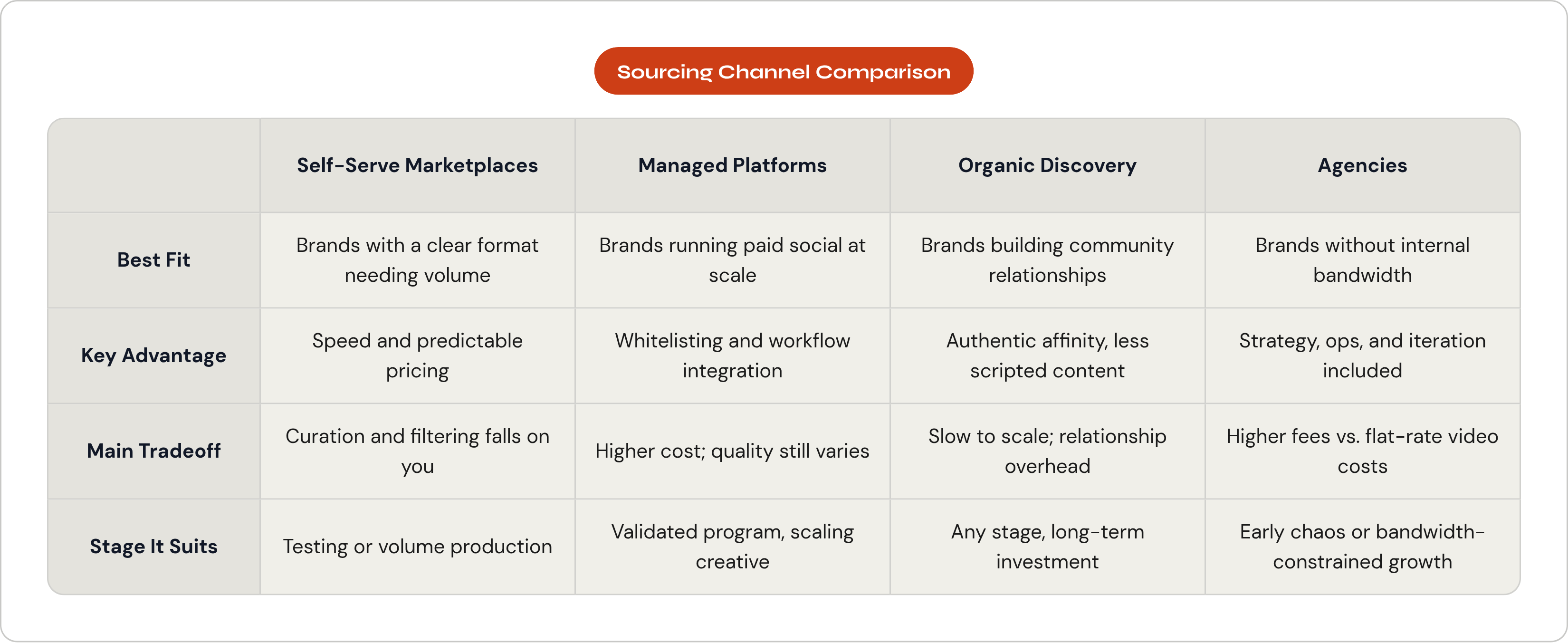
Three things decide which channel is right for you right now. Stage: are you testing UGC for the first time, scaling something that's already working, or fine-tuning a program that's been running for a year? Volume: do you need five test pieces or a pipeline that never stops? And use case: is this going to organic social, into paid ads, onto your product page, or all three at once?
Here's roughly how that maps out. Testing UGC for the first time on a tight budget: Collabstr or Trend.io, since both give you transparent pricing and low commitment while you figure out what works. Need steady volume for paid e-commerce ads: Billo or Clip, built for predictable cost and speed. Scaling a program that needs whitelisting and cross-channel workflow: Insense, Popular Pays, or Cohley, where the subscription cost buys you infrastructure you'd otherwise build yourself. Want to build real relationships inside your product community: organic discovery on TikTok and Instagram, slower, but the ceiling is higher than anywhere else. Need the program to grow without eating your team's bandwidth: an agency, where sourcing and ops and iteration are the actual deliverable.
Each of these channels has a place, and the right mix depends on matching them to your situation. The mistake I see most often is a brand defaulting to whatever platform they saw an ad for, without asking if it actually fits their volume, their quality bar, or how much internal time they have to run it.
And the channel you pick doesn't just affect this month's content, it shapes your ceiling. Brands that never move past a single self-serve marketplace tend to plateau, because they end up optimizing for how fast they can get content delivered instead of what they're learning from each piece. A program that shifts its sourcing mix as it grows, that treats the channel choice itself as a decision worth revisiting, ends up treating creator marketing as a channel that compounds, rather than a line item that just repeats.