A/B Testing UGC Hooks for Paid Social Creative Optimization
Testing the first three seconds unlocks the highest-leverage optimization for paid social ads.

A user decides whether to keep watching a UGC ad within the first three seconds, before the offer loads, before the product even appears on screen sometimes. That decision window is the hook, and it is the single highest-leverage variable a paid social team can isolate and test, because everything downstream, the body copy, the CTA, the landing page, only gets evaluated if the hook does its job first.
Google's own data puts creative at 70% of campaign success, with media placement accounting for the rest. Inside that 70%, the hook carries disproportionate weight because it's the gate everything else has to pass through. On Meta specifically, 85% of video ads get watched with the sound off. A hook has to land visually before it ever gets a chance to land verbally. That's not a stylistic preference. It's a structural fact about how the format gets consumed.
What counts as "the hook" operationally? It's not just the first line of dialogue. It's the opening frame, the first spoken or captioned words, the visual treatment, and the emotional register, all firing at once in the same three-second window. Test any one of those in isolation and you learn something. Bundle them together and the result tells you almost nothing you can act on.
Why UGC is the best format for hook testing
UGC isn't a supplementary tactic anymore. Per the Influencer Marketing Hub's 2026 Creator Economy Report, 78% of DTC startups now run UGC as their primary ad format on Meta. That shift changes the math on testing, because the format itself carries a performance premium worth protecting.
Meta's 2025 Creative Best Practices guide puts UGC-style video well ahead of the click-through rate of polished brand video on Facebook and Instagram. EmbedSocial's UGC Statistics Report found UGC posts generating 28% higher engagement than branded content, and Moburst, citing the same data, reports UGC ads achieving 4 times the click-through rate and 50% lower cost-per-click versus traditional display. Those aren't small gaps. They're the kind of numbers that justify building a testing operation around the format rather than treating it as one creative option among several.
Why is UGC so sensitive to the hook specifically? Because the format's entire value proposition rests on feeling native and unscripted. A hook that breaks that illusion, one that feels like an ad opening rather than a person talking, kills the effect in the first frame. A hook that reinforces it compounds the format's natural advantage. The Edelman Trust Barometer, as cited by Moburst, found 80% of consumers view peers and real customers as the most credible source of brand information. That trust signal has to activate immediately, or it never activates.
There's also a cost structure argument here. UGC pricing runs on creative output, not follower count. A brand can commission four or five hook variants from a single creator without paying influencer-tier premiums. That economics is what makes hook testing feasible at scale in the first place, rather than a nice idea that gets cut from the budget.
Platform matters too. TikTok runs UGC engagement rates between 2.01% and 3.70% for brand campaigns, against Instagram's baseline of 0.30% to 0.48%. The stakes of getting a hook right, and the cost of getting it wrong, shift depending on where the ad runs.
The creative testing hierarchy: concept, hook, variation, and why order matters
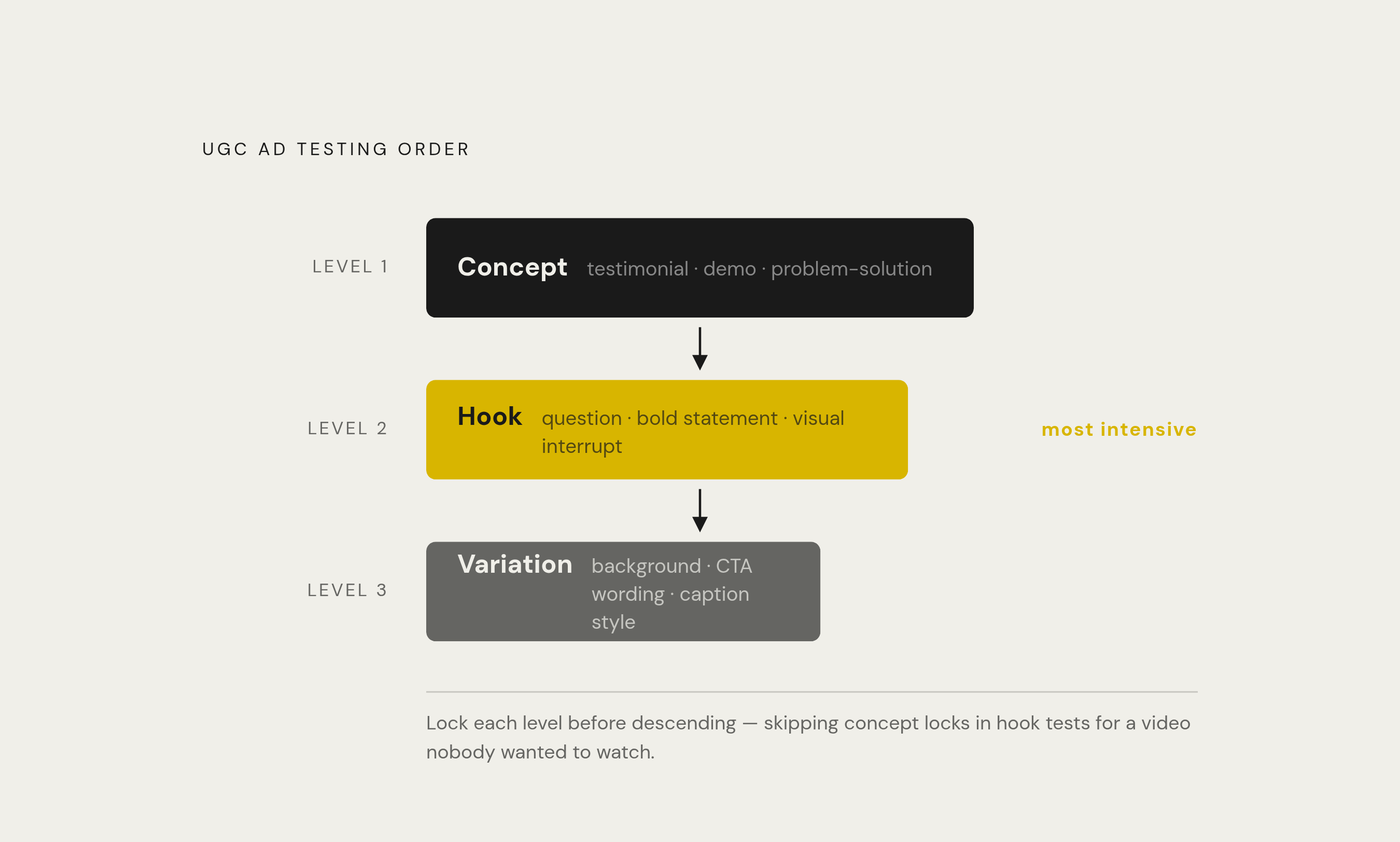
Madgicx's 2026 A/B testing resource lays out three levels worth keeping separate in any testing plan. Concept is the big idea, testimonial versus product demo versus a problem-solution narrative. Hook is the first three seconds within that concept, a direct question versus a bold statement versus a visual pattern interrupt. Variation sits below both, the smaller tweaks like background, CTA wording, caption style.
Testing hook variation before the concept is settled means a brand ends up optimizing the opening three seconds of a video nobody actually wanted to watch past that point anyway, so concepts should be tested broadly first, then hooks isolated within whichever concept wins. Test broad concepts first, then isolate hooks within whichever concept wins. Skipping straight to hook variation before the concept is settled means a brand ends up optimizing the opening three seconds of a video nobody actually wanted to watch past that point anyway.
Concept selection narrows the territory. Hook testing inside that territory is where the real performance differentiation happens, and it's why hooks get tested second but optimized far more intensively than anything else in the stack. A brand running three creative angles, say a testimonial, a demo, and a founder story, needs to land on a winning angle before it starts producing multiple hook variants for each. Otherwise the hook data comes back contaminated by concept noise, and nobody can tell if a hook underperformed or if the whole concept was weak to begin with.
One variable per test. Changing more than one thing means the result doesn't tell you anything you can act on next time. That applies to hooks specifically, which break down into a handful of genuinely discrete, testable elements:
Hook format: question, statement, statistic, command
Each of those is a lever. Pull one at a time.
Briefing creators for modular hook production without inflating costs
Here's the efficient version of hook production: ask each creator to film one video body with two or three different openings attached. Collabonly's 2026 UGC paid ads guide notes that this approach yields significantly more testable creative for a modest incremental cost. That's a much better ratio than commissioning entirely separate videos for each hook variant.
But the brief has to specify real detail, or the creator ends up guessing at what "different" means. Each hook variant needs its own exact opening line or visual action spelled out, a stated emotional register (curious, alarmed, relatable, excited), a note on whether it has to work with sound off, and clear instructions on caption placement and timing for those first three seconds.
Creator selection matters just as much as the brief itself. A creator who understands direct-response delivery, who knows how to build a pattern interrupt or land a statement with weight, produces genuinely different hooks across variants. One who doesn't understand that distinction just performs the same energy in different outfits, and the test ends up measuring nothing.
There's a meaningful difference between briefing off brand guidelines and briefing off live ad account data. New Engen's 2026 UGC agency guide draws that line clearly: a performance-oriented brief tells a creator which hook formats held view time in past tests, which hook formats drove CTR, which audiences actually converted. A brand-guideline brief tells a creator to "sound authentic" and hopes for the best.
Creator-versus-creator is its own legitimate test, and it should be treated as seriously as format-versus-format. Testing creator A against creator B on the identical hook script tells a brand something different than testing two hook formats on the same creator, and collapsing both questions into one messy test just produces a result nobody can read. A reasonable target before spend commits: four to six hook variants, across two to three creators, minimum.
Running the test: two Meta methods and the minimum conditions for a readable result
Meta gives advertisers two practical paths here, and each one trades control for convenience differently.
The first is what Madgicx's 2026 resource calls the ABO lab. Set up an Ad Campaign Budget Optimization campaign, place exactly one creative variant per ad set, and assign identical daily budgets across every ad set so spend distributes evenly. The upside is full control over how budget lands. The downside is that it takes manual management and doesn't produce a statistical significance readout on its own, so someone still has to eyeball the results and make a judgment call.
The second path is Meta's native Experiments tool. It splits the audience cleanly and reports statistical significance directly, which makes it the better option for a team that wants a defensible result without building manual guardrails by hand.
Whichever method gets used, a few minimum conditions apply. Madgicx recommends running each test for at least 3 to 5 days, long enough to get past daily fluctuation and see something closer to a real pattern. Apexbrands' DTC paid social testing guide sets a floor of 50 conversion events per variant before anyone makes a kill-or-scale call. Click-through rate alone, however tempting it is to check on day one, isn't enough to decide on.
There's also a real trade-off between binary and multi-variant testing. A traditional two-variant A/B test produces one data point every two to three weeks. Running three to five variants in parallel produces a full ranked hierarchy of creative in that same window. For hook testing specifically, multi-variant almost always wins out, because the number of plausible hook formats to try exceeds what binary testing can work through at any reasonable pace.
Timing looks different by platform, too. TikTok campaigns reach creative saturation in 7 to 10 days, per TikTok's own platform data and Marpipe's benchmarks, and TikTok's Smart Creative tool auto-pauses videos showing fatigue signals within 3 to 5 days. That's a tight window, and it means the pace of hook iteration on TikTok has to move fast just to keep up. Meta cold prospecting creative has more runway, degrading over 2 to 4 weeks according to Motion's practitioner analysis, but even that's short enough that a brand without a standing testing pipeline is always playing catch-up rather than staying ahead of fatigue.
Which metrics tell you a hook worked, and which ones mislead
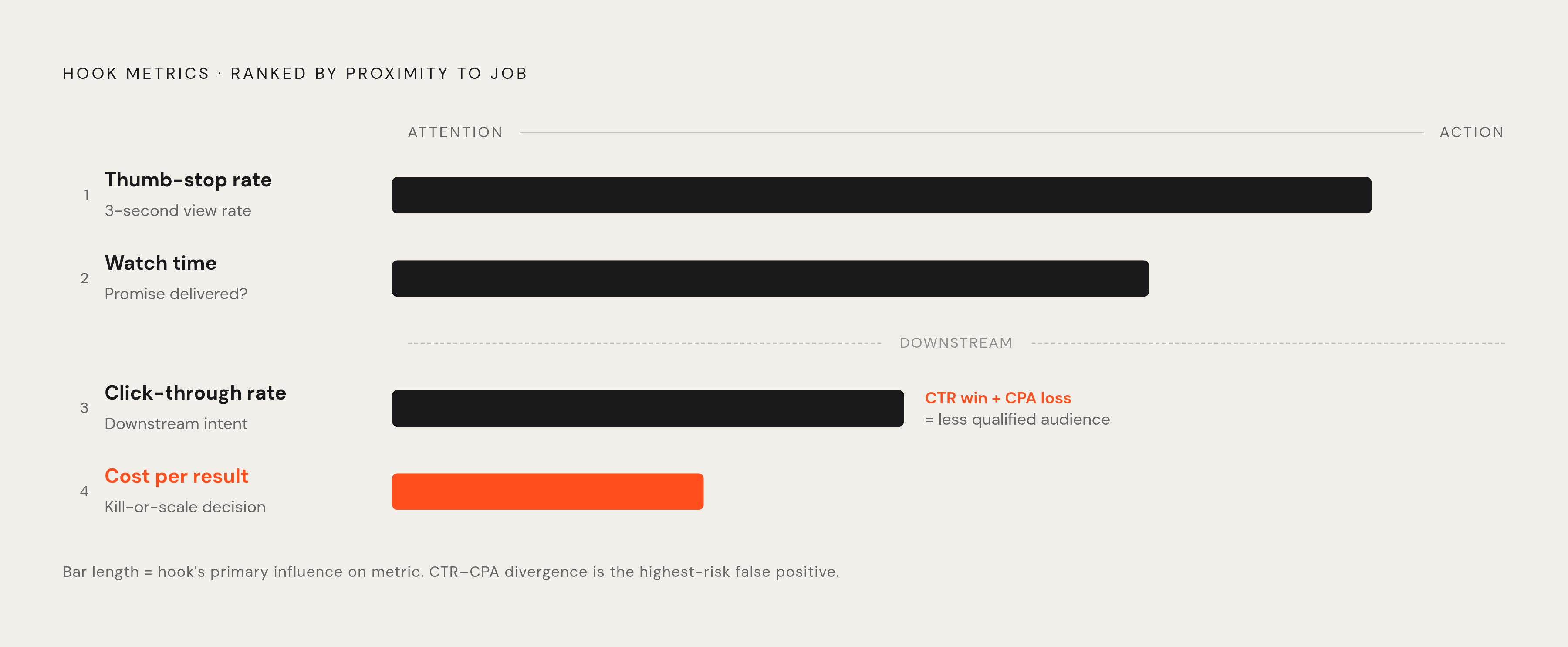
Four metrics matter here, and each one measures a different piece of the hook's job.
Thumb-stop rate, or video view rate at three seconds, is the most direct read on whether the hook actually arrested attention. That's the hook-specific signal, full stop. Watch time measures something slightly different: whether the hook delivered on whatever promise it made. A hook that over-promises produces a visible drop-off cliff early on, right when the viewer realizes the video isn't going where the opening line suggested.
Click-through rate measures whether the hook generated enough intent to act on, but it's downstream of the hook's core job and shouldn't be read in isolation. Cost per result, whether CPA or cost per purchase, is the metric that actually decides whether to kill or scale a hook. A hook that wins on CTR but loses on cost per acquisition is pulling in a wider, less qualified audience. That gap between CTR and conversion points to a mismatch introduced at the hook level rather than further down the funnel.
A hook that wins on cost per purchase but shows a lower CTR is likely converting a smaller, more motivated audience, and that's often the better outcome even though it looks weaker on the surface metric. Killing that hook based on CTR alone would be a mistake.
Review results on a fixed weekly cadence, not daily. Daily check-ins on ad performance create panic decisions built on insufficient data. A test needs its runway. And even a clean result only tells a brand which hook format won with a specific audience at a specific moment. It doesn't explain why, and that "why" requires someone actually sitting with the winning creative and pulling out what made it work.
Turning a winning hook into a repeatable creative principle, not a one-time result
A brand that tests hooks, picks a winner, and moves on without extracting the underlying reason is running something closer to a lottery than a system. Each new test starts from zero instead of building on what came before it. It's easy to mistake "we found a winning hook" for "we learned something," and those are not the same accomplishment.
A transferable principle looks different from a single winning result. It sounds like: pain-acknowledgment hooks outperform curiosity hooks for this audience on Meta. Or: creator-to-camera with direct eye contact in the opening frame beats a product close-up, and that held true across three separate concepts, not just one. Or: silent-optimized hooks, the ones built around on-screen text rather than spoken dialogue, consistently outperform spoken hooks on TikTok. Each of those statements informs the next round of briefs. A single "hook B won" doesn't.
Winning hook data flows straight back into the next creator brief. New Engen's agency framework states that the next brief should specify which hook formats held view time in the last test round, not which ones felt on-brand or creative to whoever wrote the brief.
AI tools entered this picture in 2026 mostly as an acceleration layer, helping teams identify winning hooks and angles at scale and then apply those patterns across new campaigns faster than manual review would allow. That's not a replacement for creators. It's a way to shorten the distance between "test finished" and "principle extracted."
According to Forbes, more than a million advertisers used Meta's generative AI tools to produce over 15 million ads in a single month. Read that number carefully: creative volume stopped being the bottleneck a while ago. The bottleneck now is having a testing system disciplined enough to know which of those millions of variants deserves the budget.
One viral hook is a lucky campaign. A ranked library of hook formats with documented, repeated performance patterns behind them is growth infrastructure. And given that TikTok creative fatigues in 7 to 10 days and Meta cold prospecting creative degrades over 2 to 4 weeks, the only way to keep pace is a standing production-and-testing loop built on accumulated principles, not fresh guesses every cycle.
What a functioning hook-testing operation looks like at the program level
Four things need to be in place at once for this to actually run as a system rather than a series of one-off tests.
A creator roster built for modular production is a stable network of creators briefed on a rolling cadence, not a fresh casting call for every new campaign. A brief template that translates live ad account data into concrete creator instructions, updated after every test round rather than rebuilt from brand guidelines each time someone needs new creative. Testing infrastructure inside the ad account itself, whether that's the ABO lab setup or Meta's Experiments tool, configured the same way every time so results across rounds can actually be compared against each other. And a performance review cadence that runs weekly, with a standing kill-or-scale framework built around cost per result and minimum conversion thresholds, rather than a gut check every morning.
Production speed is its own requirement here. New Engen's 2026 UGC agency analysis notes that mid-market brands running always-on paid social need creative shipping at platform pace, meaning new variants ready before the current winners fatigue out, not on whatever schedule a campaign calendar happens to dictate.
Brands with standing creator relationships tend to iterate fastest on hooks, because a creator already familiar with a brand's brief format and performance bar moves faster than one starting cold. Brands that iterate fastest on hooks tend to be the ones with standing creator relationships, not the ones sourcing a new roster for every campaign, because a creator already familiar with a brand's brief format and performance bar simply moves faster than one starting cold. Data cited by InfluenceFlow from creator marketing research found brands with a structured discovery and vetting process saw 35% higher campaign ROI than those making creator selections informally. Creator infrastructure and testing infrastructure aren't really separable pieces here. They're the same system, viewed from two different angles.
Whether that system runs in-house or through an agency comes down to overhead, sourcing creators, managing briefs and contracts and payments, setting up tests, running the analysis, and closing the loop back into the next brief. That's a real operational lift either way, and the honest answer is that the lift doesn't go away just because a brand outsources it. It just moves.