UGC Hook Formats That Lower Meta CPMs
Open with your customer's actual problem, not your product's features.

Meta's auction doesn't price your ad on bid alone. It prices on predicted engagement, and that prediction is shaped by what happens in the opening seconds of playback, before most of the ad has even run. The hook is the thing being priced. Get it wrong and CPMs climb no matter how good the rest of the creative is.
That pricing mechanic explains something a lot of media buyers have felt but couldn't name: CPMs across Meta rose 30 to 40 percent year over year from 2024 to 2025, based on managed-account data from Opascope covering accounts spending $30 million or more per month across six channels. Switching from studio-shot ads to UGC used to be a reliable way to bring that cost down. It still helps, but per Opascope (July 2026), format alone can't absorb an increase that size anymore. "The math catches up to them by the second or third month of testing," the firm noted, watching accounts that leaned on format switching alone lose the CPM advantage within a single quarter.
Opascope's internal lever hierarchy ranks hook type first, creator relationship second, and placement third. Format sits downstream of all three. That ordering is the reason this piece spends most of its time on hook type. It's the lever a media buyer or founder can pull this week, without renegotiating a creator contract or restructuring an ad account.
How hook rate and hold rate translate into CPM outcomes
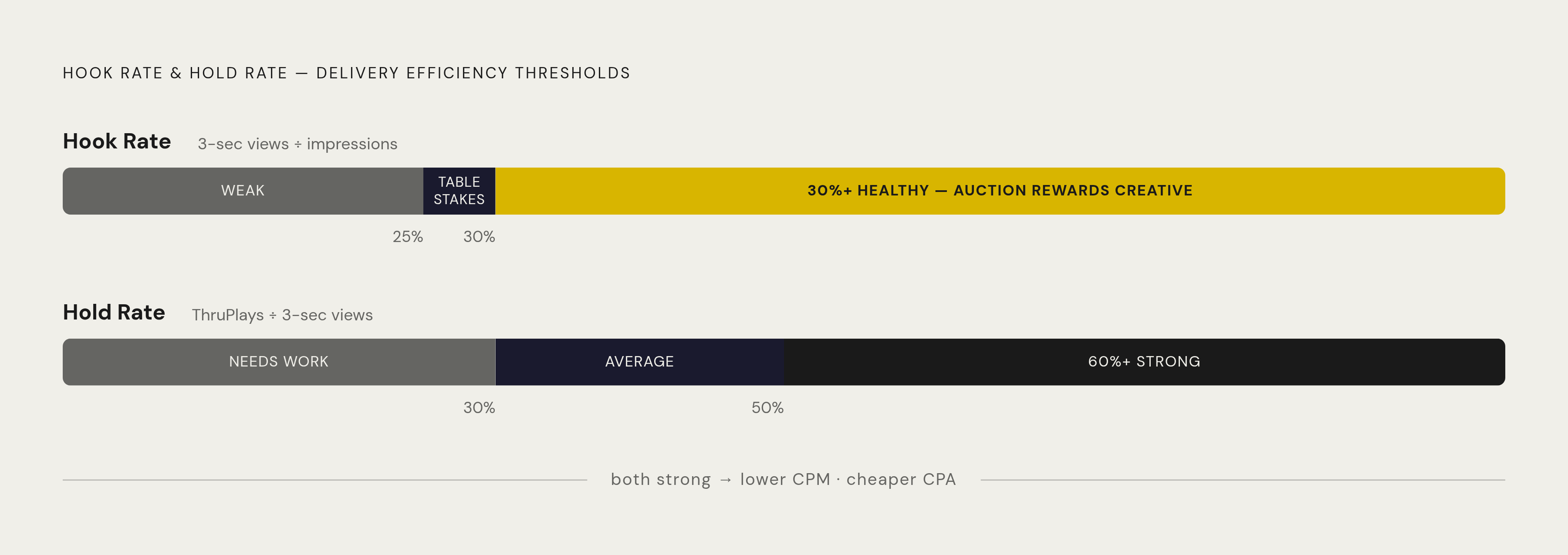
Two numbers do most of the work here. Hook rate is the share of impressions that watch past the opening seconds, calculated on Meta as three-second video views divided by impressions. Hold rate is the share of those hooked viewers who keep watching, calculated as ThruPlays divided by three-second views.
Industry benchmarks put a hook rate of 25 percent at table stakes on Meta and 30 percent or higher in healthy territory. Hold rate averages 40 to 50 percent, with 60 percent-plus considered strong and anything under 30 percent flagged as needing work.
Why does the opening matter this much? TikTok's Marketing Science team found, in 2024 research reported by Social Media Today, that half of an ad's total impact lands in the first two seconds. By six seconds, cumulative impact on Ad Recall hits roughly 90 percent, and Awareness lift lands around 80 percent. Most of what an ad will ever do to a viewer's brain happens before most viewers have decided to keep watching.
The broader implication is that content engaging viewers quickly earns more efficient delivery, which shows up as lower CPMs and cheaper cost per action. Hook rate becomes a leading indicator for CPA before the campaign has even had time to mature.
One caution worth sitting with: two ads can post an identical hook rate and produce wildly different ROAS. Hook rate on its own doesn't tell the full story, and it needs to be read alongside hold rate and downstream CPA, never in isolation. A strong hook that immediately loses the viewer might shave a few points off CPM in week one, but it won't sustain delivery efficiency once Meta's algorithm gets more data on what happens after the hook.
Why format fatigue erodes hook performance faster than most teams expect
UGC worked when it broke onto the scene around 2019 because it looked and felt nothing like the polished studio ad sitting next to it in the feed. That contrast is gone. Per Pixis (pixis.ai), the audience that once saw UGC as a break from advertising now recognizes it instantly as advertising, just in a different costume.
Audiences didn't lose trust in UGC. They learned to pattern-match it. Once a format becomes legible as "an ad," the same scroll resistance that used to greet a 30-second TV spot kicks back in. The scripted problem-solution arc, the ring-lit testimonial, the "I was skeptical at first, but…" open: these have all become recognizable shapes, according to Pixis's March 2026 research, no different in effect from a jingle or a slogan that's been overused.
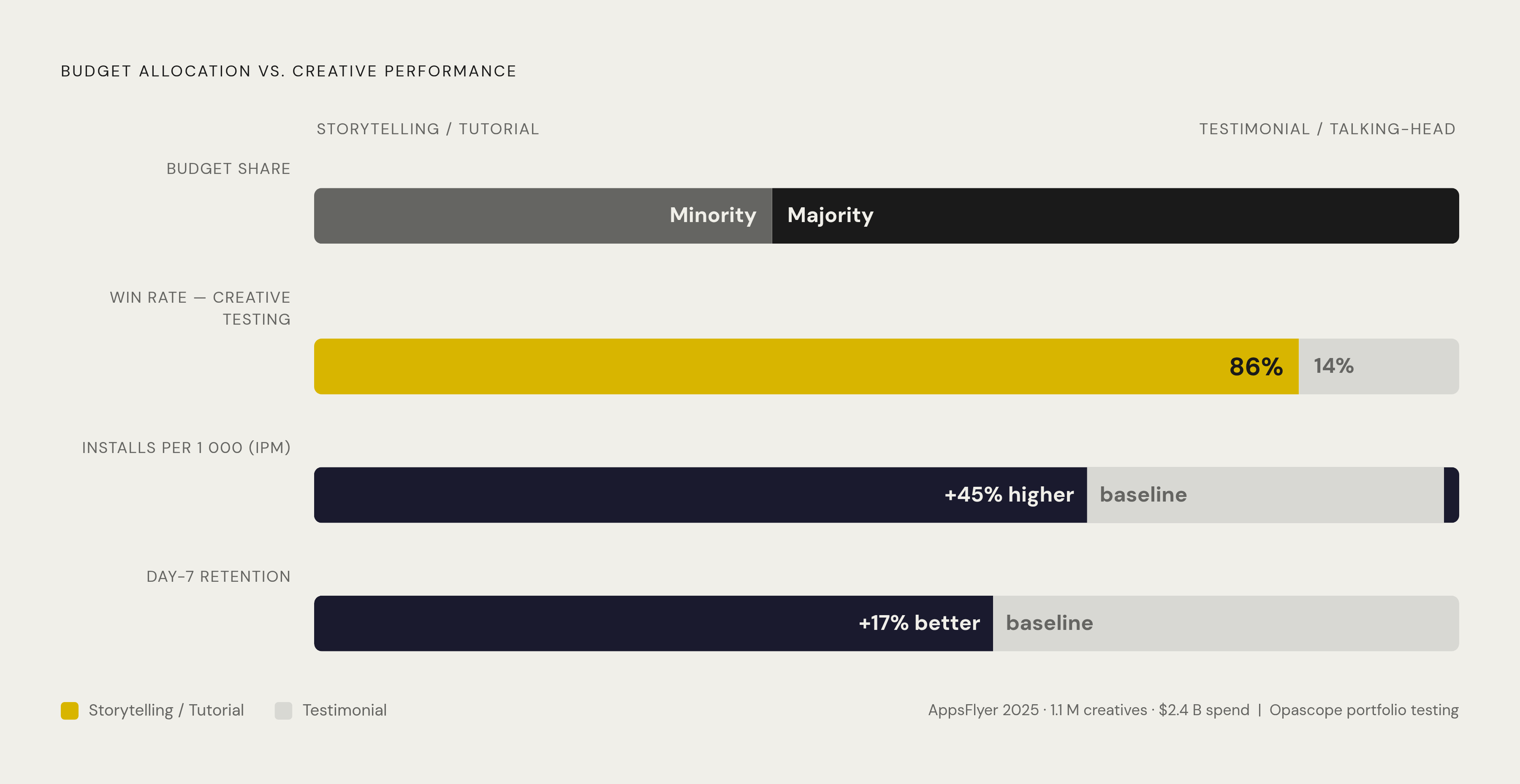
Here's the part that should reframe how budgets get spent. AppsFlyer's 2025 Creative Optimization Report, drawing on 1.1 million creative variations and $2.4 billion in ad spend, found tutorial and app-review formats generating 45 percent higher installs per thousand impressions than testimonials, plus 17 percent better day-seven retention. Testimonials still soaked up the majority of ad budgets anyway.
What does that gap tell you? Teams have confused creator fatigue with format fatigue. The problem was never a real person talking to a camera. It's that every real person is saying the same thing, in the same structure, in the same three-beat arc. Swap the face and the product, and the underlying script hasn't moved an inch.
The fatigue cycle itself has also sped up. What used to take months to burn out now takes weeks, sometimes less, per Pixis (pixis.ai). A fatigued hook shows up first as a declining hook rate, and a falling hook rate signals weakening engagement, which puts upward pressure on delivery costs. Creative fatigue isn't just a CTR problem anymore. It's a CPM problem, and it compounds on a shorter clock than most media plans account for.
That compression is exactly why a single winning hook, however good, isn't a strategy. A library of hooks is.
The seven hook archetypes that earn lower CPMs on Meta, and how each works mechanically
Seven hook formats are widely identified as consistently outperforming on Meta UGC campaigns. Each one triggers a different mental shortcut, and each earns Meta's favor through a slightly different mechanism.
Problem Hook. Names a specific frustration in the opening frame. It creates instant relatability and stops the scroll by making the viewer feel understood before any product shows up. This one carries the most weight in high-skepticism categories: supplements, beauty, wellness, anywhere the audience has been burned before.
Curiosity Hook. Withholds information on purpose, the classic curiosity-gap move. The viewer keeps watching because stopping now would feel like walking away from an answer they were already promised.
Pattern Interrupt Hook. A sudden movement, an unexpected sound, a glitch cut, a visual switch-up. It jolts the viewer out of scroll autopilot before their brain has consciously decided whether to engage at all. That's the whole mechanism: capture attention before the decision gets made.
Authority Hook. Opens on the creator's credentials or a demonstrated skill, rather than a smile and a product in hand. Opascope's portfolio testing found storytelling visual hooks beating talking-head UGC by a margin of 86 to 14 percent. That's not a small edge. It suggests a lot of ad accounts are over-investing in a format that's structurally weaker than the alternative sitting right next to it.
Comment Reply Hook. Frames the ad as a response to a real or simulated viewer question, mimicking the shape of an actual conversation. It builds social proof through structure alone, and it reads as native to the feed instead of broadcast at the feed.
Handwriting Hook. The creator writes the message out in real time, on a mirror, a notebook, whatever surface is on hand. In a feed full of talking heads, going analog registers as behind-the-scenes rather than produced, which is exactly the impression it's built to create.
Transformation / Before-After Hook. Compresses the entire arc into the first three seconds. Per Opascope, storytelling visual hooks have consistently beaten talking-head UGC in portfolio testing. For DTC brands selling an outcome rather than a feature list, this is often the format that converts hardest.
Pixis's March 2026 research adds two more that are outperforming the legacy seven going into 2026. The Hot Take / Contrarian Open leads with a statement that contradicts something the category assumes as fact, not manufactured outrage, just a genuine reframe delivered with the cadence of a good podcast clip. It does best where the product needs to teach the viewer something or change a habit. The Scenario Hook drops the viewer straight into a recognizable moment, no product introduction up front, just the situation. It borrows its structure from organic TikTok and Reels storytelling, and BFCM 2025 testing data showed it performing consistently across DTC categories.
Underneath all seven (or nine) sits one principle: specificity beats generic phrasing, every time. "I was spending $200 a month on skincare that wasn't working" beats "Are you tired of bad skincare?" The specific line skips right past the pattern-matching that makes a viewer's brain flag something as an ad.
One production note worth flagging. Hook rate doesn't always predict CTR. Billo's H2 2025 dataset, covering more than 80,000 Meta video sales ads, found Toys & Games hooks ranking second-best for hook rate but second-worst for clicks. Health & Beauty was the only category in the dataset that won on both metrics at once. The hook earns the watch. Everything after it still has to earn the click.
Matching hook format to funnel stage and audience temperature
Cold audiences need to be stopped and taught why they should care in the first place. Warm audiences already know the category, so they need proof and specificity to close, not another introduction to a problem they've already accepted they have.
For top-of-funnel prospecting, pattern interrupts, problem hooks, hot takes, and scenario hooks do the heaviest lifting. Mid-funnel education tends to favor formats built to hold attention long enough to deliver information rather than just stop a thumb. Retargeting and conversion generally call for formats focused on proof rather than discovery, since audiences at that stage already know the category.
Context matters for the numbers too. Meta CTR benchmarks for UGC-style content run 0.5 to 1.5 percent. Instagram Reels ads average 0.30 to 0.50 percent on their own, but jump to 3.8 percent when paired with creator-led UGC. That lift is real, but it only shows up when the creative and the placement are actually matched. Slot a mid-funnel authority hook into cold prospecting, and it'll likely underperform, not because the format is weak, but because a viewer who's never heard of the brand has no reason yet to care about anyone's credentials.
Worth remembering too: a hook built for TikTok needs rewriting for Meta, not just resizing. Same underlying mechanism, different execution, different pacing, different visual grammar. Platform-specific variants aren't a nice-to-have. They're closer to a requirement.
How to test hooks at volume without rebuilding the entire creative each time
Decouple the hook from the body of the ad. Brief the body once, then test ten to twenty different openings against that same fixed script. The incremental production cost of each new hook is small, and the data generated informs every future brief, not just the one running now.
Call this the Hook Matrix: hold the script body constant, swap only the opening seconds. It's a far more efficient system than briefing a brand-new full creative for every refresh cycle, and it isolates the one variable that actually determines delivery cost.
Volume matters here too. Per ROASPIG, accounts spending $100,000 or more per month on Meta should test 25 to 50 new creative variations per week, just to stay ahead of fatigue. Smaller accounts testing five to ten new UGC creatives a week still build a performance database over time, one that starts revealing patterns across audiences, hooks, and product angles the longer it runs. After three to six months of testing at that pace, a lot of advertisers land on repeatable frameworks: specific hook formulas, structures, and creator profiles that reliably produce strong ads.
A workable budget split looks something like 70 percent on proven winners, 20 percent on variations of those winners, and 10 percent on entirely new, unproven angles. That mix keeps the library growing instead of resetting to zero every time a refresh cycle rolls around. And the refresh cycle itself matters: brands that rotate creative every two to three weeks consistently outperform those that let the same ad run until performance visibly drops off.
AI-generated UGC has a role here too, mostly at the validation stage. AI avatar tools can turn a script and a product URL into a realistic talking-head video without sourcing or scheduling a creator, which makes each test variant faster and cheaper to produce. Real creator UGC still does something AI can't fake: authentic performance and genuine social proof, which matters most once an angle is already validated and ready to scale. The two aren't competing tools. They belong in sequence, AI for testing volume, real creators for scaling what's already proven.
That 86-to-14 gap between storytelling hooks and talking-head formats, from Opascope's portfolio data, points to something simple: most test slates are probably overweighted toward talking-head UGC already. Rebalancing that slate is a smaller, faster fix than a full creative overhaul, and it's the more obvious place to start.
Building a hook library that compounds over time rather than decaying
A hook library isn't a folder of past winners. It's a taxonomy, a record of which psychological trigger, which audience state, which funnel stage, and which creator delivery style produced which result. Tagging every tested hook by type (problem, curiosity, pattern interrupt, and so on), funnel stage, audience segment, and outcome turns a pile of old ads into something searchable, something that shapes the next brief instead of starting that brief from a blank page.
What makes a library actually compound? Patterns that show up after three to six months of consistent testing turn into durable frameworks, specific formulas and creator profiles that keep producing strong ads on a predictable basis. That's a real edge, and one that's genuinely hard for a competitor to copy quickly, since it's built from months of proprietary testing data, not a public playbook.
What makes a library rot instead? Treating it as a script archive rather than a map of mechanisms. Recycling the same problem-solution-testimonial arc with different words and calling it a new hook. Skipping the tagging step, which means fatigue patterns stay invisible until CPMs have already climbed.
Creator relationship sits second in Opascope's hierarchy, right behind hook type, and here's why that ranking makes sense: a creator who understands the brand's hook taxonomy and can deliver several format types across one brief cycle is worth more than a creator who can nail a single format and nothing else. That's the real argument for always-on creator programs over one-off gigs, once a brand is serious about building a library rather than just running a campaign.
Nielsen data shows 94 percent of people trust peer recommendations over brand messaging. A hook library's entire job is earning that trust in the first two to three seconds of a video, which means authentic delivery from the right creator isn't a production detail tucked at the end of the process. It's a performance input, as load-bearing as the script itself.
Running this at real scale, meaning 50 to 200-plus creators at once, briefing each on hook variants, checking content for brand fit, and rotating assets on a two-to-three-week cadence, is a genuine operational load. It gets heavier as the library grows, not lighter. The brands that end up with libraries that actually compound are the ones treating hook testing as an ongoing program built to run indefinitely, not a creative sprint that wraps up when the quarter ends.