UGC Agency Contract Terms Brands Negotiate Most
Usage rights and exclusivity duration matter most when budgets scale.

UGC contracts turn on five terms: usage rights, exclusivity, revision rounds, ownership, and performance pay. Get these five right and the deal grows with you without blowing up. Get them wrong, and the same piece of paper you signed in good faith turns into a problem six months later, usually right as the campaign starts working.
Here's the mix-up I see all the time when brands move from influencer deals into UGC. With influencers, you're renting an audience: follower count, engagement rate, reach. That's the asset, and the terms follow from it. With UGC, nobody cares how many followers the creator has, and you're buying a produced video meant to run as a paid ad, often through a channel with zero organic audience behind it at all. Follower clauses stop mattering. What matters is usage rights, revision limits, who owns the raw footage, and whether you're actually allowed to run the thing through paid ad systems. Same invoice format on the surface, a completely different contract underneath.
U.S. creator ad spend hit $37 billion in 2025 according to the IAB, up 26% year over year, and brands also spent an estimated $15 billion on UGC production in 2025. At that scale, a sloppy usage clause stops being paperwork, and it becomes a recurring cost line, or worse, a campaign that gets pulled mid-flight because nobody checked whether the license covered the platform it was running on.
So before you draft a single clause, ask the question that decides everything else: are you buying reach, or are you buying content? The answer tells you which terms deserve your energy and which ones can wait.
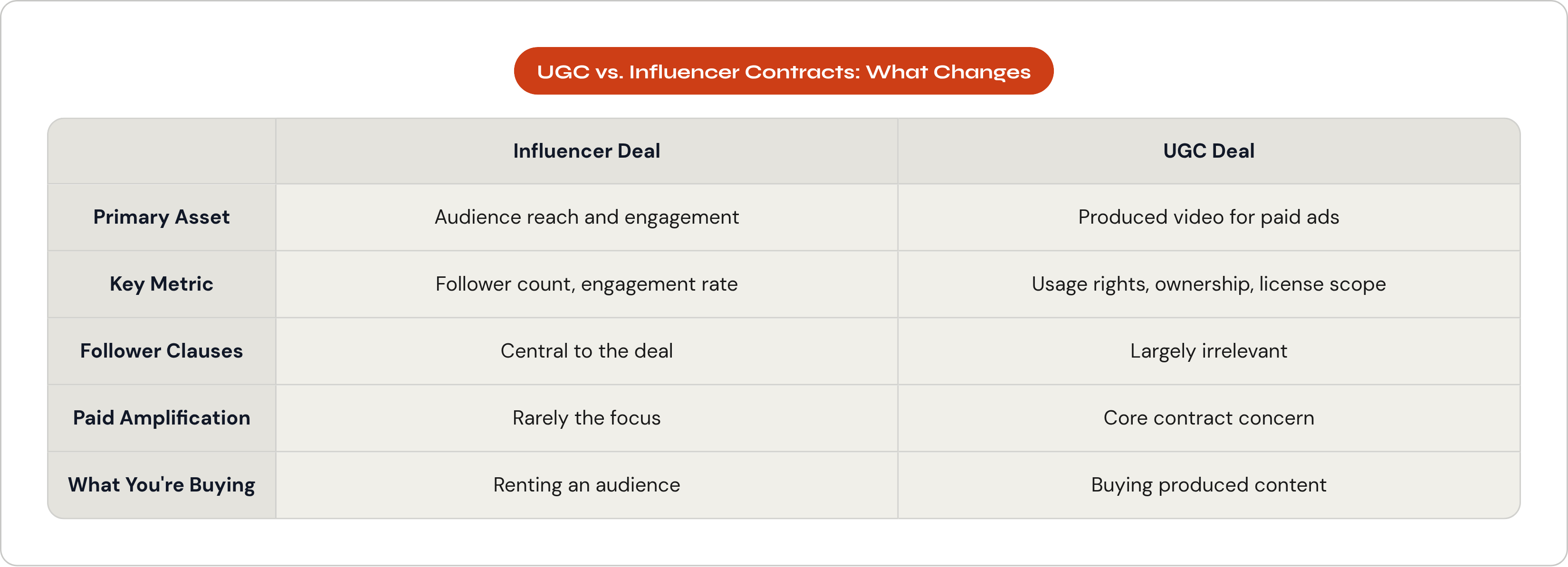
The clause stack every UGC contract needs before negotiation begins
A working contract needs, at minimum: scope of work, payment terms, usage rights, a revision policy, deadlines, a liability clause. That's the floor, not the ceiling.
Plain language matters more than it sounds like it should. Dense legal phrasing doesn't protect either side; it just guarantees both parties forget what they agreed to, and six months later you're arguing over what "reasonable use" meant in a clause nobody's reread since signing day. Industry norm sits around one to two pages. Push past that and onboarding stalls, especially with creators juggling five or six brand relationships who aren't going to read eight pages of terms for a modest flat-fee job.
Which clause deserves top billing? Revision counts, deadlines, deliverable specs? I used to think that was the right question to sit with, but it turns out it isn't. The clauses that look most routine are usually the ones causing friction once a program scales past a handful of creators, and no ranking fixes that. Only knowing the full stack does. A missing liability clause or an undefined deadline costs more than a term you negotiated imperfectly, and a gap in the baseline is leverage you never knew you had, and someone will find it.
Usage rights duration and scope (where most of the money actually lives)
Most UGC budget disputes I've seen have nothing to do with the creation fee. They're about what happens to the video after it ships, and brands haggle hard over day rates, then get blindsided months later when a creator sends a cease-and-desist over a Spark Ad they never agreed to.
Usage rights split into three tiers, and mixing them up is where most disputes start. Content licensing covers the brand reusing the asset on its own channels: website, email, organic social, maybe in-store signage. No ad dollars behind it. Paid amplification, sometimes called whitelisting, or Spark Ads on TikTok, is a different animal entirely: the brand runs paid media through the creator's own handle, using the platform's ad system. Different risk, different price, different consent required. Then there's "in perpetuity" language, which shows up more than it should. Treat that phrase as a red flag if you see it in a draft — it usually means nobody actually thought the term through — and swap in a specific window instead.
Brands license content "for use on brand social channels" and assume that covers boosting the post or running it as a paid ad. That assumption doesn't hold. Those are separate rights, and a creator who finds their face in a paid ad they never licensed for has a real complaint, not a technicality.
On duration, the industry has settled into rough benchmarks. Paid social usage tends to run around 12 months, while out-of-home or broadcast adaptations carry longer windows, usually with an extension rate agreed on up front. Full buyouts exist too, done properly, and they come with a real premium, often multiples of the base rate.
Adding paid amplification typically tacks on 25 to 100% or more over the base creation fee. A 90-day paid usage license on its own can command a substantial premium, and multiplied across dozens of creators that stops looking like a rounding error fast.
Leverage sits at signing, not at renewal. Lock the extension rate before the campaign launches. Once a video is performing and you need another 90 days, the creator knows exactly how dependent you've become on that asset, and the negotiating position flips on you overnight. There's no universal pricing standard by platform yet; rates swing by creator tier, by platform, by whether whitelisting comes bundled or priced apart. Which is exactly why locking terms early matters so much.
Exclusivity windows (what brands are actually buying and for how long)
Exclusivity gets treated as one clause when it's really two, and mixing them up causes real confusion at the table.
Creator exclusivity means the person can't work with a competing brand during a set window. Content exclusivity means that specific video can't be licensed out or adapted for another brand, regardless of what the creator does elsewhere. Different scope, different price, often a different duration too.
Why does this matter more for UGC than for a typical sponsored post? Paid amplification depends on a clean signal. If a brand whitelists a creator's content while that same creator shows up in a competitor's ad, attribution gets muddy fast, and the spend starts working against itself.
Brands that handle this well do a few specific things. They ask for category exclusivity instead of a blanket ban on all competitors: narrower, cheaper, an easier yes. They tie exclusivity to the paid amplification window specifically, not the full contract length. And they push back hard on exclusivity that runs well past the campaign with no extra pay attached.
That last point is where deals fall apart most often. Long exclusivity windows with no fee bump are one of the most common reasons an experienced creator walks, or counters hard enough that the deal stalls. The fix on paper is simple: tie exclusivity duration to the usage rights window. Ninety days of paid amplification, ninety days of exclusivity, that's defensible. Six months of exclusivity bolted onto a one-time production fee is not, and creators who've been burned before will say so, loudly, in the group chats brands don't see.
Worth flagging for anyone running a bigger roster: exclusivity at 50-plus creators stops being a legal term and becomes an operational one. Somebody has to actually track who's under what window, with which competitors excluded, and that's a compliance job, not something you run out of a filing cabinet.
Revision rounds (a clause that looks administrative but controls creative velocity)
Revision language reads like housekeeping, but it actually sets the ceiling on how many times a brand can push back on a video before extra charges kick in, or before the relationship starts fraying at the edges.
Most contracts spell out a fixed number, usually one or two rounds, with anything past that billed hourly or per asset. Simple on paper. In practice, three things cause the friction.
First, internal approval chains. A brand with four stakeholders signing off on a video will burn through revision rounds on internal disagreement, not creative problems, and the creator eats the cost of a process issue that has nothing to do with their work. Second, the definition problem: does swapping the hook count as a revision? What about reshooting under different lighting, or adding a new call to action? If the contract doesn't spell it out, every disagreement becomes its own mini-negotiation. Third, how the agency bills overages. Some bundle revisions into the flat rate; others bill separately, and that one difference can shift total campaign cost by a real margin.
The stakes sharpen at volume. A paid social program running 10 to 20 new assets a week, or 50-plus at higher budgets, means revision friction on one creator compounds across the whole roster fast.
So what should brands actually push for? A precise, written definition of what counts as a revision, not just a number attached to a vague word. A split between structural changes (re-recording, new hook, new narrative) and cosmetic ones (caption tweaks, music swaps), priced as separate categories. A revision timeline that keeps pace with weekly ad refreshes, not a two-week turnaround built for a single evergreen post.
The pattern that emerges from revision disputes is consistent: overruns are usually a brief problem, not a creator problem. Brands that write tight briefs — under 400 words, with hook, narrative arc, product demo, and call to action all spelled out — give creators less room for misalignment than brands that hand over a loose concept and expect three rounds to sort out what they should've decided upfront.
Content ownership and raw footage rights (the gap most brands don't notice until it's expensive)
Here's what catches most brands off guard: in most jurisdictions, the creator owns what they made unless the contract says otherwise, in writing. Paying for the shoot doesn't transfer copyright by itself, no matter how the invoice reads.
The assumption is "we paid for it, so we own it." The reality runs differently. Ownership only transfers through an explicit assignment clause or a work-for-hire provision written into the contract. Without one, the brand holds a license to use the content on whatever terms got agreed, and the creator still holds the copyright underneath it.
Raw footage is its own negotiation, separate from the finished video, and brands miss this constantly. The edited deliverable and the raw footage are two different assets entirely. Raw footage is what lets a brand cut new hooks, test different openings, build several ad variants out of a single shoot day, without paying for a second production from scratch. Plenty of creators treat raw footage as a premium add-on, priced separately, and won't offer it unless someone asks directly.
Why does this matter at scale? A brand running a high-volume paid social program needs to swap hooks and test new calls to action without booking a new shoot every time, and that flexibility only exists if raw footage rights got locked in at signing, not requested after the fact when the creator has no reason to say yes cheap.
Work-for-hire is the strongest version of this: ownership transfers the moment the content gets made. Experienced creators know exactly what they're giving up when they sign it, since it's also the priciest route, so expect pushback and a higher rate to match.
Framing raw footage and ownership as part of an ongoing relationship, rather than a one-off transaction, is where brands hold real leverage. A creator producing content for the same brand every month has more reason to accept favorable ownership terms than someone doing a single low-rate gig once and moving on. One thing still shifting under everyone's feet: whether brand-owned UGC footage can train internal AI tools. No settled norm exists yet, and contracts that dodge the question entirely will look dated within a year or two.
Performance-based payment structures (the term brands want most and creators resist hardest)
UGC ads beat traditional brand ads by a wide margin: roughly 4x higher click-through rates and 50% lower cost-per-click, according to available benchmarks. So naturally, brands want pay tied to that lift, and why write a flat check when the content itself is driving the number?
Creators push back, and it's a fair objection when you sit with it. They control the content but not the media buy. A brand that underfunds distribution or targets the wrong audience can turn great creative into a mediocre ROAS number, and tying pay to that outcome asks the creator to carry a risk they never signed up to carry.
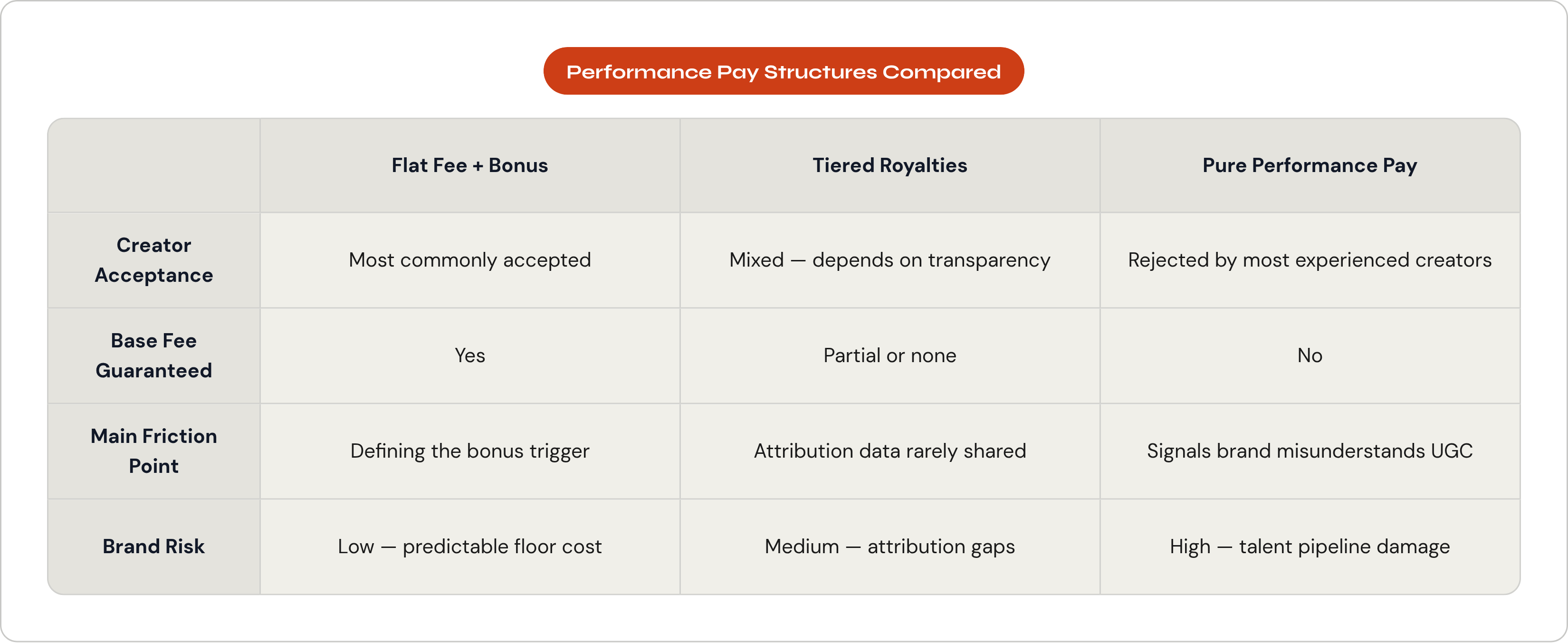
Three structures come up in negotiation, and they land very differently at the table.
Flat fee plus performance bonus is the one creators actually accept most of the time. The base fee covers production regardless of outcome; the bonus rewards results on top of it. The real fight happens over what triggers the bonus: views, conversions, a ROAS threshold. Tiered royalties on conversions look great on a spreadsheet but tend to fall apart in practice, mostly because they need attribution transparency that brands rarely hand creators in the first place. Pure performance pay, no guaranteed base at all, gets rejected by nearly every experienced creator I've come across, and it tends to signal to the market that a brand doesn't understand how UGC production actually works.
What brands can realistically win is a performance bonus with a clear, measurable trigger, not a swap for the base fee: an addition on top that rewards content when it genuinely moves the numbers. There's a catch brands underestimate here: for the bonus to feel fair, the brand has to share the attribution data behind it. A creator who can't see why they hit or missed the threshold has no reason to trust the structure, and once that trust is gone, the whole arrangement collapses with it.
How the terms interact (and why negotiating them in isolation creates new problems)
None of these clauses live alone. Change one, and you've quietly changed the value of two others without meaning to.
Push usage rights out to two years across five platforms, and exclusivity gets harder to justify at the original price. The creator's cost of saying no to competitors just went up, so the exclusivity fee climbs with it. Grant work-for-hire ownership, and the revision clause matters less, since the brand can edit the raw footage directly instead of sending it back for another round. Performance pay only makes sense once usage rights are locked down first: a creator can't reasonably accept a bonus tied to results from content whose full reach and duration were never pinned down in the first place.
That ordering matters more than any single clause on its own. Settle usage rights and ownership before touching the rest, since those two terms set the outer boundary everything else operates inside.
Negotiating these terms one deal at a time across a roster of 40 or 50 creators is where it gets messy at scale. You end up with the same deliverable governed by different revision counts, different exclusivity windows, different usage terms, creator by creator. That's not just messy paperwork. It's a compliance problem that grows exactly as fast as the roster does, and it doesn't announce itself until someone's chasing down an expired license mid-campaign.
The fix that shows up again and again in mature programs is standardization: a contract template with pre-agreed negotiation ranges for each clause, instead of starting from scratch every time someone new signs on. Onboarding gets faster, since creators aren't reading a new eight-page document each round. The brand gets a cost model it can actually plan around instead of guess at. Legal review per contract shrinks, since the acceptable range of terms is already defined before anyone sits down to talk numbers.
More than half of marketers say they plan to put more weight on creator partnerships in the coming year, by most surveys I've seen floating around. The brands scaling those programs without the legal mess piling up underneath them are the ones building contract infrastructure now, while the roster's still small enough to fix by hand instead of by committee.
Tracking usage rights expiration dates, exclusivity compliance, revision counts, and raw footage rights across dozens of creator relationships is real, ongoing work. It doesn't run itself, and it doesn't get lighter as the roster grows — which is the overhead an agency ends up absorbing once it manages the program directly, rather than something bolted on after the spreadsheet's already too big to trust.