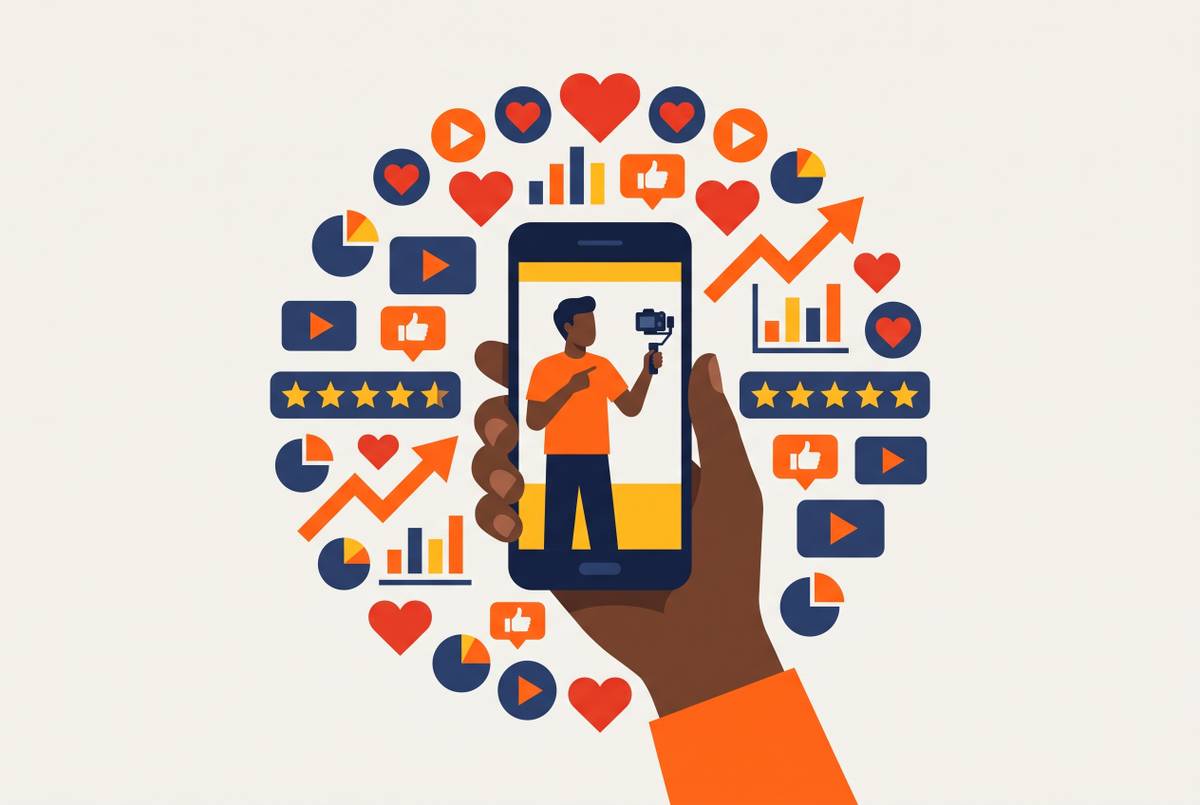
How to Market an App With No Audience or Ad Budget
Lean on nano creators and organic content to build early traction cost-free.

Paid acquisition runs on data: what audience converts, what creative holds attention, what price per install the business can sustain. A new app has none of that yet, so every dollar spent on ads in the first weeks is a dollar spent guessing. Creator-led UGC works through an algorithmic distribution mechanism. A platform like TikTok surfaces content to the people predicted to watch it, regardless of how many followers posted it or how much anyone paid. That means a small creator with no brand deal behind them can reach a scaled audience that a paid placement with the same budget can't touch.
There's a trust gap here too, and it matters more for an app than for almost any physical product. Nobody can pick an app up off a shelf, turn it over, and decide if it's worth buying. A creator filming themselves actually using it does the job a shelf presence would otherwise do: it shows the product working, in someone's hands, before the viewer ever taps install. Shoppers treat that kind of footage as a peer recommendation, and that credibility is something no ad budget can buy. For an app with no audience and no money to spend chasing one, this is the more structurally sound place to start.
UGC versus influencer marketing, and the budget math for an early-stage app
Early-stage founders often stall here because they assume creator marketing means paying someone with a large following to post about the app on their channel. That's influencer marketing, and it is a transaction for access to an existing audience. UGC is a different transaction entirely: the brand pays for a content asset it owns and controls, with no requirement that it ever touches the creator's own feed.
That distinction changes the economics completely. A paid UGC creator might deliver a thirty-second vertical demo video or a before-and-after clip for a fraction of what an influencer placement would cost, and the contract can specify exactly which channels the brand gets to use that footage on, from the app's own TikTok account to paid ad campaigns months later. For an app with no existing user base, paid UGC fills the content gap while the organic engine gets built. There's also a tier below that costs almost nothing: seeding the product to nano creators, who often post in exchange for free access. An app with no budget should think of its content supply as two lanes. One is seeded organic posts that cost nothing but product access. The other is owned UGC assets, produced cheaply, that the brand can deploy on its own channels or fold into paid amplification down the line.
Recruiting the first creators with no brand recognition and nothing to offer but access
Recruiting a first roster doesn't require cash. It requires a structured outreach process and a clear-eyed read on which tier of creator actually serves an early-stage app best.
Nano creators, generally those with small but engaged followings, are the right place to start. Their relationship with their audience is personal, their engagement rates run meaningfully higher than macro accounts, and they convert better: creators under five thousand followers convert twenty percent better than larger accounts, because their followers treat a recommendation from them like advice from a friend. Conversion rates on seeding outreach vary by category. Beauty and food creators tend to convert at the high end of the range, tech converts lower, so an app team should plan outreach volume with that in mind rather than expecting every invitation sent to turn into a posted video.
Compensation doesn't have to mean a flat fee. Cal AI, a calorie-tracking app, built its early growth around micro-influencers in health, food, and lifestyle niches, each given a referral code tied to commissions on attributed downloads and sign-ups. That structure turned every creator into someone with a real stake in the app's growth, not someone who got paid once and moved on. Cal AI reached a million dollars in revenue within four months, and was later acquired by MyFitnessPal in December 2025, a deal announced in March 2026.
Because conversion from outreach to posted content is a numbers game, the invitation list needs to be several times larger than the target roster. The number worth working toward, once the pipeline is running, is a roster of several dozen creators. That's the point where there's enough volume feeding the testing system described later in this piece, not a bar to clear before starting.
What to Put in a Creator Brief
The brief is the single biggest lever an app team has over content quality, and most teams get it wrong in one of two directions: scripting every line, which kills the authenticity that makes UGC work in the first place, or handing over nothing, which produces content with no hook and no clear job to do.
Start with the hook. The completion rate threshold that governs algorithmic distribution has risen sharply. A video now has roughly three seconds to earn the viewer's attention or it never gets shown to anyone beyond the first small test audience. The brief should specify the hook structure (a question, a visual surprise, a bold claim) and name the one core demonstration the video has to include. For an app, that demonstration is almost always the app doing its job on screen, not a creator describing what it does. Cal AI's creator videos followed exactly this pattern: hook the viewer in the first few seconds, then show the app actually tracking a meal or logging a calorie count.
A useful brief for a health app, for example, might lay out a hook option ("I stopped guessing my calories and started doing this instead"), a required on-screen demonstration (opening the app, scanning a meal, seeing the result), and a short list of proof-point angles the creator can choose from: a testimonial about results, a before-and-after, a day-in-the-life integration, or a quick tutorial. Each of those angles answers a different objection a viewer might have, and each produces a distinct asset worth testing. What the brief should not do is dictate every word the creator says. One more thing matters for reach: creators whose existing content already lives in a consistent niche get better distribution than ones who post across unrelated topics, because the algorithm has an easier time matching their audience to new content. Brief creators whose feed already looks like the app's category.
How TikTok distributes new content
TikTok tests every new video with a small seed audience first, typically existing followers following a shift in late 2025 away from the prior model of interest-matched strangers, and watches how that small group responds before deciding whether to push the video to a progressively larger pool. A video that doesn't clear the bar at one stage simply stops moving outward.
Not every signal in that calculation carries equal weight. Watch time and completion rate matter most. Re-watches, shares, and saves run at a similarly high tier just below that. Comments matter less, and likes alone do almost nothing to drive scaled reach. Shares now outweigh likes in the algorithm's math, and that has a direct implication for the brief: content that offers real utility, teaches something, or gives the viewer something worth sending to a friend gets rewarded structurally over content that is simply pleasant to watch.
This is why organic testing should come before paid spend, not after. Organic performance is the cheapest filter an app team has. It shows which hooks, which formats, and which creators clear the algorithm's bar before any money gets spent amplifying something that might not have worked anyway. After each post goes live, the number to watch first is completion rate, followed by share rate. View count and likes are the least informative numbers on the dashboard.
Iterating on what works: hooks, formats, and creators as variables in a repeatable testing system
Week over week, a functioning program looks less like a marketing campaign and more like a production line: briefs go out on a schedule, content comes back, the numbers get reviewed, and the next round of briefs gets sharper based on what the data showed. Repeating that pattern lets an app sustain UGC-driven growth instead of catching a single viral moment and then plateauing because no one knows why it worked.
Three variables should get tested independently. The hook is what the first three seconds say or show. The format is the structural choice, testimonial, demo, before-and-after, stitch. The creator is whose audience, voice, and niche actually produced the strongest completion and share rates. Running multiple formats against the same core product message tests which angle on the same story converts, and that's the information that sharpens the next round of briefs.
Roster size sets the pace of learning. A roster of several dozen creators produces enough parallel results to generate real signal within a few testing cycles. A roster of five produces so little variation that patterns take far longer to emerge. Success in this system means identifying which specific elements, the hook type, the format, the creator's niche, the demonstration style, made a top performer work, and then briefing those same elements into new creators to see if the result reproduces. A music app or a productivity app that can repeat a result across five different creators has found something real. One that can't has found a fluke.
Building a viral growth loop into the app itself so creator content drives installs, not just views
A video with a million views that produces no installs is a distribution win and nothing else. For creator content to translate into growth, the app itself has to be built to catch the traffic that content generates, not just hope some fraction of viewers remember to search the App Store later.
The mechanic that does this well is a web-view sharing loop. Rather than asking a user to invite a friend directly, which is a cold and often ignored ask, the app lets users share one specific piece of output, a generated result, a score, a finished creation, through a link. That link lets the recipient experience the core value of the app in a browser, with no install required, and then presents a clear call to action pointing to the App Store. A music generation app used exactly this pattern: users shared songs their friends could listen to right in a browser, with a visible "Create Your Own" button sitting next to the player. By the time that recipient lands on the App Store listing, they've already experienced the product. The install is the natural next step, not a cold ask from a stranger's ad.
This matters for conversion specifically because it changes who's arriving at the listing. Instead of cold traffic funneled in from a generic paid placement, the App Store sees high-intent visitors who've already seen the app do something they wanted to see. Creator content accelerates this loop directly: when a creator's video shows the shareable output and links to it, every viewer of that video becomes a potential entry point into the loop, not a passive number added to a view count.
Turning the best organic posts into paid assets through whitelisting and Spark Ads
Organic testing is the filter that tells the team which creative is worth paying to amplify in the first place, even while the budget is thin, which makes whatever paid spend comes later far more efficient than starting from a blank page.
Whitelisting and Spark Ads let a brand run paid advertising from a creator's own account or content rather than from the brand's page, which keeps the authenticity and social proof of the original post intact while adding the targeting precision and reach that paid media provides. The rule that governs this well: negotiate whitelisting rights before the shoot, not after a post takes off. Rights negotiated retroactively almost always cost more, because the creator knows the post has already proven itself and has leverage in that conversation. For organic content that's already live and performing, roughly half of creators will agree to free retroactive usage rights on their top performers, which makes it worth asking before commissioning brand-new content aimed at the same angle.
What this produces, when it's working, is a single connected pipeline. Organic posts surface winning creative at close to zero cost. The strongest performers get amplified through Spark Ads or whitelisting. The performance data from that paid spend then feeds back into the next round of creator briefs, sharpening the hooks and formats the team tests next. Zero-budget tactics and paid growth aren't opposites in this model. Paid is simply what the organic system produces once it starts working.
The operational overhead that quietly kills early UGC programs
The most common reason an early UGC program stalls has nothing to do with creative ideas. It's a coordination failure: briefs go out late or inconsistently, creators miss deadlines, usage rights are never clearly spelled out, payments get handled manually and slip through the cracks, and nobody is tracking which posts are actually performing well enough to replicate.
At a roster of several dozen creators, that operational surface adds up fast. Every single relationship involves a brief, a review cycle, some form of contract or agreement, a payment, and a performance check. None of those steps is complicated on its own. Multiplied across dozens of creators running in parallel, they consume more time than most early-stage teams have to give, and that's usually the point where a promising program quietly stops producing anything new.
One piece of overhead isn't optional regardless of team size: disclosure. Platforms including Instagram require clear labeling of paid or commissioned content, and FTC compliance on this point is a legal requirement, not a best practice. Skipping it exposes the brand to platform penalties and regulatory risk that no amount of good creative can offset. Building the tracking, the rights management, and the disclosure process into the system from day one is what lets a roster of several dozen creators actually compound into the kind of repeatable testing engine the rest of this piece describes, rather than collapsing under its own logistics before it gets the chance.