What High-Performing UGC Video Looks Like by Format
Each UGC format drives different results depending on funnel stage and structural details.

What High-Performing UGC Video Looks Like by Format.
Format: The Missing Variable in UGC Video Programs
Most brands treat UGC as a vibe. Something that feels raw, feels unscripted, feels like it wasn't made by a marketing department. That's a reasonable starting instinct, but it's also where the strategy usually stops, and that's the problem. UGC is a set of distinct formats, each with its own structural logic, its own psychological trigger, and its own specific job at a specific point in the funnel, not a texture you sprinkle on top of a media plan.
Skipping that distinction causes this: a brand gets a testimonial video that crushes it on a product page, tries to repeat the win with more testimonials, and watches performance flatline. Why? Because nobody isolated what actually worked. Was it the specificity of the claim? The platform? The funnel placement? Without knowing, the win becomes a one-off instead of a repeatable system.
Marketers' intentions and their actual systems diverge, and government and industry data reflect that gap. The IAB's Outlook Study found 57% of marketers plan to increase focus on creator partnerships this year influencermarketinghub.com. But only 16% of businesses have anything resembling a dedicated strategy for producing UGC ads systematically influencermarketinghub.com. That gap between what marketers want to do and what they've actually built a process around is roughly where most wasted UGC budget lives.
This piece works through the format layer directly: what each one is structurally, why it triggers action psychologically, and where in the funnel it earns its keep. The focus here stays on video specifically, not static image UGC, and leans on paid social and on-site placement, since that's where the performance data is most complete.
The performance baseline that makes format selection matter
Before getting into individual formats, the aggregate level is where this matters, and establishing why sets the ceiling that smart format choices are actually reaching toward.
The numbers are not subtle. Watch-through rates run 35% higher than polished brand ads, and production costs land anywhere from 30% to 71% lower billo.app. On the qualitative side, 81% of eCommerce marketers say visual UGC resonates more with customers than professionally shot photography or influencer content, and 90% of consumers name UGC as the single most influential factor in a purchase decision vidlo.video billo.app.
Stacking those figures together shows a pattern: the advantage is large, and it appears almost everywhere UGC gets measured against brand-produced content. But the aggregate number hides something important. It averages across formats that behave completely differently from one another. The real leverage isn't in "doing more UGC." It's in picking the right format for the right slot in the funnel and getting the structural details right within it.
That's the actual argument of this piece. Not that UGC works (that part's settled), but that understanding what "good" looks like, format by format, is what separates a brand getting repeatable lift from one chasing a lucky video that happened to go right once. UGC video can drive a 4x higher click-through rate billo.app. UGC video can generate 6x more engagement billo.app.
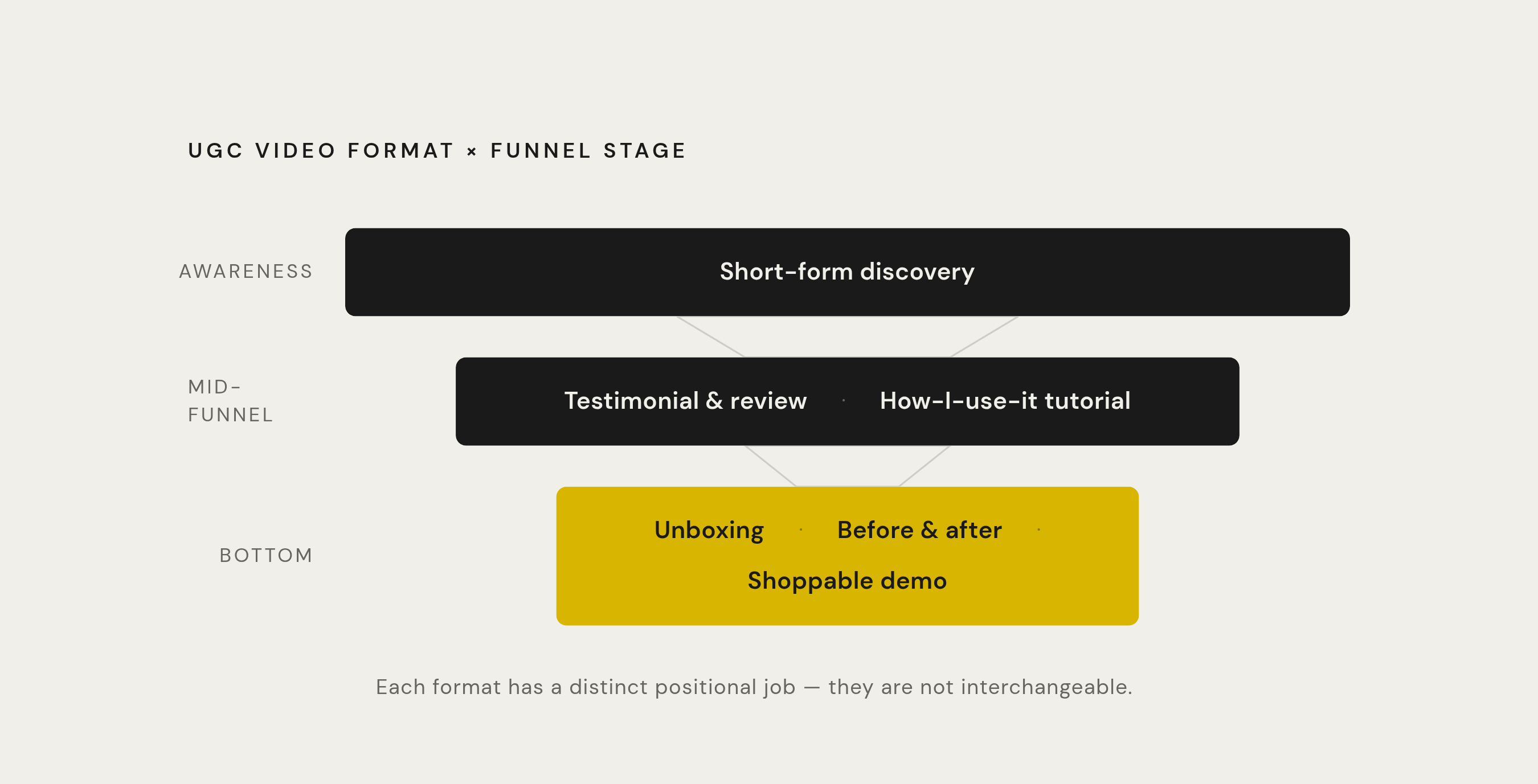
Unboxing videos: why first-reaction content converts at the bottom of the funnel
An unboxing video shows a creator opening a product on camera and reacting. The reaction is the content. There's no script driving it, and that's the point.
Three psychological triggers fire at once in a good unboxing video. Anticipation, since the viewer doesn't know what's inside yet. Tactility, since watching someone hold and use an object triggers a kind of vicarious sensory response that a product photo can't. And social proof, since somebody already spent their money on this thing and is reacting to it honestly, in real time.
That combination makes unboxing content strongest at the bottom of the funnel: product pages, Amazon's video carousel, retargeting sequences aimed at someone who's already circling a purchase decision. The viewer is looking for the final nudge rather than an introduction to the product, and a reaction that reads as genuine gives them one.
Length and format follow a fairly tight spec: 30 to 60 seconds, shot vertical for Reels and Shorts, horizontal for the Amazon listing itself. The categories where this format hits hardest tend to be skincare, fashion, food, and newly launched direct-to-consumer SKUs, where the "what's inside" question carries real weight.
One production detail decides whether the whole thing works or falls apart: the "before" shot, the still-sealed box. Viewers can tell when a reaction has been staged, and once that trust breaks, it breaks for the rest of the video too. Shoppers are also substantially more likely to buy when a review comes with photo or video proof attached rather than text alone, which is really the underlying mechanic that makes unboxing content convert in the first place. A high-performing unboxing video on Amazon's video carousel can lift add-to-cart by 25% to 40% within the first month, contingent on packaging that tells a story and a creator reaction that reads as genuinely surprised, not scripted influencermarketinghub.com.
Testimonial and review videos: social proof that works mid-funnel
A testimonial video is a real person, customer, fan, or hired creator, talking straight to camera about their experience with a product. Often unscripted, sometimes lightly guided, but never reading off a brand's messaging deck.
This format sits mid-funnel. It works best where a shopper who's already considering the product needs one more push of credibility: the product page itself, an email flow, or a retargeting audience made up of people who visited but didn't buy. Among marketers, 26% name user-generated video reviews as their top format for driving engagement, the highest share of any single UGC type measured. That tracks with a broader trust pattern: 92% of consumers say they trust recommendations from individual people over brands, and testimonial video is that principle executed about as directly as it gets.
What separates a testimonial that converts from one that doesn't usually comes down to specificity. "I've tried three retinols and this is the only one that didn't dry out my skin" does more work than "I love this product," because the first sentence contains information and the second is just enthusiasm. Oddly enough, mentioning one real downside tends to outperform a flawless five-star script, since a small complaint signals the review wasn't manufactured. Delivery matters too, though not in the way brands often assume: camera confidence and natural pacing beat acting polish every time.
Drunk Elephant runs this well by regularly reposting customer review clips from TikTok, short pieces of people showing their skin after using the product. It works because the message is coming from actual fans, not brand copy dressed up as one. Starface takes a similar approach with testimonials built around before-and-after experiences using its Hydro-Star pimple patches, which starts to show how these formats blend into each other rather than staying in separate lanes.
Platform matters here more than people assume. YouTube UGC earns 98% higher trust than content on other platforms, which makes it the strongest environment for longer testimonials or detailed review content where runtime helps make the case billo.app. And on cost: the average UGC creator charges around $198 per video. At that price, a brand can build out a real library of testimonials across different customer demographics without anything close to studio-level spend.
Before-and-after and transformation videos: compressing the proof into two shots
The structure here is about as simple as video formats get: two states, shown in sequence, problem first, then result, with barely any narration required. The visual gap between the two shots does the persuading. Nobody has to explain what changed, because the viewer can see it happen.
That simplicity makes this one of the fastest-converting formats available. It compresses an entire sales argument into two shots and a cut, and the viewer never has to imagine what the outcome might look like, because it's right there on screen. Categories where the result is visually obvious tend to dominate here: fitness, skincare, home organization, pet grooming. Anywhere the transformation can be seen rather than described.
The format is versatile across the funnel, which is a little unusual. It works at the awareness stage, since a relatable "before" state pulls people in, and it works at the closing stage, since the "after" proves the transformation is real rather than promised. Starface's before-and-after content built around the Hydro-Star patches is a good example of how this overlaps with the testimonial format entirely, one creator, one piece of content, delivering both a personal account and a visual transformation at once.
One production rule decides whether any of this holds up: the "before" has to be genuinely unflattering. A staged "before" that already looks decent kills trust in the "after" instantly, because viewers can sense when a starting point has been softened to make the ending look more dramatic than it is. Spec-wise, this format runs vertical at 9:16, under 60 seconds, and the cut between the two states needs to be fast. Any delay in the reveal and the viewer's attention is gone before the payoff lands.
How-I-use-it tutorials: turning product education into the creative itself
A how-I-use-it tutorial is a creator walking through their actual, lived use of a product. Not a polished instructional video, but something closer to "here's what this looks like in my regular life." The distinction matters, because it answers a question the viewer is already silently asking (how would this actually get used?) without ever feeling like a pitch.
Apple's "Shot on iPhone" campaign works as marketing precisely because real user-generated content sits at its core, even though it also features professional directors, photographers, and scripted short films. What makes it effective as marketing is that it never presents itself as marketing. The tutorial impulse and the product demo impulse blur together until the viewer stops noticing which one they're watching.
There's a practical sourcing advantage here too. Every "how do I actually use this?" comment sitting under a brand's product listing is, in effect, a tutorial brief that a customer already wrote. Tutorial content keeps expanding through 2026, especially in fashion, DIY, and productivity categories, largely because the format scales in a way few others do: one product can generate dozens of distinct use cases across dozens of creator demographics.
Funnel placement sits mid-to-lower, since this format works best for considered purchases where a shopper wants to see the product functioning before committing money to it. Framing the tutorial around a personal success story, rather than a dry feature list, tends to hold attention longer. Platform-wise, the format works across TikTok, Reels, and YouTube Shorts, though YouTube Shorts and long-form YouTube carry an edge for more complex products where extra runtime actually helps explain the thing.
Short-form discovery video: the format that operates on platform logic, not brand logic
The mistake brands make with this format is applying instincts built for traditional advertising, meaning polish, messaging hierarchy, logo placement front and center, to a format whose algorithm rewards close to the opposite. Content that looks too finished underperforms on TikTok specifically, because the platform's engagement signals favor phone-camera footage, natural lighting, imperfect delivery, and an opinion that sounds like it belongs to an actual person rather than a brand voice. Socialinsider's 2026 benchmarks show a significant year-over-year increase in TikTok engagement rates, and that rise tracks with a broader shift toward rougher, less produced content performing better, not worse.
Paid amplification backs this up directly. TikTok Spark Ads running authentic, creator-style content deliver 142% higher engagement than standard ad placements do, which is really the bridge connecting organic discovery performance to paid social return billo.app. Instagram Reels carries its own distinct advantage: 25% of users report buying directly from Reels content, the strongest purchase-intent signal of any short-form platform measured influencermarketinghub.com.
Hook mechanics decide almost everything in this format. Someone keeps watching or stops based on the first three seconds, and a slow build reliably underperforms regardless of how good the payoff eventually is. On-screen text within those first three seconds appears consistently across high-performing short-form UGC, since it communicates value immediately instead of making the viewer wait for a reveal. Trend-jacking works because jumping on a sound or format that's already trending buys reach no media budget can purchase outright, but arrive a few days late and the same video reads as out of touch instead of current. Speed is the actual competitive advantage here, not creativity in the abstract.
This format sits firmly at the top of the funnel. Its job is to stop a scroll and generate interest, not to close a sale. That matters given who's watching: 57% of Gen Z say they prefer short-form video over any other content format, which makes this the default way the most commercially active generation consumes content. Short-form discovery video is creator-made clips optimized for organic discovery and paid social reach on TikTok, Instagram Reels, and YouTube Shorts (vertical, sound-on, hook-first).
Shoppable demo and community repost formats: closing the loop between content and purchase
Shoppable demo video pairs a product demonstration directly with a way to buy, whether that's a shoppable tag, a live Q&A session, or a bio link pointed straight at checkout. This format sits at the very bottom of the funnel, built for a viewer who has already decided they want something and just needs the shortest possible path from that decision to a completed purchase.
Nike's SNKRS Live streams show this model at full scale, pairing real-time product demonstrations with live audience Q&A, showing how demo content and commerce infrastructure merge into a single continuous moment. The production rule for this format is straightforward: the demo has to show the product actually being used. Viewers this far down the funnel are looking for proof of function, not persuasion.
Community repost series work on an entirely different economic logic. Instead of producing content, the brand collects the best material its own customers are already making and reposts it with credit. GoPro built its content strategy almost entirely around this model, running a pipeline for surfacing and reposting user footage rather than staffing a large in-house production team. The signal this sends is hard to fake at any budget: seeing real people actually using something, across a volume of uncoordinated voices, carries more weight than any single paid creator ever could.
Cost-wise, this is the cheapest UGC format to run at scale, since the content already exists and the brand's job shrinks down to curation and distribution. It also extends naturally into AI-remixed UGC, where one authentic creator clip gets stretched into several ad variations for testing, one real source asset producing many versions without needing to hire more creators to do it. One CPG protein shake brand applied this logic across post-purchase emails, sampling events, and in-store QR codes, and after repurposing customer videos across paid ads, email, and its website, saw UGC volume rise 65% alongside a 32% lift in sales. That's what the format layer actually buys a brand: not a single viral clip, but a system that keeps producing results because someone understood which structure was doing the work.