What Can Go Wrong with Influencer Marketing
Failures cluster into predictable patterns—and each one is fixable with the right approach.
What Can Go Wrong with Influencer Marketing
Why influencer marketing failures follow predictable patterns
Influencer marketing doesn't fail randomly. That matters because the money involved is not small. The UK market alone was valued at $3.1 billion in 2025, growing at a projected 29.5% a year through 2033, and U.S. brands are pouring significant sums into creator ad spend more broadly https://www.kolsquare.com/en/blog/want-to-know-why-influencer-campaigns-fail-heres-the-fix. Yet 53% of influencer campaigns miss their performance goals https://www2.thecirqle.com/blog-post/top-5-influencer-marketing-mistakes-to-avoid-in-2025-and-how-to-fix-them. It's most campaigns, most of the time. That's most campaigns, most of the time.
Fraud layers on top of this, and the picture gets worse before it gets clearer. Brands lose an estimated $1.3 billion a year to influencer fraud alone https://www.talentresources.com/post/influencer-marketing-mistakes-2026. That number reframes what "a bad campaign" even means. A systemic, measurable drain caused by fraud and weak creative briefs together raises costs that appear on a spreadsheet whether or not anyone's watching for it.
So why does this keep happening at scale, in an industry that's growing this fast? Failures cluster into four recurring categories (creator selection, briefing, measurement, and program structure), and each is fixable once identified. Each one is fixable, and that is the point. None of this is mysterious once it's named.
Choosing creators by follower count rather than audience fit
Follower count measures popularity. It does not measure whether that audience will act on anything the creator says. Brands that treat the two as the same thing keep running into a specific, embarrassing outcome: strong impression numbers in the first few hours, then nothing. No clicks that convert, no sales bump, no lift in the metrics that actually pay the bills.
Why does this happen with creators who look, on paper, like a safe bet? A few reasons compound at the top end of the market. Mega-influencers often carry broad, generic audiences that don't map cleanly onto any one brand's customer. Their trust also gets diluted fast: a creator promoting five categories in a month reads differently to their audience than one who's chosen and consistent https://www2.thecirqle.com/blog-post/top-5-influencer-marketing-mistakes-to-avoid-in-2025-and-how-to-fix-them. Adding both together, a brand ends up buying impressions, not conversions, which is a different purchase entirely even if the invoice looks the same.
Micro- and nano-influencers tend to solve this by accident. They post in tighter niches. Their engagement-to-follower ratio runs higher, because the people following them followed them for a specific reason, not because an algorithm surfaced a viral clip once. That's relevance, and relevance is the thing reach was always supposed to be a proxy for. Somewhere along the way, brands started treating the proxy as the goal.
Fake and fraudulent audiences: what brands are paying for
Start with the scale of it. A 2026 audit of 100,000 creator accounts found that 37.2% of influencer followers show signs of being fake, purchased, or inauthentic https://www.kolsquare.com/en/blog/want-to-know-why-influencer-campaigns-fail-heres-the-fix.
The counterintuitive part is where the fraud concentrates. That's exactly the range a lot of brands consider "safe", big enough to matter, small enough to seem authentic. Turns out that's the range to check hardest, not the range to skip the check on.
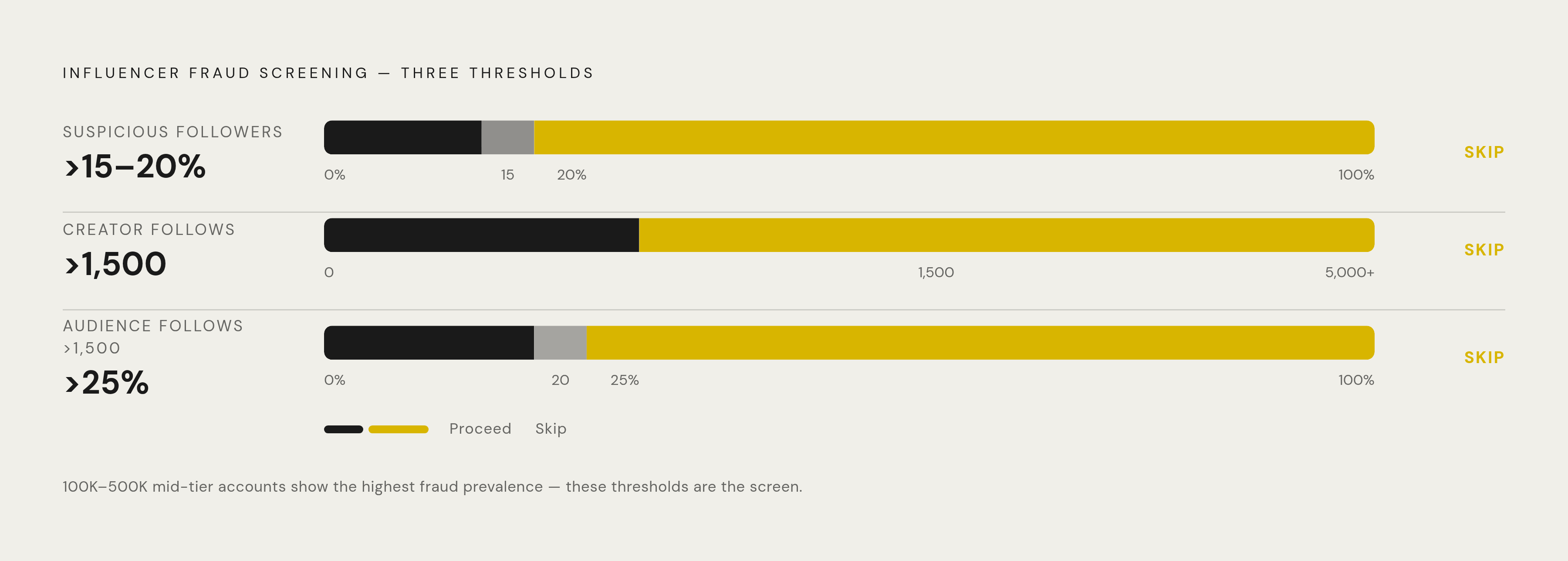
A quarter of influencers buy counterfeit followers specifically to look more influential than they are https://www.talentresources.com/post/influencer-marketing-mistakes-2026. The inflation is often deliberate, not incidental. There are concrete tells for this: specific numbers to check rather than gut feeling. If more than 15 to 20% of a creator's audience looks like suspicious accounts, that's a skip https://iqfluence.io/public/blog/influencer-marketing-mistakes. If a creator's own account follows more than 1,500 people, sponsored content has a good chance of not reaching that creator's full audience, because the platform's own distribution logic starts working against them https://iqfluence.io/public/blog/influencer-marketing-mistakes. If over 25% of a creator's followers themselves follow more than 1,500 accounts, that's another skip signal, and the inverse holds too: when fewer than 20% of the audience follows that many accounts, it's a decent sign the content is actually landing in people's feeds https://iqfluence.io/public/blog/influencer-marketing-mistakes.
Now add the newer wrinkle. AI-generated fake creator profiles are appearing in the pipeline now as a live category brands need to screen for. Identity checks and content-quality checks used to be a nice-to-have for cautious teams. They're now closer to a baseline requirement, the same way checking a vendor's business license stopped being optional a long time ago. The counterintuitive finding from Kolsquare is that creators with 100K–500K followers are most likely to have fake followers, the mid-tier, not just the fringe
Vague briefs and their output
Here's the mechanic that explains a lot of "off-brand" content that brands then blame on the creator. If a creator doesn't know the brand's voice, the key messaging, the content objective, or the product's actual selling point, they don't produce a blank page. They produce their own established style, whatever's worked for them before, because that's the only reference point they've been given. Sometimes that's fine. Often it's completely off-brand, and nobody involved did anything "wrong" exactly. The brief just never told them what "right" looked like.
IQfluence's Chief Product Officer said that without a clear brief, the influencer doesn't really know what a brand expects of them. Messaging drifts, deadlines slip, or a creator delivers fewer assets than promised, and the brand ends up paying for exposure that never had a chance to convert, because the rules were never spelled out in the first place.
The downstream cost appears in a few predictable places: generic content that needs extra rounds of revision, timelines that stretch because nobody agreed on the deliverable up front, and legal exposure on usage rights or disclosure if those terms were never written down anywhere a court or a platform could point to.
A brief that actually does its job tends to cover the same ground each time. It spells out tone of voice along with explicit brand do's and don'ts, going beyond a mood board. It states the key messaging and the product's actual USPs, avoiding a vague "make it feel authentic." It names specific deliverables, down to format, two Reels and one Story set rather than "some content". It sets KPIs that tie the creator to a business outcome, a target ROAS, say, rather than judging success on how nice the footage looks. And it settles usage rights, approval steps, and what happens if something goes sideways, ideally with annotated visual examples of content that worked and content that didn't, so nobody's guessing at "brand fit" from a one-line email.
Measuring the wrong things and missing what the campaign did
Likes are easy to report and hard to defend. That's the trap.
Without attribution that actually connects a post to a sale, influencer spend turns into a guessing game, and guessing games don't survive budget season. Growth teams ask for clear numbers, and when a program can't produce them, the program gets cut, whether or not the creative was good.
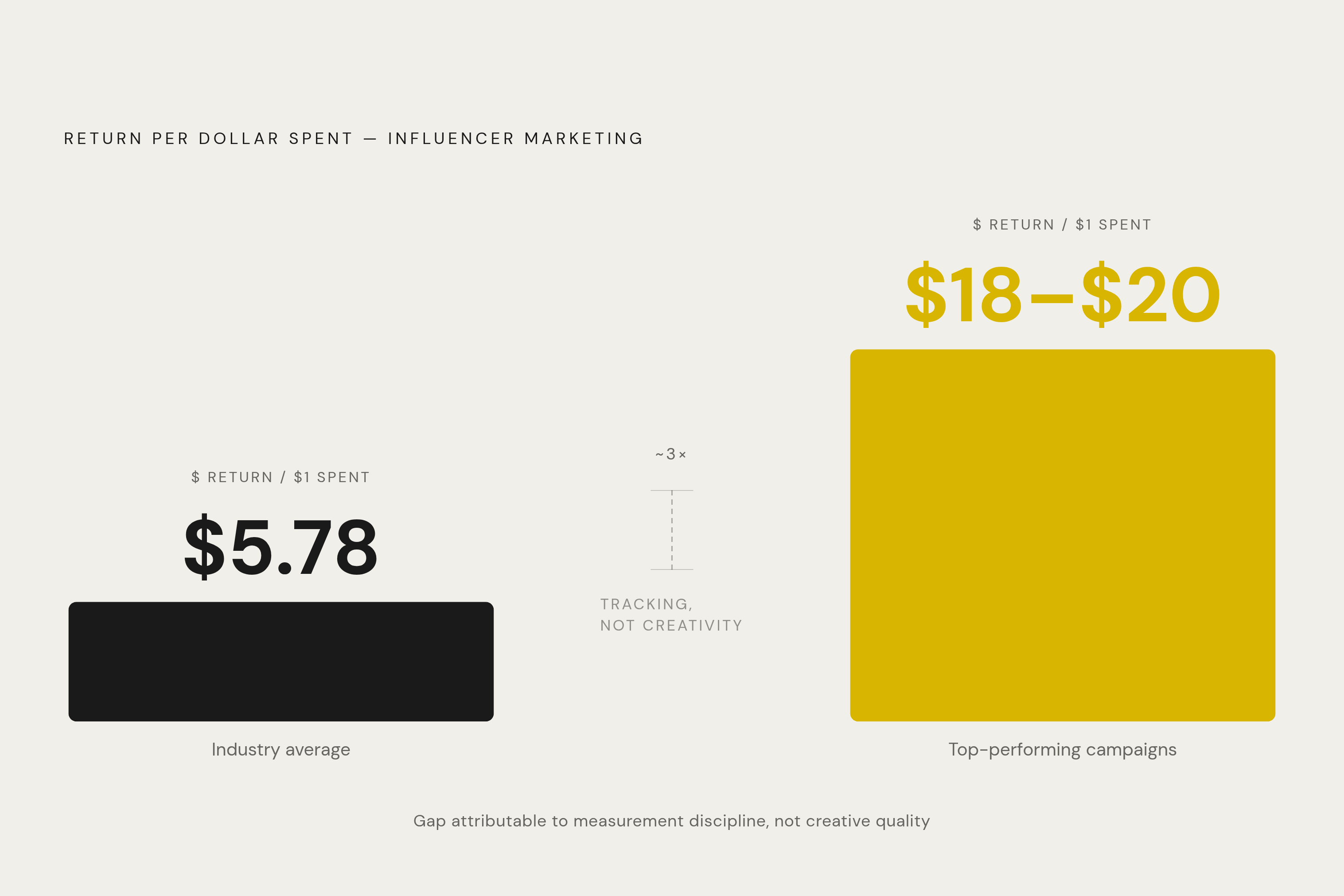
The size of the gap is the clearest evidence that this is a measurement problem rather than a creative one. The average return across influencer marketing is around $5.78 for every dollar spent, while the top-performing campaigns pull $18 to $20 per dollar, a spread too wide to blame on creative quality alone https://www.zutsumedia.com/post/common-influencer-marketing-mistakes-brands-make. That's not a small spread. If the creative quality across an industry varied that wildly, the whole channel would be shut down as unreliable. It doesn't vary that much. What varies is whether anyone's tracking the right things and adjusting mid-flight.
A four-category framework closes most of that gap. Awareness metrics: reach, impressions, video completion rate, the top-of-funnel numbers that still matter, just not alone. Engagement metrics that go past the passive like: saves, shares, comment quality, the signals that show someone actually cared enough to act. Conversion metrics: CPA, ROAS, conversion rate. And retention metrics: customer lifetime value, repeat purchase rate, the ones that prove the campaign built something that outlasted the post itself.
Why one-off activations structurally can't compound
A single post doesn't give an audience time to build familiarity, and familiarity is what turns a stranger's recommendation into something a person actually trusts. Repeated exposure compounds recognition and purchase intent in a way one post, however well-produced, structurally cannot replicate. That's not a creative failing. It's math: trust builds across repetitions, and a one-off gives you exactly one.
The industry seems to be catching up to this. 54% of brands say they plan to invest more in long-term collaborations during 2026, a shift toward continuity over campaigns, toward relationships over transactions https://www.kolsquare.com/en/blog/want-to-know-why-influencer-campaigns-fail-heres-the-fix. And close to 72% of brands running influencer programs expect to grow their influencer budgets over the same period https://www.kolsquare.com/en/blog/want-to-know-why-influencer-campaigns-fail-heres-the-fix.
That second number should give any brand running one-off activations some pause. Scale is coming to this channel regardless. But scale without a system that repeats and improves doesn't fix the four failure modes already covered (creator selection, briefing, measurement, and program structure), it just funds them at a bigger size. More budget poured into follower-count selection, vague briefs, and vanity metrics produces more failed campaigns, not fewer.
One-off campaigns fail for structural reasons that don't show up until you look for them. There's no time inside a single activation to figure out which creative elements actually drove performance, so nothing learned transfers to whatever comes next. Creator relationships never deepen past a single transaction. Content quality and brand fluency never improve either, because nobody's had two tries at getting it right. And distribution algorithms tend to reward consistency: one post, on most platforms, gives the system nothing to build momentum on.
The operational weight that falls on brand teams when there's no system
Running a creator program at any real volume is a genuine operational job, a full role rather than a side project bolted onto someone's existing role. It means sourcing creators and vetting their audience quality before anything gets signed. It means writing briefs, running approval cycles, managing revisions when the first draft misses. It means contracts: usage rights, disclosure compliance, timelines that hold up if something goes wrong. It means processing payments, often tied to performance, which is its own tracking problem. It means reviewing content, setting up whitelisting permissions, configuring paid amplification behind the organic post. And it means tracking KPIs, building attribution models, and reporting all of it up to leadership in language that survives a budget meeting.
That's a lot of surface area for one team, and it scales badly. A brand running a meaningful roster of creator partnerships hits a point where vetting alone exceeds what the team can actually do by hand, checking follower authenticity, engagement ratios, and account-following patterns for each one.
The operational misses tend to compound the four failure modes rather than sit apart from them. Whitelisting left out of the initial brief means renegotiating permissions after content is already published, a fight nobody needs to have twice. Missing contracts leave a brand exposed on rights, timelines, and disclosure exactly when it matters most. And ad hoc payment processes create friction with creators, which quietly kills the odds of a long-term partnership before it starts, precisely the kind of relationship the industry's now moving toward.