Setting UGC Program Goals for a Brand's First 90 Days
Establish infrastructure and pick a single goal before measuring results three months in.

Ninety days into a UGC program, most brands do one of two things: they cancel it, or they double the budget on a hunch. Both reactions come from the same mistake. They're measuring month-one output against month-three expectations, and the math never works out, because those two months aren't supposed to look alike.
Why the first 90 days of a UGC program almost always disappoint
A pattern kills more UGC programs than bad creative ever does: a brand launches in week one, checks conversion numbers in week four, sees nothing dramatic, and pulls the plug. But what if the program was never supposed to show conversion lift in week four? What if that's simply not the job month one was doing?
UGC is a compounding channel. Early assets aren't there to perform, they're there to teach you something: which hook stops the scroll, which creator sounds like an actual person and not a script, which format gets someone to tap "shop now." Skip that learning phase, and you skip the compounding that makes month three worth anything. A brand that cancels in week six because reach looked flat is just quitting the research phase before the results show up. It's just quitting the research phase before the results show up.
That raises an important question: why do so many brands still confuse a 90-day build with a 90-day campaign? Probably because campaigns are the mental model most marketing teams already have. A campaign has a launch, a flight, a wrap report. A program doesn't work that way. One runs for a quarter and ends. The other runs indefinitely and gets better every month it's alive, assuming someone's paying attention to what the first batch of content is trying to tell them.
What a brand builds in the first 90 days
Most UGC programs are at Stage 2: campaign-driven. Budget gets tied to specific launches, reporting gets built after the fact (if at all), and there's no standing roster of creators to call on. It works, sort of, the same way running a business out of a spreadsheet works, right up until it doesn't.
Stage 3 looks different. There's a dedicated owner, a standing budget instead of a one-off spend, a vetted roster of creators instead of a scramble every time a campaign needs content, and conversion tracking that's built in from the start rather than reverse-engineered afterward. The honest goal for the first 90 days is getting from Stage 2 to Stage 3, full stop. It's a program still building toward a fully tuned paid creative engine. It's getting from Stage 2 to Stage 3, full stop. Everything else, the viral hit, the paid engine that beats studio content on cost per acquisition, becomes possible only once that infrastructure exists.
One decision shapes almost everything downstream, and it has to happen in week one: pick a single goal for the first 90 days, conversion or awareness, not both.
Conversion-first programs run on-site and on product pages. They need volume, because conversion testing needs enough assets to compare, and they need rights coverage locked down before a single video goes live on a product page. Awareness-first programs live on paid social and organic reach instead. They need creators with real resonance, not just competent ones, and formats built native to whatever platform they're running on.
Programs that try to chase both goals from week one tend to underperform single-goal programs by roughly 2x on whichever metric they were supposedly optimizing for. That's not a small gap. Split focus doesn't average two good outcomes together, it drags both down.
Month one goals: infrastructure, baseline, and the operational decisions that cannot be skipped
Month one is about the decisions and systems everything downstream gets measured against. It's about the decisions and systems everything downstream gets measured against, and skipping any of them means month three's numbers won't mean anything.
The checklist looks something like this:
- One goal confirmed (conversion or awareness) with a written reason attached, not just a gut call
- One content type selected to start with, resisting the urge to layer multiple formats before there's any data
- A rights and usage framework locked in before content collection even begins, since paid and gifted posts need FTC-compliant disclosure and usage windows (often 30 to 90 days, longer if paid social reuse is part of the plan)
- Distribution surfaces mapped out ahead of time: which pieces go to product pages, which to email, which to paid social or the homepage
- A measurement baseline recorded before any UGC goes live. Without knowing what conversion looked like beforehand, there's no way to credit month three's lift to anything
Creator sourcing happens in parallel. Start with a small initial group of creators, no more than a handful. That's enough to test formats and messaging without turning brief management into a full-time job before the pipeline even works.
What matters when picking those first few creators has less to do with follower count than most brands assume. Brief compliance, responsiveness, a consistent work ethic, and the ability to sound natural on camera determine campaign outcomes more than reach does. Hard disqualifiers to screen for before any contract gets signed include FTC disclosure violations in past work, hate speech buried in archived content, active competitor sponsorships, or a documented history of not delivering on contract terms.
Three channels tend to produce usable creators: creator platforms (the fastest route from brief to delivered asset), social discovery through product and competitor hashtags, and existing customers, who are probably the most underused source of all three.
Structured programs, with clear deliverables and deadlines, tend to see post rates in the 80 to 90% range. No-strings gifting, where a brand just ships product and hopes, tends to run around 30 to 40%. That gap alone justifies the extra setup work in month one.
Success at the end of month one doesn't look like impressive content. It looks like a functioning pipeline: contracts signed, rights language finalized, first assets sitting in review, and baseline numbers on record.
Month two goals: creative iteration and reading the signal the first assets produce
Month two is about reading signal, not making more content for its own sake. Which hooks actually stop someone mid-scroll? Which formats convert better than others? Which of the initial 3 to 5 creators stay on-brief and hit deadlines without a chase-down email?
Iteration is the mechanism here, and it needs to be deliberate, not just "post more and see." Test these three variables on purpose:
Hook variations matter because the first 3 seconds decide whether anyone watches the rest. The same core message, tested with different openings, tells a brand more in two weeks than a month of identical hooks ever would.
Format variations matter too. An unboxing video does a different job than a review-style clip, which does a different job than a routine-integration video or a before-and-after. Each one is at a different point on the path to purchase, and lumping them together in reporting hides what's actually working.
Creator variations round it out. Within the initial creator roster, some voices will land with the target audience and some won't, and there's no way to know which until the content's actually out.
Short-form video is the main testing surface heading into 2026. Clips running 10 to 45 seconds on TikTok, Reels, and YouTube Shorts lead both discovery and conversion right now, which makes them the natural place to run these tests first.
Repurposing multiplies the value of every asset without multiplying the cost. A single creator video can be cut down into shorter platform clips, trimmed for a product page, and repurposed for an email send, multiple touchpoints from one shoot, and it's how signal gets gathered across surfaces without production costs climbing in step.
Month three goals: performance optimization and building repeatability into the program
Month three is the first point where asking about conversion attribution is actually fair. There's a baseline on record, there's tested creative signal from month two, and there's finally enough volume to run comparisons that mean something.
Holdout testing is the framework that makes this credible: page-level A/B comparison, not impressions, not reach. On product pages, the number worth watching is conversion lift among shoppers who interact with UGC versus those who don't. Shoppers who click into UGC convert at rates well above the site average, and that gap is the real benchmark for whether month three delivered. On paid social, the question shifts slightly: which creative variants are beating studio-produced ads on cost per acquisition and click-through rate?
Whitelisting is the lever that turns month three from a reporting exercise into a growth mechanism. Top-performing organic creator content gets converted into paid media, which is how UGC ends up doing double duty, building awareness and driving conversion at the same time, off the same asset.
Micro-influencer content tends to be the efficient end of that trade. Industry data puts engagement per dollar spent on micro-influencer creative at 3 to 4 times higher than that of macro influencers. And the average cost of a UGC asset is around $198, down 44% from the year before, which makes paid amplification of the winners a genuinely cheap bet relative to what studio production costs.
The real test of whether a program has actually matured is repeatability. It's repeatability: can the brand take a format that worked, hand it to a different creator, run it on a different platform, apply it to a different product, and get a similar result? If the answer's yes, that's Stage 3. If every win feels like a one-off, the program's still stuck in Stage 2, no matter how good the month-three numbers look in isolation.
The KPIs that belong to each phase
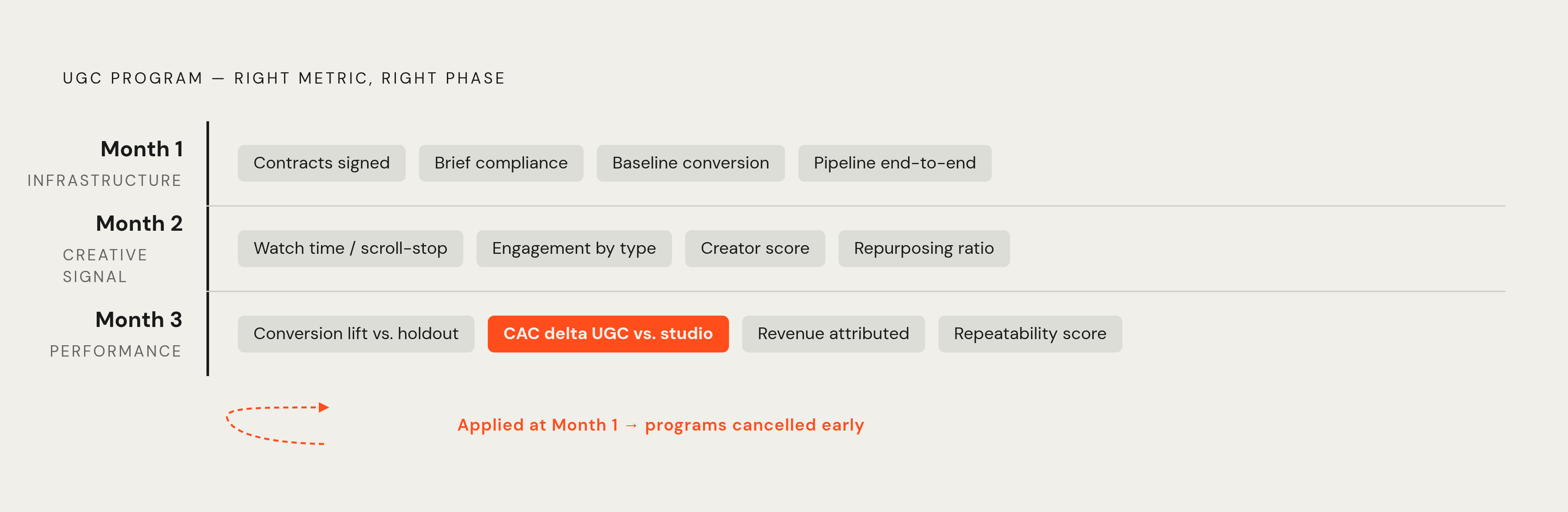
A KPI only means something in the phase it was built for. Pulling a month-three metric into a month-one review is probably the single most common reason good programs get killed early, since it's the wrong ruler for what's being built at that stage.
Month one's KPIs are about infrastructure: creator contracts signed and rights language confirmed, first assets delivered on-brief and on-time (brief compliance rate), baseline conversion recorded on the target surface before any UGC appears, and a pipeline that actually runs end to end, from sourcing through brief, delivery, rights, and distribution.
Month two shifts to creative signal: average watch time and scroll-stop rate by format, engagement broken out by content type (saves, shares, click-throughs), a creator performance score tracking on-brief rate and revision rounds and delivery speed, and a repurposing ratio measuring how many derivative assets came out of each original piece.
Month three, finally, is where performance KPIs belong: conversion lift on product pages against a holdout group, the CAC delta between UGC-driven paid campaigns and studio-produced ones, revenue attributed to UGC-driven sessions, and a repeatability score tracking how many top formats got successfully replicated with a second creator or on a second platform.
Apply month three's CAC delta to a program that's three weeks old, and the numbers will look terrible, because there's no volume yet to make the comparison fair.
The operational load that brands consistently underestimate
The whole 90-day framework assumes somebody owns it day to day. The most common silent failure isn't a bad strategy, it's a good strategy with nobody actually running it.
The workload adds up fast once it's laid out. Creator sourcing and vetting alone got heavier: the number of UGC creators available jumped 93% between 2024 and 2025, which sounds like good news until you realize more options also means more fake portfolios, more inflated engagement numbers, and more noise to filter through before finding the 3 to 5 worth working with.
On top of that, there's brief management, revision rounds, and content approvals running continuously. Rights collection and usage tracking need constant upkeep too, and manual processes for that tend to break down as the creator roster grows, well before month three even wraps. Add individual creator payments (at roughly $198 per asset, even a modest batch of 10 to 20 pieces means dozens of separate payments to track), plus ongoing performance tracking and documentation of what's being learned from each round of iteration.
The first five creators take a few hours to manage. The next forty-five take over your life. That's not an argument against scaling, it's an argument for building the operational capacity to handle scale before actually doing it.
Three structural options exist for carrying that load. An in-house dedicated owner works, provided the headcount is actually there to support it. Creator platform tools can automate a good chunk of matchmaking, contracts, and payments, handling brief-to-delivery without a person touching every step. Or a managed agency program can absorb the entire operational stack, letting the brand's own team stay focused on the business instead of chasing down revision rounds and rights paperwork. None of the three is universally right. Which one fits depends on how much the brand wants UGC to become a durable channel versus a project that runs for a quarter and then quietly disappears.