TikTok Spark Ads Setup Using UGC Creator Posts
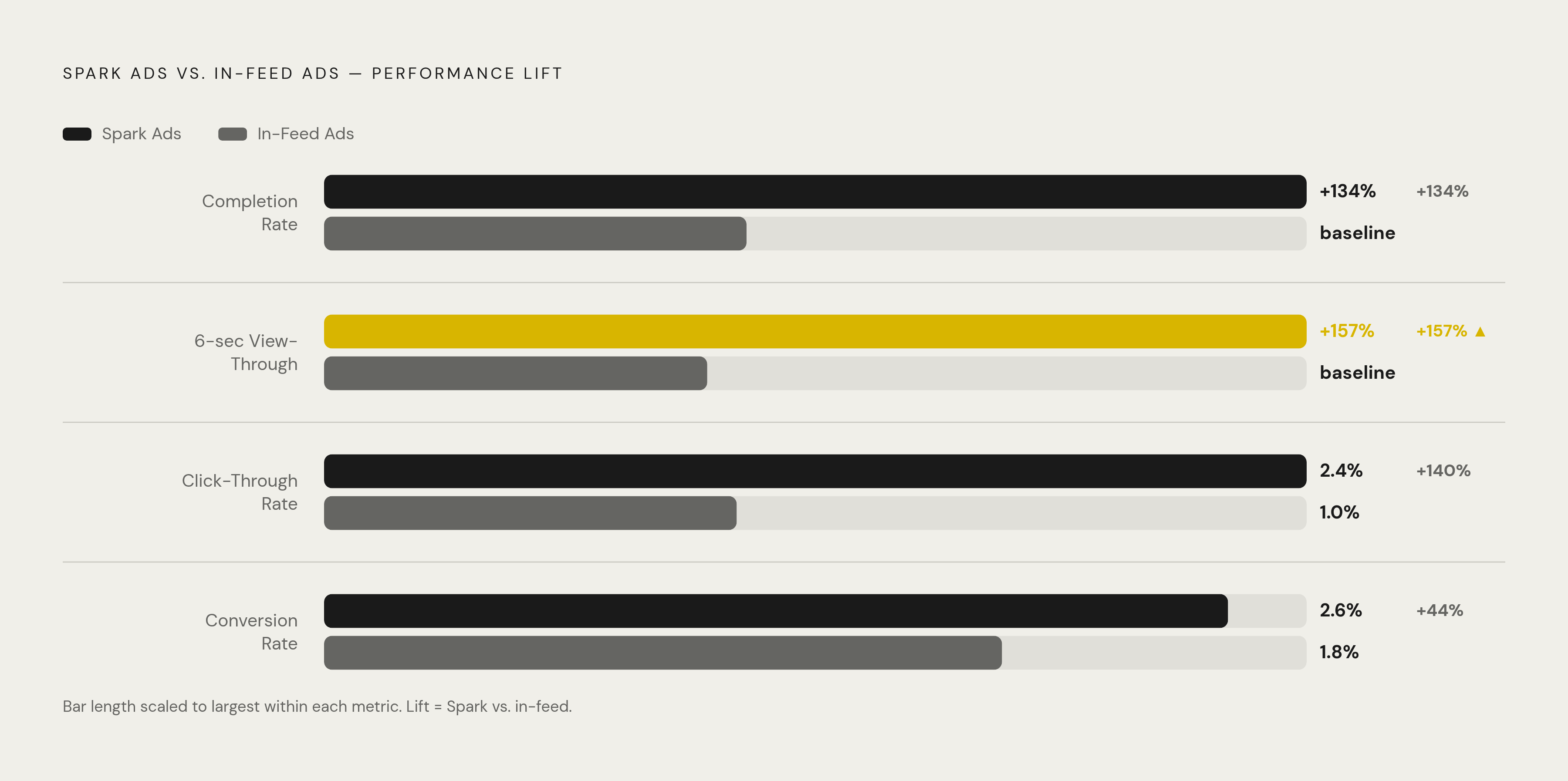
Spark Ads boost completion rates 134% by amplifying existing creator posts with paid reach.

Spark Ads take an existing organic TikTok post and put ad spend behind it, without touching the original handle, comments, likes, shares, or follower count. That distinction sounds small, but it changes almost every decision in the setup, from which post gets picked to how the authorization code gets negotiated. The rest of this piece walks through that setup, step by step, with the reasoning behind each call.
Start with the basic mechanics. A standard in-feed ad is a new creative asset with no history attached to it: social proof resets every time you launch one. A Spark Ad works differently. It inherits the post's caption, its comment thread, its like count, all of it. Profile clicks send viewers to the creator's TikTok page, which keeps the whole thing feeling native instead of promotional.
That inherited history is not just a nice side effect. TikTok for Business's Spark Ads 101 reports that Spark Ads post a 134% higher completion rate and a 157% higher 6-second view-through rate compared to standard in-feed ads. When TikTok updated the profile landing-page UI, conversion rate rose 69% and CPA dropped 37% against the prior version. Digital Applied's Q1 2026 composite data tells a similar story from a different angle: Spark CTR at 2.4% against 1.0% for in-feed, and CVR at 2.6% against 1.8%. Spark does cost more per click, $1.41 versus $1.02, so the case for it rests on conversion quality, not on being the cheaper option.
Why does this matter now, specifically? TikTok's monthly active user base is 2.04 billion, and per the platform's 2025 trend report, two out of three users say they like it when brands work with a range of different creators. That's the audience telling the platform, in effect, what kind of ad it will tolerate. Because Spark Ads compound rather than reset, every setup decision, which post to spark, whose account it lives on, how long the authorization runs, carries more weight than it would in a standard campaign. That's the thread the rest of this guide follows.
Why UGC Creator Posts Are the Strongest Raw Material for Spark Ads
Viewers read brand content as an ad. They read creator content as a recommendation from someone like them. That gap is the whole reason UGC works: UGC generates several times more engagement than brand-made content, and per Flowbox, 79% of consumers say UGC significantly shapes their purchasing decisions.
TikTok users scroll past anything that smells like a commercial, almost on reflex. UGC gets past that filter because it looks and sounds like every other organic post in the feed. Nothing about the lighting, the pacing, or the delivery tips the viewer off that money is behind it.
The platform's own algorithm reinforces this. It rewards watch time and engagement, and UGC tends to hold attention longer because it feels worth watching in the first place, not because it's telling you to buy something. When that UGC becomes a Spark Ad, it doesn't just carry the creative style forward. It carries the comment thread too, and a thread full of real reactions does more convincing than any line of ad copy could.
Consider a UGC post that has already accumulated substantial likes before it ever becomes a Spark Ad. A viewer sees that count before reading a single word of the caption, and the number alone does some of the persuading. That's the flywheel: engagement built organically becomes credibility once the post goes into paid rotation.
The economics work in UGC's favor too. The average creator charges around $198 per video, and finding one winning ad typically takes somewhere between 5 and 15 attempts. Running that same volume through a studio shoot makes the budget fall apart fast. Influee reports that 85% of marketers say visual UGC is more affordable than professional photography, a figure that functions less as a supporting stat and more as the whole argument for treating UGC as the primary creative input, not a backup plan.
Brands getting the best results have stopped treating UGC as a one-time content drop and started building a continuous pipeline instead. A single campaign creates a spike. A system creates something that compounds. Spark Ads are the distribution layer for that system, and getting there starts with how creators get chosen.
Selecting creators whose posts are worth sparking
Follower count and trust don't move in the same direction, oddly enough. Nano creators, the 1,000 to 10,000 follower range, often clear 8% engagement rates and get treated by their communities more like a friend giving advice than an influencer running a promotion. They also make up 87.68% of all creators on TikTok and generate roughly 7 times more engagement than macro accounts.
Micro creators, 10,000 to 100,000 followers, deliver around 60% higher engagement rates than accounts over a million followers, at close to a tenth of the cost per post. Influencer Marketing Hub puts micro-influencer engagement at 3.8% on average, against 1.2% for mega-influencers. On TikTok specifically, follower count doesn't even predict reach reliably: a creator with 5,000 followers can trip the algorithm and rack up millions of views, while a creator with a million followers posts something that quietly flops.
Finding the right creators takes more than scrolling hashtags. Here are a few tools worth knowing.
- TikTok Creator Marketplace, which draws on first-party platform data, generally more reliable here than third-party estimates from outside tools
- Heepsy, an influencer database with authenticity scoring, though it skips creators under 3,000 followers, which limits its use for nano-influencer sourcing
- Upfluence, useful for cross-referencing e-commerce data to find customers who are also creators
- Syncly Social, a 2026 tool that scans video and audio tracks directly, surfacing untagged brand mentions that keyword search would miss entirely
- A brand's own customer list, cross-referenced against social accounts. Customers who already use the product and carry a small following tend to make the most credible nano partners, because the relationship with the product is real before the partnership even starts
Vetting matters as much as discovery. A practical scorecard weighs conversion history, audience authenticity, content-category fit, and engagement quality, with the relative emphasis adjustable depending on the campaign goal. Completion rate deserves special attention on TikTok, since the algorithm rewards videos people watch to the end more than videos people merely start.
Fraud checks aren't optional at this stage either. Tools like HypeAuditor or Social Blade flag accounts with suspicious engagement patterns, and with fake accounts circulating across social platforms, skipping this step puts budget at risk before a single dollar gets spent. One viral video also doesn't prove reliability. Look for a pattern across multiple posts that repeats.
Long-term partnerships tend to beat one-off deals on every axis that matters: authenticity, cost efficiency, sustained brand presence. 63% of creators say they prefer ongoing arrangements, and a meaningful share of marketers have already shifted toward always-on programs rather than one-time bookings. Creators who stay selective about how many brands they promote each month also tend to post stronger engagement on sponsored content, likely because their audience hasn't been trained to tune out the sponsorships. A creator already producing strong organic UGC is, in effect, a Spark Ads asset sitting there waiting to be activated, which sets up the next question: how do you brief them to keep producing content that scales?
Briefing creators to produce content that can scale as a Spark Ad
The brief is the single most important document in this entire process, more important than the platform settings that come later. A strong one covers the target audience, the key product benefits, the specific pain points the product solves, and examples of past videos that performed well. A vague brief produces vague content, and vague content fails once real ad spend gets behind it.
Format matters as much as message. Handheld footage, natural lighting, no heavy post-production: the video needs to look like it belongs in the feed, because that resemblance is the entire authenticity advantage Spark Ads run on. Vertical video at 9:16, at a minimum resolution suitable for feed display (with a higher resolution recommended), in MP4 or MOV. For posts already published organically and later selected for sparking, TikTok gives some flexibility on ratio and resolution, as long as runtime stays under 10 minutes. New in-feed UGC generally runs 5 to 60 seconds.
A handful of content types tend to convert reliably in a Spark context:
- Review and testimonial videos, which answer buyer hesitation directly and often collect comment threads that become social proof in their own right
- Founder or brand explanation videos, useful for education around a new product or launch
- Before-and-after or demonstration content, which shows the product working rather than just claiming it does
- Objection-handling videos, aimed at the specific questions buyers ask right before they decide to purchase
- Offer content, which pairs an already-credible organic post with a time-limited incentive
One winning ad usually takes testing somewhere between 5 and 15 videos, so the brief needs to be a repeatable template usable across creators. Build a template that multiple creators can work from at once, so testing volume doesn't bottleneck on writing new briefs every week.
A creator who makes something authentic-looking differs from a creator who understands direct-response mechanics. The second one builds toward a specific action: a strong hook in the opening seconds, a clear call to action, pacing that keeps someone watching to the end. Brief for that specifically, not just for product storytelling. And let the content publish organically first. Paid budget comes after, once the post has already told you something about how real viewers respond to it.
Reading organic signals to decide which posts deserve paid budget
Not every post earns paid spend. Organic performance functions as a vote the audience casts before a single ad dollar goes out the door.
A handful of signals predict how a post will do once it's sparked. A high save rate means viewers found the content worth returning to, which tracks closely with purchase intent. Watch time and completion rate matter too, since the algorithm already rewarded that post for holding attention, and a Spark Ad inherits that momentum rather than starting from zero. Comment quality is its own signal: comments asking "where do I get this?" or "does this work for curly hair?" show the post is already doing conversion work without any paid push behind it. Profile clicks round it out. Someone clicking through to a creator's profile has decided the content built enough trust to warrant a closer look.
Give a post a few days to breathe before judging it. Early metrics, especially in the first hours, tend to be noisier and less predictive than the metrics visible after the post settles into its natural reach.
One workable sequence: test hooks first through standard in-feed ads, since uploading a new file is faster than managing authorization codes back and forth with a creator. Once a hook proves itself in-feed, moving it over to a Spark Ad on the creator's own handle tends to improve the economics again, on top of whatever the in-feed test already showed.
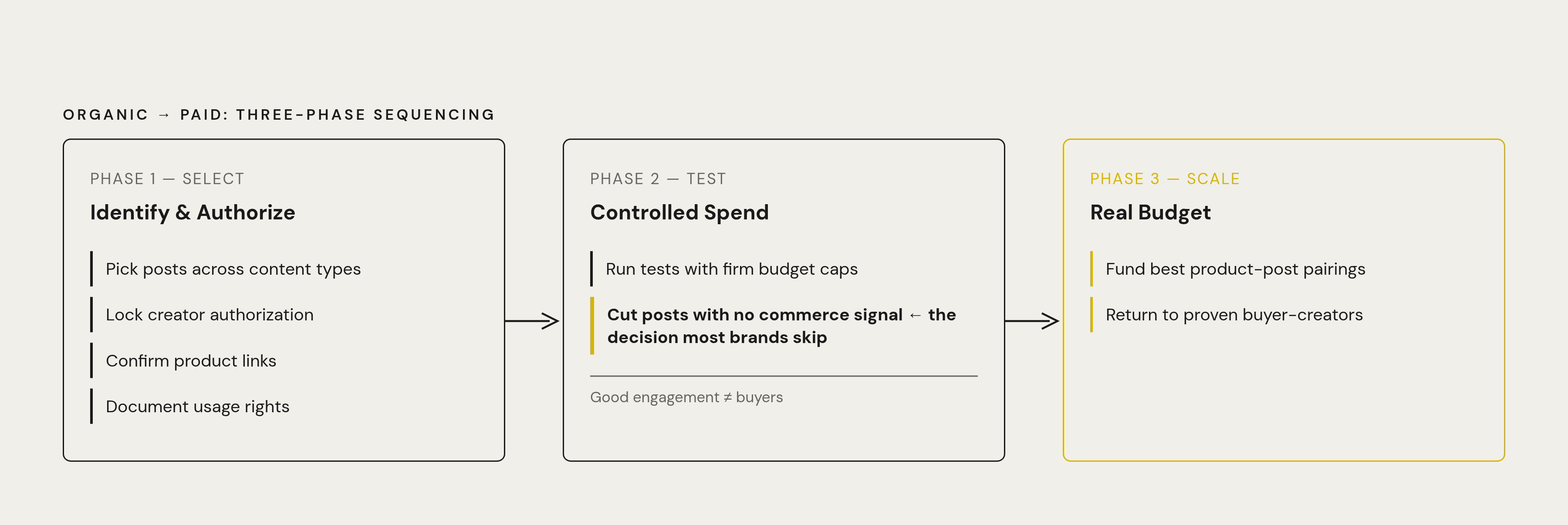
A 14-day sequencing model from Eva's TikTok Shop seller guide (July 2026) lays this out concretely. In the early phase, select a set of organic posts spanning different content types. Next, lock down authorization, confirm product links, and document usage rights in writing. In the middle phase, run a controlled test with firm budget caps and reporting broken out by product. Then cut posts showing weak commerce signal, even the ones with engagement numbers that look good on the surface. In the final phase, put real budget behind the best product-post pairings, and go back to the creators whose content generated actual buyers to ask for more.
Views alone don't mean much without the rest of the picture. A post with high views but no saves, no comments, no profile clicks is entertainment, and sparking it wastes budget on a signal that was never there. Spark the posts where the audience has already started doing the buyer's work.
Securing creator authorization codes: the technical steps and the contract terms that protect them
Three paths lead to authorized creative. Brand-owned posts connect directly through the brand's TikTok account into Ads Manager or Business Center, no code required. Creator posts need an authorization code: the creator turns on ad authorization for that specific video inside the TikTok app, generates a code, picks a duration, and sends it over. The brand then pastes that code into Ads Manager when building the campaign. A third path, Business Center identity linking, suits deeper ongoing integrations rather than a single sparked post.
Put the creator-side steps directly into the brief or onboarding doc, since most creators haven't done this before.
- Open the TikTok app and go to the specific video
- Tap the three dots on the video
- Tap the Ad settings icon
- Tap Generate to pull up the post authorization code
- Choose the authorization duration and send the code over
Duration is where most brands trip up. Codes are tied to a specific video, and durations run anywhere from 7 to 365 days. The single most common Spark Ads failure happens when a top-performing ad is scaling nicely, the short-duration code quietly expires mid-flight, and the creator isn't reachable to renew it fast enough. The campaign goes dark for reasons that have nothing to do with performance.
Default to requesting the longest available authorization duration, and put renewal terms into the creator contract up front, not as a scramble over DM once the code is about to lapse. Authorization duration belongs in the written agreement as a campaign continuity term, the same way payment terms or usage rights would be. For creators in ongoing partnerships, push toward the 365-day ceiling and build renewal into the regular relationship cadence rather than treating it as a one-time task.
Run a few checks before flipping the Spark Ad live. Confirm TikTok hasn't removed or restricted the original post, since a banned post can't be sparked no matter how good the authorization code is. Check that the caption and display name are final: both pull straight from the organic post and can't be edited once the ad is running. If the campaign runs through Video Shopping Ads or TikTok Shop, confirm the product links are attached correctly. Pull the Spark Ad authorization before deleting the original video from the creator's account, since deleting it while the ad is live breaks the campaign. At the account level, one TikTok Ads Manager account can hold up to 10,000 Spark Ads, which isn't a real ceiling for most brands but matters for anyone running UGC at real volume.
Building the campaign in TikTok Ads Manager: objectives, structure, and targeting decisions
Spark Ads support several auction objectives inside Ads Manager: Reach, Traffic, Video Views, Community Interaction, and App promotion. Each one pulls the algorithm toward a different outcome, so the choice should track back to what the sparked post is actually meant to do, not default to whichever objective sits at the top of the list.
A post built around a review or testimonial, one already carrying purchase-intent comments from its organic run, points toward objectives tied to traffic or conversions rather than pure reach. A founder explanation video introducing something new might do more work under Video Views or Community Interaction, where the goal is exposure and engagement rather than an immediate click. Matching objective to post type keeps the campaign structure honest to what the organic signals already showed.
From there, the rest of the build, ad group structure, audience targeting, budget allocation, follows the same logic threaded through this whole piece: the sparked post already earned its credibility organically. The setup's job is to protect that credibility while putting real reach behind it, rather than burying it under a generic campaign structure built for a cold creative asset that never had an audience vote behind it.