How to Split a Small UGC Budget Across Creators, Ads, and Tools
Allocate small UGC budgets across creator fees, paid ads, and testing tools as an integrated system.

Most small brands put their entire UGC budget into creator fees, then wait for a single strong video to turn into repeatable growth. It rarely does. The budget fails because it was never really a UGC budget at all. It was a content purchase, missing two of the three legs a performance system needs.
Why a UGC budget fails when it isn't treated as three interdependent buckets
A UGC program that works has three moving parts: creator content, paid amplification, and tooling. Creator content gives you assets to test. Tooling tells you which assets won. Paid amplification scales the winners, and the data from paid spend briefs the next creative. That loop restarts, and it compounds.
Skip any one leg and the whole thing collapses. Without tooling, you're guessing which asset deserves ad spend. Without paid spend, a proven winner dies in obscurity. Without creator content, nothing enters the system at all. The brands that treat UGC as a one-time content buy never see the compounding effect. They fund one leg and wonder why it wobbles.
That's the core mistake worth naming clearly: UGC isn't a line item, it's a system. It needs creative output, creator supply, paid distribution, and iteration loops that build on each other over time. The next section lays out what funding that system actually looks like.
The three-bucket framework and how to size each one relative to your stage
The three buckets are creator content, paid amplification, and tooling. All three must be funded at every stage. What shifts is the proportion.
Early-stage brands should weight toward creator content. Before you commit serious money to paid distribution, you need a tested creative library. Tooling can be minimal at this stage, but it cannot be zero. You still need some way to tell which assets are working. As a brand scales, paid media becomes the largest share of the budget. The mix shifts, but the three buckets don't go away.
There's a sequencing rule that matters more than any percentage split. If the budget forces a choice, invest in testing-ready creative first. A single UGC asset that proves a hook is worth more than a large paid budget behind creative nobody has validated. Paying to amplify an unproven asset is just paying to learn the wrong lesson faster.
A brand new to UGC should start with a small creator roster to generate assets, run minimal paid tests to identify winners, and only then expand all three buckets proportionally. Pouring budget into paid before the creative is validated inverts the order. The framework is simple to state and easy to skip under pressure. The three sections that follow get into what each bucket actually costs and how to spend it well.
What creator content actually costs and how to get more volume for less
UGC creator fees swing far more than most brands expect. If you understand what moves the number, a small budget can still buy enough volume to find a winner. Four things drive pricing: experience level, usage rights, content type, and add-ons. Follower count is essentially irrelevant for UGC work because you're paying for the asset, not for distribution. A creator with a modest following who delivers a natural, convincing video is worth more than a big account with polish but no persuasive power.
Usage rights are the cost multiplier most brands overlook. Organic-only use is usually included in the base price. Paid ads then add roughly 30 to 50 percent on top of that base rate. Extended paid usage adds more. Negotiate these terms upfront, not after the content is live. Whitelisting and Spark Ads access also add a meaningful monthly premium. Plan for it in the creator fee bucket rather than absorbing it as a surprise line item later.
Add-ons inflate cost quickly. Hook variations, CTA variations, raw footage access, rush delivery, and script writing all stack up. If a brand needs multiple hooks per concept, that should be priced in from the start. The brands that get more volume for less negotiate bundles. A three- or five-video package usually comes at a discount from individual rates, and creators prefer the guaranteed volume. One-off purchases are the most expensive way to buy UGC.
Volume math is straightforward. At mid-level rates, a modest monthly creator budget buys you enough assets to test multiple hooks per concept. That's the minimum needed to identify a repeatable winner. Testing one asset and hoping it's the one is not a strategy.
Retaining good creators also costs less than finding new ones. A brand that ships product quickly, approves content promptly, and runs repeat campaigns will keep better creators than one paying more but ghosting for weeks. Speed and respect are negotiation leverage.
This is where the volume conversation matters. Brands that run creator content at scale learn fast: iteration velocity matters far more than individual creator fame. The best performing campaigns are often built from mid-tier and entry-level creators working in high rotation. Understanding the pricing levers for bundles, usage rights, and add-ons is what separates a budget that finds winners from one that burns cash on one-offs. Data-driven creator marketing agencies like Pebble structure their campaigns around exactly this logic, treating creator supply as a system to be optimized rather than a series of individual transactions.
How to vet creators so the budget doesn't go to assets that can't perform
The most common creator-selection mistake is optimizing for follower count and production polish. Neither predicts content performance or amplification value. A beautiful video from the wrong creator will underperform a rough one from the right creator every time.
Three things actually predict UGC performance. Camera confidence, meaning natural delivery rather than acting ability. Brief compliance, meaning the creator can follow direction without sounding scripted. And audience match, meaning the creator should look, sound, and feel like the target customer. If those three align, the asset has a chance. If any one is missing, no amount of editing saves it.
Engagement rate offers a useful filter. A rate in the 3 to 6 percent range signals a real, active audience. A very low rate can flag fraudulent inflation or pod activity. But the rate alone isn't enough. Check comment quality. Are people responding with substance, or is it a wall of emoji spam from other creators?
For paid amplification specifically, one criterion matters above all. The creator must be willing to grant whitelisting or Spark Ads access as part of the deal. Confirm this before briefing, not after delivery. A creator who won't grant rights produces an asset that can only live organically, which means it cannot become a paid performance tool.
Pebble's creator selection process applies this logic at scale. The company vets for audience alignment and brief compliance using data, so every creator entering the program is already a viable candidate for paid amplification. That's the structural difference between a curated roster and a gamble. You're not hoping the asset performs under paid distribution. You selected for the traits that make paid performance likely in the first place.
Paid amplification: which assets to boost, on which platform, and what it costs
Paid amplification is where UGC earns its keep as a performance channel. But it only works when applied selectively to validated assets. Using it to rescue underperforming creative is spending money to confirm what the organic run already told you.
The smart sequencing starts organic. Publish UGC through the creator's channel first, let it run for a short window, and pull the performance signals: watch time, comment sentiment, save rate, share rate. Flag only the assets that clear threshold benchmarks for paid amplification. Archive or iterate everything else. The organic run is the audition. Paid is the booking.
Two paid mechanisms matter most. Whitelisting grants you broader rights to run multiple ad variations and dark posts. Partnership Ads, Meta's current required format, run specific approved content with a paid-partnership label. Plan for a flat fee plus a rights premium. Meta's data shows this approach produces a 19 percent lower cost per acquisition than business-as-usual campaigns, though the underlying tests date to 2021-2022.
On TikTok, Spark Ads amplify a specific existing organic post using an authorization code valid for a defined period. The key advantage is that all paid engagement accrues to the original post's public metrics. Social proof compounds as the campaign runs, and each successive viewer arrives at a post that already looks popular. That's a structural advantage, not a marginal one.
Channel logic follows sales channel. If you sell on TikTok Shop, start with affiliate plus Spark Ads. The loop is native, attribution is built in, and cost follows revenue. If you sell on your own site or on Amazon, start with Meta Partnership Ads. Pixel-based attribution is cleaner there, and creative control protects you on product claims.
Rights must be negotiated before content is delivered. Brands that try to whitelist after the fact are negotiating from weakness because the content already exists and the creator holds the leverage. Build whitelisting and Spark Ads access into the contract from the start, priced into the creator fee bucket. This is a budgeting decision as much as a legal one.
At early stage, the paid budget's job is validation, not scale. Spend enough to get statistically meaningful signal on two or three creative concepts. Then concentrate spend on the winner rather than spreading thin across all assets. A small paid budget that concentrates beats a larger one that scatters.
Tooling: the budget bucket most brands cut first and why that breaks everything
Tooling is the connective tissue between creator content and paid performance. Cutting it doesn't save money. It makes the other two buckets less efficient until they become wasteful.
The tooling stack most brands forget spans three layers. Attribution and measurement, which gives you CAC and ROAS visibility across channels. Creative analytics, which tracks hook-rate and angle performance at the asset level. And creator management, which covers discovery, outreach, contracts, and payments. Without all three, the system runs on memory and guesswork.
This layer has a real cost. Once attribution, creator ops, and reporting are combined, tooling commonly runs $500 to $2,000 per month for growth-stage DTC teams. That's a fixed cost, not an optional add-on. Brands that treat it as optional are budgeting for a system missing its own nervous system.
For very tight budgets, some AI UGC tools give you a lower-cost entry point for asset production. But they don't replace the measurement and attribution layer. That still has to be funded separately. An AI-generated asset with no way to measure its performance is just a file on a drive.
The creative analytics layer is what closes the loop. Without hook-rate and angle tracking at the creative level, a brand cannot brief the next creator cohort on what worked. Every new campaign starts from scratch instead of compounding on prior learning. This is the mechanism that makes UGC a channel rather than a series of disconnected experiments. Pebble absorbs this entire tooling and ops layer end-to-end, handling creator sourcing, briefing, contracts, payments, and analytics so brand teams don't build or pay for a separate stack. For a brand whose core team shouldn't be managing creator ops, that's a structural alternative to assembling point solutions.
How the three buckets connect: the measurement loop that turns UGC into a repeatable channel
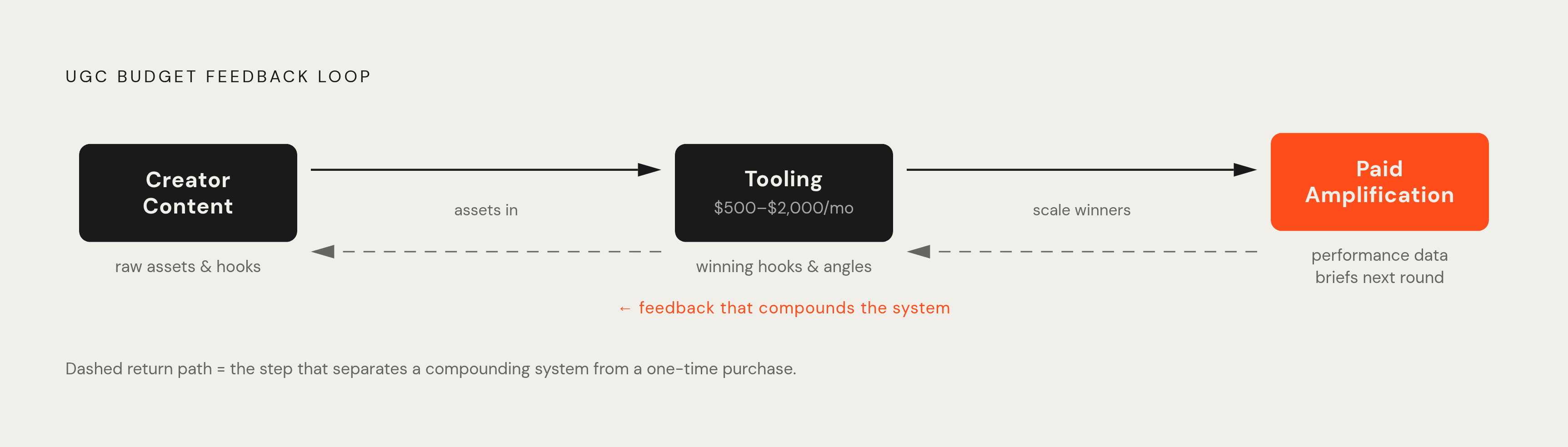
The goal of a UGC budget isn't to produce a viral moment. It's to build a system that can replicate one. Repeatability is what makes UGC a growth channel rather than a lucky campaign.
The loop works in practice. Creator assets enter the system. Tooling identifies which hooks and angles are working. Paid amplification scales the winners. Performance data from paid informs the next creative brief. New creator assets are briefed against proven patterns. Then it repeats.
Measure UGC at the creative level: hook rate, CPA, and ROAS in paid social. Not by reach or engagement on organic posts. Organic engagement is an early signal to filter candidates for amplification, not a success metric in itself. A post that earns likes but converts poorly is not a winner, no matter how good the comments look.
Creative fatigue is a loop problem, not a creative problem. A high-performing UGC asset degrades in efficiency over time. That means the system must continuously feed new assets into the top of the funnel. Creative velocity, the number of tested assets, matters more than creative perfection. A perfect asset that fatigues in three weeks loses to a good enough asset that arrives every two.
The compounding effect is the payoff. Each iteration of the loop produces a better creative brief. That brief produces a higher-performing next cohort of assets. Those assets produce cleaner paid performance data. The system gets more efficient over time rather than resetting after each campaign.
This loop is exactly how data-driven creator marketing agencies structure high-volume campaigns: each bucket enables the next, and skipping any one collapses the system. Pebble's four-step process, Decide, Design, Diligence, Deliberate, is built around this loop. Measurable creative briefs, data-driven creator selection, performance analysis after every cycle, and deliberate iteration into the next brief. Compounding is the outcome, not the exception.
For brands building from zero, the first cycle is the hardest because there's no prior performance data to brief from. Start with a small, diverse creator set across two or three hook directions. Treat the first round as a paid learning exercise. Brief the second round against what the data shows. The sequencing principle here, validating creative before scaling paid spend, mirrors how established creator-led growth programs operate. They test assets across a small creator roster first, measure performance through their analytics layer, and only then expand budget proportionally across all three buckets.
The three-bucket framework isn't a one-time budget exercise. It's an operating model. Fund all three, connect them through measurement, and let each cycle brief the next. That's when UGC stops being a content purchase and becomes a channel.