Usage Rights Pricing for UGC Paid Amplification
Brands should price usage rights separately, not fold them into production fees.

Usage rights pricing for UGC paid amplification follows its own logic, and most brand teams still get it backwards. They treat it as cleanup work after the content already ran: something to sort out once a video takes off, rather than a line item built into the brief from day one. That order of operations is the mistake, and it costs more than the fee itself.
Three years ago, this was simple. A creator made a video, posted it, and the brand reposted it or screenshotted it into a story. Now paid amplification, Spark Ads, Meta whitelisting, dark posts, is the default distribution method, not an occasional bonus round. Organic reach has thinned out so much that a creator with 100,000 followers might reach only 5 to 10% of that audience without paid support. That single fact changes everything downstream: the creator's content carries a different economic relationship once it becomes a paid ad asset than it did as an organic one. Brands still briefing and contracting like it's 2022 are negotiating blind.
What usage rights actually cover, and what they don't
Three separate things get lumped into one number, and that's where the trouble starts.
There's the production fee: what the creator gets paid for the time and work of making the asset. There's usage rights: the license that lets the brand use that asset, on specific channels, for a specific window of time. And there's paid amplification permission, whitelisting or Spark Ads authorization, which is its own grant letting the brand run ads from or behind the creator's handle.
A brand can license content for paid use and never spend a dollar on ads. A brand can also run amplification against content where the usage terms were never nailed down, and that second scenario carries real compliance exposure. Disclosure and consent obligations don't disappear once content moves from organic to paid distribution. Vague terms don't protect anyone.
Here's the mistake worth naming directly: folding usage rights into the production fee, treating them as one line item. That habit makes creators undersell what their content is actually worth, and it leaves brands with nothing concrete to negotiate, extend, or check later. Usage rights need their own line on the invoice, priced on purpose, rather than left as a guess that happens to carry a dollar sign.
The base rate floor before usage rights enter the equation
Before usage rights even enter the conversation, there's a base rate, and it swings wide. UGC creator rates run anywhere from $75 to $3,000 or more per video, depending on experience, content type, and industry. Most short-form assets land near $200, a decent anchor point for mapping out a scenario.
Break it down by tier for a typical 15 to 30 second vertical video, and the pattern gets clearer:
- Entry-level or marketplace creators: $50 to $150
- Mid-tier, 10K to 100K followers: $150 to $600
- Proven ad performers or premium talent: $300 to $500, with top-tier testimonial work reaching $1,500
Vertical matters just as much as tier. Tech and beauty run higher than most, averaging $300 to $1,500 per video. Tech pays more because the creator has to actually understand the product and demonstrate a feature, a heavier lift than holding something up and smiling at a ring light. Bundle pricing shifts the math too. Packages of 3 to 10 videos usually come at a 10 to 25% discount versus paying one-off, which matters once a brand is running a high-volume program instead of a single campaign.
These numbers are benchmarks. Use them to judge whether the number a creator opened with is in market, or whether it's padded.
The variables that move usage rights fees up or down
Once the base rate is set, usage rights get layered on with a fairly standard formula: base rate, plus (base rate times usage percentage times duration in months), equals total project fee.
Channel is the first variable. Paid social ads typically run 20 to 30% of the base rate, per month. Website or owned media use runs around 25% of base rate monthly. Out-of-home, broadcast, or retail placements cost meaningfully more, and those get negotiated on their own; don't fold them into a standard rate card.
Duration is the second variable. Standard organic use often gets bundled in for 6 to 12 months at no extra cost. Extended paid use adds a real premium on top of base. Perpetual rights sit at the top of the scale, and here's the thing worth saying plainly: most performance programs never need perpetual rights. Accepting them as a default because the term sounds simpler than negotiating a window is an expensive habit, and it's the one brands fall into most often.
Exclusivity is the third variable, and it's a big one. Category exclusivity, where a creator agrees not to work with competitors, commands a real premium worth paying for a hero asset carrying a whole campaign. It's rarely worth paying when a brand is just testing ten variations to see what sticks.
Fourth: raw footage. Getting the unedited files for remixing or repurposing costs extra, and it matters for brands running multivariate creative tests where one shoot needs to become five different cuts.
Fifth: whitelisting and Spark Ads authorization, priced differently enough from everything above it that it earns its own section below.
Treat these as five separate levers, not one bundled number. A brand negotiating a single flat fee has no leverage on any of them individually, and that's the whole problem with treating usage rights as an afterthought instead of a line item.
How whitelisting and Spark Ads change the pricing conversation
Whitelisting and Spark Ads get used like synonyms, though the difference between them changes how each gets priced.
Whitelisting, on Meta, gives the brand ad permissions through Business Manager to run ads from the creator's own handle. The brand can edit copy, swap out the call to action, run A/B tests on different versions, all under the creator's name. Spark Ads, TikTok's native version, works differently: it uses an authorization code to promote the creator's existing organic post as-is. All the social proof, likes, comments, shares, stays attached to the creator's profile, and the editing room is limited.
The performance gap between these and a standard ad is real. The performance gap between Spark Ads and standard in-feed ads is widely documented, tied directly to that unaltered, native feel. That's exactly why creators charge separately for it: the brand is capturing value that came from the creator's own authentic presentation, not from the brand's production budget.
The creator-side cost for Spark authorization is usually a percentage of the base content fee, charged per 30-day authorization window. Spell that window length out explicitly in the contract, don't leave it implied. A brand planning to run Spark Ads against its best performers needs that authorization window, and the renewal terms attached to it, locked in at signing, well before the ad account throws up a re-authorization prompt and the campaign stalls mid-flight.
Dark posting is worth mentioning as an alternative: running the ad without any public organic post at all, sidestepping the creator's handle entirely. Tighter creative constraints, but no ongoing authorization dependency to manage.
A worked scenario showing how the layers stack
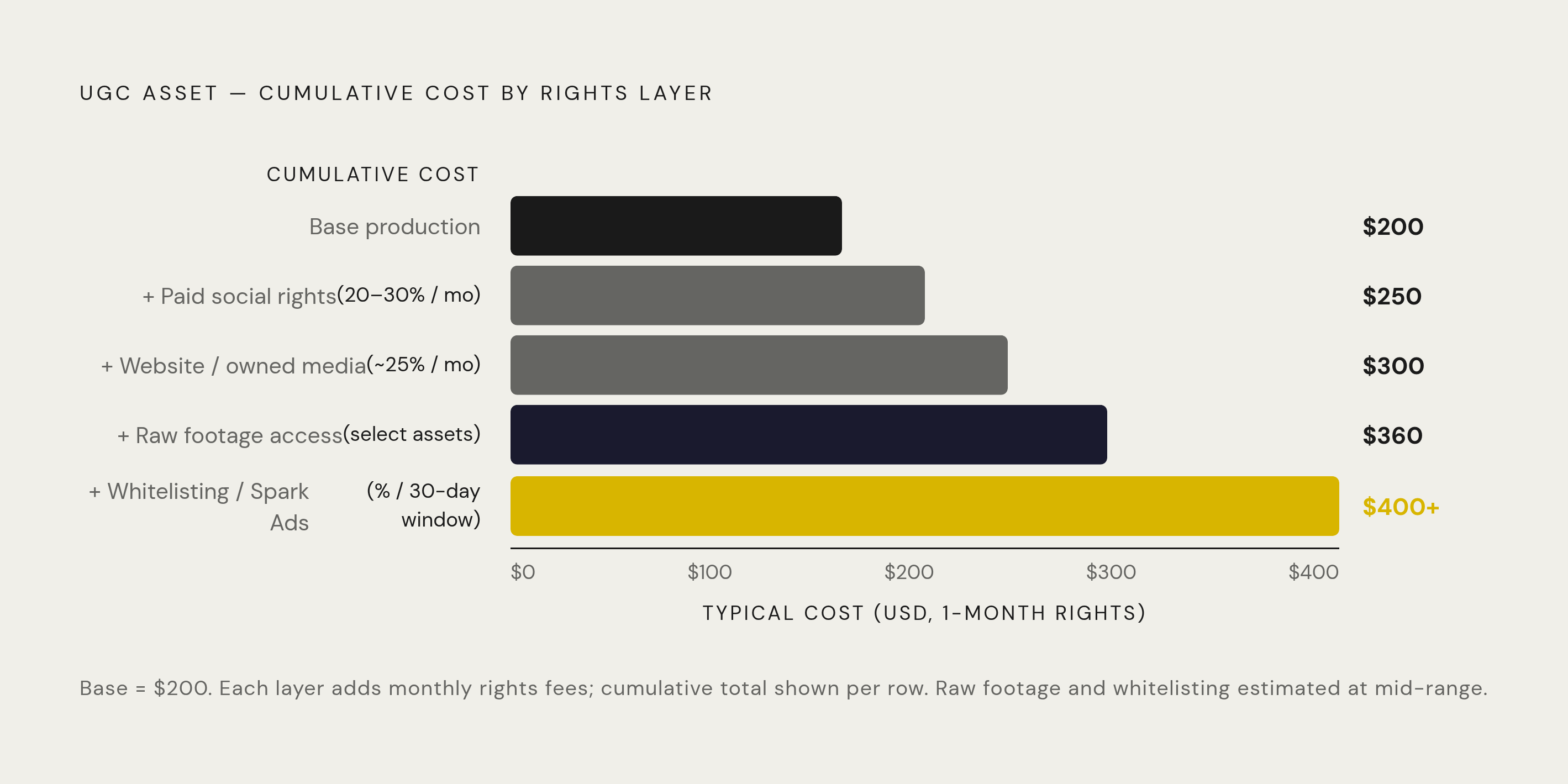
Here's how this looks with real numbers attached. A brand commissions a batch of 20 UGC short-form videos at a $200 base rate each.
Base production alone comes to 20 videos at that base rate, totaling a few thousand dollars, and that's just the floor.
Usage rights get applied selectively, only to the videos that actually perform, rather than blanket-licensed across all 20. Raw footage access gets bought on a smaller subset earmarked for creative testing. Whitelisting or Spark authorization gets added only on the handful of top performers, for a defined window, not the whole batch. Revision rounds get budgeted at a set per-round rate instead of left open-ended.
Add it up, and the total meaningfully exceeds the base production cost before any agency or marketplace fees. Base production routinely represents only a portion of the real total cost once paid amplification rights get factored in properly.
The second thing this scenario shows matters just as much as the first: applying usage rights and whitelisting only to assets that prove themselves is where a smart program actually controls spend. Licensing all 20 videos for paid use up front, before knowing which ones work, inflates cost without any matching return. This is exactly why the brief, ahead of the negotiation table, is where cost gets controlled. Knowing in advance which assets are candidates for whitelisting changes what gets negotiated, and when.
Why renewal and extension terms matter as much as the initial rate
Skip pre-negotiated extension terms, and every renewal turns into a fresh price negotiation from zero. That's a bad spot to be in, especially with a winning asset on the table and a media buyer waiting on it.
Creators increasingly have their own visibility into how their content performs as a paid ad, through whitelisting dashboards and Spark Ads analytics. They know when an asset is driving results, and when they know, they price the renewal accordingly. Fair enough, since it's their content generating the return.
Two structures handle this well. Time-based tiers define the rate for a 3-month extension, a 6-month extension, and perpetual rights, all agreed at signing, so nobody's guessing later. Spend-based tiers work differently: usage rights include paid amplification up to a set cumulative spend threshold, and an amplification fee kicks in only once spend crosses that line. This second structure fits performance marketing better, because no one knows at signing which asset takes off and which one flops.
Contracts should spell out the renewal rate, the notice period required to trigger it, and whether the creator holds approval rights over the renewed usage. Leave any of those three undefined, and friction shows up right when speed matters most, usually mid-campaign, with money already flowing.
There's a rhythm to this too. Brands refreshing their creative bank every 6 to 8 weeks to stay ahead of ad fatigue are constantly cycling in new assets. That cadence only holds up if the extension terms on the winners are simple to trigger, sparing both sides a renegotiation every single time a video keeps performing past its original window.
How to build usage rights pricing into the brief, not the back-and-forth
So where does this actually get fixed? In the brief, before a single word gets exchanged back and forth over email.
A usage-rights-ready brief spells out the intended platforms (Meta, TikTok, owned site, wherever), whether whitelisting or Spark authorization is needed, the initial license duration and how renewal works, whether raw footage is required, and the scope of any exclusivity. Get these five things down on paper up front, and both sides price accurately from the start instead of guessing and correcting later.
For volume programs, standardized contract templates with pre-set usage tiers aren't optional. Negotiating fresh terms with every single creator at scale isn't something any team can sustain, operationally or otherwise. Vetting matters here too: screening for creators who've already granted paid amplification rights before saves real time, since a creator unfamiliar with whitelisting mechanics can stall a launch just by not knowing which button to click in Business Manager.
Agencies and partners handling creator operations end-to-end can bake standard usage terms into every agreement right at sourcing, which takes the back-and-forth off the brand's desk entirely. That's where the operational weight either gets absorbed properly, ahead of time, or piles up unmanaged until someone in finance asks why the invoice doesn't match the media plan. Get the pricing structure right at the brief stage, and the rest of the campaign stops running on guesswork.