What to Expect from a UGC Agency in the First 90 Days
A structured 90-day sprint separates failed UGC partnerships from sustainable ones.

Most agency relationships with UGC partners fall apart before the one-year mark, and talent is almost never the reason. Research puts the failure rate at 73%, which means the first 90 days aren't a warm-up. They're the actual test of whether the process holds up under real conditions, and that distinction matters more than most brands realize going in.
Here's the mistake I keep seeing. Brands walk in wanting volume before strategy's locked, or they treat UGC like an influencer campaign with a bigger spreadsheet bolted on. I used to think the two models were close enough that the same playbook would basically work — but sitting with actual sprint timelines, the gap became obvious. UGC moves faster and stays more visible than either model was built to handle. Drafts show up in days, creator vetting happens almost immediately, and whoever you pick in week one shapes everything downstream. Split the 90 days into three phases (setup, first production, then the push toward performance) and it gets a lot easier to tell a slow start from a broken one.
What the agency needs from the brand before any creator is sourced
Kickoff sets the creative direction for everything after it, and cutting corners here means paying for it in weeks later, not days.
Before sourcing starts, the agency needs approved product claims, messaging guardrails, hook angles worth testing, and the ones to avoid outright. Brand voice references matter too, meaning real examples of what "on-brand" sounds like, not a slide with five adjectives on it. If there's existing top-performing creative, that becomes the control everything new gets measured against.
Platform disclosure rules and usage rights get settled at kickoff, with no exceptions, since this decides what the agency can legally do with an asset once it hits paid channels. Retrofitting rights onto a video that's already working mid-campaign is a headache nobody has time for, and it happens more than it should.
Reporting alignment matters just as much. What does success look like at 30, 60, and 90 days? Who signs off, in what format? Skip this conversation and the first creator briefs go out on guesswork, which usually means a reset at day 30 instead of usable assets. One thing brands consistently underestimate: how fast their own team turns around creator submissions. I didn't expect this to matter as much as it does until I traced a few stalled sprints back to the same root cause. Slow internal feedback is one of the most common reasons a first sprint runs late, and it has nothing to do with the agency at all.
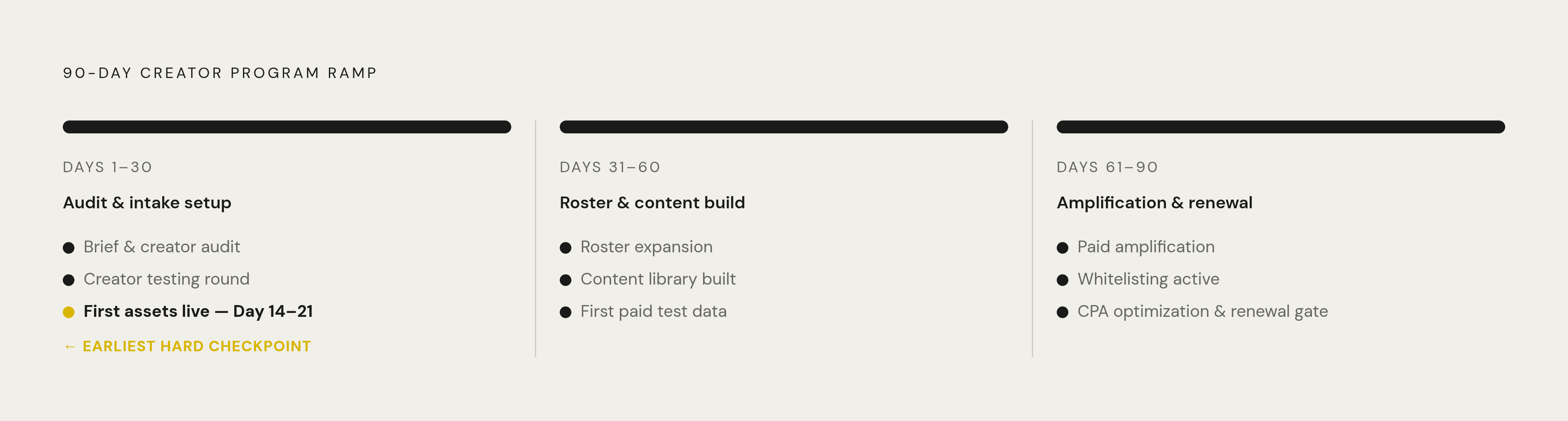
Days 1–30: building the foundation (audit, creator testing, and first assets)
Before any outreach, a decent agency audits what's already there, checking what's performing, what formats are missing, and where the paid creative has gone stale. That's how you find the real gaps instead of guessing at them.
Creator sourcing stays small on purpose in this first sprint, usually 3 to 5 people, which is enough to test variation in format and angle without turning into a management headache before any system exists to handle one. Vetting leans on delivery authenticity and platform fluency more than follower count, and each creator's character and presenter type gets locked before the first shoot. That choice shouldn't get revisited mid-sprint because someone had a new idea on a Tuesday.
First assets tend to go live between day 14 and day 21, faster than most brand teams expect. A well-run agency delivers first creative within 72 hours of kickoff for initial review, and that turnaround alone tells you whether intake actually worked. That first sprint tests one variable against a control: a focused check, not a sprawl through every format at once, agencies like Pebble, a TikTok and Instagram creator agency, build this kind of constrained first-sprint structure into their content frameworks.
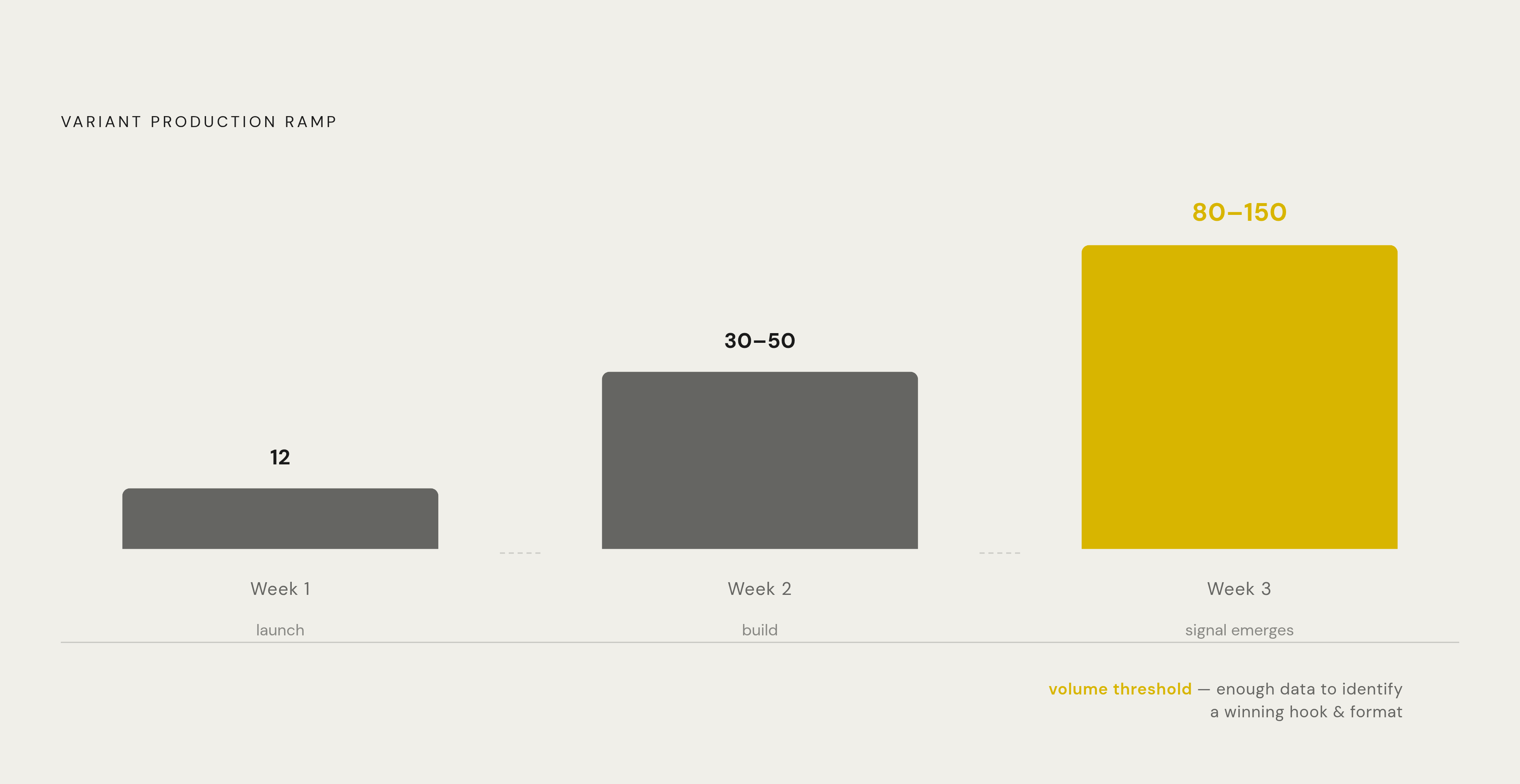
Volume ramps in stages. AI Vidia's production framework runs roughly 12 variants in week one, climbs to 30 to 50 in week two, then scales toward 80 to 150 by week three. More variants in market just means more data points to compare, and faster signal on which hook and format actually converts.
By day 30, you want a small vetted creator roster, a first batch of raw and edited assets, a paid test live or ready to launch, and a baseline read on performance. Missing any of those four means something upstream broke.
Days 31–60: expanding the roster and building a content library that's actually usable
Signal from the first sprint decides what happens next, as underperforming creators get cut while top performers move onto retainer, usually 2 to 4 videos a month per creator. Format gaps flagged in the original audit get addressed here too: if the first sprint leaned heavily on testimonial content, this is where demonstration or product-in-use formats show up.
Roster growth should follow logic, not just headcount targets: diversify by format, by demographic fit, by platform. Hustler Marketing's 2026 guide notes roughly 8 in 10 UGC creators stop producing within 1 to 2 months. That's a brutal churn rate to build a program around, and it reframed how I think about roster planning entirely — the real question is whether you've built for the drop-off in advance. That's exactly why a decent agency keeps 2 to 3 new creators in test at all times, just to keep the line moving.
Content library construction happens in this window too, and it's the part brand-side reviews tend to skip past even though paid performance depends on it. Every asset needs a catalog entry: usage rights, creator attribution, performance data attached. Assets get sorted by format (static, short-form video, testimonial, demonstration) so paid teams can pull by type instead of scrolling a folder hunting for the right clip. Top performers get flagged by spend and ROAS so they get reused and iterated on, instead of rediscovered by accident six weeks later.
Because UGC pricing runs on content volume rather than follower count, cost per asset should be predictable by now, with a real number by day 60 rather than a rough guess someone throws out in a meeting. You want a roster with a clear tier structure, a catalogued library with rights confirmed, and enough paid test data to draw a first directional read on which format and hook combination is working.
Days 61–90: moving from production to performance (paid amplification and first optimization cycle)
The question shifts, moving from how much content exists to whether any of it converts.
Whitelisting and paid amplification enter the picture here. Top organic UGC assets get pushed into paid channels, a workflow that only works because rights got settled back at kickoff. Creator content run through paid channels tends to beat brand-shot ads on CPM and relevance scores, and a good agency tracks that split explicitly instead of just asserting it.
The 90-day review gate matters more than it sounds like it should. Per AI Vidia's performance retainer model, the renewal decision ties to quantitative thresholds, not a gut feeling about how things are going. Each gate has a number attached to it.
What good looks like here: CPA tracked at the creative level, broken out by creator type, hook style, and format, not averaged across the whole campaign into mush. A winning combination gets identified (whichever pairing produces the lowest CPA), documented, and briefed forward as the next direction. Iteration speed matters more than any single campaign result; how fast the agency turns a winning insight into the next test is the real signal for where ROAS goes from here.
By day 90, expect a documented performance baseline, a clear top-performer profile by creator type and format, a renewal recommendation tied to actual numbers, and a proposed creative roadmap for next quarter.
The KPIs that actually tell you whether the first 90 days worked
The most common mistake I see: judging UGC against organic social benchmarks (likes, shares, follower growth) when its actual job is feeding paid creative and bringing CPMs down. That's a mismatch in what's being measured against what the content is for, and it took me longer than it should have to see why that mismatch matters — it leads brands to celebrate metrics that don't move the number that actually counts.
The fix is simple to say, harder to run: pipe UGC assets into the same reporting dashboard as your other paid creative, with the same KPIs applied from day one of paid testing.
In the first 30 days, focus on production metrics: assets delivered on schedule against the brief, creator approval rate on first submission, cost per asset. From day 31 through 90, the focus shifts to performance. CPA at the creative level, segmented by creator type, hook style, and format rather than averaged. ROAS as a directional read confirming what already worked. Iteration speed, meaning how fast a winning signal turns into a new brief in market.
A creator scorecard, tracking which profiles consistently produce the lowest CPA, is worth keeping on its own. Brands that maintain one tend to write better briefs, rebook stronger talent, and drive down CPA over time without touching budget or platform mix at all.
One red flag worth watching for: an agency reporting only at the campaign level, with no creative-level breakdown, has no real way to get better. The 90-day cycle just repeats without getting faster or cheaper. On the money side, brands earn an average of $5.78 for every dollar spent on influencer marketing, while top campaigns (the ones with real creator selection and real tracking) return $11 to $20 per dollar. That gap comes down to measurement and iteration more than it does talent or budget.
What a competent agency handles operationally so the brand team doesn't have to
Sourcing creators at real scale takes active pipeline management, not a one-time search. Managed marketplaces like Billo, Insense, and Trend handle matching and licensing, but they take a 20 to 30% commission for it. An agency managing direct relationships at volume keeps that margin and builds its own creator data over time instead of renting someone else's. Competitive platforms like Twirl reportedly field 400 to 500-plus creator applications a week. Vetting at that volume isn't something a brand team should be doing on the side of their actual job.
Contracts and usage rights decide what can actually happen with an asset once it hits a paid channel, and they're not paperwork to file and forget. The gaps tend to surface at the worst possible moment, right when a top-performing asset is ready to scale and someone realizes the rights don't cover it.
Managing creator relationships across a growing roster takes real tooling (Notion or Airtable to track deliverables, revision rounds, and performance history per creator). Churn management belongs here too, since keeping 2 to 3 new creators in test at all times is what keeps a roster drop-off from stalling production altogether.
Brand safety needs a documented vetting process before any creator goes live, clear guardrails in the briefs to limit drift once production starts, and ongoing monitoring rather than a one-time check before launch. Per eMarketer, Meta's brand safety tools for Instagram and Threads now include third-party verification through DoubleVerify and IAS, launched October 2025. Influencer fraud costs the industry an estimated $4.8 billion a year in wasted spend, so catching fake engagement before a creator gets briefed is a real cost saving.
Payments and compliance add up fast across a roster: different payment terms, tax documentation, platform-specific disclosure rules. It's a load that grows quickly past a handful of creators. When the brand's own team ends up absorbing contracts, creator communication, asset tagging, and payment reconciliation, iteration speed slows down, every time.
How to hold your agency accountable across each stage without micromanaging the process
Accountability and micromanagement get confused constantly, and mixing them up backfires. Reviewing outputs against agreed milestones is accountability, while rewriting briefs yourself or directing individual creators tips into interference, and it slows the whole system down without you noticing until it's already slow.
At each gate, the brand's job comes down to a few questions. Did the agreed deliverables show up on schedule? Is performance data reported at the creative level, or only at the campaign level? Is the agency explaining what it learned and how the next sprint changes because of it, or just recapping what already happened?
At 30 days, deliverables are mostly production-side: creator roster confirmed, first assets reviewed, paid test live or close to it. At 60 days, you want a first directional performance read, which format or hook is producing signal, plus confirmation the content library is actually being maintained, rights and performance data attached to everything. At 90 days, the renewal decision should rest on data: a CPA baseline broken out by creative segment, a top-performer profile, a specific hypothesis for next quarter's direction.
Watch for a few red flags at any stage: reporting that only exists at the campaign level, no documented creator scorecard or roster history, churn with no replacement pipeline running, or usage rights still ambiguous on assets the brand wants to push harder in paid.
The brands that get the most out of the first 90 days share a few habits, and none of them are complicated. They're fast on internal feedback, and they're clear about what "on-brand" means before the first brief goes out. And they treat the 90-day milestones as a structure both sides are accountable to, rather than an audit they're quietly running on a vendor behind closed doors.