UGC Agency Pricing Models Compared
Understand what each pricing model actually includes before comparing rates.

Several models cover UGC agency pricing: flat retainer, per-asset, percentage of ad spend, and hybrid variations. Most brands compare rates instead of asking what each rate buys, sizing up a $200 video quote against a $4,000 retainer without checking what either number actually includes. That comparison costs money, because the pricing model shapes what the agency prioritizes behind the scenes, not just what shows up on the invoice.
Retainers get picked by default whenever the budget allows it, mostly because they're easy to sell, not because they fit the situation. But the rate was never the real question. What matters is whether the structure matches volume needs, growth stage, and what the creative has to do once it's live.
What the flat monthly retainer actually buys and where it caps out
Most UGC agencies price this way, so most brands hit a retainer offer first, often before they've worked out what they actually need.
A mid-tier program runs several thousand dollars a month for 8 to 20 finished videos. Push past 40 assets across formats, with a dedicated creative strategist and platform-specific optimization built in, and the range climbs significantly higher. Run a mid-range retainer against 12 videos and the per-asset cost lands in the low hundreds, sourcing, editing, and rights all folded in.
That bundling is the real value, not the discount. One fee covers sourcing, vetting, briefing, editing, usage rights, and program management, so nobody's chasing five vendors for five separate steps.
But the ceiling is fixed by the tier, and that's where retainers start to hurt. Need 30 assets one month and only 10 the next? Doesn't matter. The retainer bills for 20 either way, used or not. Retainers reward steady, predictable content needs and punish anyone with a seasonal spike or a lumpy production calendar.
Below a few thousand dollars a month in media spend, a retainer usually costs more than the media budget it's meant to feed. Under that line, a small batch of freelance creators beats locking into a monthly agency fee almost every time. Brands skip this math constantly, sign the retainer anyway, and then wonder three months in why it feels like dead weight on the P&L.
How per-asset pricing works and when it stops being cheaper
Per-asset pricing is the opposite bet: pay a flat fee per piece, no ongoing commitment, order only what's needed.
Rates vary by format. A testimonial or review video runs $150 to $350. An unboxing or first-look video runs $150 to $300, close to the freelance median of roughly $175. Tutorials and how-to content run higher, $250 to $500 or more, since they take more planning and more footage to cut down. A hook-plus-demo ad format lands at $200 to $450. A simple slideshow or B-roll piece with captions comes in cheapest, at $120 to $250.
An agency's managed à la carte rate, rights included and quality checked, runs higher than what an individual creator charges direct. That gap is earned, not padding: someone still has to vet the creator, handle the contract, and check the file before it lands in the inbox.
Per-asset pricing looks cheap at low volume. Order two or three videos and it beats a retainer without much of a fight. The math flips once volume gets consistent, though bundle discounts soften the landing: 5-10% off for two videos, 10-15% off for three or four, 15-25% off for five or more. At five-plus videos, the average discount runs around 19% off the single-asset rate, so a $200 video effectively drops to about $162.
Per-asset pricing fits brands still testing messaging, brands with genuinely unpredictable needs, or anyone trying out a creator before committing further. It stops working the moment a brand needs fresh creative every three to five days to stay ahead of ad fatigue. At that cadence, one-off ordering is both too slow and too expensive.
The line items that turn a quoted rate into your real total
Usage rights are where most quotes fall apart, and it's the most underpriced conversation in this industry. A rate that looks like a bargain often excludes paid-ad licensing entirely, buried in a footnote nobody reads before signing.
Extended usage rights (the right to run content as a paid ad beyond a standard organic-only window) typically add 30-50% on top of the base rate. Perpetual rights, so content can run indefinitely once it starts performing, add 100-150%. Whitelisting, running ads through the creator's own account, sometimes called Spark Ads, adds roughly 30% of the base rate, and that charge isn't one-time: it recurs every month the ad stays live. Raw footage, so an in-house team can cut its own variants, adds another 30-50%. Rush delivery on a 24 to 72 hour turnaround adds 25-50%, and any revision outside the original scope runs $25 to $75 each.
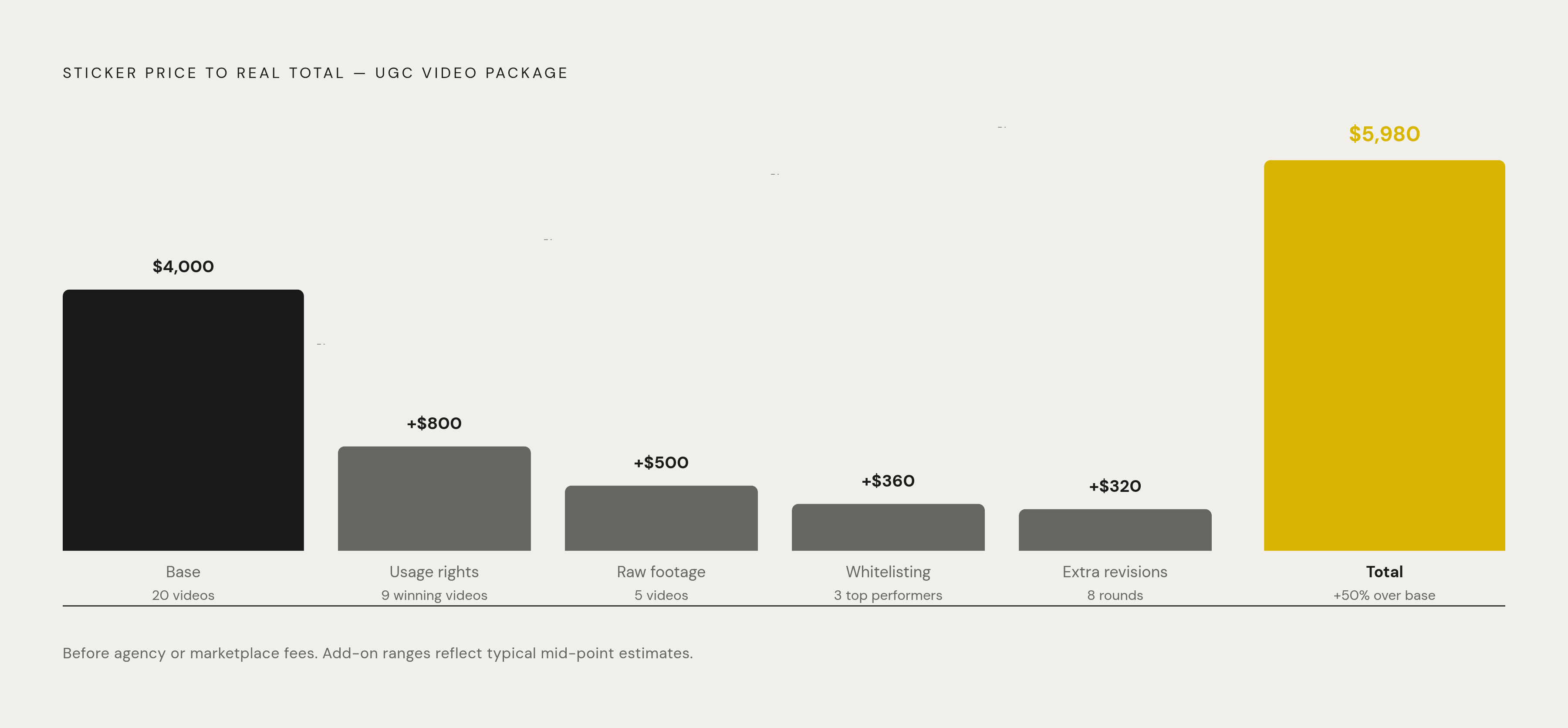
Stack those up and a quote balloons fast. Take 20 videos at $200 base: $4,000 flat. Add usage rights on nine winning videos, raw footage on five still in testing, whitelisting on three top performers, and eight extra rounds of revisions across the batch. The total comes to roughly $5,980, before any agency or marketplace fee even applies.
That's nearly 50% over sticker price. A higher quoted rate that bundles usage rights in from the start can end up cheaper than a lower rate billed piecemeal, but the gap only shows up once content starts working and someone wants to keep it running. Ask upfront what the rate covers for paid-ad usage, whitelisting, and raw footage. A vague answer means the real total will be a surprise, and not the kind anyone wants.
What percentage-of-spend and hybrid models cost at different budget levels
Some agencies skip flat pricing entirely and charge a percentage of monthly media spend, typically a percentage of monthly media spend. This is the model to be most wary of, and the pitch sounds fairer than it actually is.
On paper, the fee scales with investment, so a small brand spending modestly pays a proportionally small fee. But follow that logic past the pitch: once a brand scales its spend, even a moderate percentage turns into a large absolute number, and the agency's revenue climbs right alongside it, whether or not the creative actually gets any better. That's the model's real flaw, not a footnote to it. Sophisticated brands negotiate a declining percentage at higher spend tiers specifically to blunt that.
Hybrid pricing tries to split the difference: a flat base fee, plus a smaller percentage above a spend threshold. One common structure pairs a fixed monthly base fee with a smaller percentage that only kicks in above a defined spend threshold. The logic holds together better than either pure model. The base fee keeps production funded no matter what a given month's spend looks like, and the percentage only kicks in once media investment crosses a real threshold, without the full exposure of a straight percentage deal.
Percentage-of-spend also taxes high-volume creator programs harder than low-volume ones, and there's no good reason for that. A flat fee per creator, or per finished asset, keeps unit economics steady whether a program runs ten creators or many hundreds. So the real question isn't which model sounds most fair. It's what's actually constraining the brand: creative volume or media efficiency. Those are different problems, and one pricing structure rarely solves both.
How creator-level rates sit inside agency pricing, and where the markup goes
Strip away the agency layer and look at what individual creators actually charge, and the markup stops being abstract.
For a single short-form video, beginner creators run $50 to $150. Mid-level creators, the tier most always-on programs actually hire, run $150 to $300. Premium creators run $300 to $500 or more. Across the market, the average lands between $150 and $212, with a median around $175.
Creator type matters as much as experience level. An amateur shooting on a smartphone with minimal editing runs $100 to $250 a video. A polished, trend-aware creator runs $250 to $600. Studio UGC, professionally shot footage built to still feel native and unpolished, runs $600 to $1,500 a video. High-volume, brand-owned account content runs on a different scale entirely: $20 to $40 per post at base, with a view-bonus stacked on top, since reach and algorithm performance drive value there, not follower count.
Agency management typically adds 20-40% on top of whatever the creator charges. That markup pays for vetting, contracting, briefing, quality control, legal review, and payment processing, handled without the brand's own team touching any of it. It's a fair markup when an agency actually does that work, and a bad one when it's just a line item with nothing behind it.
Follower count barely matters anymore for pure commission work, and that shift is worth sitting with. A creator with a small following who consistently makes natural, compelling video is just as commercially useful as someone with a massive audience. That widens the sourcing pool considerably, and it's a big reason well-run agencies end up with more pricing leverage than a brand trying to source creators solo.
What each model implies about how the agency will prioritize your program
Every pricing model quietly tells the agency what to optimize for. That explains a lot of behavior that otherwise looks strange from the outside.
A retainer agency gets paid the same whether creative performance climbs or flatlines, since the relationship itself is what's stable, not the output. Worth asking any retainer agency directly how it defines improvement and how often it actually reports it. A per-asset agency, by contrast, makes more money by shipping more orders, so the incentive points straight at volume. Ask whether it's iterating on what's working, or just fulfilling each brief and moving to the next one without looking back.
A percentage-of-spend agency carries a subtler problem. Its fee rises when media spend rises, so what happens the month better creative would let the brand spend less and hit the same result? That recommendation costs the agency money, so don't expect it to come up unprompted. Hybrid models tend to align incentives more cleanly: if the base fee covers day-to-day production and the percentage only kicks in past a real spend threshold, both sides have a reason to grow the program efficiently instead of just bigger.
The sharpest question to bring into any pricing conversation: does the agency treat creative as a performance channel that gets measured and iterated on, or as a delivery service that ships assets and moves to the next brief? Replicating a winning format across new creators and new concepts is harder than producing one good video, and the pricing model should reflect that work instead of pricing everything like simple delivery. Agencies that fold briefing, performance data, and creator management into one fee, rather than billing each piece separately through different vendors, build a real feedback loop between what the data says and what gets made next. Split those functions across three billers, and that loop breaks somewhere in the handoff.
Matching pricing model to brand stage and media spend level
None of these four models wins in general, and anyone who says otherwise is selling one of them. Fit depends on where a brand sits in its paid media arc, and what the creative needs to do at that stage.
Early-stage brands with modest monthly media spend do better with per-asset pricing or a small-batch retainer. The goal there is validating formats and messaging, not chasing volume for its own sake. A small initial creator cohort is usually enough to find out what resonates before scaling further. Once media spend gets consistent and the real bottleneck becomes fresh creative rather than audience reach, a flat retainer starts to earn its keep.
High-volume programs running dozens of assets a month across platforms need hybrid or flat-fee-per-creator structures to keep unit economics predictable. Percentage-of-spend gets punishing fast at that scale, and it punishes success specifically, which is an odd thing for a pricing model to do. For brands running whitelisting or Spark Ads at volume, check that the pricing model accounts for the recurring monthly cost of running ads through a creator's own handle. That detail gets left out of retainer scopes more often than it should.
The creator mix matters as much as the pricing model wrapped around it. High-touch human creators fit brand storytelling and mid-funnel trust content. High-volume, lower-cost UGC fits top-of-funnel hook testing, where fast iteration beats polish every time. A well-run agency builds that mix on purpose instead of treating every asset as interchangeable inventory.
Whichever model a brand lands on, the same checks apply: is the briefing process actually structured, is performance reporting genuinely transparent, and can the agency show it iterates on what works instead of just delivering and moving on. An agency that handles sourcing, contracts, payments, and analytics under one roof takes on operational weight that would otherwise land on the brand's own team, and that absorbed weight has value on its own, apart from the creative itself. It belongs in the price, whichever model ends up on the contract.