Influencer Marketing Platforms vs Creator Marketplaces — What Brands Actually Get
Platforms give brands control; marketplaces streamline transactions; agencies handle the work.
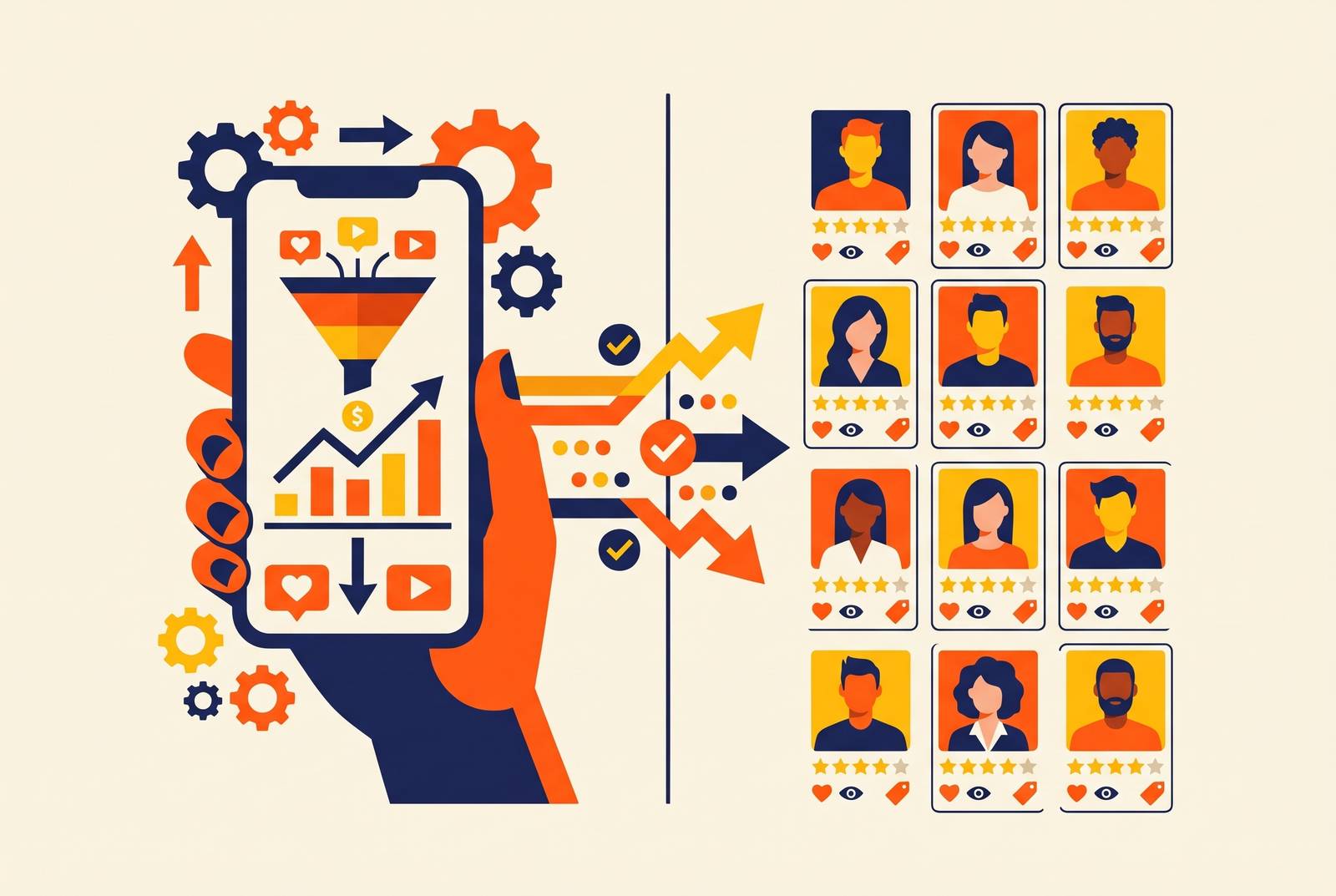
Influencer marketing platforms and creator marketplaces help brands in different ways, while full-service agencies do the work for them. The choice is less about which product has more features than who will do the work.
Why "influencer marketing platform" and "creator marketplace" are not interchangeable terms
An influencer marketing platform is primarily software that a brand operates directly. It usually has a creator database that the brand can search, campaign management tools, and an analytics dashboard. The brand uses those tools to find creators, organize collaborations, and track results. The product is access to the software. Workflow automation can change how much manual work remains without changing who operates the system.
A creator marketplace is a transactional environment where brands and creators find each other and complete collaborations. Discovery, vetting, briefing, contracting, payment, and basic tracking can happen within the same system. Some marketplaces are self-serve, while others include managed workflow features. The distinction is the structure around the collaboration. Rather than simply giving a brand records to search, a marketplace connects creator access to the process of getting work commissioned and delivered.
A full-service agency takes responsibility for execution, including sourcing, creative direction, contracts, payments, and reporting. The brand is buying work performed on its behalf. These definitions separate three things that often share the same marketing vocabulary, namely software access, a collaboration environment, and an execution service. A marketplace can have a lot of software, and a platform can automate many tasks. Neither fact alone makes it a full-service agency, because the defining question is who owns the work between finding a creator and reporting the result.
What software-first platforms actually put in a brand's hands
Software-first platforms put creator discovery under the brand’s control. Searchable databases can filter creators by niche, social platform, audience demographics, and engagement quality, while some offer AI-assisted matching. The brand decides which candidates deserve outreach. Campaign tools then keep communication, deliverables, and workflow automation in one place, so the brand has less need for separate project management systems to manage the collaboration.
GRIN’s published pricing page describes Gia, an AI agent that handles creator search, outreach drafting, campaign building, and reporting. Brands can approve consequential steps involving messages, money, and contracts, or enable full automation without step-by-step approval. That is more than a static database. Even so, the brand still runs campaigns through the software and does the work an agency would otherwise handle.
The analytics layer can track reach, engagement, conversions, and content output in real time. Stronger integrations connect that activity to revenue. Upfluence connects to Shopify and WooCommerce and attributes sales to individual creators, giving the brand a more specific view than campaign-wide totals.
The cost, however, extends beyond the subscription. When people still chase creators manually, reconcile links by hand, or build reports outside the system, the software has relocated administration. Tools are not the same as execution. A platform can give a capable team extensive control, but a brand without a dedicated creator manager may underuse even a sophisticated system.
What creator marketplaces actually put in a brand's hands
Creator marketplaces make discovery part of the process of working with creators, going beyond a search result alone. Creators can find brand programs and apply, reversing the cold-outreach model and shortening the path to activation. The brand reviews people who have already expressed interest. That changes the sourcing work, although it does not remove the need to judge fit.
The workflow is built for throughput. A brand can brief multiple creators at once and handle vetting, contracting, payment, and basic tracking within one system instead of negotiating every collaboration separately. JoinBrands offers gifting, paid partnerships, affiliate, and UGC campaign types on entry-level tiers, with TikTok, Instagram, YouTube, and Amazon among its key channels. Its entry point is free to join. That describes access to the marketplace, with the total cost and staffing needs of a creator program still to be accounted for.
Tracking is part of the collaboration loop, but basic campaign tracking is not automatically revenue attribution. The brand still needs to understand what a particular marketplace measures and what work remains outside it. Some marketplaces also include usage rights in collaboration agreements. Aspire includes image rights through digital term sheets embedded in its workflow, connecting commissioning with later content reuse.
The central limitation is uneven vetting quality. A marketplace that screens creators provides something different from an open directory, even if both offer a convenient transaction process. Vetting depth therefore deserves more attention than the apparent ease of joining. The model structures the collaboration, but the quality of that structure determines how much selection work the brand must still perform.
The operational gap between buying software and getting execution
Those differences become a staffing decision as soon as campaigns begin. Outreach, brief writing, contract management, payments, and performance analysis need an owner, whether the work happens in a platform or a marketplace. Someone still has to run the program. A marketplace can simplify the sourcing loop while demanding more brand time than an agency that handles execution.
At low campaign volume, one platform user may be able to manage the workflow. With multiple simultaneous campaigns, dozens of creators, and continuous UGC production, the workload can exceed what a brand team can absorb without dedicated headcount or an external partner. The subscription does not capture that expansion. Labor spent chasing deliverables, stitching attribution data, and preparing reports is part of the operating cost, even when it sits elsewhere in the budget.
Automation reduces some of this burden, but creative judgment remains. Brief quality, creator fit, and content review cannot be fully automated, and those decisions shape performance. Fewer manual steps do not eliminate responsibility for the result. A team can therefore have sophisticated software without having the capacity to run a sophisticated program.
A full-service agency takes on that execution burden, but introduces different tradeoffs. Retainer cost replaces some internal operational work, data transparency may be reduced, and execution quality can be diluted across multiple clients. The comparison is between keeping the work inside the brand and paying a partner to perform it, with different forms of control in each arrangement.
How creator access differs across the three models — and why it shapes content quality
Creator access also shapes how relationships begin. In the platform model, the brand searches a database and initiates outreach, so the relationship starts cold and depends on the brand’s communication and brief. In a marketplace, creators apply to programs that interest them. That self-selection can support more authentic content.
An agency handles sourcing and creative direction on the brand’s behalf, taking on selection and relationship work from the internal team. Responsibility moves, but the creative requirement does not. Someone still needs to connect the product, the creator, and a brief that gives the collaboration a clear purpose.
Across all three models, the quality of the audience matters more than the size of the database. Inflated follower counts distort expected results, which makes audience authenticity checks valuable before outreach or commissioning begins. Shallow, transactional relationships can also produce shallower content that performs less well over time.
When partnerships last, niche creators can become genuine advocates for the brand. Either a platform or a marketplace can support those relationships, but they require intentional program design and consistent briefs. Rights need similar attention at the outset. Usage rights for paid amplification and whitelisting belong in the initial agreement, yet platforms and marketplaces differ in whether those terms are built into contracting or left for the brand to negotiate.
Performance measurement and attribution across the three models
How a brand measures results affects its ability to make the case for its creator budget and grow it. Follower counts and raw likes describe activity, but they do not establish creator-driven revenue. Finance needs a clearer connection to purchases. The useful shift is toward acquisition cost, return on ad spend, conversions, and customer value rather than treating visible engagement as the final result.
Promo codes, tracking-tagged URLs, and pixel tracking provide signals linking creator activity to purchases. A platform that connects codes, links, clicks, and sales in one view reduces the work needed to explain performance. Upfluence attributes clicks, conversions, and ROI per creator. That granularity supports a different analysis from an aggregate campaign report.
A marketplace’s basic tracking may help a brand follow collaborations without fully connecting creator activity to revenue. The brand team takes on any work of connecting activity to revenue left outside the system. Agency reporting creates another tradeoff. Managed services often give brands summary reports in place of raw data access, which can make it harder to see how each creator or piece of content did.
Last-click measurement undervalues creators who begin customer journeys, making multi-touch attribution necessary when the purchase path includes more than one creator touchpoint. Business outcomes should lead the analysis. The ability to spend at volume while maintaining acceptable return, conversions, and acquisition costs comes before creative diagnostics such as hook rate, hold rate, and click-through rate, which help explain why the content produced those outcomes.
Turning creator content into paid media — and which model makes it easier
Repurposing raw UGC as paid social creative changes what a creator program needs to deliver. The requirement is no longer just a sponsored post, but a continuing supply of assets that a brand can distribute and test. Paid use starts before content is commissioned. It needs to be reflected in briefs, contracts, budgets, and measurement.
The permissions also need to match the intended use. Whitelisting involves a creator approving brand use of their social identity for paid distribution. Meta Partnership Ads allow adjustments to copy, calls to action, and targeting from a creator’s handle, but do not grant full creative editing rights or dark posting capability. Traditional account-level whitelisting provides those broader controls. TikTok Spark Ads allow brands to boost existing organic creator posts with the creator’s authorization.
Licensing is a separate part of that preparation. Aspire’s embedded image rights illustrate how content reuse can be handled within the collaboration workflow, while other systems may leave separate negotiations to the brand. Built-in terms can simplify the process. Brands need to check that the agreement allows their planned paid use, even when a tool offers contracting.
Paid social also needs fresh creative to avoid ad fatigue, which gives an edge to marketplaces and agencies set up to keep producing UGC. Briefing multiple creators can produce different hooks, formats, and personalities for A/B testing, and both platforms and marketplaces support that approach. Execution still depends on the brief. When a brand lacks people to write briefs and manage creators, a full-service partner that handles briefing, contracts, and iteration gives it a more direct way to produce content at high volume.
Matching the right model to where a brand actually is
For a brand making this choice, the useful starting point is its capacity to operate the program. A self-serve platform fits a team with a dedicated creator manager, an existing roster to bring into the CRM, and the ability to write briefs, manage outreach, and build attribution reporting. That team can use direct control productively. Without those skills and resources, the brand may have more features than it can use.
A creator marketplace fits a different need. It gives brands faster access and a set workflow for working with creators without having to do cold outreach, as long as someone can manage applications and review content. The brand retains meaningful operational responsibility. This makes the model useful for teams that want a shorter sourcing process but are prepared to direct the work.
A full-service agency or managed partner suits brands that lack staff to work with creators, need high-volume UGC for paid media, or cannot justify setting up everything needed to run the program from scratch. Early-stage brands can run sophisticated creator programs but are especially exposed to the cost of choosing a model they cannot run. For teams seeking the outcome without absorbing the execution workload, a partner’s value lies in end-to-end delivery, iteration, and measurable results, balanced against cost and reporting transparency.
Over time, a proven creator roster, performance benchmarks, and repeatable content workflows become durable assets regardless of the model used. The structural choice affects how quickly the brand builds them and how much internal resource the process consumes. Repeatability is the stronger test of program success. A viral moment is one data point, while a program gives the brand a way to use what it learns in the next brief, collaboration, and content decision.